Kinetics Part II Rate Laws Order of Reaction

- Slides: 18
Kinetics Part II: Rate Laws & Order of Reaction Jespersen Chap. 14 Sec 3 Dr. C. Yau Spring 2014 11
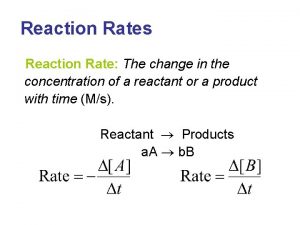
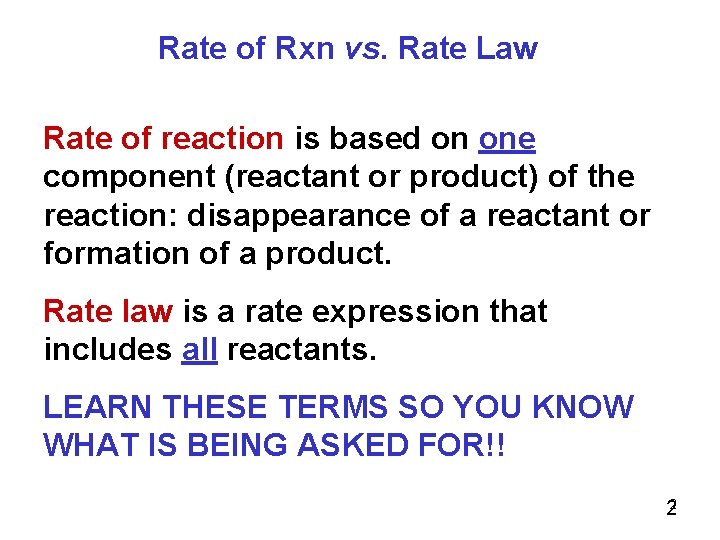
Rate of Rxn vs. Rate Law Rate of reaction is based on one component (reactant or product) of the reaction: disappearance of a reactant or formation of a product. Rate law is a rate expression that includes all reactants. LEARN THESE TERMS SO YOU KNOW WHAT IS BEING ASKED FOR!! 22
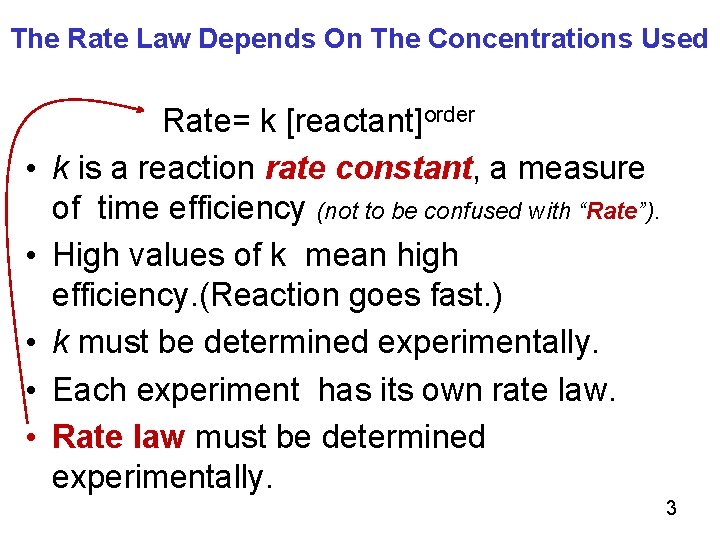
The Rate Law Depends On The Concentrations Used • • • Rate= k [reactant]order k is a reaction rate constant, a measure of time efficiency (not to be confused with “Rate”). High values of k mean high efficiency. (Reaction goes fast. ) k must be determined experimentally. Each experiment has its own rate law. Rate law must be determined experimentally. 3
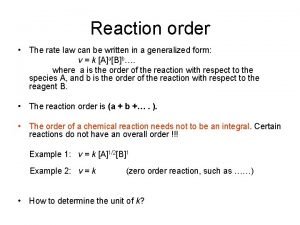
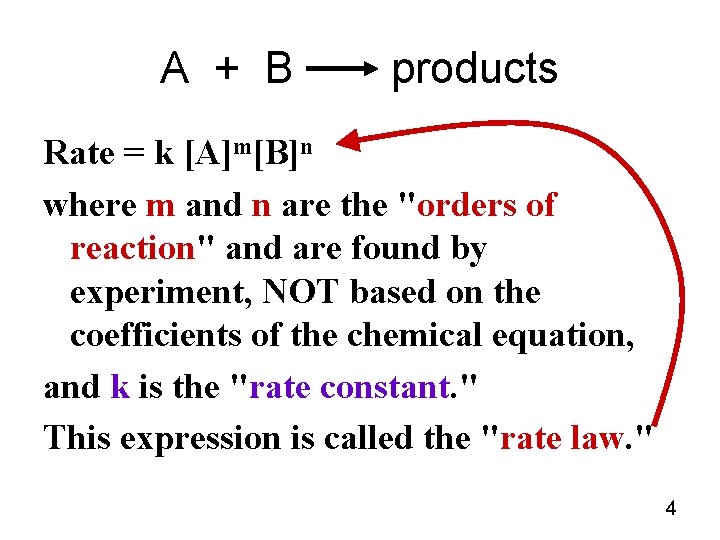
A + B products Rate = k [A]m[B]n where m and n are the "orders of reaction" and are found by experiment, NOT based on the coefficients of the chemical equation, and k is the "rate constant. " This expression is called the "rate law. " 4
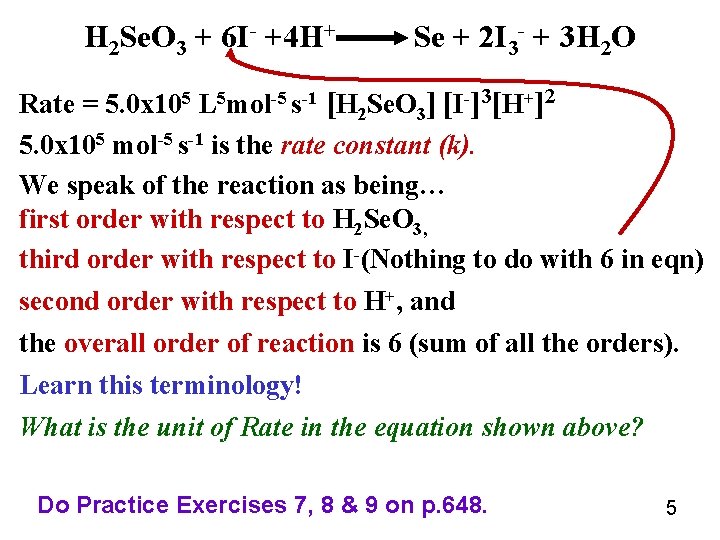
H 2 Se. O 3 + 6 I- +4 H+ Se + 2 I 3 - + 3 H 2 O Rate = 5. 0 x 105 L 5 mol-5 s-1 [H 2 Se. O 3] [I-]3[H+]2 5. 0 x 105 mol-5 s-1 is the rate constant (k). We speak of the reaction as being… first order with respect to H 2 Se. O 3, third order with respect to I-(Nothing to do with 6 in eqn) second order with respect to H+, and the overall order of reaction is 6 (sum of all the orders). Learn this terminology! What is the unit of Rate in the equation shown above? Do Practice Exercises 7, 8 & 9 on p. 648. 5
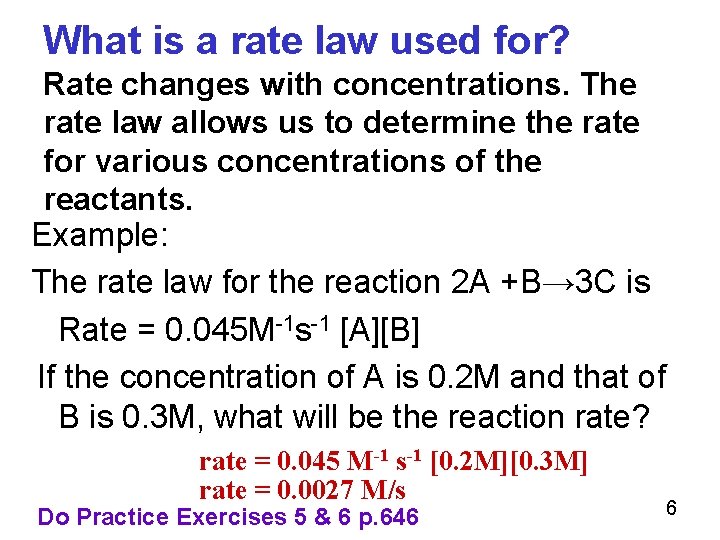
What is a rate law used for? Rate changes with concentrations. The rate law allows us to determine the rate for various concentrations of the reactants. Example: The rate law for the reaction 2 A +B→ 3 C is Rate = 0. 045 M-1 s-1 [A][B] If the concentration of A is 0. 2 M and that of B is 0. 3 M, what will be the reaction rate? rate = 0. 045 M-1 s-1 [0. 2 M][0. 3 M] rate = 0. 0027 M/s Do Practice Exercises 5 & 6 p. 646 6
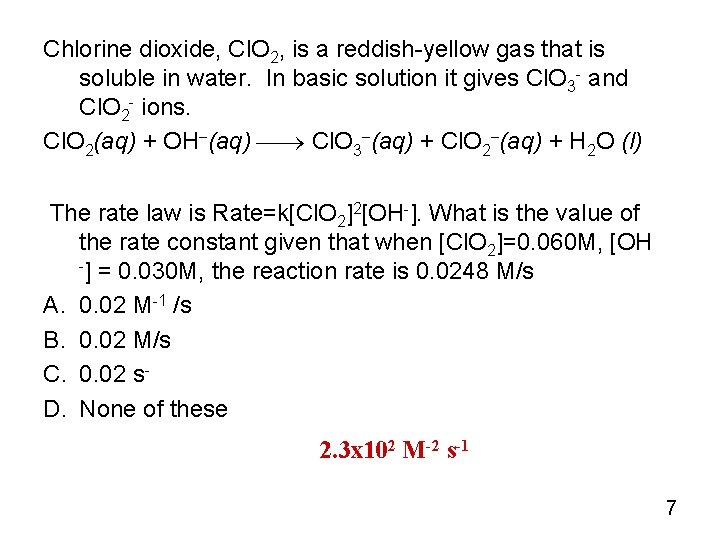
Chlorine dioxide, Cl. O 2, is a reddish-yellow gas that is soluble in water. In basic solution it gives Cl. O 3 - and Cl. O 2 - ions. Cl. O 2(aq) + OH (aq) Cl. O 3 (aq) + Cl. O 2 (aq) + H 2 O (l) The rate law is Rate=k[Cl. O 2]2[OH-]. What is the value of the rate constant given that when [Cl. O 2]=0. 060 M, [OH -] = 0. 030 M, the reaction rate is 0. 0248 M/s A. 0. 02 M-1 /s B. 0. 02 M/s C. 0. 02 s. D. None of these 2. 3 x 10² M-2 s-1 7
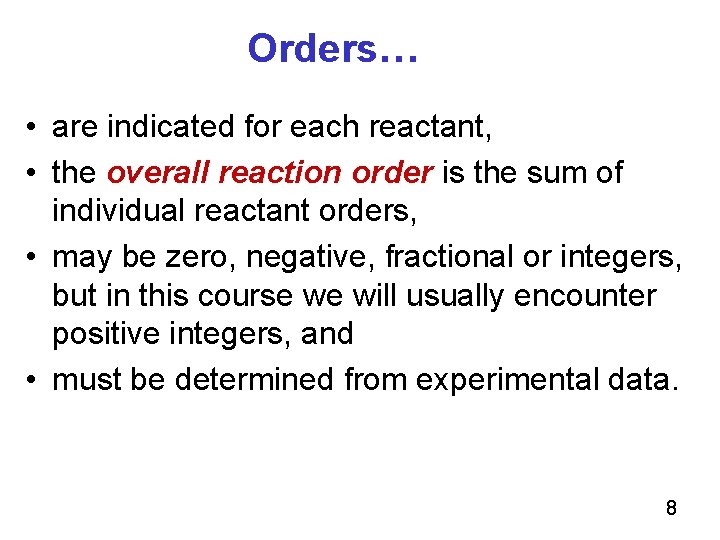
Orders… • are indicated for each reactant, • the overall reaction order is the sum of individual reactant orders, • may be zero, negative, fractional or integers, but in this course we will usually encounter positive integers, and • must be determined from experimental data. 8
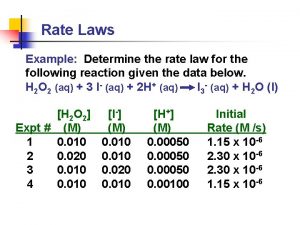
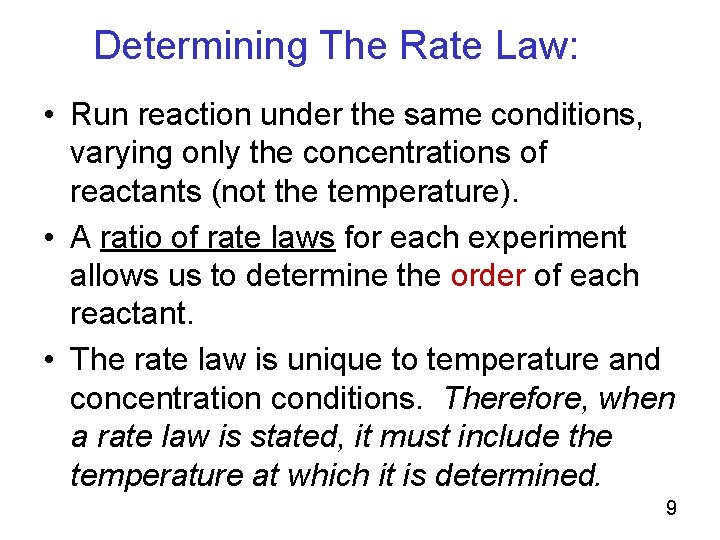
Determining The Rate Law: • Run reaction under the same conditions, varying only the concentrations of reactants (not the temperature). • A ratio of rate laws for each experiment allows us to determine the order of each reactant. • The rate law is unique to temperature and concentration conditions. Therefore, when a rate law is stated, it must include the temperature at which it is determined. 9
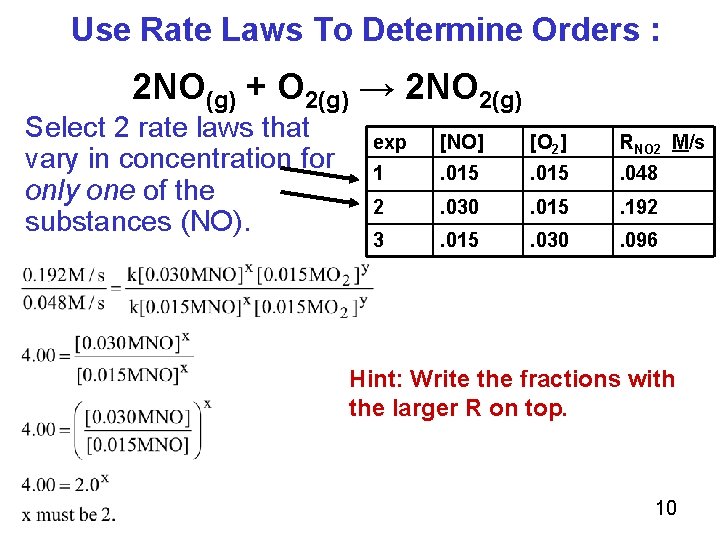
Use Rate Laws To Determine Orders : 2 NO(g) + O 2(g) → 2 NO 2(g) Select 2 rate laws that vary in concentration for only one of the substances (NO). exp [NO] [O 2] RNO 2 M/s 1 . 015 . 048 2 . 030 . 015 . 192 3 . 015 . 030 . 096 Hint: Write the fractions with the larger R on top. 10
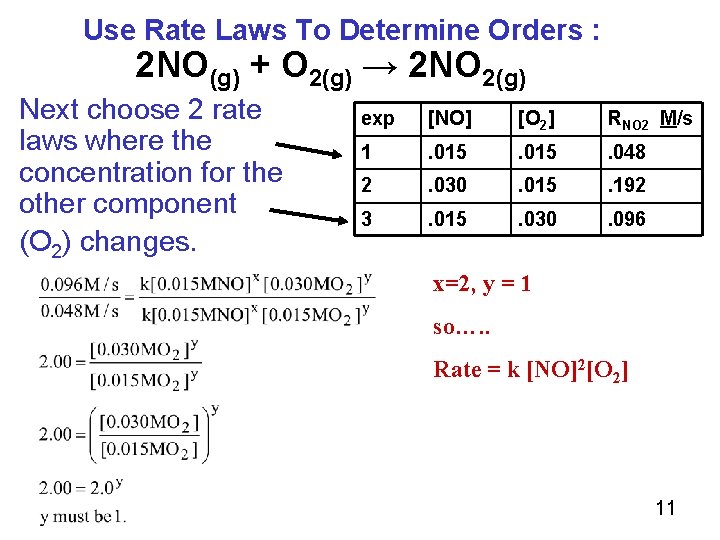
Use Rate Laws To Determine Orders : 2 NO(g) + O 2(g) → 2 NO 2(g) Next choose 2 rate laws where the concentration for the other component (O 2) changes. exp [NO] [O 2] RNO 2 M/s 1 . 015 . 048 2 . 030 . 015 . 192 3 . 015 . 030 . 096 x=2, y = 1 so…. . Rate = k [NO]2[O 2] 11
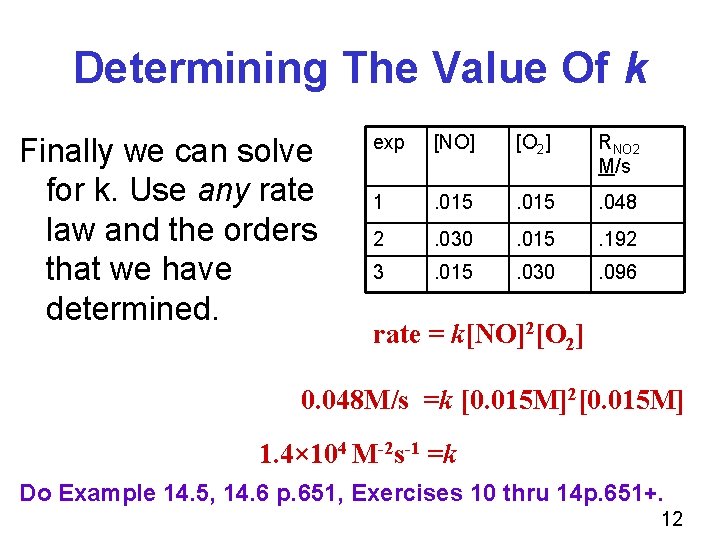
Determining The Value Of k Finally we can solve for k. Use any rate law and the orders that we have determined. exp [NO] [O 2] RNO 2 M/s 1 . 015 . 048 2 . 030 . 015 . 192 3 . 015 . 030 . 096 rate = k[NO]2[O 2] 0. 048 M/s =k [0. 015 M]2[0. 015 M] 1. 4× 10⁴ M-2 s-1 =k Do Example 14. 5, 14. 6 p. 651, Exercises 10 thru 14 p. 651+. 12
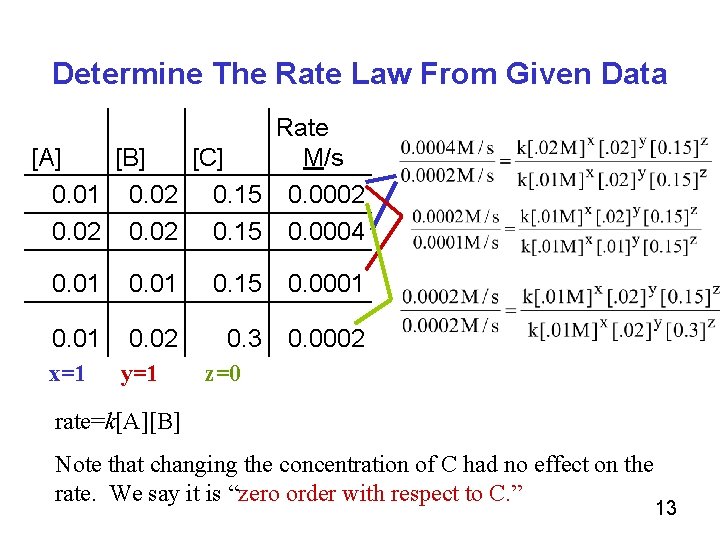
Determine The Rate Law From Given Data Rate [A] [B] [C] M/s 0. 01 0. 02 0. 15 0. 0002 0. 15 0. 0004 0. 01 0. 15 0. 0001 0. 02 x=1 y=1 0. 3 z=0 0. 0002 rate=k[A][B] Note that changing the concentration of C had no effect on the rate. We say it is “zero order with respect to C. ” 13
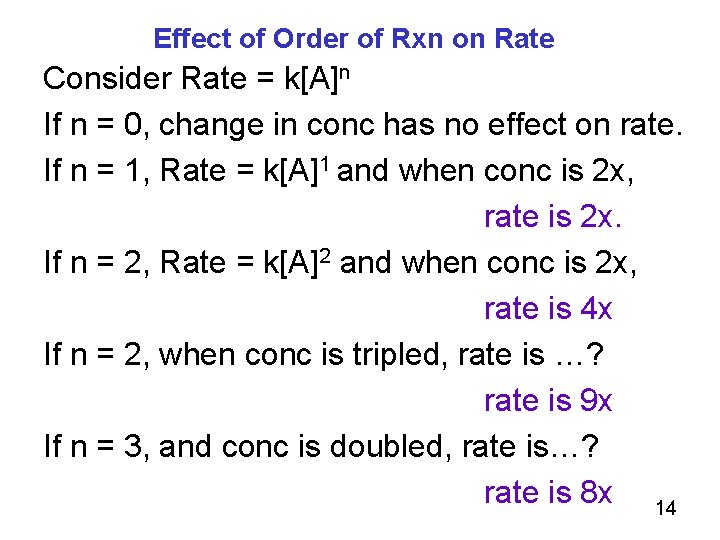
Effect of Order of Rxn on Rate Consider Rate = k[A]n If n = 0, change in conc has no effect on rate. If n = 1, Rate = k[A]1 and when conc is 2 x, rate is 2 x. If n = 2, Rate = k[A]2 and when conc is 2 x, rate is 4 x If n = 2, when conc is tripled, rate is …? rate is 9 x If n = 3, and conc is doubled, rate is…? rate is 8 x 14
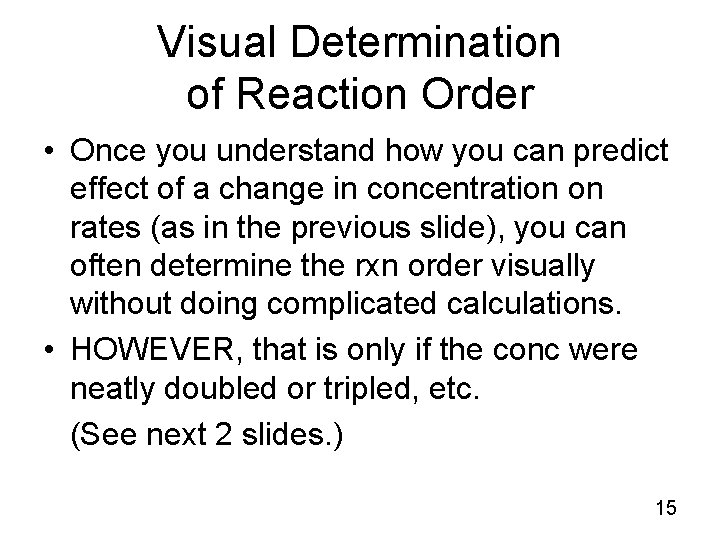
Visual Determination of Reaction Order • Once you understand how you can predict effect of a change in concentration on rates (as in the previous slide), you can often determine the rxn order visually without doing complicated calculations. • HOWEVER, that is only if the conc were neatly doubled or tripled, etc. (See next 2 slides. ) 15
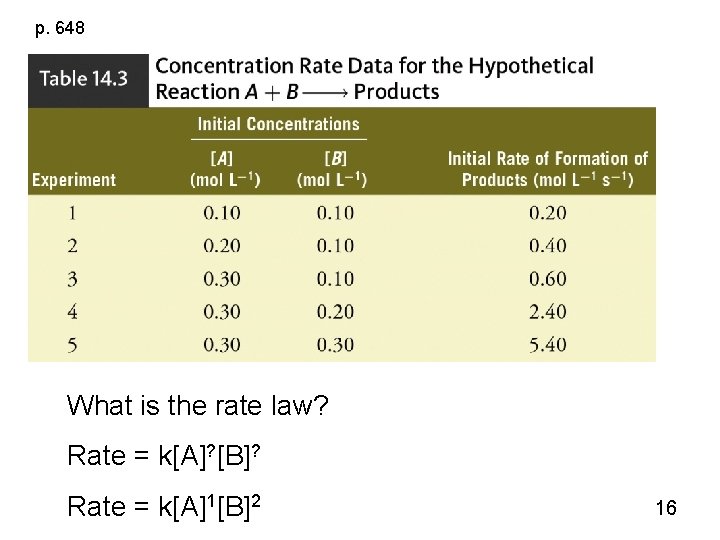
p. 648 What is the rate law? Rate = k[A]? [B]? Rate = k[A]1[B]2 16
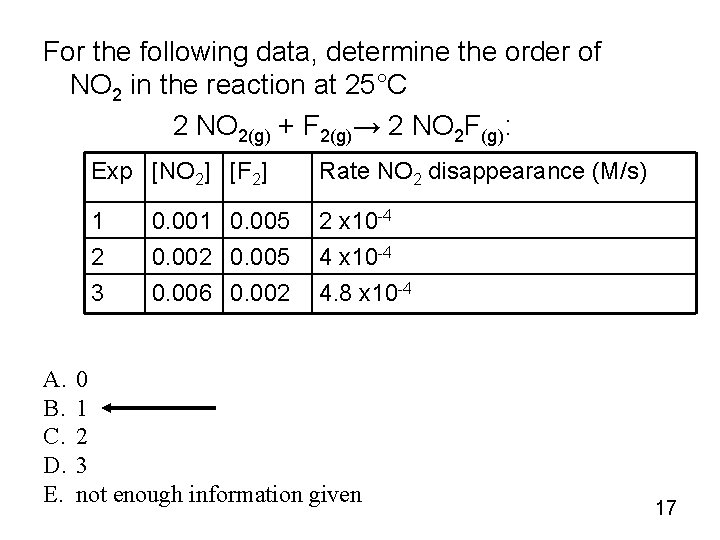
For the following data, determine the order of NO 2 in the reaction at 25°C 2 NO 2(g) + F 2(g)→ 2 NO 2 F(g): A. B. C. D. E. Exp [NO 2] [F 2] Rate NO 2 disappearance (M/s) 1 0. 005 2 x 10 -4 2 3 0. 002 0. 005 0. 006 0. 002 4 x 10 -4 4. 8 x 10 -4 0 1 2 3 not enough information given 17
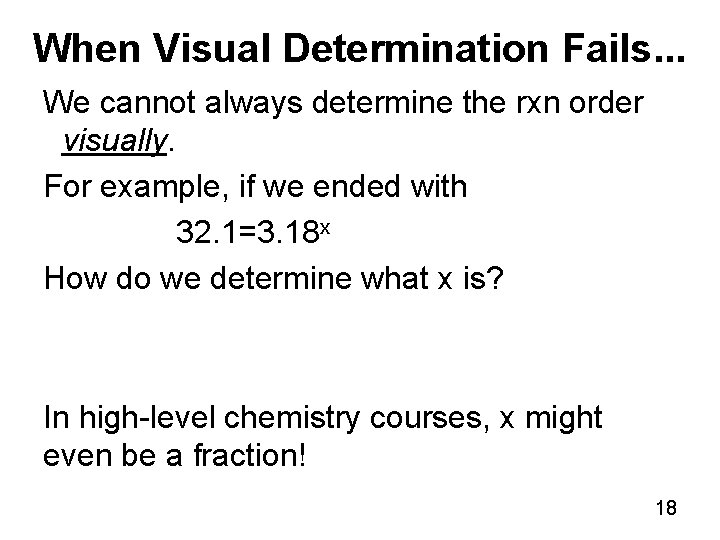
When Visual Determination Fails. . . We cannot always determine the rxn order visually. For example, if we ended with 32. 1=3. 18 x How do we determine what x is? In high-level chemistry courses, x might even be a fraction! 18