Karen Ditty Senior Clinician NWAMHS Shared Care A
- Slides: 19
Karen Ditty Senior Clinician NWAMHS Shared Care
A NATIONAL FRAMEWORK FOR RECOVERY-ORIENTED MENTAL HEALTH SERVICES: GUIDE FOR PRACTITIONERS AND PROVIDERS Capability 3 B: Focusing on strengths and personal responsibility updated 2013 “Recovery-oriented mental health care focuses on people’s strengths and supports resilience and capacity for personal responsibility, self-advocacy and positive change. ” http: //www. health. gov. au/internet/publications/publishing. nsf/Content/mental-pubs-nrecovgde-toc~mental-pubs-n-recovgde-app-3~mentalpubs-n-recovgde-app-3 -b
“Characteristics Values and attitudes Mental health practitioners and providers. . . n convey their belief in people’s capacity to reach their aspirations and to shape a life rich in possibility and meaning n acknowledge and positively reinforce people’s strengths and capacity for personal recovery n reflect a strengths focus in attitude,
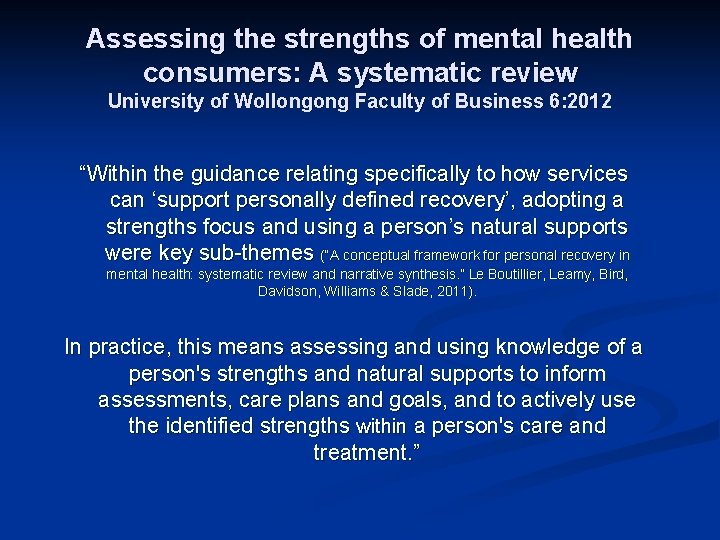
Assessing the strengths of mental health consumers: A systematic review University of Wollongong Faculty of Business 6: 2012 “Within the guidance relating specifically to how services can ‘support personally defined recovery’, adopting a strengths focus and using a person’s natural supports were key sub-themes (“A conceptual framework for personal recovery in mental health: systematic review and narrative synthesis. ” Le Boutillier, Leamy, Bird, Davidson, Williams & Slade, 2011). In practice, this means assessing and using knowledge of a person's strengths and natural supports to inform assessments, care plans and goals, and to actively use the identified strengths within a person's care and treatment. ”
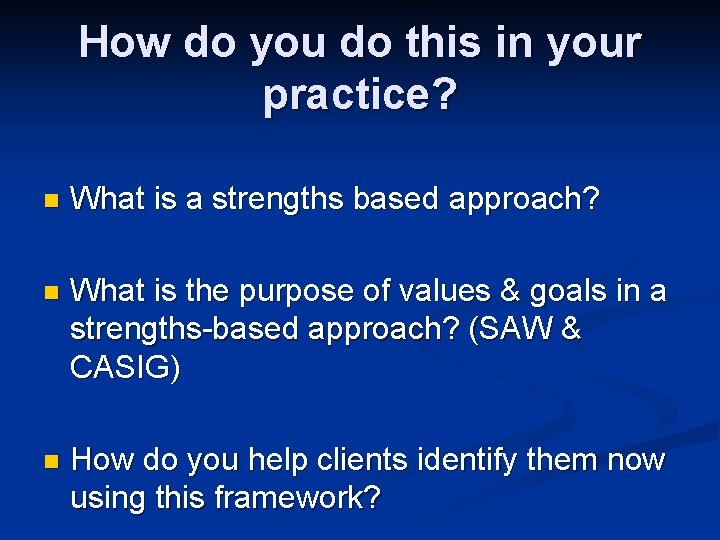
How do you do this in your practice? n What is a strengths based approach? n What is the purpose of values & goals in a strengths-based approach? (SAW & CASIG) n How do you help clients identify them now using this framework?
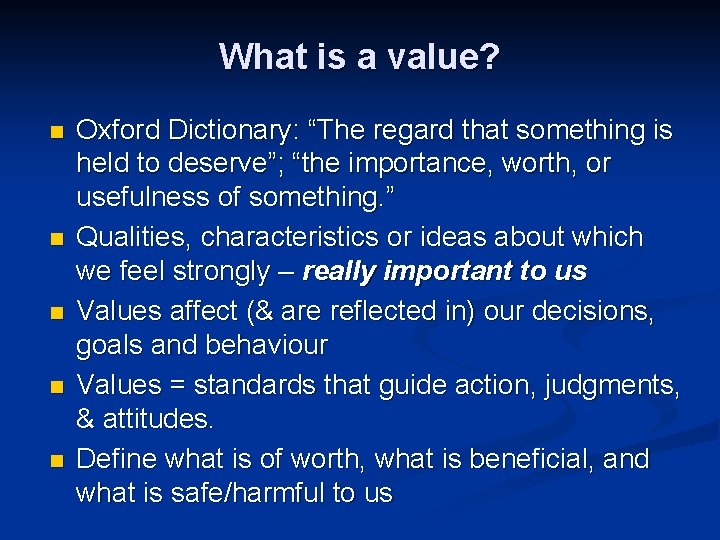
What is a value? n n n Oxford Dictionary: “The regard that something is held to deserve”; “the importance, worth, or usefulness of something. ” Qualities, characteristics or ideas about which we feel strongly – really important to us Values affect (& are reflected in) our decisions, goals and behaviour Values = standards that guide action, judgments, & attitudes. Define what is of worth, what is beneficial, and what is safe/harmful to us
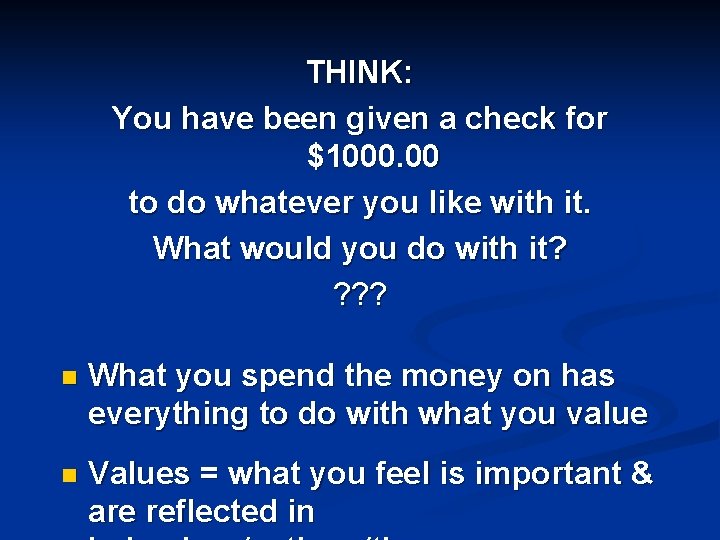
THINK: You have been given a check for $1000. 00 to do whatever you like with it. What would you do with it? ? n What you spend the money on has everything to do with what you value n Values = what you feel is important & are reflected in
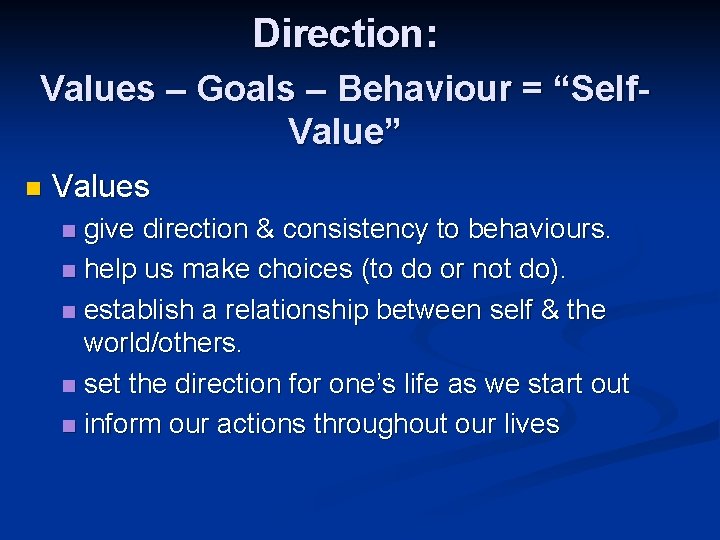
Direction: Values – Goals – Behaviour = “Self. Value” n Values give direction & consistency to behaviours. n help us make choices (to do or not do). n establish a relationship between self & the world/others. n set the direction for one’s life as we start out n inform our actions throughout our lives n
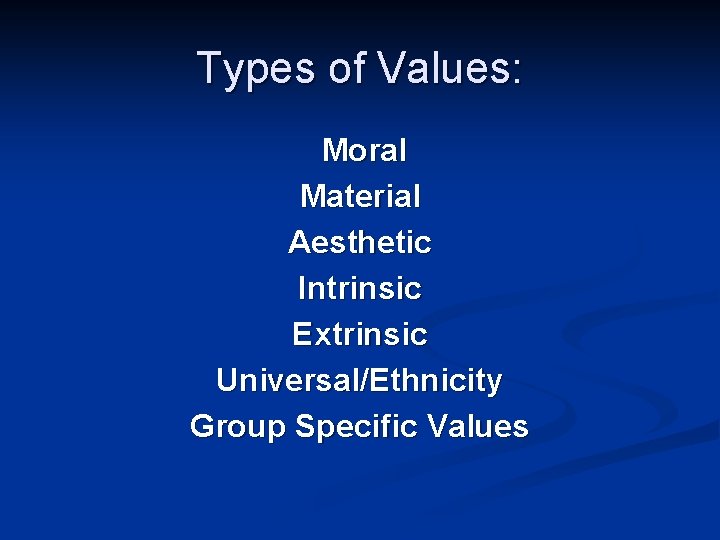
Types of Values: Moral Material Aesthetic Intrinsic Extrinsic Universal/Ethnicity Group Specific Values
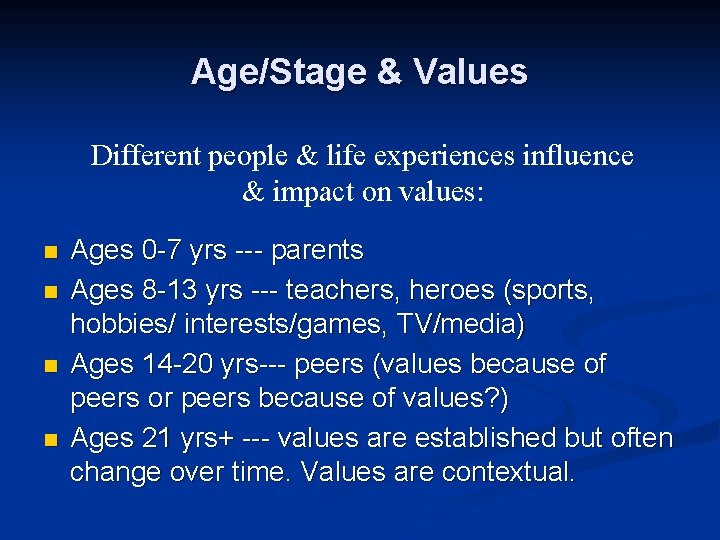
Age/Stage & Values Different people & life experiences influence & impact on values: n n Ages 0 -7 yrs --- parents Ages 8 -13 yrs --- teachers, heroes (sports, hobbies/ interests/games, TV/media) Ages 14 -20 yrs--- peers (values because of peers or peers because of values? ) Ages 21 yrs+ --- values are established but often change over time. Values are contextual.
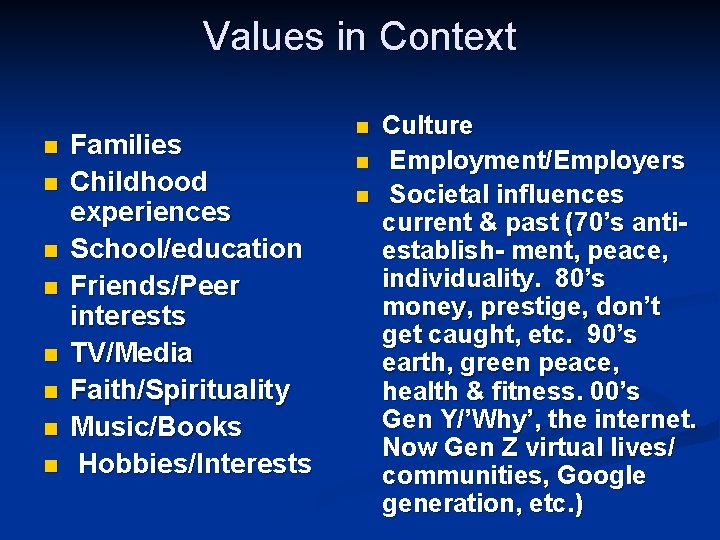
Values in Context n n n n Families Childhood experiences School/education Friends/Peer interests TV/Media Faith/Spirituality Music/Books Hobbies/Interests n n n Culture Employment/Employers Societal influences current & past (70’s antiestablish- ment, peace, individuality. 80’s money, prestige, don’t get caught, etc. 90’s earth, green peace, health & fitness. 00’s Gen Y/’Why’, the internet. Now Gen Z virtual lives/ communities, Google generation, etc. )
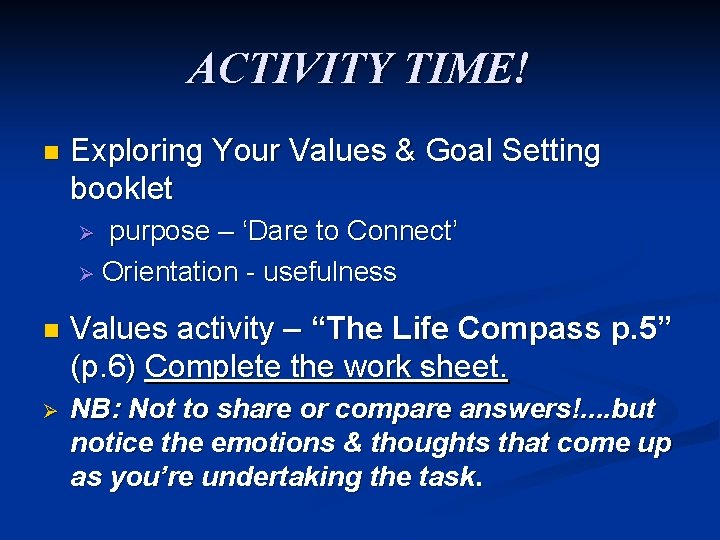
ACTIVITY TIME! n Exploring Your Values & Goal Setting booklet Ø purpose – ‘Dare to Connect’ Ø Orientation - usefulness n Values activity – “The Life Compass p. 5” (p. 6) Complete the work sheet. Ø NB: Not to share or compare answers!. . but notice the emotions & thoughts that come up as you’re undertaking the task.
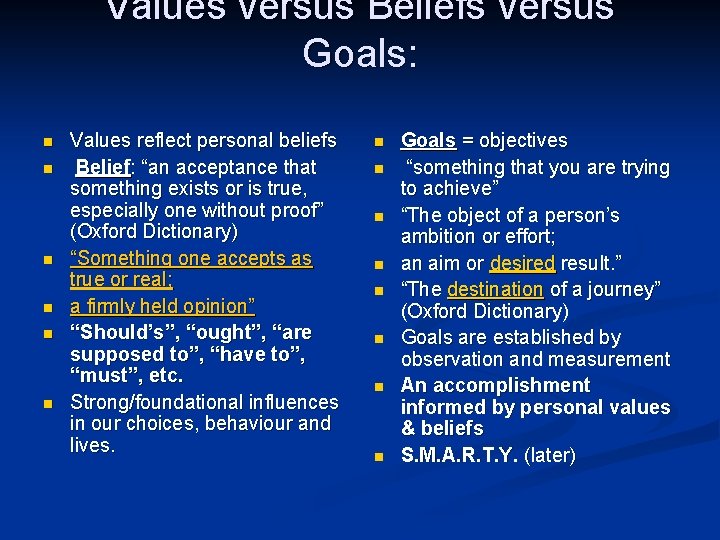
Values versus Beliefs versus Goals: n n n Values reflect personal beliefs Belief: “an acceptance that something exists or is true, especially one without proof” (Oxford Dictionary) “Something one accepts as true or real; a firmly held opinion” “Should’s”, “ought”, “are supposed to”, “have to”, “must”, etc. Strong/foundational influences in our choices, behaviour and lives. n n n n Goals = objectives “something that you are trying to achieve” “The object of a person’s ambition or effort; an aim or desired result. ” “The destination of a journey” (Oxford Dictionary) Goals are established by observation and measurement An accomplishment informed by personal values & beliefs S. M. A. R. T. Y. (later)
“When your values become clear to you, Making decisions become easier. “
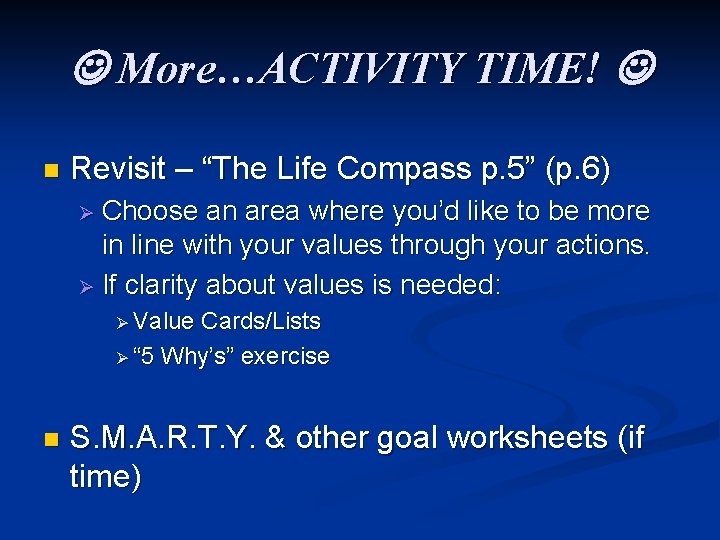
More…ACTIVITY TIME! n Revisit – “The Life Compass p. 5” (p. 6) Ø Choose an area where you’d like to be more in line with your values through your actions. Ø If clarity about values is needed: Ø Value Cards/Lists Ø “ 5 Why’s” exercise n S. M. A. R. T. Y. & other goal worksheets (if time)
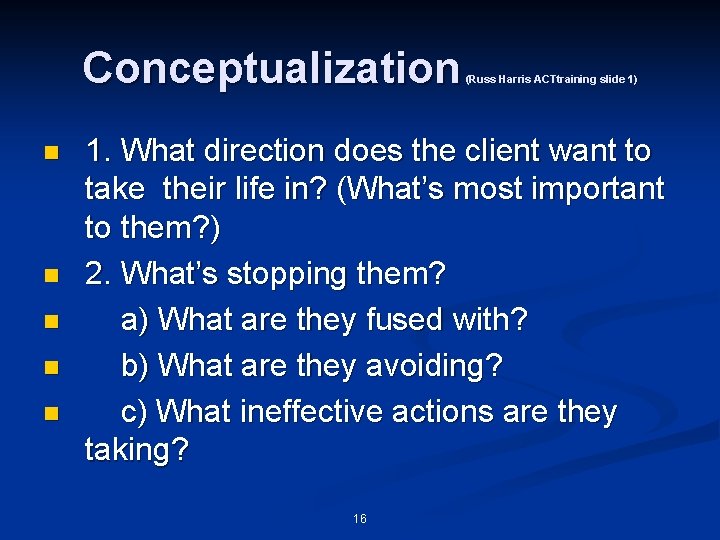
Conceptualization n n (Russ Harris ACTtraining slide 1) 1. What direction does the client want to take their life in? (What’s most important to them? ) 2. What’s stopping them? a) What are they fused with? b) What are they avoiding? c) What ineffective actions are they taking? 16
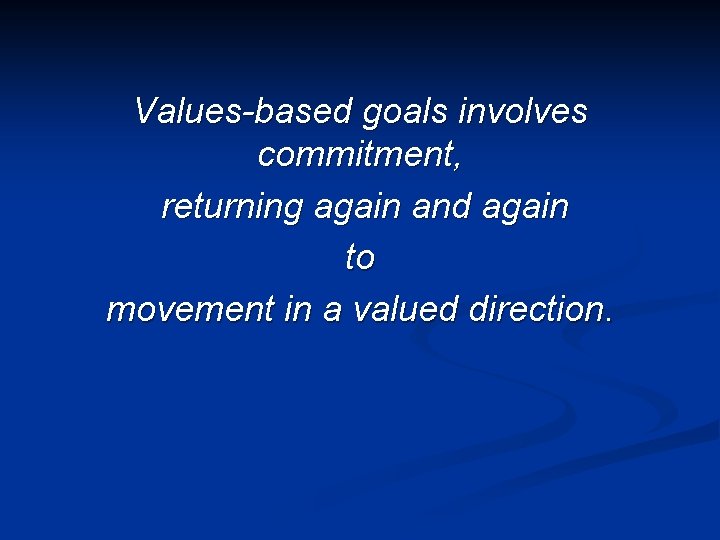
Values-based goals involves commitment, returning again and again to movement in a valued direction.
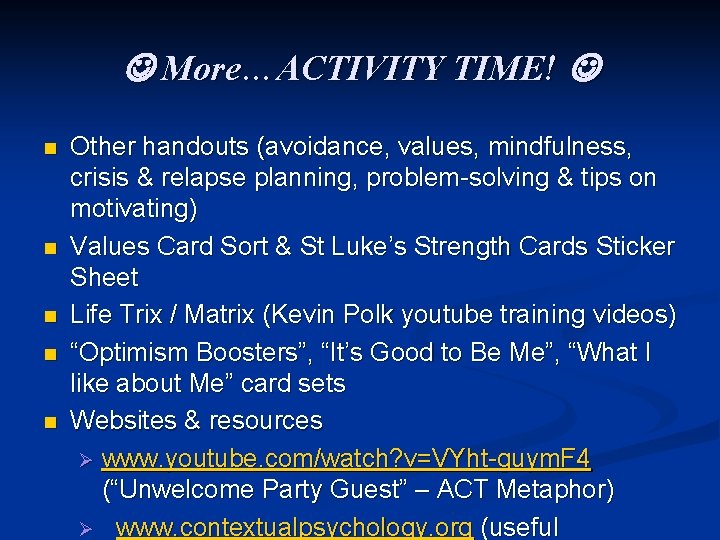
More…ACTIVITY TIME! n n n Other handouts (avoidance, values, mindfulness, crisis & relapse planning, problem-solving & tips on motivating) Values Card Sort & St Luke’s Strength Cards Sticker Sheet Life Trix / Matrix (Kevin Polk youtube training videos) “Optimism Boosters”, “It’s Good to Be Me”, “What I like about Me” card sets Websites & resources Ø www. youtube. com/watch? v=VYht-guym. F 4 (“Unwelcome Party Guest” – ACT Metaphor) Ø www. contextualpsychology. org (useful
Questions? ? ? & Evaluations