
Adapting the CAHPS Clinician and Group Survey to
- Slides: 19
Adapting the CAHPS® Clinician and Group Survey to the American Indian Population drhays@ucla. edu http: //twitter. com/Ron. DHays http: //gim. med. ucla. edu/Faculty. Pages/Hays/
Choctaw Nation Health Services and Agency for Healthcare Research and Quality • Debbie Dalpoas – Chief of Quality/Risk and Compliance Officer, Choctaw Nation Health Care Center • David Wharton – Preventive Health Informaticist, Choctaw Nation Health Care Center • Patrik Johansson – Assistant Research Professor, George Washington Univ. School of Public Health and Health Sciences • Charles Darby 3 – Social Science Administrator with AHRQ
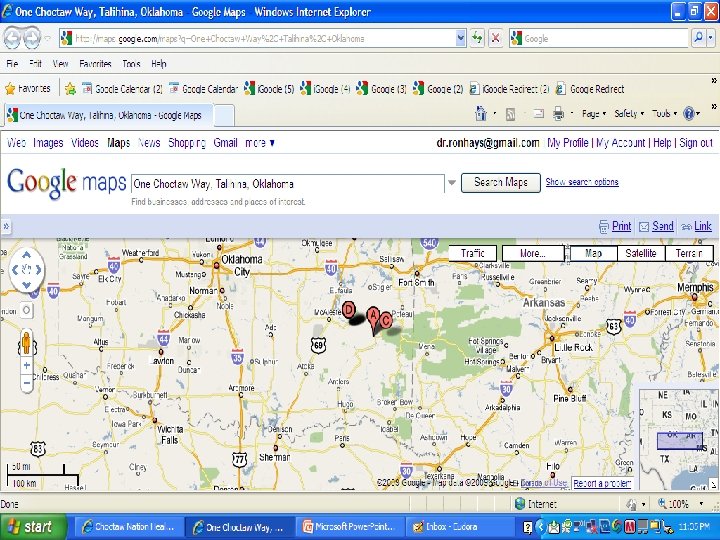
Choctaw Nation of Oklahoma • First in U. S. to build a tribally-owned hospital with tribal funding • Choctaw Nation Health Care Center, located in Talihina, OK: – 145 k square foot health facility with 37 hospital beds for inpatient care and 52 exam rooms in outpatient clinic. – Five comprehensive health centers – Accredited by The Joint Commission – Provide care to about 50 k Native Americans in 4 11 counties in southeastern OK
Study Objectives • Develop survey to assess ambulatory health care at Choctaw Nation Health Services clinics • Begin benchmark of patients’ experiences with Choctaw Nation health care facilities • Compare patients’ experiences across clinics • Provide input into development of a national American Indian Survey 6
Process (1) • Choctaw Nation Health Services (CNHS) approached AHRQ in late 2003 to explore develop of a survey • AHRQ and RAND reviewed literature on working with American Indian, low-income, and vulnerable populations. – Employed a community-based participatory research model in which all partners were equal. • Research team included CNHS staff, one of who was an enrolled member of the Choctaw Nation. 7
Process (2) • Kickoff meeting in February 2004 at CNHS Talihina clinic • Discussed data ownership, data dissemination, and publication of results at beginning of the study with CNHS staff. • Got approval of the study through the Choctaw Nation IRB and Tribal Council • Monthly conference calls • Scheduled project meetings to avoid major Choctaw Nation events, celebrations and holidays 8
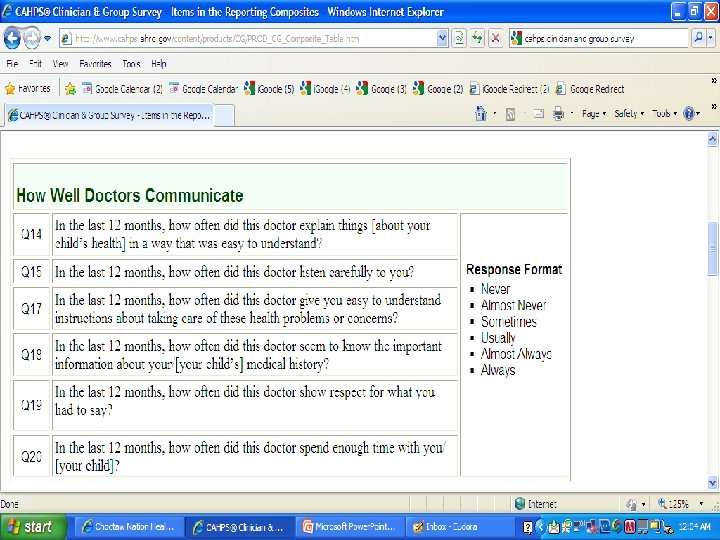
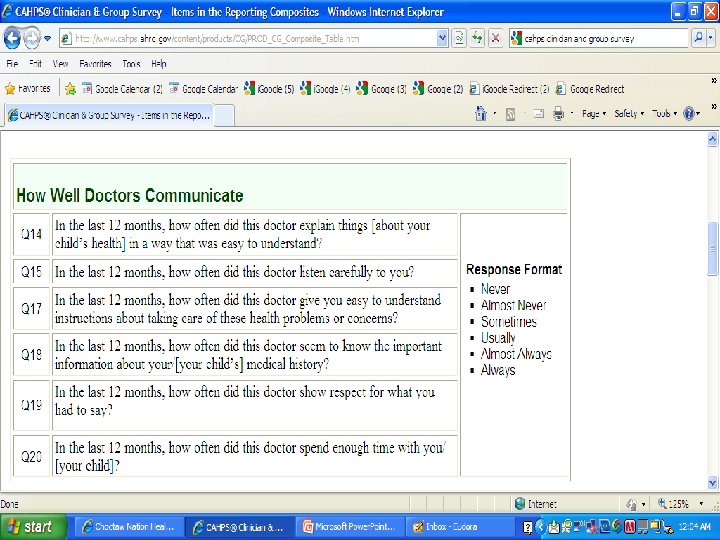
Process (3) • Worked with CNHS to identify domains of interest • Reviewed instruments already used by CNHS • Drafted items based on Consumer Assessment of Healthcare Providers and Systems (CAHPS) Clinician and Group Survey • CNHS reviewed and provided feedback on draft items – Adapted measures to reflect organizational structure of CNHS ambulatory clinics and user population 9
Process (4) • Jointly – Developed recruitment and data collection protocols – Selected sites for cognitive interviews – Outlined a sampling plan for the field test – Resolved issues as they came up. 10
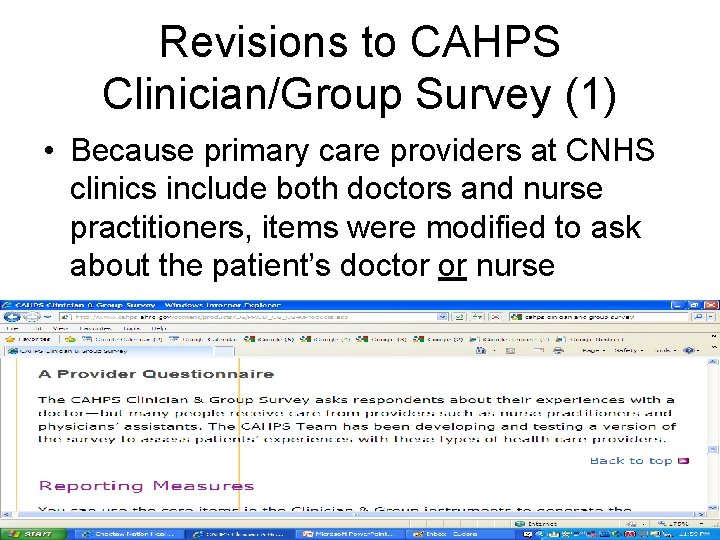
Revisions to CAHPS Clinician/Group Survey (1) • Because primary care providers at CNHS clinics include both doctors and nurse practitioners, items were modified to ask about the patient’s doctor or nurse
Revisions to CAHPS Clinician/Group Survey (2) • Substituted “health professional” for “health provider” because it is more widely used and recognized by CNHS patients. • Assessed – Shared decision making – Coordination of care – Health education – Perceived discrimination 13
Cognitive Testing • Conducted 20 in-person cognitive interviews with CNHS patients from 3 clinics to evaluate the draft survey instrument (Summer, 2004) • Patients asked to complete the questionnaire and provide feedback on item wording and their interpretation of the questions. • Survey instrument modified as a result of findings
Field Testing: June-August, 2005 • 1200 patients who had received care at 1 or more of 5 CNHS clinics (240 from each clinic) in the past 6 months • Mail survey (advance notification letter, two survey mailings, reminder, and thank you letter with $10 Walmart gift card) • Response rate = 58% (n= 696 completes) 15
Survey Content • Hypothesized 7 multi-item scales: – Getting care quickly (5 items) – Getting needed care (5 items) – Communication with providers (9 items) – Shared decision making (2 items) – Health education (5 items) – Clerks and receptionists (2 items) – Perceived discrimination (6 items) • Coordination of care (single item) • Global ratings of primary care provider and clinic 16
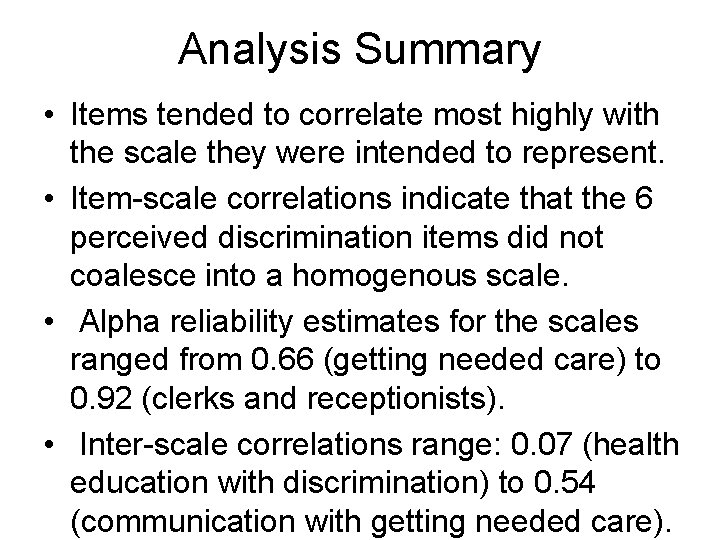
Analysis Summary • Items tended to correlate most highly with the scale they were intended to represent. • Item-scale correlations indicate that the 6 perceived discrimination items did not coalesce into a homogenous scale. • Alpha reliability estimates for the scales ranged from 0. 66 (getting needed care) to 0. 92 (clerks and receptionists). • Inter-scale correlations range: 0. 07 (health education with discrimination) to 0. 54 (communication with getting needed care).
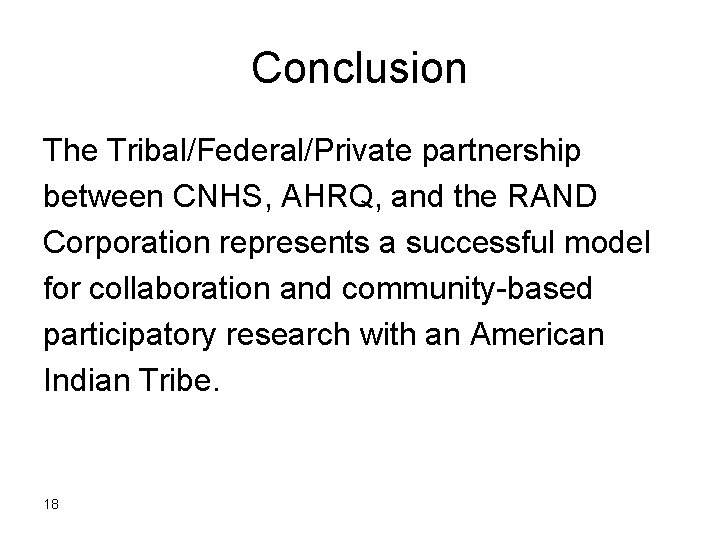
Conclusion The Tribal/Federal/Private partnership between CNHS, AHRQ, and the RAND Corporation represents a successful model for collaboration and community-based participatory research with an American Indian Tribe. 18
Weidmer-Ocampo, B. , Johansson, P. , Dalpoas, D. , Wharton, D. , Darby, C, & Hays, R. D. (2009). Adapting CAHPS® for an American Indian population. Journal of Healthcare for the Poor and Underserved. 20, 695 -712. http: //www. cahps. ahrq. gov/content/products/A I/PROD_AI_AIIntro. asp