Jupiter Radius 43 441 miles 69911 km Gravity


- Slides: 8
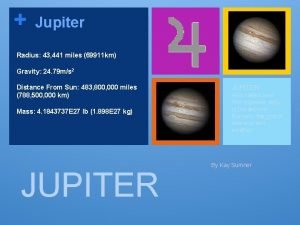
+ Jupiter Radius: 43, 441 miles (69911 km) Gravity: 24. 79 m/s 2 Distance From Sun: 483, 800, 000 miles (788, 500, 000 km) Mass: 4. 1843737 E 27 lb (1. 898 E 27 kg) JUPITER: Also called Jove. The supreme deity of the ancient Romans: the god of heavens and weather By Kay Sumner
+ Position n Fifth planet in the solar system n 483, 800, 000 miles (788, 500, 000 km) from the Sun n It takes 12 years to orbit ( Earth years ) n It orbits in the shape of a flower Jupiter SUN s u n
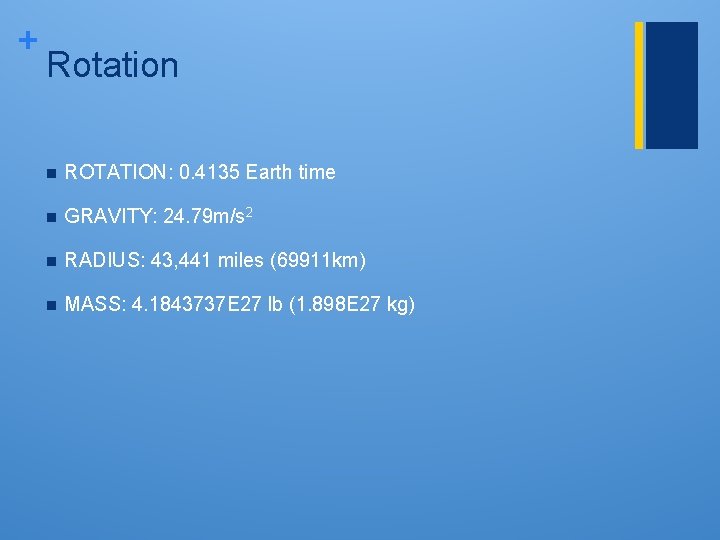
+ Rotation n ROTATION: 0. 4135 Earth time n GRAVITY: 24. 79 m/s 2 n RADIUS: 43, 441 miles (69911 km) n MASS: 4. 1843737 E 27 lb (1. 898 E 27 kg)
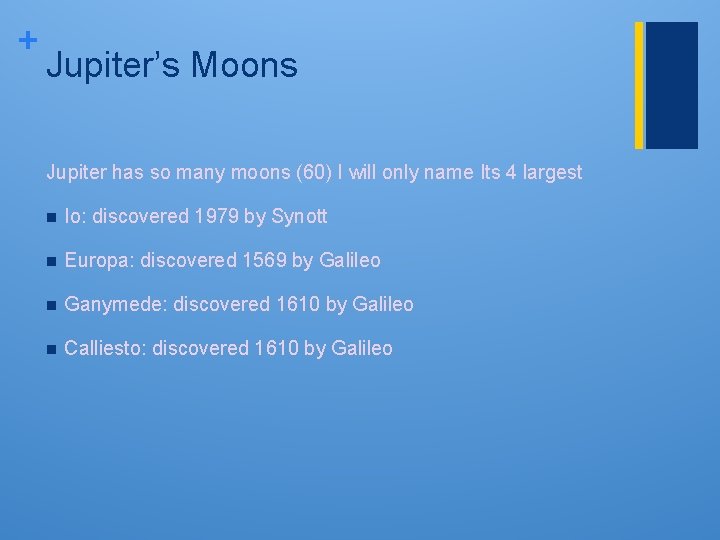
+ Jupiter’s Moons Jupiter has so many moons (60) I will only name Its 4 largest n Io: discovered 1979 by Synott n Europa: discovered 1569 by Galileo n Ganymede: discovered 1610 by Galileo n Calliesto: discovered 1610 by Galileo
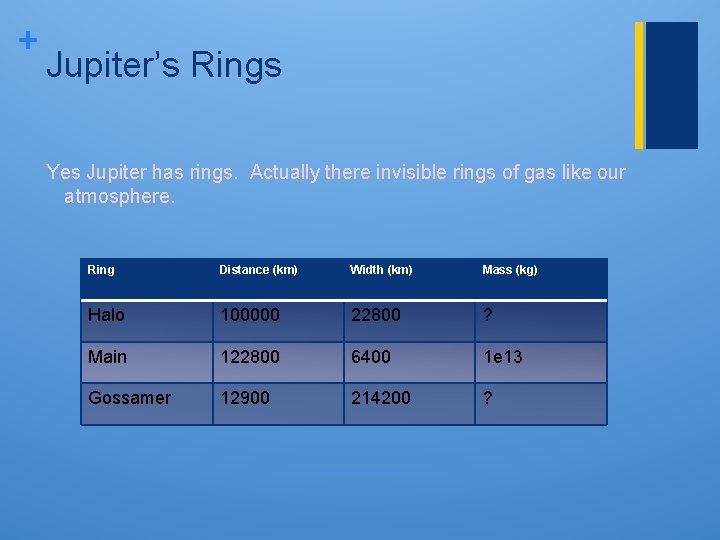
+ Jupiter’s Rings Yes Jupiter has rings. Actually there invisible rings of gas like our atmosphere. Ring Distance (km) Width (km) Mass (kg) Halo 100000 22800 ? Main 122800 6400 1 e 13 Gossamer 12900 214200 ?
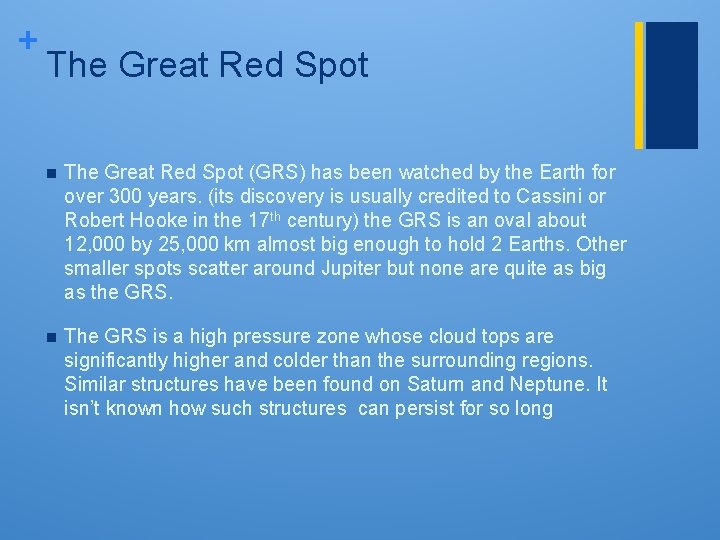
+ The Great Red Spot n The Great Red Spot (GRS) has been watched by the Earth for over 300 years. (its discovery is usually credited to Cassini or Robert Hooke in the 17 th century) the GRS is an oval about 12, 000 by 25, 000 km almost big enough to hold 2 Earths. Other smaller spots scatter around Jupiter but none are quite as big as the GRS. n The GRS is a high pressure zone whose cloud tops are significantly higher and colder than the surrounding regions. Similar structures have been found on Saturn and Neptune. It isn’t known how such structures can persist for so long
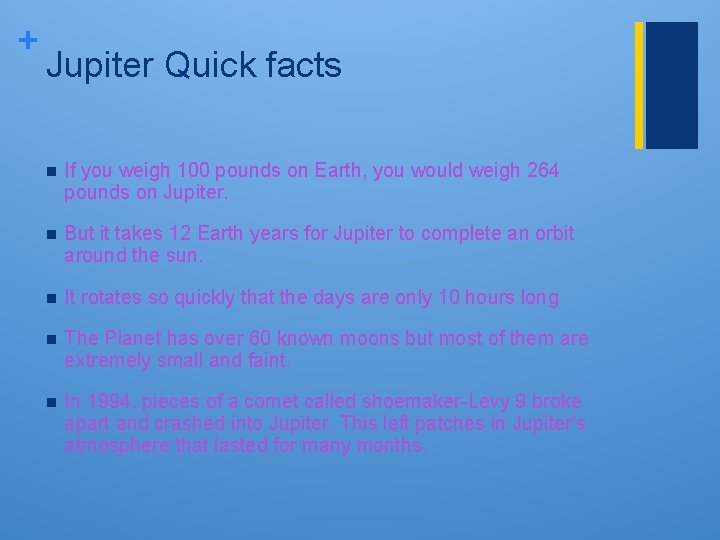
+ Jupiter Quick facts n If you weigh 100 pounds on Earth, you would weigh 264 pounds on Jupiter. n But it takes 12 Earth years for Jupiter to complete an orbit around the sun. n It rotates so quickly that the days are only 10 hours long n The Planet has over 60 known moons but most of them are extremely small and faint. n In 1994, pieces of a comet called shoemaker-Levy 9 broke apart and crashed into Jupiter. This left patches in Jupiter's atmosphere that lasted for many months.
+ MLA n www. astronamycafe. net n http: //nineplanets. org/jupiter. html n http: //www. kidsastronomy. com/jupiter. htm n http: //www. space. com/7 -jupiter-largest-planet-solar-system. html n http: //www. enchantedlearning. com/subjects/astronomy/planets/ jupiter/ n http: //www. aerospaceguide. net/planetjupiter. html