Judith Lumley Centre Identifying and responding to children
- Slides: 23
Judith Lumley Centre Identifying and responding to children and families experiencing domestic abuse: an Australian perspective Leesa Hooker, Ph. D Senior Research Fellow Judith Lumley Centre La Trobe University, Melbourne latrobe. edu. au/jlc CRICOS Provider 00115 M
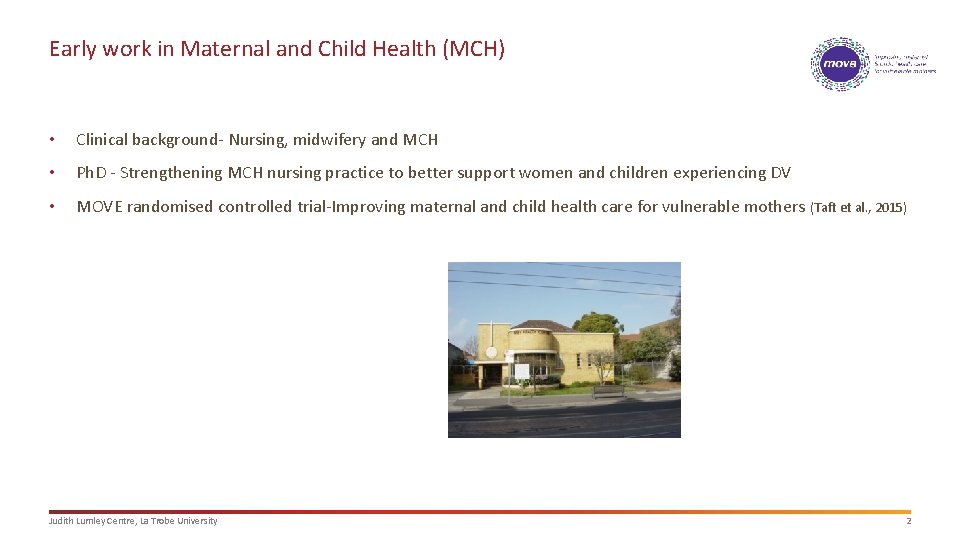
Early work in Maternal and Child Health (MCH) • Clinical background- Nursing, midwifery and MCH • Ph. D - Strengthening MCH nursing practice to better support women and children experiencing DV • MOVE randomised controlled trial-Improving maternal and child health care for vulnerable mothers (Taft et al. , 2015) Judith Lumley Centre, La Trobe University 2
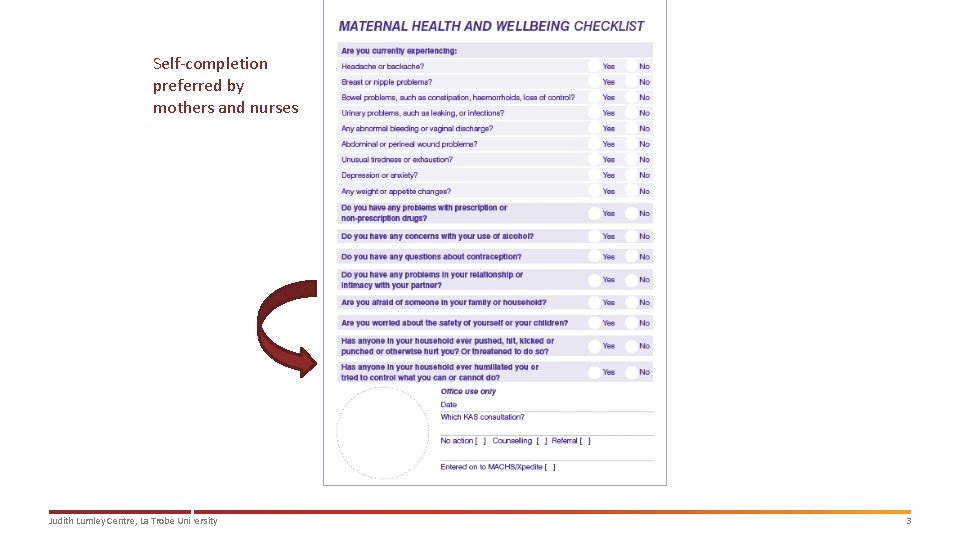
Self-completion preferred by mothers and nurses Judith Lumley Centre, La Trobe University 3
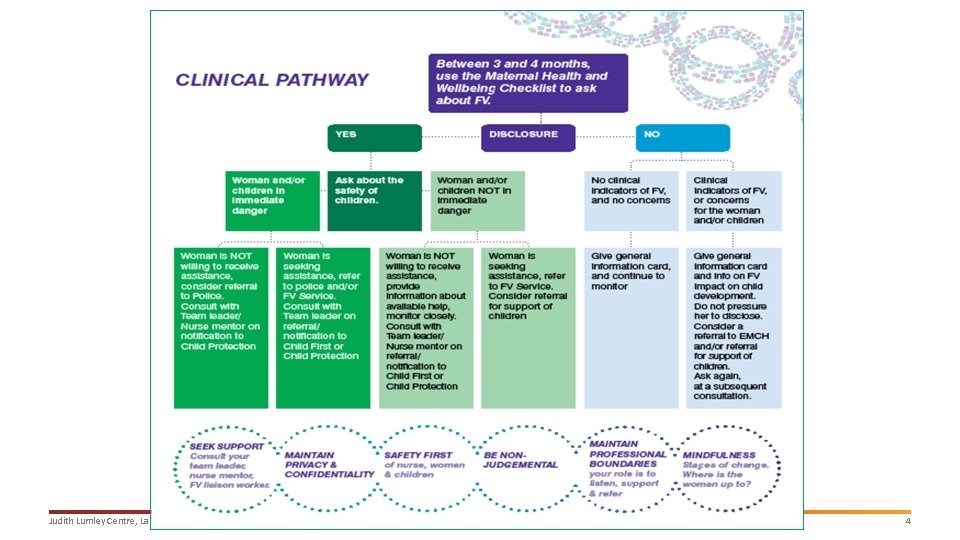
Judith Lumley Centre, La Trobe University 4
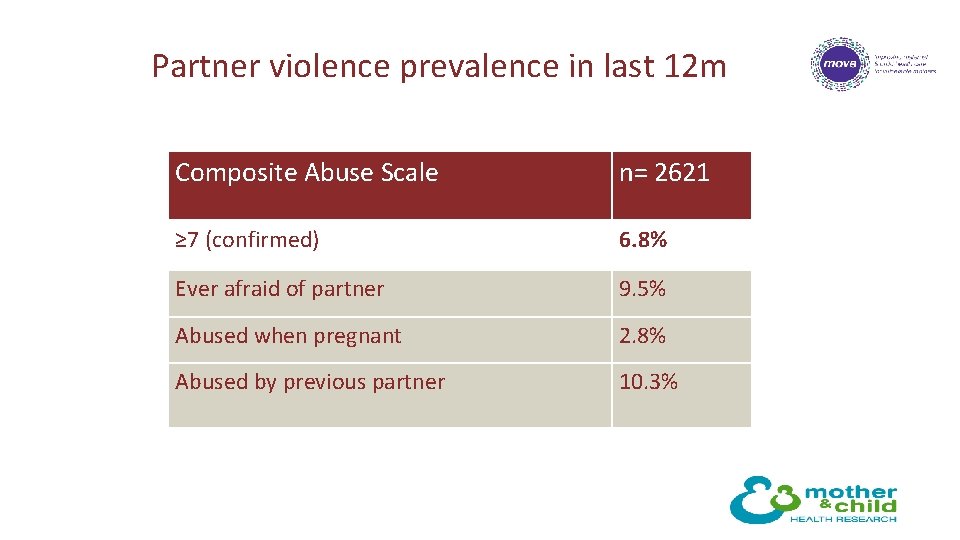
Partner violence prevalence in last 12 m Composite Abuse Scale n= 2621 ≥ 7 (confirmed) 6. 8% Ever afraid of partner 9. 5% Abused when pregnant 2. 8% Abused by previous partner 10. 3%
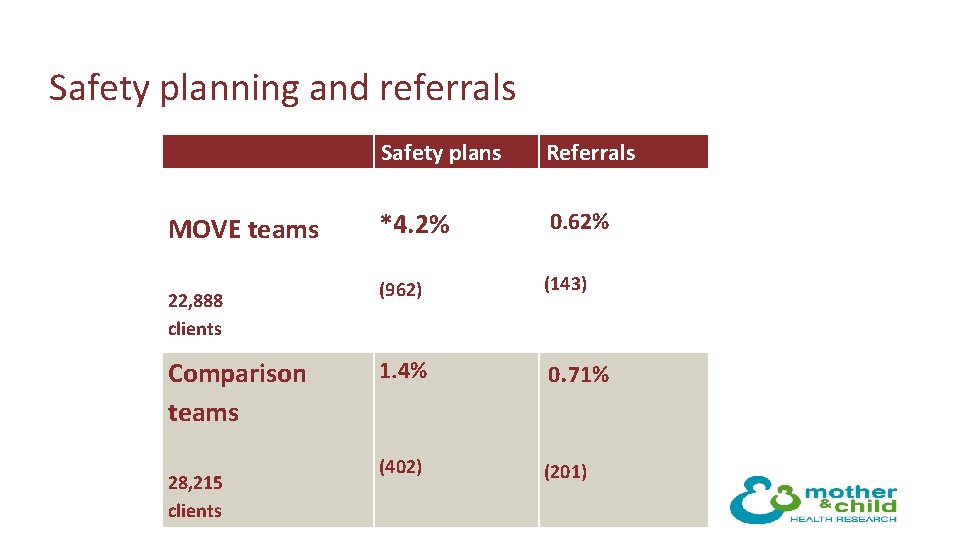
Safety planning and referrals MOVE teams 22, 888 clients Comparison teams 28, 215 clients Safety plans Referrals *4. 2% 0. 62% (962) (143) 1. 4% 0. 71% (402) (201)
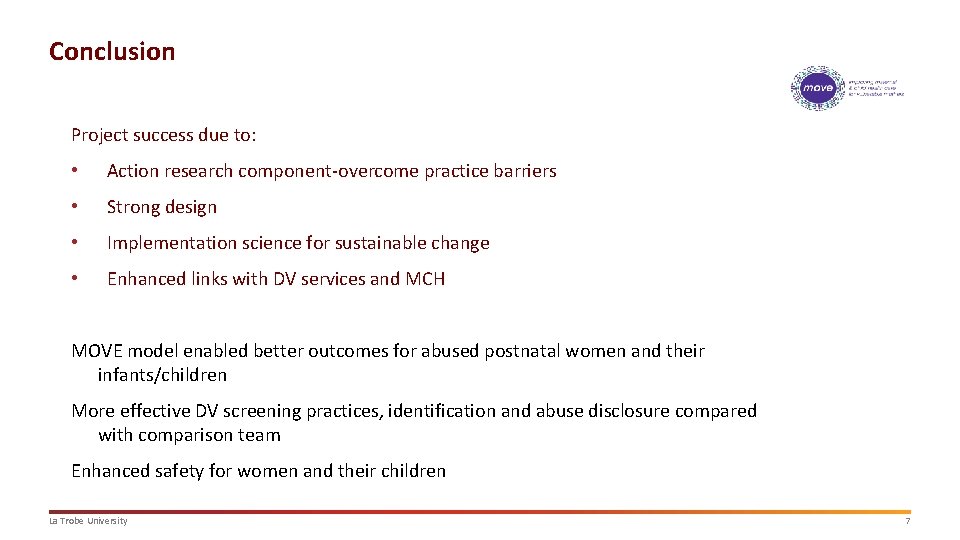
Conclusion Project success due to: • Action research component-overcome practice barriers • Strong design • Implementation science for sustainable change • Enhanced links with DV services and MCH MOVE model enabled better outcomes for abused postnatal women and their infants/children More effective DV screening practices, identification and abuse disclosure compared with comparison team Enhanced safety for women and their children La Trobe University 7
MOVE publications 1. MOVE theory Hooker, L. , & Taft, A. (2016). Using theory to design, implement and evaluate sustained nurse domestic violence screening and supportive care. Journal of Research in Nursing, 21(5 -6), 432 -442. https: //doi. org/10. 1177/1744987116649633 2. MOVE primary outcomes paper Taft , A. , Hooker, L. , Humphreys, C. , Hegarty, K. , Walter, R. , Adams, C. , Agius, P. , Small, R. (2015). Maternal and child health nurse screening and care for mothers experiencing domestic violence (MOVE): a cluster randomised trial. BMC Medicine, 13(150). https: //doi. org/10. 1186/s 12916 -015 -0375 -7 3. MOVE process evaluation Hooker, L. , Small, R. , Humphreys, C. , Hegarty, K. , & Taft, A. (2015). Applying normalization process theory to understand implementation of a family violence screening and care model in maternal and child health nursing practice: a mixed method process evaluation of a randomised controlled trial. Implementation Science, 10(39). https: //doi. org/10. 1186/s 13012 -015 -0230 -4 4. MOVE 2 years on Hooker, L. , Small, R. , & Taft, A. (2016). Understanding sustained domestic violence identification in maternal and child health nurse care: process evaluation from a 2 -year follow-up of the MOVE trial Journal of Advanced Nursing, 72(3), 534 -544. https: //doi. org/10. 1111/jan. 12851 5. MOVE data Hooker, L. , Samaraweera, N. , Agius, P. , & Taft, A. (2016). Intimate partner violence and the experience of motherhood: A cross-sectional analysis of factors associated with a poor experience of motherhood. Midwifery, 34, 88 -94. https: //doi. org/10. 1016/j. midw. 2015. 12. 011 Hooker, L. , Versteegh, L. , Lindgren, H. , & Taft, A. (2020). Differences in help-seeking behaviours and perceived helpfulness of services between abused and non-abused postpartum women: A cross sectional survey of Australian postpartum women. Health and Social Care in the Community, 28, 958 -968. https: //doi. org/10. 1111/hsc. 12927 La Trobe University 8
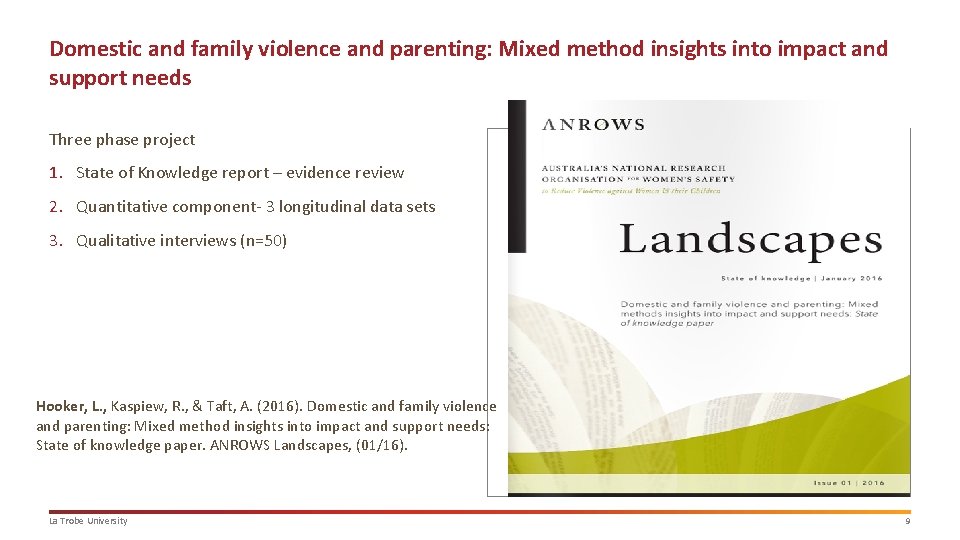
Domestic and family violence and parenting: Mixed method insights into impact and support needs Three phase project 1. State of Knowledge report – evidence review 2. Quantitative component- 3 longitudinal data sets Image area 3. Qualitative interviews (n=50) Hooker, L. , Kaspiew, R. , & Taft, A. (2016). Domestic and family violence and parenting: Mixed method insights into impact and support needs: State of knowledge paper. ANROWS Landscapes, (01/16). La Trobe University 9
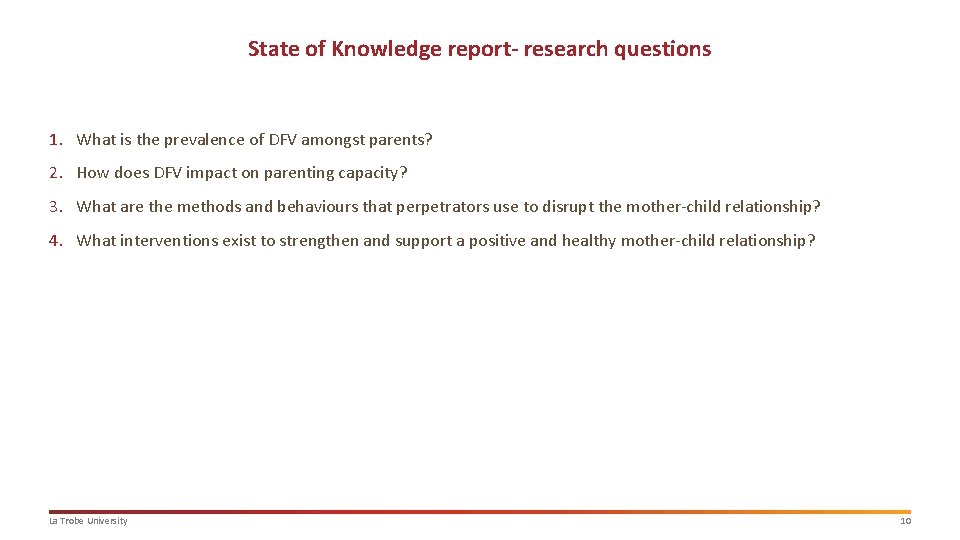
State of Knowledge report- research questions 1. What is the prevalence of DFV amongst parents? 2. How does DFV impact on parenting capacity? 3. What are the methods and behaviours that perpetrators use to disrupt the mother-child relationship? 4. What interventions exist to strengthen and support a positive and healthy mother-child relationship? La Trobe University 10
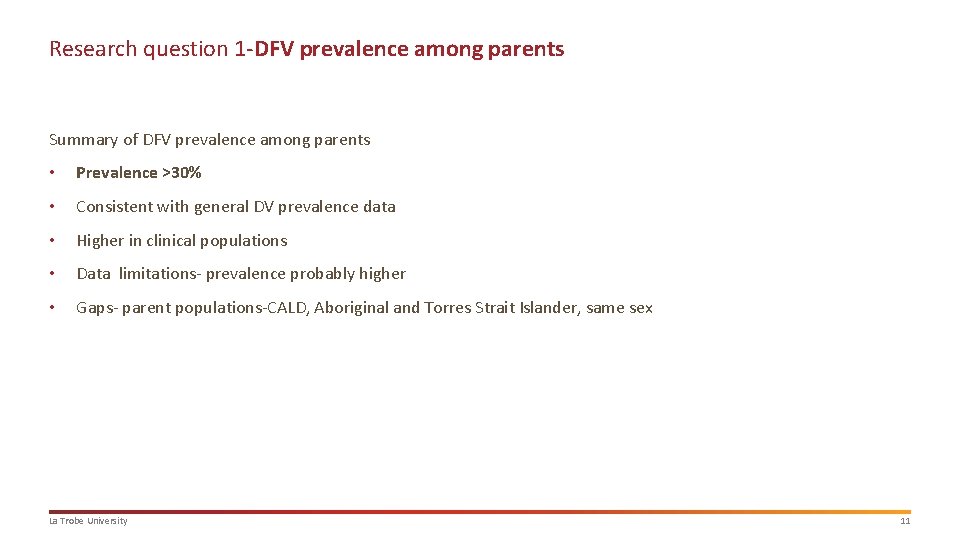
Research question 1 -DFV prevalence among parents Summary of DFV prevalence among parents • Prevalence >30% • Consistent with general DV prevalence data • Higher in clinical populations • Data limitations- prevalence probably higher • Gaps- parent populations-CALD, Aboriginal and Torres Strait Islander, same sex La Trobe University 11
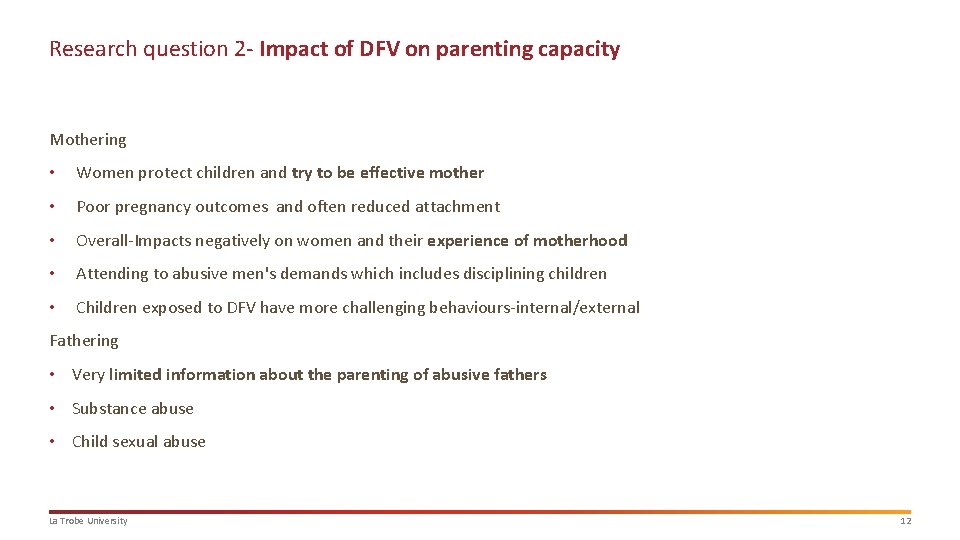
Research question 2 - Impact of DFV on parenting capacity Mothering • Women protect children and try to be effective mother • Poor pregnancy outcomes and often reduced attachment • Overall-Impacts negatively on women and their experience of motherhood • Attending to abusive men's demands which includes disciplining children • Children exposed to DFV have more challenging behaviours-internal/external Fathering • Very limited information about the parenting of abusive fathers • Substance abuse • Child sexual abuse La Trobe University 12
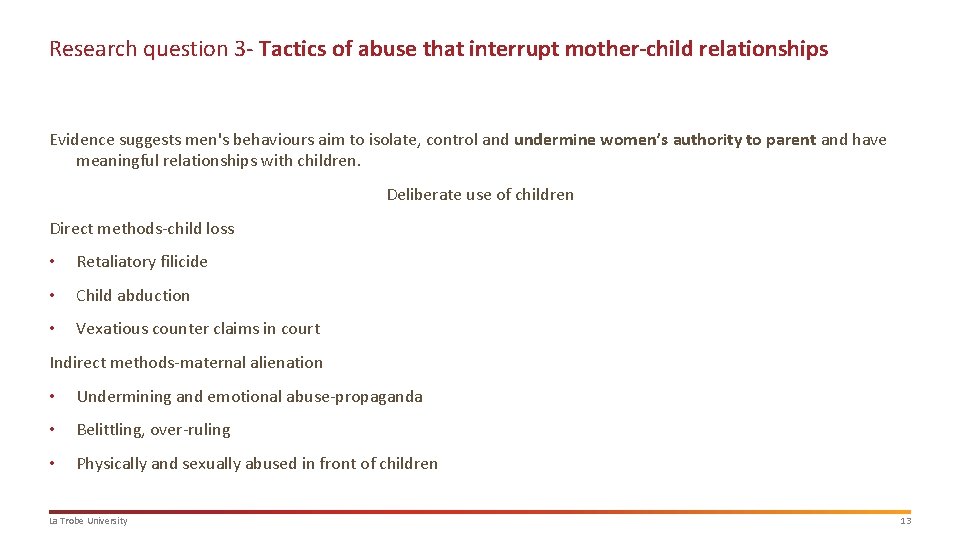
Research question 3 - Tactics of abuse that interrupt mother-child relationships Evidence suggests men's behaviours aim to isolate, control and undermine women’s authority to parent and have meaningful relationships with children. Deliberate use of children Direct methods-child loss • Retaliatory filicide • Child abduction • Vexatious counter claims in court Indirect methods-maternal alienation • Undermining and emotional abuse-propaganda • Belittling, over-ruling • Physically and sexually abused in front of children La Trobe University 13
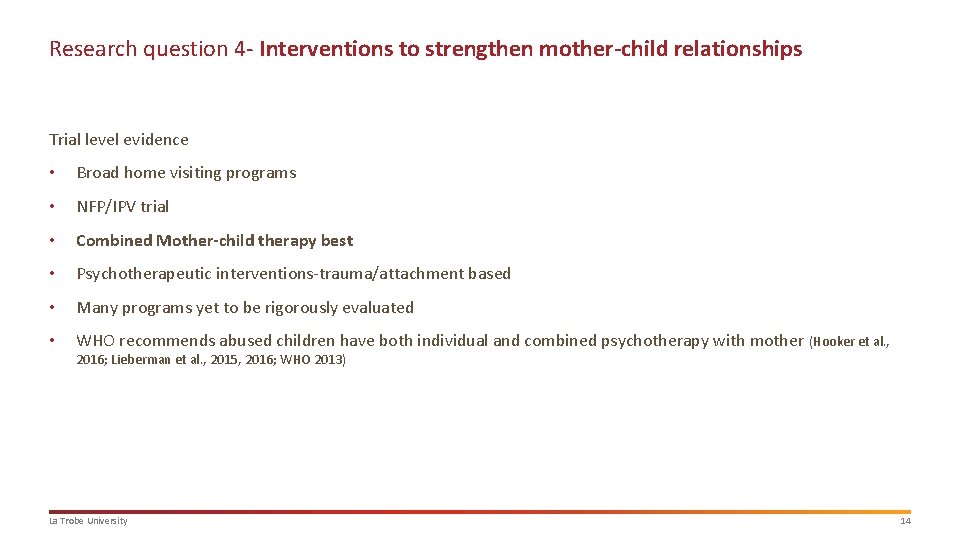
Research question 4 - Interventions to strengthen mother-child relationships Trial level evidence • Broad home visiting programs • NFP/IPV trial • Combined Mother-child therapy best • Psychotherapeutic interventions-trauma/attachment based • Many programs yet to be rigorously evaluated • WHO recommends abused children have both individual and combined psychotherapy with mother (Hooker et al. , 2016; Lieberman et al. , 2015, 2016; WHO 2013) La Trobe University 14
Reconnecting mothers and children after violence (RECOVER): The Australian Child-Parent Psychotherapy Pilot
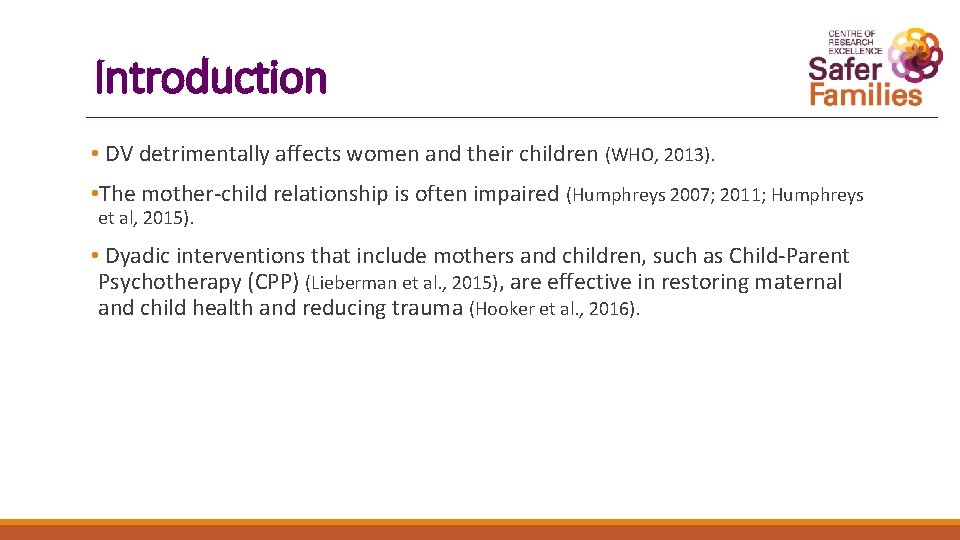
Introduction • DV detrimentally affects women and their children (WHO, 2013). • The mother-child relationship is often impaired (Humphreys 2007; 2011; Humphreys et al, 2015). • Dyadic interventions that include mothers and children, such as Child-Parent Psychotherapy (CPP) (Lieberman et al. , 2015), are effective in restoring maternal and child health and reducing trauma (Hooker et al. , 2016).
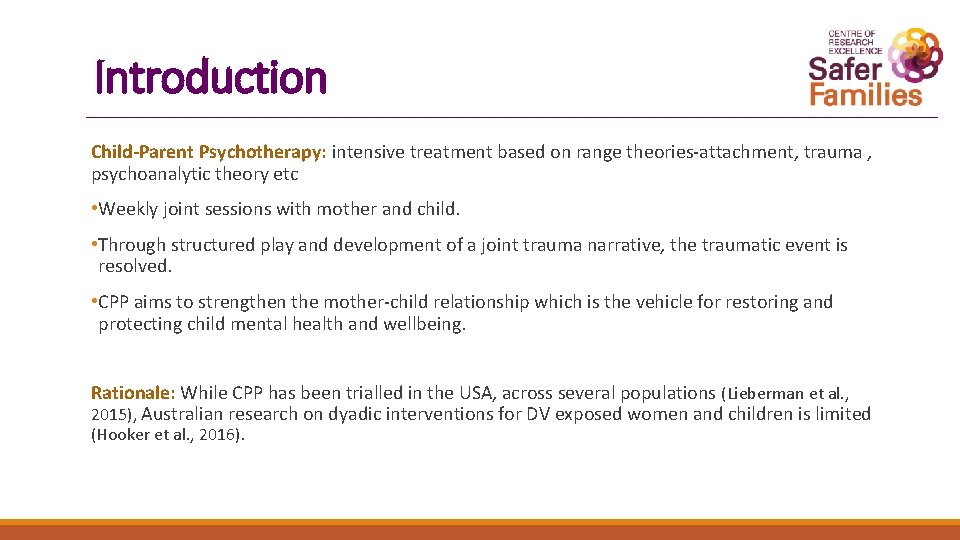
Introduction Child-Parent Psychotherapy: intensive treatment based on range theories-attachment, trauma , psychoanalytic theory etc • Weekly joint sessions with mother and child. • Through structured play and development of a joint trauma narrative, the traumatic event is resolved. • CPP aims to strengthen the mother-child relationship which is the vehicle for restoring and protecting child mental health and wellbeing. Rationale: While CPP has been trialled in the USA, across several populations (Lieberman et al. , 2015), Australian research on dyadic interventions for DV exposed women and children is limited (Hooker et al. , 2016).
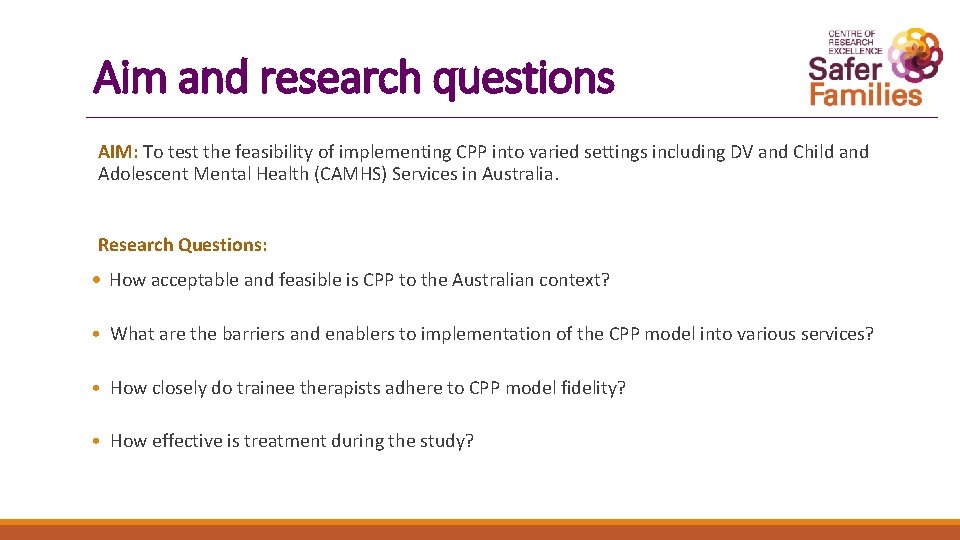
Aim and research questions AIM: To test the feasibility of implementing CPP into varied settings including DV and Child and Adolescent Mental Health (CAMHS) Services in Australia. Research Questions: • How acceptable and feasible is CPP to the Australian context? • What are the barriers and enablers to implementation of the CPP model into various services? • How closely do trainee therapists adhere to CPP model fidelity? • How effective is treatment during the study?
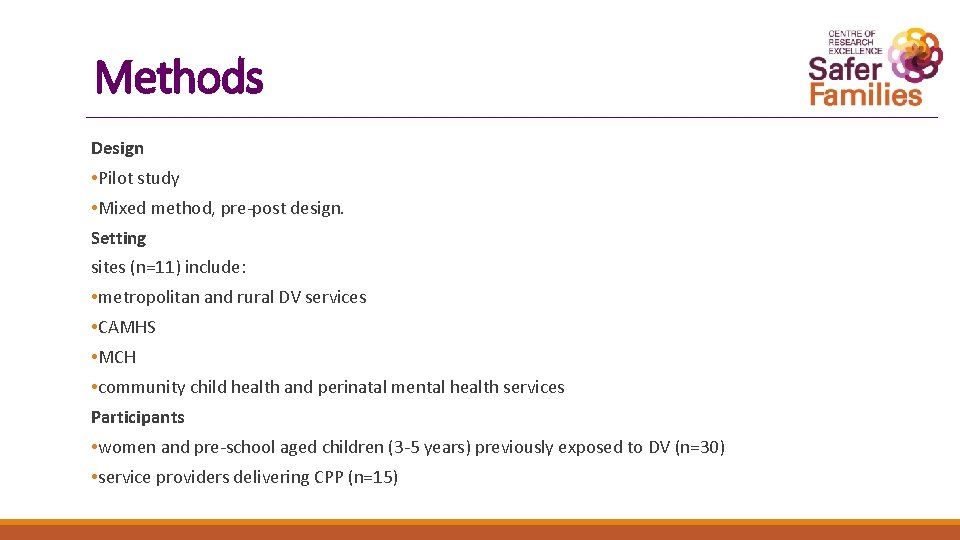
Methods Design • Pilot study • Mixed method, pre-post design. Setting sites (n=11) include: • metropolitan and rural DV services • CAMHS • MCH • community child health and perinatal mental health services Participants • women and pre-school aged children (3 -5 years) previously exposed to DV (n=30) • service providers delivering CPP (n=15)
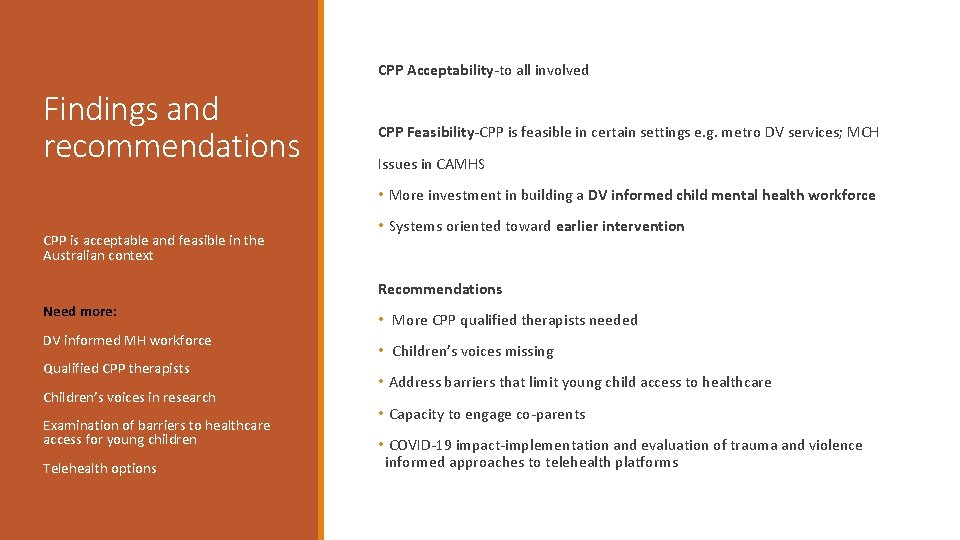
CPP Acceptability-to all involved Findings and recommendations CPP Feasibility-CPP is feasible in certain settings e. g. metro DV services; MCH Issues in CAMHS • More investment in building a DV informed child mental health workforce CPP is acceptable and feasible in the Australian context • Systems oriented toward earlier intervention Recommendations Need more: DV informed MH workforce Qualified CPP therapists Children’s voices in research Examination of barriers to healthcare access for young children Telehealth options • More CPP qualified therapists needed • Children’s voices missing • Address barriers that limit young child access to healthcare • Capacity to engage co-parents • COVID-19 impact-implementation and evaluation of trauma and violence informed approaches to telehealth platforms
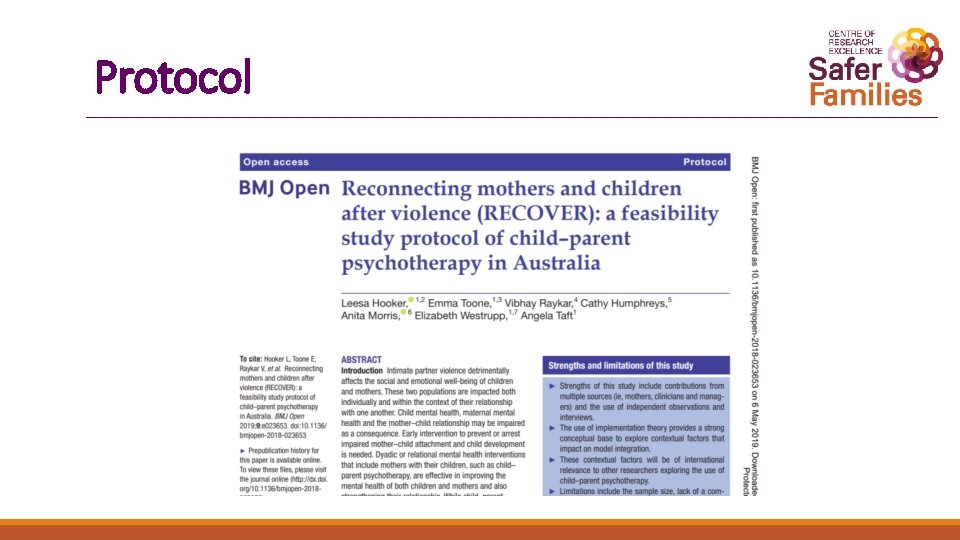
Protocol
Acknowledgements • Our thanks to the NHMRC for post doc funding. • Australia’s National Research Organisation for Women’s Safety (ANROWS) and the Luke Batty Foundation for project funding. • Thanks to our participants, clinical partners and therapists. • We also want to acknowledge Professor Chandra Gosh-Ippen (CPP co-founder) and our international colleagues for sharing their CPP knowledge and resources.
References 1. World Health Organization. (2013). Global and regional estimates of violence against women: prevalence and health effects of intimate partner violence and non partner sexual violence. Retrieved from http: //apps. who. int/iris/bitstream/10665/85239/1/9789241564625_eng. pdf 2. Humphreys, C. (2007). Talking to my mum: Strengthening relationships between mothers and children in the aftermath of family violence. Developing Practice: The Child, Youth and Family Work Journal, (19 Winter/Spring), 12 -15. 3. Humphreys, C. (2011). Rebuilding together: Strengthening the mother-child bond in the aftermath of violence. DVRCV Quarterly, (3), 6. 4. Humphreys, C. , Thiara, R. K. , Sharp, C. , & Jones, J. (2015). Supporting the relationship between mothers and children in the aftermath of domestic violence. In N. Stanley & C. Humphreys (Eds. ), Domestic violence and protecting children: New thinking and approaches (pp. 130 -147). 5. Lieberman, A. F. , Ghosh Ippen, C. , & Van Horn, P. (2015). Don't hit my mommy!: A manual for Child-Parent Psychotherapy with young children exposed to violence and other trauma. Washington DC: ZERO TO THREE. 6. Hooker, L. , Kaspiew, R. , & Taft, A. (2016). Domestic and family violence and parenting: Mixed method insights into impact and support needs: State of knowledge paper. Australia's National Research Organisation for Women's Safety (ANROWS) Landscapes, (01/16). https: //www. anrows. org. au/publication/domestic-and-family-violence-and-parenting-mixed-method-insights-into-impact-and-supportneeds-final-report/ 7. May, C. , & Finch, T. (2009). Implementing, embedding, and integrating practices: an outline of Normalization Process Theory. Sociology, 43(3), 535 -554. doi: 10. 1177/0038038509103208