Introduction to Mineralogy MineralogyMineral Science The study of
- Slides: 12
Introduction to Mineralogy
Mineralogy/Mineral Science The study of the chemistry, atomic structure, physical properties, and genesis of minerals
Subfields of Mineralogy Descriptive Mineralogy – documenting physical and optical properties Crystal Chemistry – relationship of chemical composition to atomic structure Crystallography – relationship of crystal symmetry and form to atomic structure Mineral Genesis – interpreting the geologic setting in which a mineral forms from its physical, chemical, and structural attributes and its associated minerals
Fundamental Position of Mineralogy to all other Earth Science Disciplines Petrology – the study of the origin of rocks is largely determined by evaluating the structure, texture, and chemistry of the minerals they contain. Geochemistry – study of the chemistry of earth materials which reflects the collective chemistry of the minerals they contain Structural Geology and Tectonics – Deformation of rocks is controlled by the orientation and crystal structure of its constituent minerals Environmental Geology/Hydrogeology – the study of how the biosphere, hydrosphere, and atmosphere interacts with rock and minerals (the lithosphere). Economic Geology – study of the origin and beneficiation of mineral deposits
Definition A mineral is a naturally occurring solid with a highly ordered atomic arrangement and a definite (but not fixed) chemical composition. It is usually formed by inorganic processes
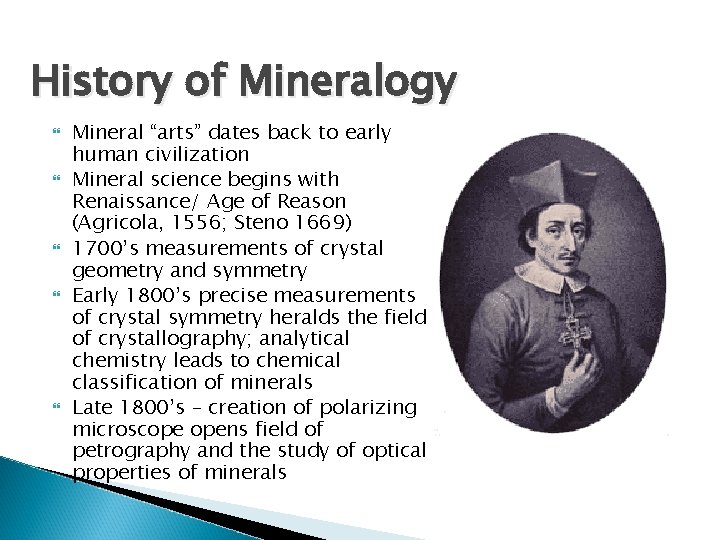
History of Mineralogy Mineral “arts” dates back to early human civilization Mineral science begins with Renaissance/ Age of Reason (Agricola, 1556; Steno 1669) 1700’s measurements of crystal geometry and symmetry Early 1800’s precise measurements of crystal symmetry heralds the field of crystallography; analytical chemistry leads to chemical classification of minerals Late 1800’s – creation of polarizing microscope opens field of petrography and the study of optical properties of minerals
History of Mineralogy (cont. ) Early 1900’s - X-ray diffraction measurements allows for precise measurement of internal symmetry and structure of minerals 1960 – development of the electron microprobe allows for accurate in situ analysis of mineral chemistry 1970 – development of transmission electron microscope allow for visualization of atomic structure and symmetry 1980 – ion microprobe allow for study of isotopic composition of minerals
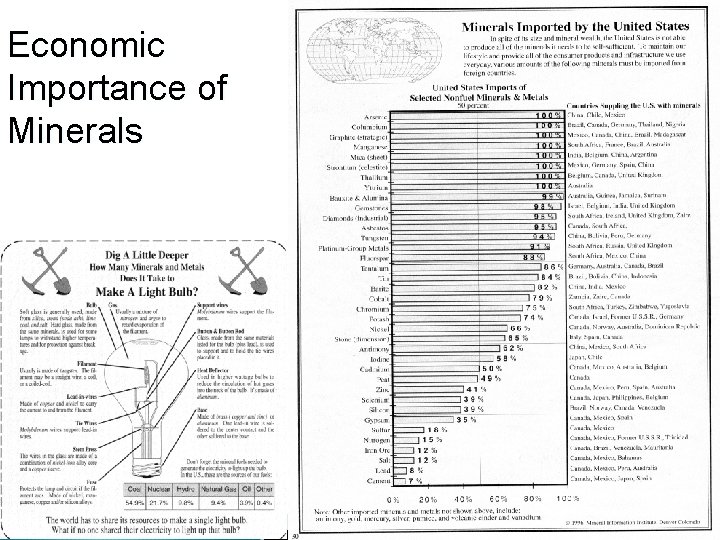
Economic Importance of Minerals
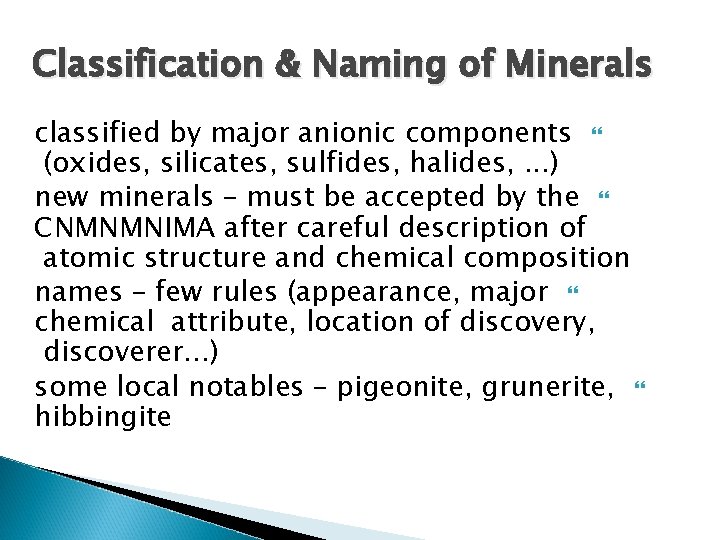
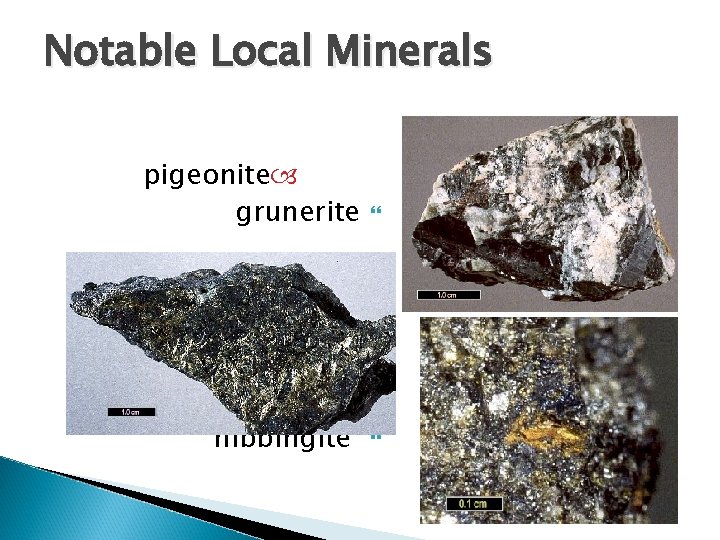
Classification & Naming of Minerals classified by major anionic components (oxides, silicates, sulfides, halides, . . . ) new minerals – must be accepted by the CNMNMNIMA after careful description of atomic structure and chemical composition names – few rules (appearance, major chemical attribute, location of discovery, discoverer. . . ) some local notables – pigeonite, grunerite, hibbingite
Notable Local Minerals pigeonite grunerite hibbingite
Next Lecture Crystal Chemistry I Composition of the Earth Structure of Atoms Elements and the Periodic Table Ions, Cations, Anions and Valence States Read