Intraoperative IsoC Carm navigation surgery for spinal and

- Slides: 20
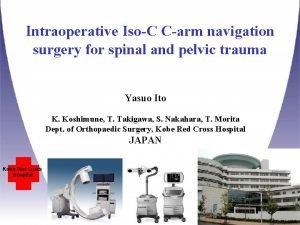
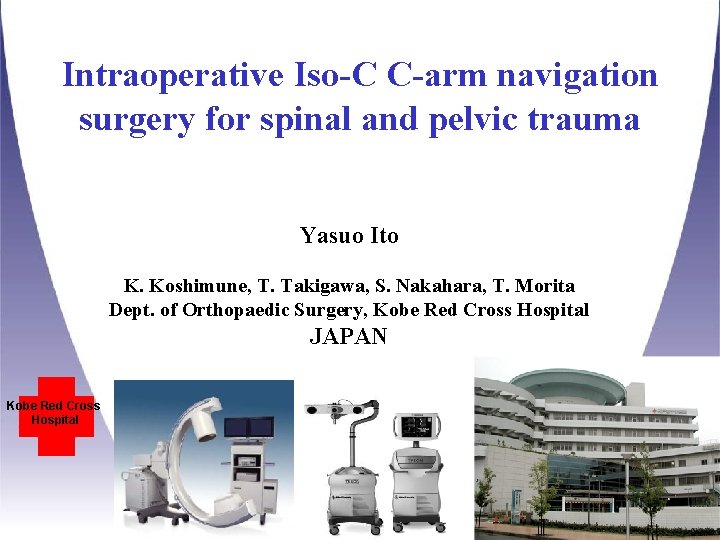
Intraoperative Iso-C C-arm navigation surgery for spinal and pelvic trauma Yasuo Ito K. Koshimune, T. Takigawa, S. Nakahara, T. Morita Dept. of Orthopaedic Surgery, Kobe Red Cross Hospital JAPAN Kobe Red Cross Hospital
Conflict of Interest • I (or a member of my immediate family) have not received anything of value from or stock in a commercial company or institution related directly or indirectly to the subject of this presentation. Disclosure information We (or a member of our immediate family) have not received anything of value from or stock in a commercial company or institution related directly or indirectly to the subject of this presentation. Kobe Red Cross Hospital
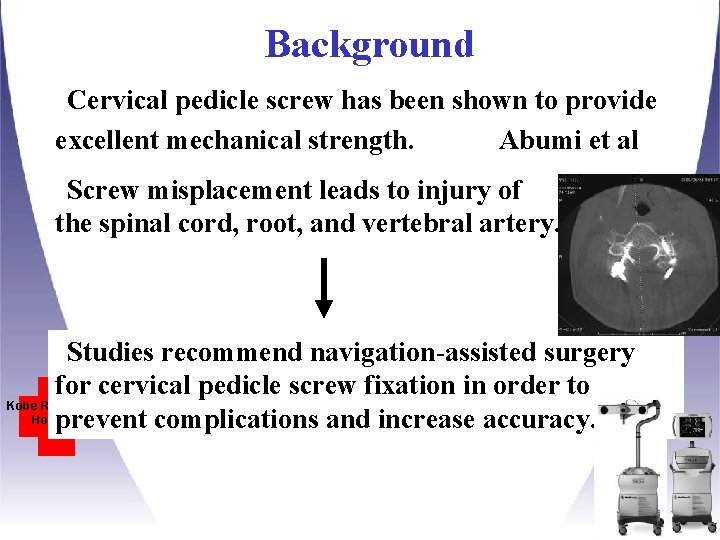
Background Cervical pedicle screw has been shown to provide excellent mechanical strength. Abumi et al Screw misplacement leads to injury of the spinal cord, root, and vertebral artery. Studies recommend navigation-assisted surgery for cervical pedicle screw fixation in order to Kobe Red Cross Hospital prevent complications and increase accuracy.
Limitations of conventional CT-based navigation system Special markers or anatomic landmarks are needed. Manual matching (registration) is subject to potential errors and time-consuming. Repeated and segmented registration must be needed for each vertebra. Kobe Red Cross Hospital Changes in the anatomy cannot be detected intraoperatively.
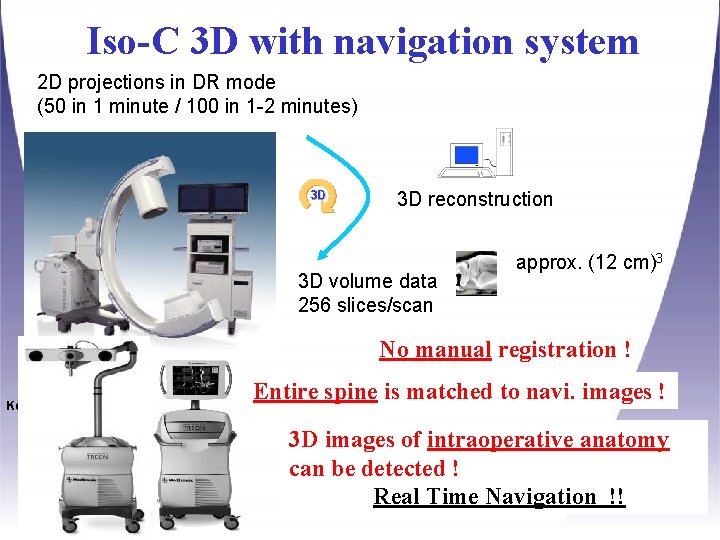
Iso-C 3 D with navigation system 2 D projections in DR mode (50 in 1 minute / 100 in 1 -2 minutes) 3 D reconstruction 3 D volume data 256 slices/scan approx. (12 cm)3 No manual registration ! Kobe Red Cross Hospital Entire spine is matched to navi. images ! 3 D images of intraoperative anatomy can be detected ! Real Time Navigation !!
Objectives To evaluate prospectively the accuracy, feasibility, advantages and applications of intra-operative Iso-C 3 D in cervical spinal surgery Kobe Red Cross Hospital
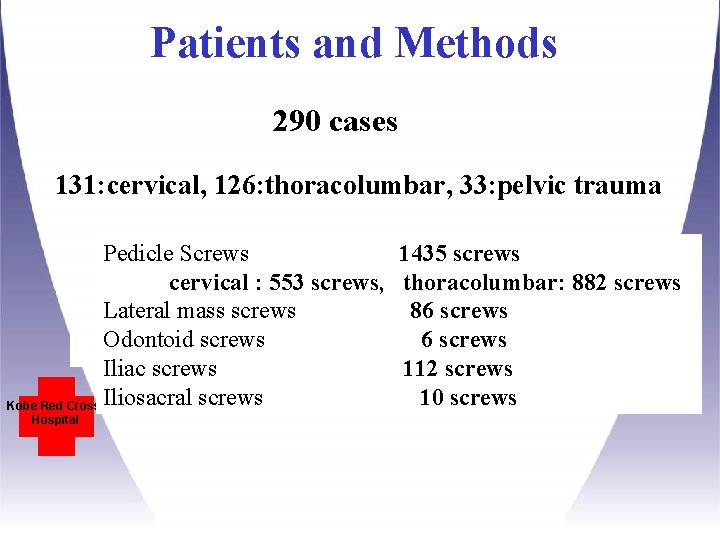
Patients and Methods 290 cases 131: cervical, 126: thoracolumbar, 33: pelvic trauma Pedicle Screws 1435 screws cervical : 553 screws, thoracolumbar: 882 screws Lateral mass screws 86 screws Odontoid screws 6 screws Iliac screws 112 screws 10 screws Kobe Red Cross Iliosacral screws Hospital
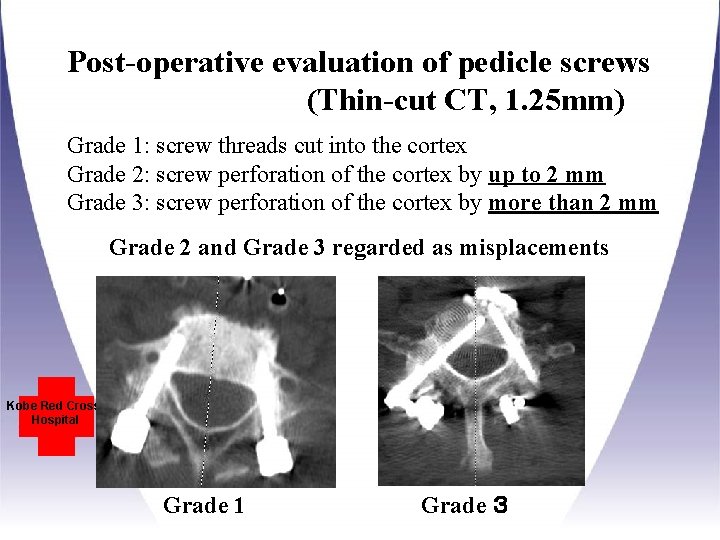
Post-operative evaluation of pedicle screws (Thin-cut CT, 1. 25 mm) Grade 1: screw threads cut into the cortex Grade 2: screw perforation of the cortex by up to 2 mm Grade 3: screw perforation of the cortex by more than 2 mm Grade 2 and Grade 3 regarded as misplacements Kobe Red Cross Hospital Grade 1 Grade 3
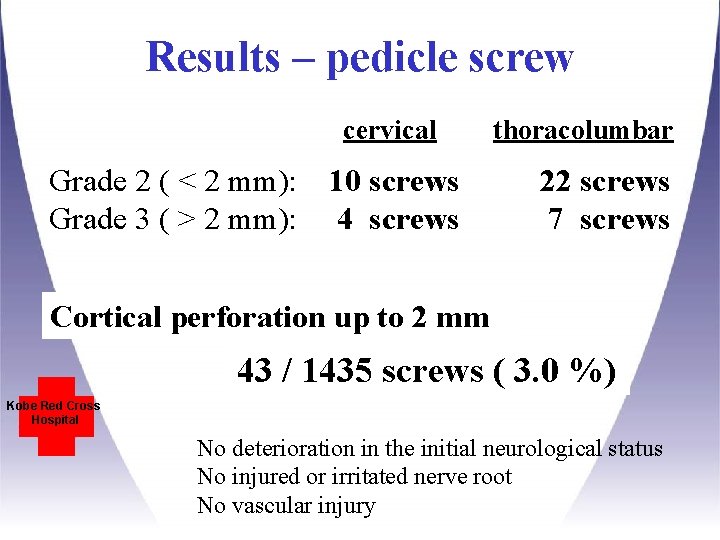
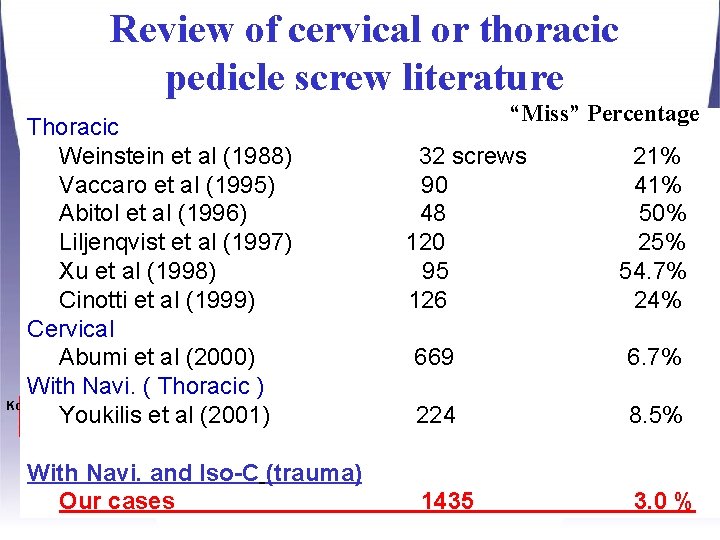
Results – pedicle screw cervical Grade 2 ( < 2 mm): Grade 3 ( > 2 mm): thoracolumbar 10 screws 4 screws 22 screws 7 screws Cortical perforation up to 2 mm 43 / 1435 screws ( 3. 0 %) Kobe Red Cross Hospital No deterioration in the initial neurological status No injured or irritated nerve root No vascular injury
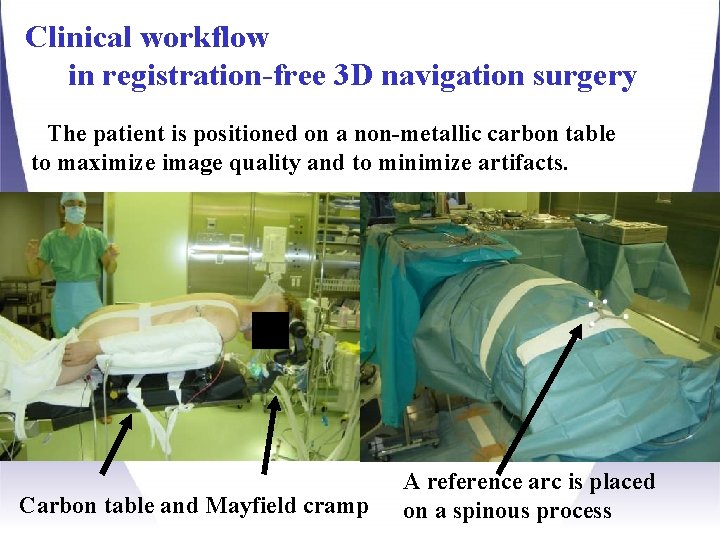
Clinical workflow in registration-free 3 D navigation surgery The patient is positioned on a non-metallic carbon table to maximize image quality and to minimize artifacts. Kobe Red Cross Hospital Carbon table and Mayfield cramp A reference arc is placed on a spinous process
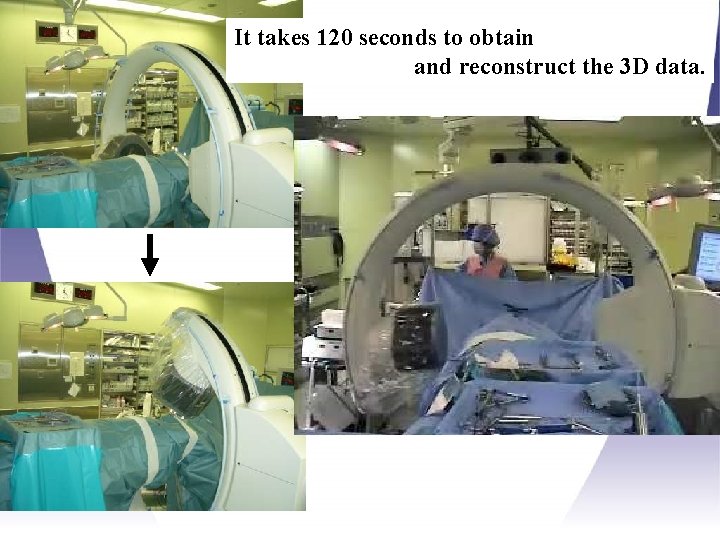
It takes 120 seconds to obtain and reconstruct the 3 D data. Kobe Red Cross Hospital
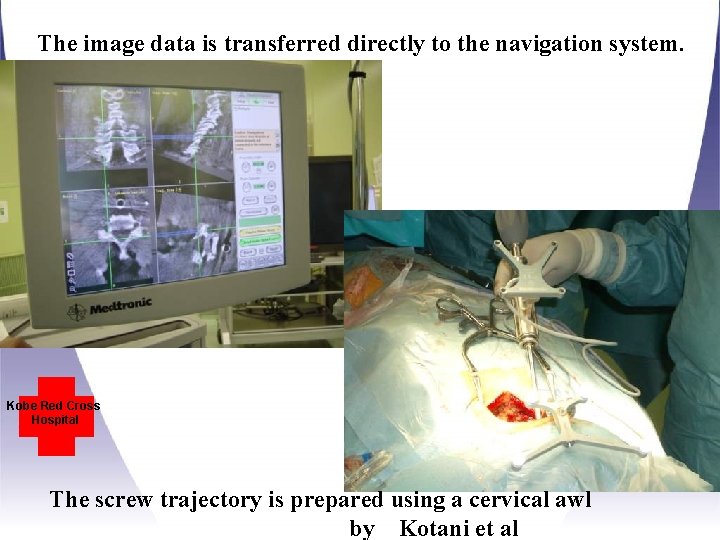
The image data is transferred directly to the navigation system. Kobe Red Cross Hospital The screw trajectory is prepared using a cervical awl by Kotani et al
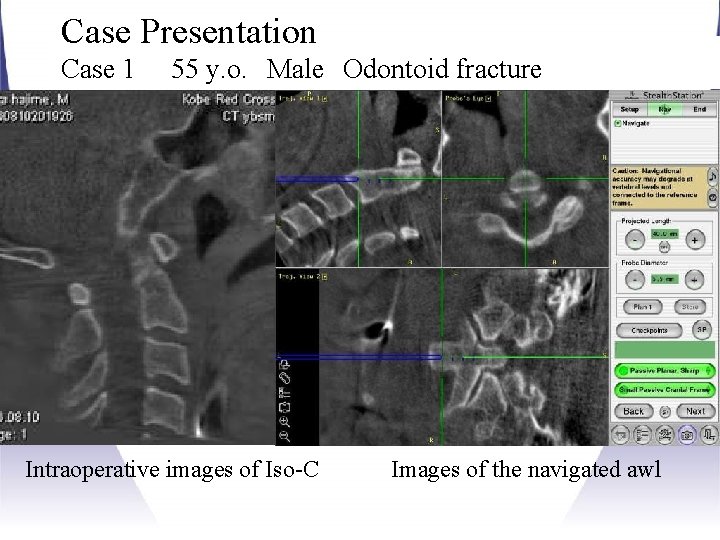
Case Presentation Case 1 55 y. o. Male Odontoid fracture Intraoperative images of Iso-C Images of the navigated awl
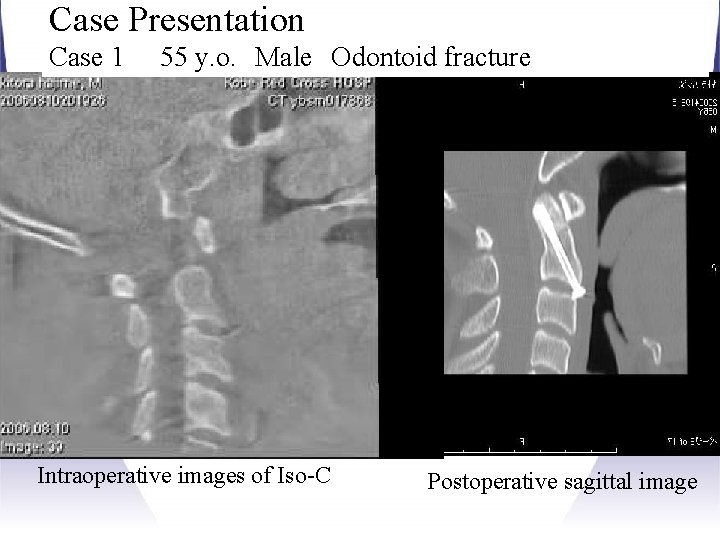
Case Presentation Case 1 55 y. o. Male Odontoid fracture Kobe Red Cross Hospital Intraoperative images of Iso-C Postoperative sagittal image
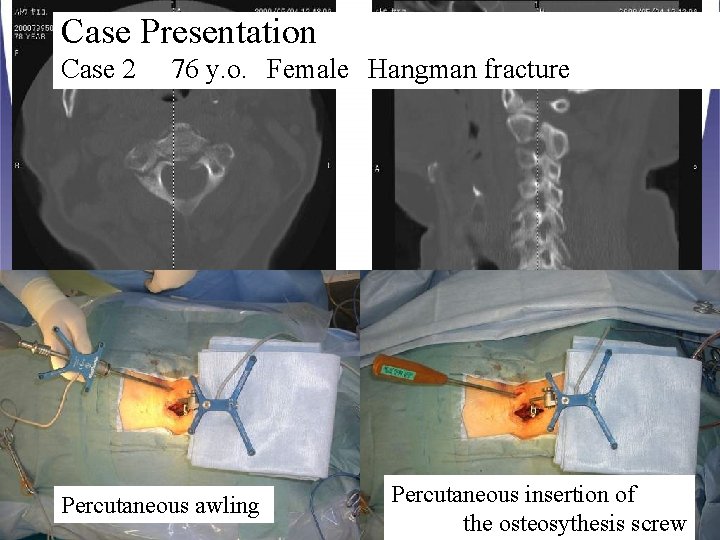
Case Presentation Case 2 76 y. o. Female Hangman fracture Percutaneous awling Percutaneous insertion of the osteosythesis screw
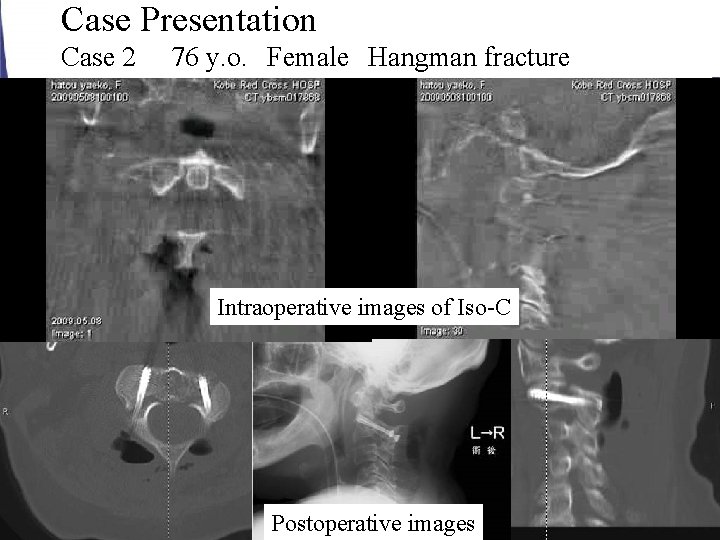
Case Presentation Case 2 76 y. o. Female Hangman fracture Intraoperative images of Iso-C Postoperative images
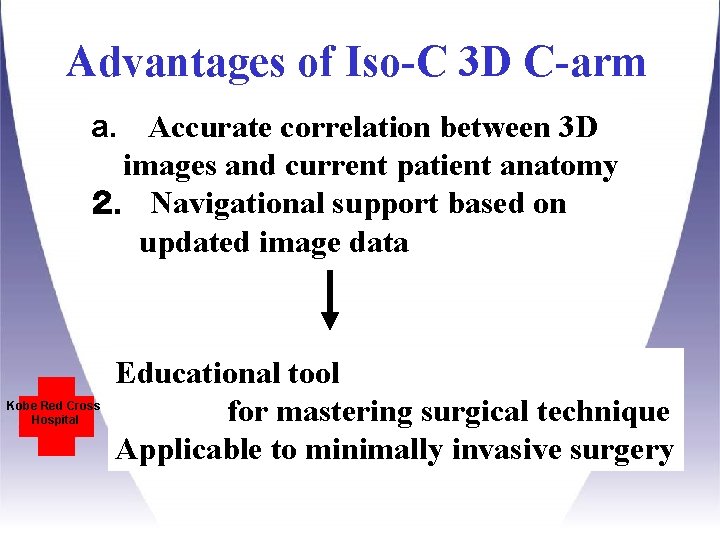
Advantages of Iso-C 3 D C-arm a. Accurate correlation between 3 D images and current patient anatomy 2. Navigational support based on updated image data Kobe Red Cross Hospital Educational tool for mastering surgical technique Applicable to minimally invasive surgery
Review of cervical or thoracic pedicle screw literature Thoracic Weinstein et al (1988) Vaccaro et al (1995) Abitol et al (1996) Liljenqvist et al (1997) Xu et al (1998) Cinotti et al (1999) Cervical Abumi et al (2000) With Navi. ( Thoracic ) Kobe Red Cross Youkilis et al (2001) Hospital “Miss” Percentage 32 screws 90 48 120 95 126 21% 41% 50% 25% 54. 7% 24% 669 6. 7% 224 8. 5% With Navi. and Iso-C (trauma) Our cases 1435 3. 0 %
Disadvantages and Pitfalls (Iso-C 3 D , navigation surgery) • Image quality • Cost Navigation system, Iso-C 3 D, Carbon bed, Mayfield headholder • Operating staff for navigation surgery • Mechanical or Human error Interference between reference arc and probe Kobe Red Cross Blurring of navigation images Hospital Eye movement between the operative field and monitor
Conclusions Registration-free navigation surgery with the Iso-C was successfully used in 100 consecutive initial patients with cervical lesions Intraoperative 3 D navigation showed significant advance in the safety and accuracy of operative procedures. This system will assist in performing truly minimally invasive surgeries. Kobe Red Cross Hospital