INTERNATIONAL MANAGEMENT Ph D Assistant Professor Radu FILIP


- Slides: 16
INTERNATIONAL MANAGEMENT Ph. D Assistant Professor Radu FILIP Bucharest Academy of Economic Studies Faculty of International Business and Economics 2011
Communication in International Management
Structure: 1. 2. 3. 4. Role of information in communication Dimensions of communication Process of international communication Efficiency of communication
1. Role of information in communication
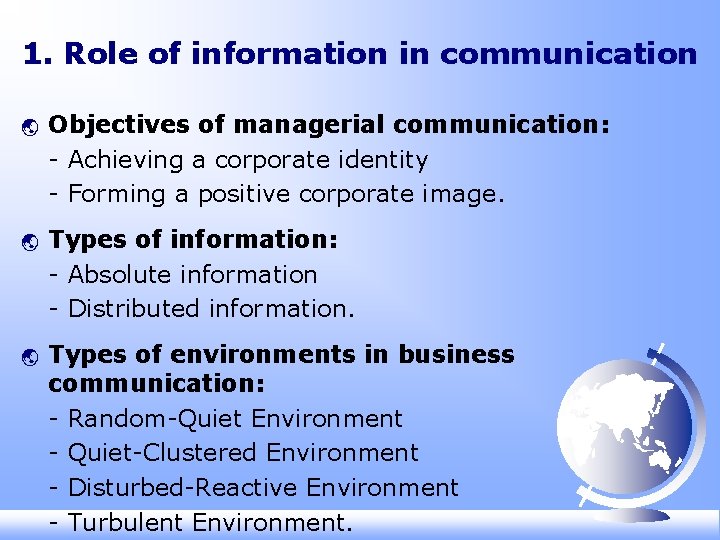
1. Role of information in communication ý ý ý Objectives of managerial communication: - Achieving a corporate identity - Forming a positive corporate image. Types of information: - Absolute information - Distributed information. Types of environments in business communication: - Random-Quiet Environment - Quiet-Clustered Environment - Disturbed-Reactive Environment - Turbulent Environment.
2. Dimensions of communication
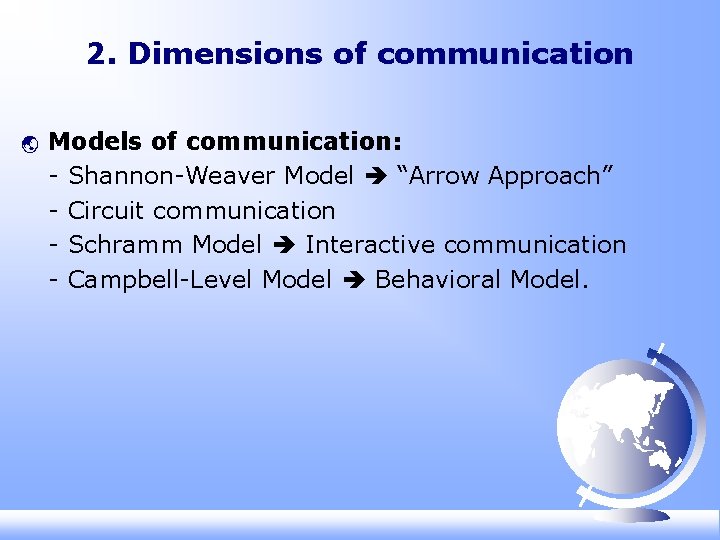
2. Dimensions of communication ý Models of communication: - Shannon-Weaver Model “Arrow Approach” - Circuit communication - Schramm Model Interactive communication - Campbell-Level Model Behavioral Model.
3. Process of international communication
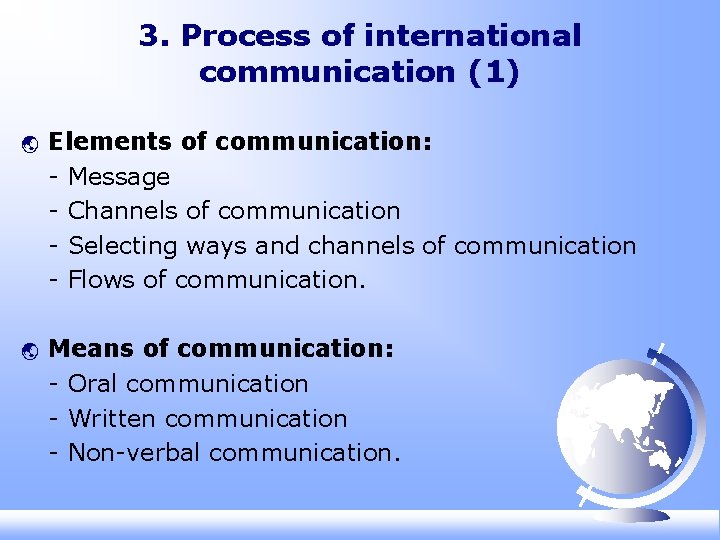
3. Process of international communication (1) ý ý Elements of communication: - Message - Channels of communication - Selecting ways and channels of communication - Flows of communication. Means of communication: - Oral communication - Written communication - Non-verbal communication.
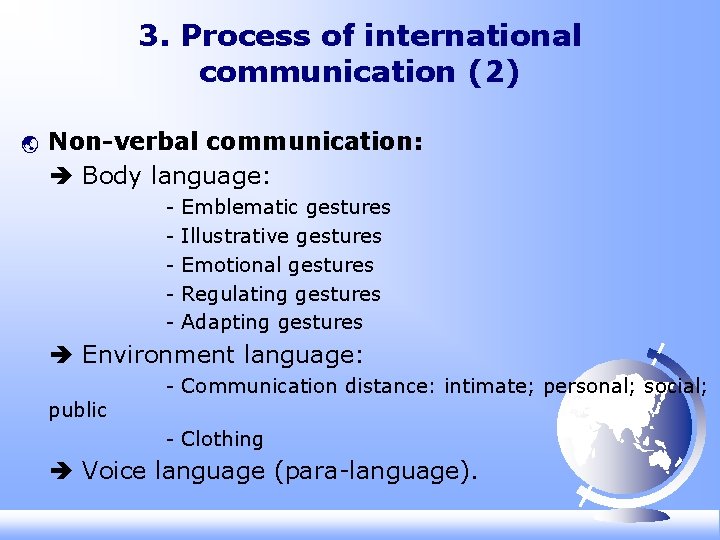
3. Process of international communication (2) ý Non-verbal communication: Body language: - Emblematic gestures Illustrative gestures Emotional gestures Regulating gestures Adapting gestures Environment language: public - Communication distance: intimate; personal; social; - Clothing Voice language (para-language).
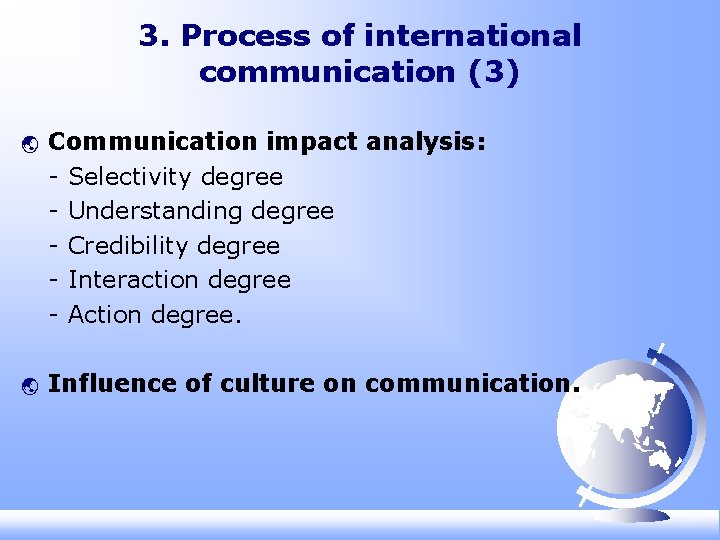
3. Process of international communication (3) ý ý Communication impact analysis: - Selectivity degree - Understanding degree - Credibility degree - Interaction degree - Action degree. Influence of culture on communication.
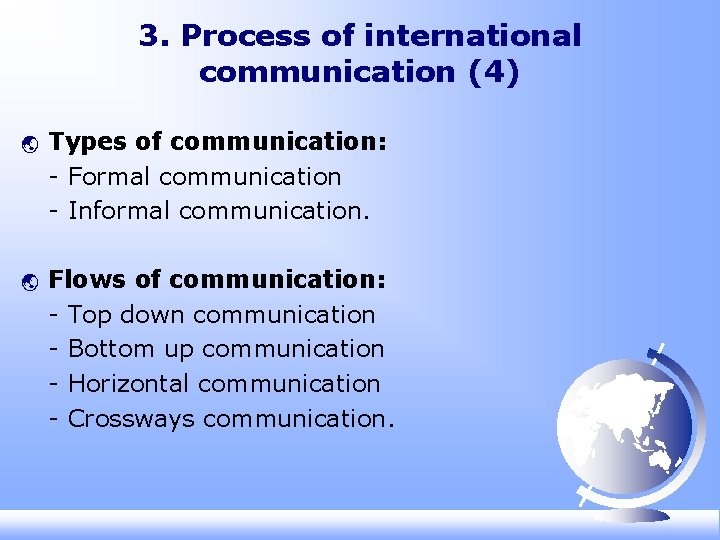
3. Process of international communication (4) ý ý Types of communication: - Formal communication - Informal communication. Flows of communication: - Top down communication - Bottom up communication - Horizontal communication - Crossways communication.
4. Efficiency of communication
4. Efficiency of communication (1) ý Barriers in communication: - Lack of communication strategy - Considering false premises - Information abundance - Lack of clarity and precision - Choosing an inappropriate communication channel - Risk of message distortion.
4. Efficiency of communication (2) ý Specific barriers in international communication: Language barriers Cultural barriers Perception barriers: - Stereotypes Halo effect Selective perception Projection.
Thank You!