Integrated Safety Management Peer Review Corrective Action Plan

- Slides: 20
Integrated Safety Management Peer Review Corrective Action Plan Howard K. Hatayama Director Environmental Health and Safety Division Presented to the LBNL Integrated Safety Management Systems Review Team August 9, 2006 1
“At a minimum, ES&H aspects that require special attention in this (Peer) review are: ” • Adequacy of administrative and engineering controls at the ALS • Adequacy of the laser safety program • Quality of Laboratory leadership regarding ES&H • Effectiveness of PI’s, middle managers, and first line supervisors as safety leaders and mentors • State of the “safety culture” at the Laboratory 2
LBNL Peer Reviewers • Reviewers – William A. Bookless, Chair ~ LLNL – John Cornuelle ~ SLAC – Dennis Derkacs ~ LANL – Tom Dickinson ~ NSLS – Brookhaven Laboratory – George Goode ~ Brookhaven Laboratory – James Johnson, Jr. ~ Howard University – Jim Smathers ~ UCLA • Three DOE Observers – W. Earl Carnes ~ DOE Headquarters – Ted Pietrok ~ PNSO – Carol Ingram ~ BSO 3
In summary, the Peer Review found…… • LBNL ISM system is sound with many strengths • Laboratory staff were very open and frank, not inhibited by DOE observers • Fear of reporting incidents noted at all levels • Need to ensure more consistent implementation and communication from top to bottom and across divisions • Principle Investigators are the most vulnerable link in the line management chain • Work planning and control should be more comprehensive and consistently implemented • The LBNL “safety culture” is generally sound 4
Corrective Action Plan Development Process • CAP Development Team - Line and support organizations • Plan development process – Extent of condition/backlook review – Root cause analysis – Corrective actions development • Interim actions implemented while CAP was developed 5
Extent of Condition/Backlook: Assessments and Reports Reviewed 2006 – Report of the RSC Sub-committee to Investigate and Review ALS Shielding Control Procedures, January – Berkeley Lab FY 05 50 OSHA Recordable Cases: Root Causes and Lessons, January 2005 – Crane, Hoist, Rigging & Forklift Safety Program Assessment, October – Causal Analysis of 15 Electrical Incidents that Occurred at Berkeley Lab from July 2002 to June 2005, October – Building 58 Electrical Near Miss Accident: Status Report on Corrective Actions, September – LBNL Building 58 Electrical Safety Event, June – LBNL Electrical Safety Self-Assessment, April 2003 – Laser Safety Program Review Panel Report, July 6
Root Cause Analysis identified corrective actions needed in 5 general categories 1. Line management (LM) execution of ES&H 2. ES&H assurance mechanisms 3. Educating managers, supervisors and division safety coordinators (SCs) 4. Proactive posture on ES&H 5. Lab-wide work control program 7
Line Management Execution of ES&H What are we fixing? • Responsibility for safety is not clearly defined below the principle investigator/staff scientist • Excessive span of control makes working safely a challenge How are we fixing it? • Define safety management responsibilities for lead post-docs and graduate students • Increase frequency of management walkarounds • Incorporate changes in Lab policies and procedures 8
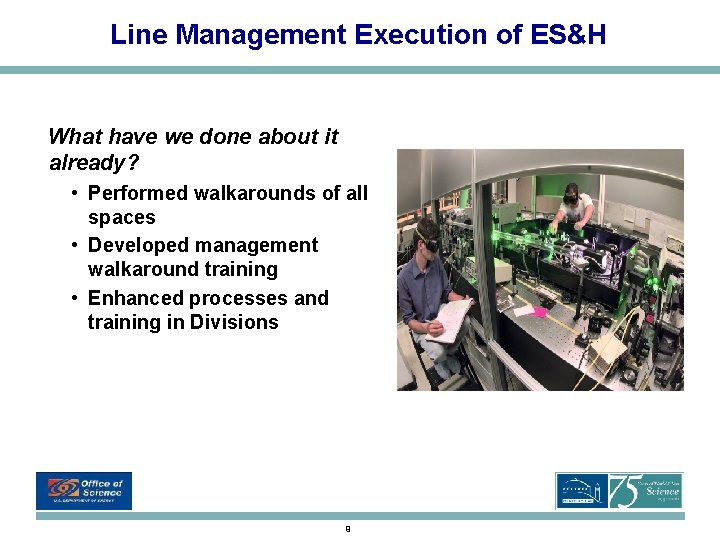
Line Management Execution of ES&H What have we done about it already? • Performed walkarounds of all spaces • Developed management walkaround training • Enhanced processes and training in Divisions 9
ES&H Assurance Mechanisms What are we fixing? • Weakened ES&H technical program assurance • Ability of assurance systems to identify weakness in execution of ES&H How are we fixing it? • Establish current baseline of ES&H assurance and re-build • Review effectiveness of walkarounds, Integrated Functional Appraisal (IFA) and Management ES&H Review (MESH) and revise criteria • Revise partnership agreement with UCB regarding ES&H 10
ES&H Assurance Mechanisms Lawrence Berkeley National Laboratory 2006 Integrated Functional Appraisal What have we done about it already? • Revised FY 06 IFA and MESH criteria • Revised division Self Assessment criteria for 2006 -07 assessment year 11
Educating Managers, Supervisors, and Coordinators What are we fixing? • Current safety oversight training for managers, supervisors, post-docs and graduate students needs to be aligned with roles and responsibilities • Roles, responsibilities, minimum qualifications and training requirements for Safety Coordinators How are we fixing it? • Enhance mentoring, safety awareness and training of post-docs and graduate students • Refine walkaround training based on formal requirements and feedback from initial roll-out • Evaluate Safety Coordinator program and revise 12
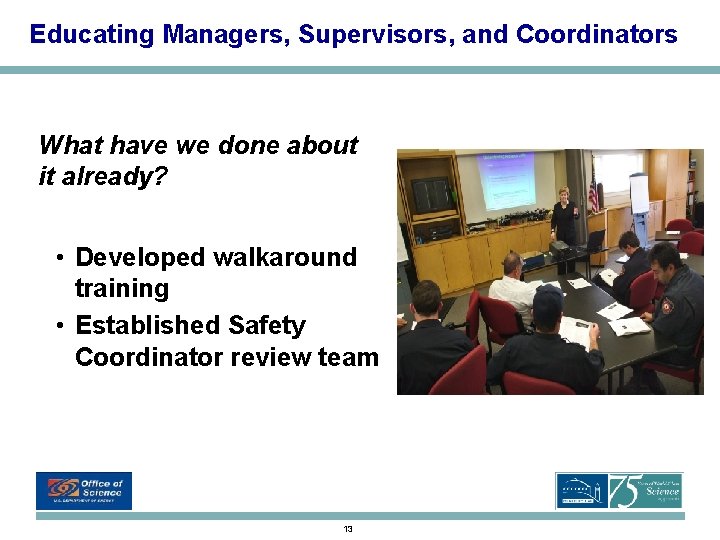
Educating Managers, Supervisors, and Coordinators What have we done about it already? • Developed walkaround training • Established Safety Coordinator review team 13
Proactive Posture on ES&H What are we fixing? • Cultural attitudes towards risk-taking and ES&H risk management • Fear and anxiety related to incident reporting How are we fixing it? • Develop an enhanced communications strategy focused on: quality of work and concern for ES&H • Revise ISM plans, PRDs, and training for line managers to identify and mitigate ES&H risks • Re-orient response away from blame and towards staff safety, lessons learned and preventative measures • Communications to encourage incident reporting 14
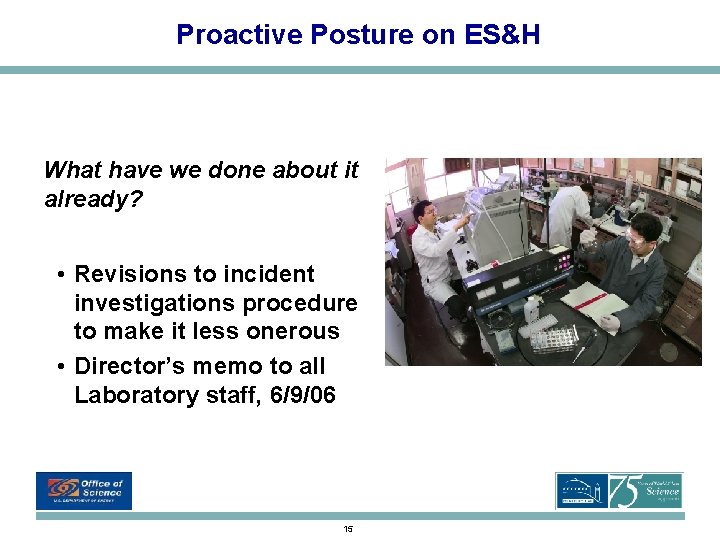
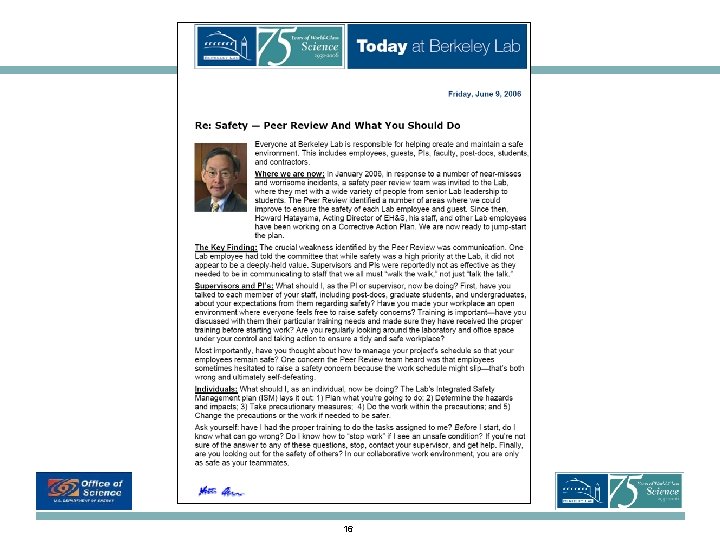
Proactive Posture on ES&H What have we done about it already? • Revisions to incident investigations procedure to make it less onerous • Director’s memo to all Laboratory staff, 6/9/06 15
16
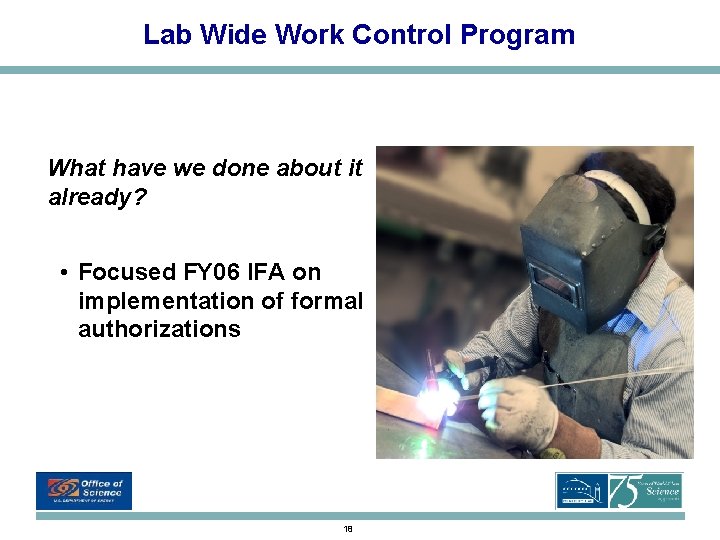
Lab Wide Work Control Program What are we fixing? • Managing of changes-people/equipment/scope • Informality in line management authorized work How are we fixing it? • Complete transition of AHDs to electronic and review effectiveness • Formalize policy and procedures for lesser hazards • Review/revise hazard identification policies for facilities, sub-contractors, and vendors • Develop methods to ensure implementation of AHDs 17
Lab Wide Work Control Program What have we done about it already? • Focused FY 06 IFA on implementation of formal authorizations 18
Current Status and Next Steps • Interim actions incorporated into CAP • Teams and Lead for CAP tasks identified • Establish Change Control Board • Follow-up on DOE Validation Team recommendations • Integrate ISM External Review recommendations into CAP • Implement and close-out corrective actions • Validation and on-going assurance 19
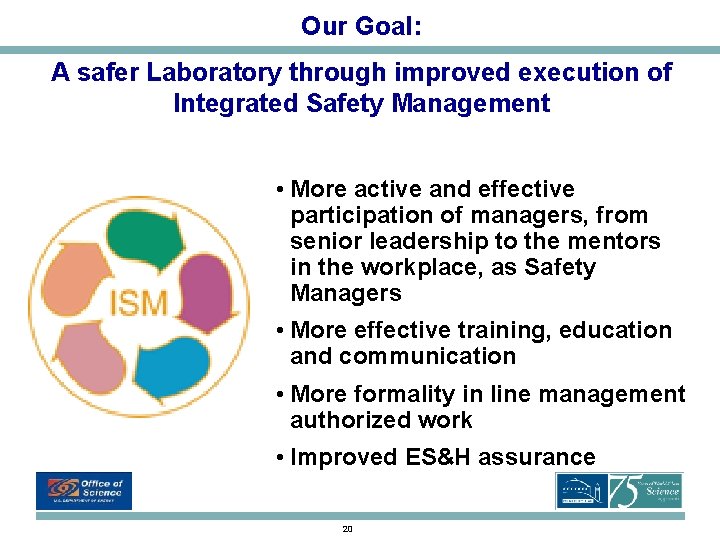
Our Goal: A safer Laboratory through improved execution of Integrated Safety Management • More active and effective participation of managers, from senior leadership to the mentors in the workplace, as Safety Managers • More effective training, education and communication • More formality in line management authorized work • Improved ES&H assurance 20