INFORMATIVE ASSESSMENT August 2011 Are You ASSESSMENT SAVVY



- Slides: 29
(IN)FORMATIVE ASSESSMENT August 2011
Are You… ASSESSMENT SAVVY? n Skilled in gathering accurate information about students learning? n Using it effectively to promote further learning?
Workshop Objectives Understand the various reasons as to why assessment is essential in teaching/learning n Describe 3 types of assessments and identify the purpose of each (why) n Identify assessment targets (what) n Explain various methods of assessment (how) n Apply assessment information to current teaching experience
HOW DO YOU ASSESS? List some ways you typically assess students in your classroom. 1. 2. 3. 4.
WHEN DO YOU ASSESS? Traditionally, teachers have assessed students at the end of an instructional unit or sequence. However, when assessment and instruction are interwoven, both the students and the teacher benefit.
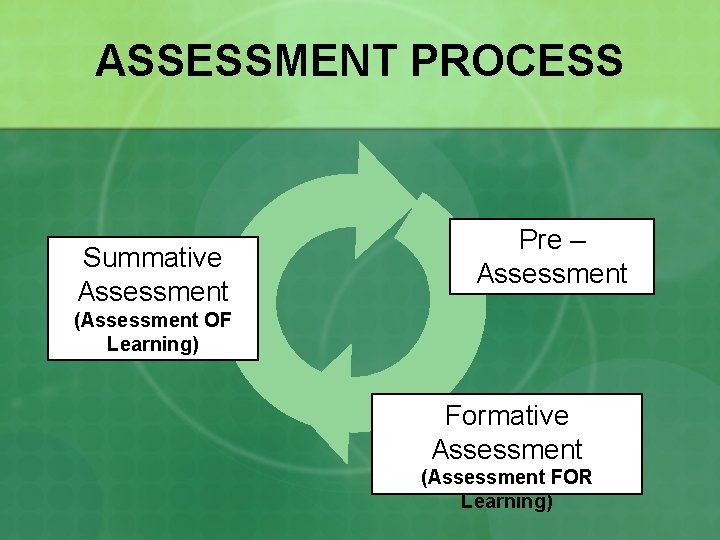
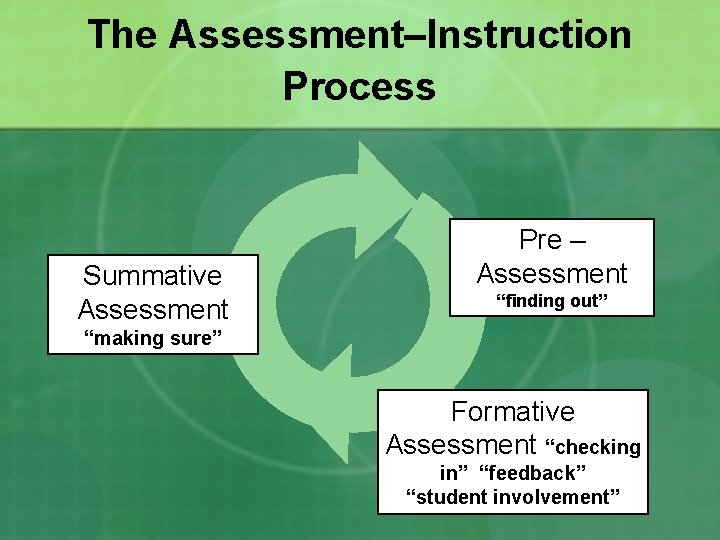
ASSESSMENT PROCESS Summative Assessment Pre – Assessment (Assessment OF Learning) Formative Assessment (Assessment FOR Learning)
PRE-ASSESSMENT n The purpose of pre-assessment is to determine what students know about a topic before it is taught. n Pre-assessment will help the teacher determine flexible grouping patterns and should be used regularly.
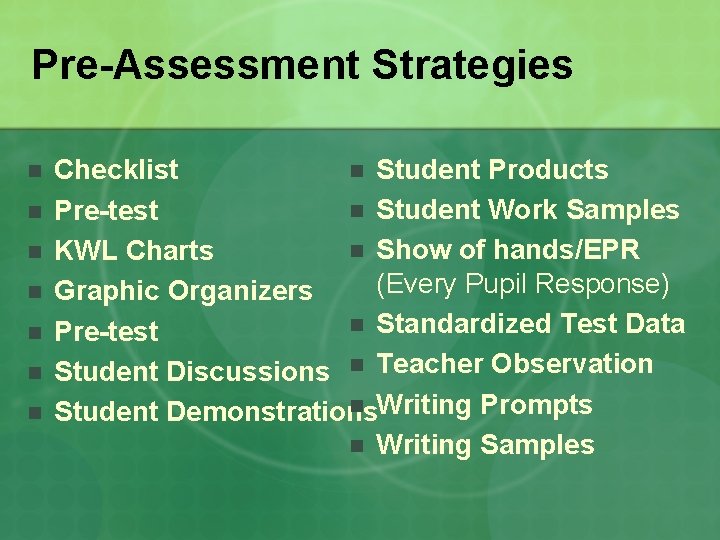
Pre-Assessment Strategies n n n n Student Products Checklist n Student Work Samples Pre-test n Show of hands/EPR KWL Charts (Every Pupil Response) Graphic Organizers n Standardized Test Data Pre-test Student Discussions n Teacher Observation n Writing Prompts Student Demonstrations n Writing Samples
FORMATIVE ASSESSMENT Assessments FOR learning happens while learning is still underway. These are assessments that: n are conducted throughout teaching and n n n learning to diagnose student needs plan the next steps in instruction provide students with feedback they can use to improve the quality of their work help students see and feel how they are in control of their journey to success
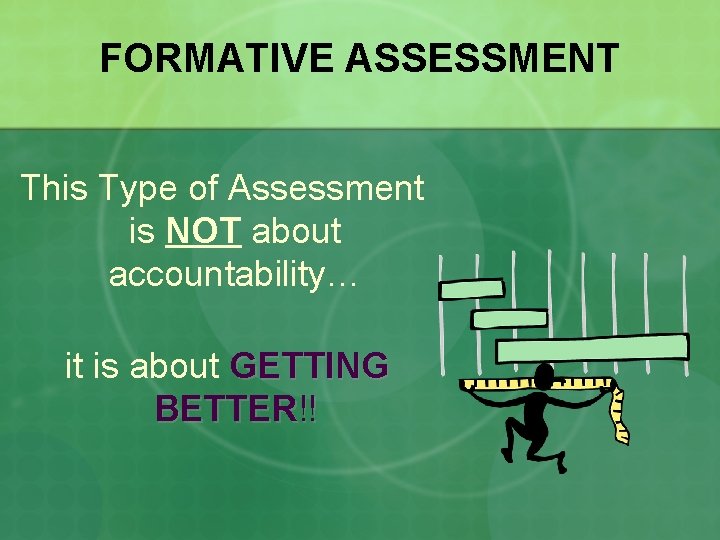
FORMATIVE ASSESSMENT This Type of Assessment is NOT about accountability… it is about GETTING BETTER!!
FORMATIVE ASSESSMENT Seven Strategies Where am I going? 1. Provide a clear and understandable vision of the learning target
What Can Be Assessed? ACHIEVEMENT TARGETS Knowledge Mastery Reasoning Proficiency Performance Skills Ability to Create Products
FORMATIVE ASSESSMENT Seven Strategies Where am I going? 1. Provide a clear and understandable vision of the learning target 2. Use examples and models of strong and weak work
FORMATIVE ASSESSMENT Seven Strategies Where am I now? 3. Offer regular descriptive feedback. 4. Teach students to self-assess and set goals.
FORMATIVE ASSESSMENT Seven Strategies How can I close the gap? ? 5. Design lessons to focus on one aspect of quality at a time. 6. Teach students focused revision. 7. Engage students in self-reflection, and let them keep track of and share their learning.
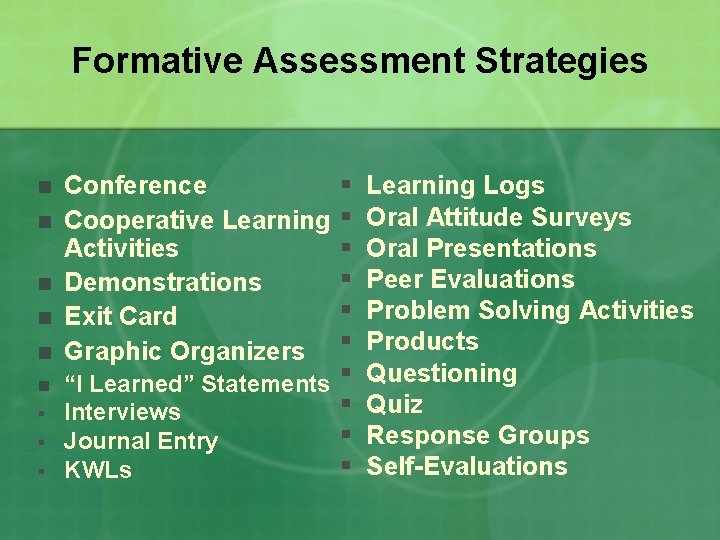
Formative Assessment Strategies n n n § § § § § “I Learned” Statements § § Interviews § Journal Entry § KWLs Conference Cooperative Learning Activities Demonstrations Exit Card Graphic Organizers Learning Logs Oral Attitude Surveys Oral Presentations Peer Evaluations Problem Solving Activities Products Questioning Quiz Response Groups Self-Evaluations
SUMMATIVE ASSESSMENT This type of assessment is a successful end product and/or the fulfilling of the pre -stated objective.
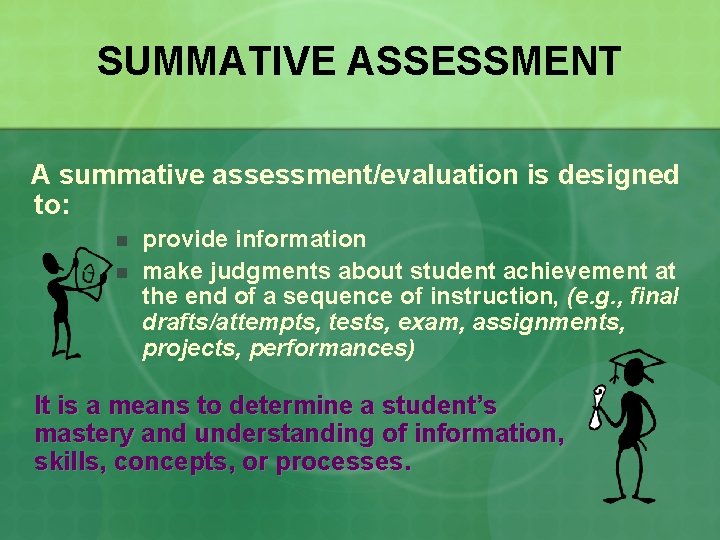
SUMMATIVE ASSESSMENT A summative assessment/evaluation is designed to: n n provide information make judgments about student achievement at the end of a sequence of instruction, (e. g. , final drafts/attempts, tests, exam, assignments, projects, performances) It is a means to determine a student’s mastery and understanding of information, skills, concepts, or processes.
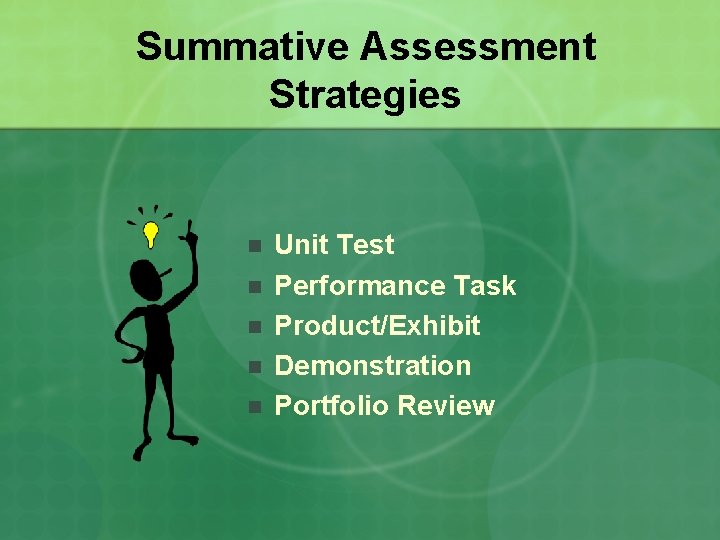
Summative Assessment Strategies n n n Unit Test Performance Task Product/Exhibit Demonstration Portfolio Review
The Assessment–Instruction Process Summative Assessment Pre – Assessment “finding out” “making sure” Formative Assessment “checking in” “feedback” “student involvement”
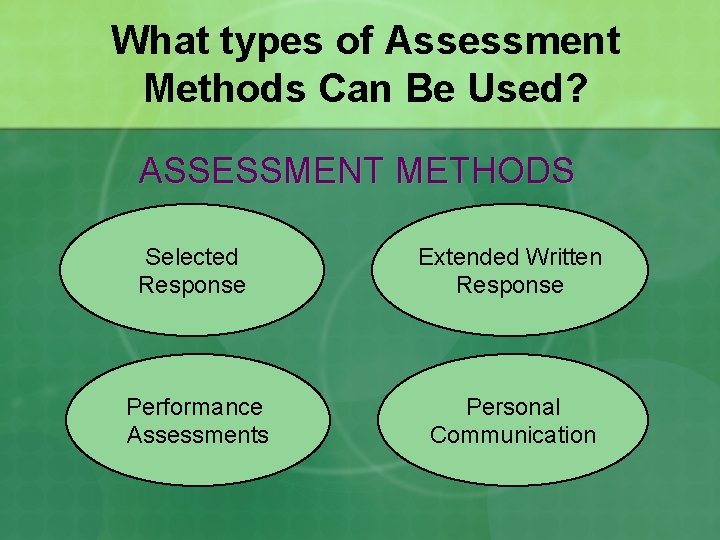
What types of Assessment Methods Can Be Used? ASSESSMENT METHODS Selected Response Extended Written Response Performance Assessments Personal Communication
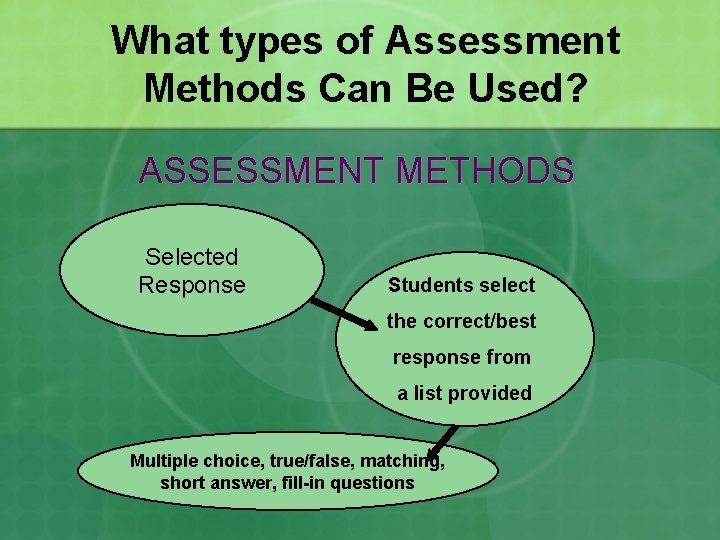
What types of Assessment Methods Can Be Used? ASSESSMENT METHODS Selected Response Students select the correct/best response from a list provided Multiple choice, true/false, matching, short answer, fill-in questions
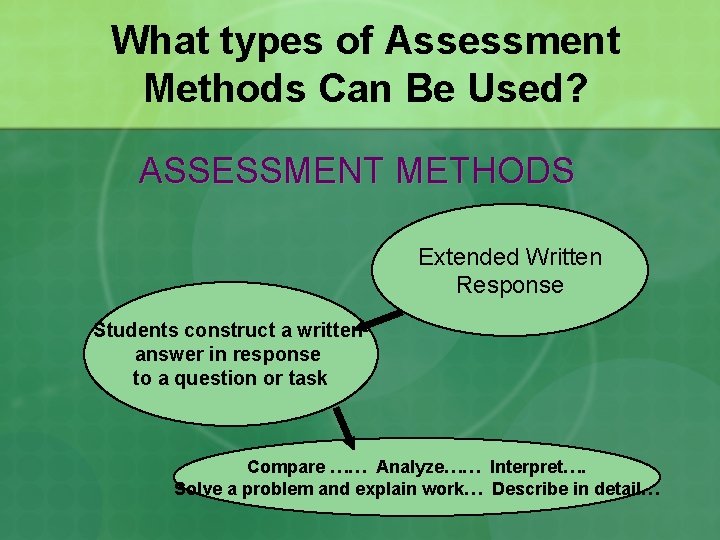
What types of Assessment Methods Can Be Used? ASSESSMENT METHODS Extended Written Response Students construct a written answer in response to a question or task Compare …… Analyze…… Interpret…. Solve a problem and explain work… Describe in detail…
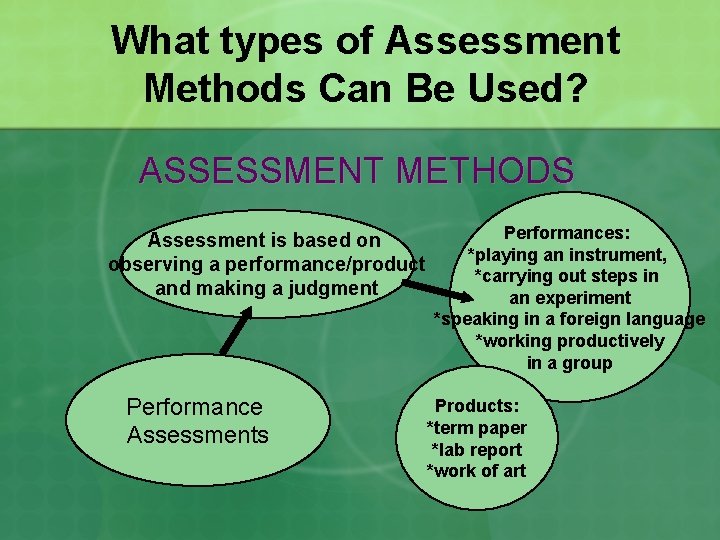
What types of Assessment Methods Can Be Used? ASSESSMENT METHODS Assessment is based on observing a performance/product and making a judgment Performance Assessments Performances: *playing an instrument, *carrying out steps in an experiment *speaking in a foreign language *working productively in a group Products: *term paper *lab report *work of art
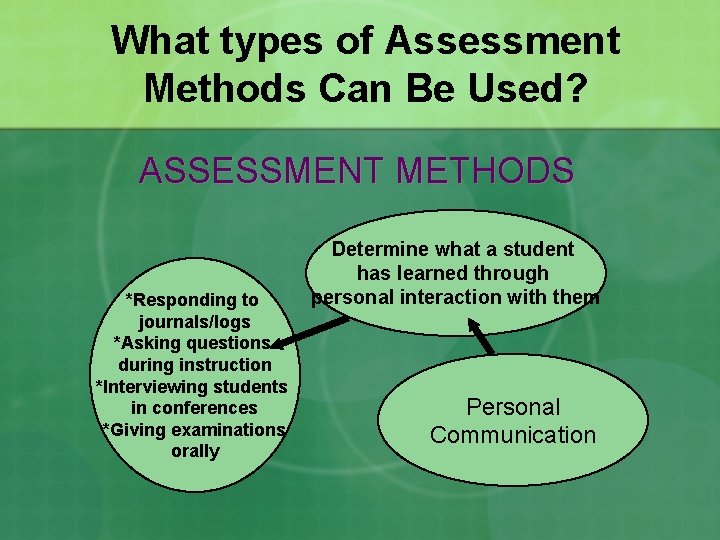
What types of Assessment Methods Can Be Used? ASSESSMENT METHODS *Responding to journals/logs *Asking questions during instruction *Interviewing students in conferences *Giving examinations orally Determine what a student has learned through personal interaction with them Personal Communication
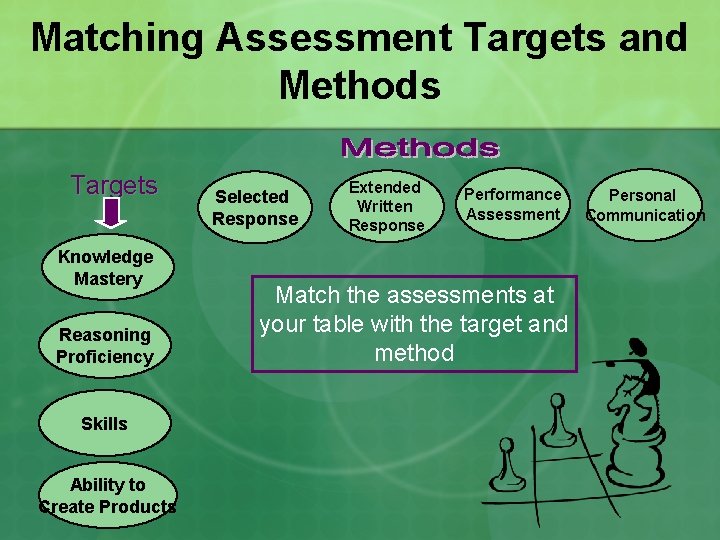
Matching Assessment Targets and Methods Targets Knowledge Mastery Reasoning Proficiency Skills Ability to Create Products Selected Response Extended Written Response Performance Assessment Match the assessments at your table with the target and method Personal Communication
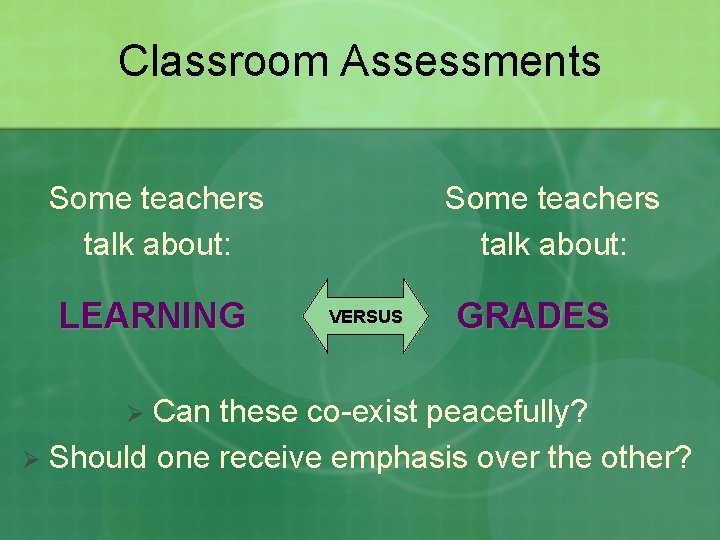
Classroom Assessments Some teachers talk about: LEARNING Some teachers talk about: VERSUS GRADES Can these co-exist peacefully? Ø Should one receive emphasis over the other? Ø
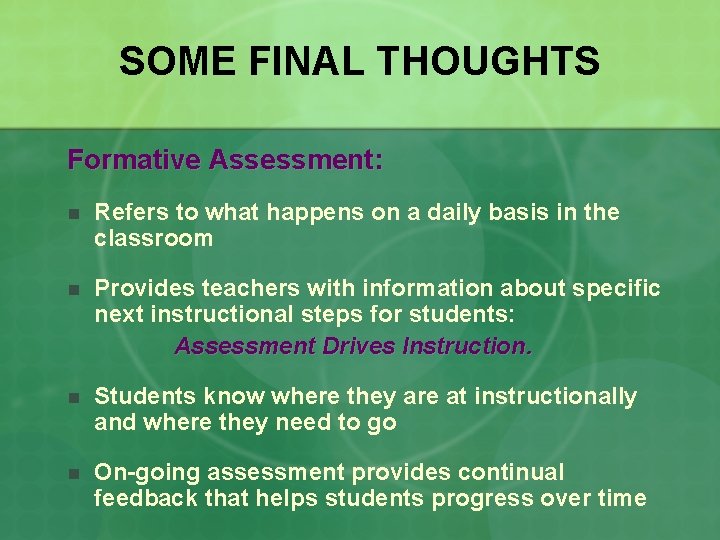
SOME FINAL THOUGHTS Formative Assessment: n Refers to what happens on a daily basis in the classroom n Provides teachers with information about specific next instructional steps for students: Assessment Drives Instruction. n Students know where they are at instructionally and where they need to go n On-going assessment provides continual feedback that helps students progress over time
(IN)FORMATIVE ASSESSMENT