Industrial Wastes Challenges and Issues Ravi Agarwal 30
- Slides: 11
Industrial Wastes Challenges and Issues Ravi Agarwal 30 th. June , 2016 ASSOCHAM
Industrial Wastes and Categories • As such there is no such standard definition of industrial waste • Industrial waste refers to the solid, liquid and gaseous emissions, residual and unwanted wastes from an industrial operation Industrial wastes could be classified into two types. • Hazardous industrial waste • Non-hazardous industrial waste 30 th. June , 2016 ASSOCHAM
Hazardous Industrial Waste • Hazardous wastes, which may be in solid, liquid or gaseous form, may cause danger to health or environment, either alone or when in contact with other wastes • Over 6. 2 million tonnes annually • It is presumed that about 10 to 15 percent of wastes produced by industries are hazardous • Generation of hazardous wastes is increasing at the rate of 2 to 5 percent per year • 141 dumpsites identified and 88 critically polluted areas. 30 th. June , 2016 ASSOCHAM
Hazardous Waste Generation: India • Hazardous Waste Generating Industries in India - 36, 165 nos. • Hazardous Waste Generation - 62, 32, 507 MTA • The category-wise classification of this quantity is Ø Land Fillable HW – 27, 28, 326 MTA Ø Incinerable HW - 4, 15, 794 MTA Ø Recyclable HW - 30, 88, 387 MTA • The Indian industrial sector generates an estimated 100 Million Tonnes per year of solid wastes, with coal ash from thermal power stations accounting for more than 70 million tons/year Source – - National Inventory of Hazardous Wastes Generating Industries & Hazardous Waste Management in India Feb 2009 - http: //ebtc. eu/pdf/111031_SNA_Snapshot_Waste-management-in-India. pdf 30 th. June , 2016 ASSOCHAM
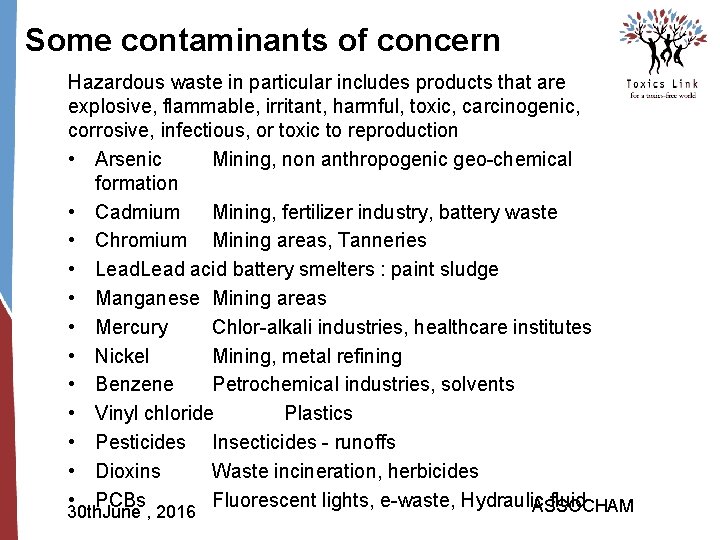
Some contaminants of concern Hazardous waste in particular includes products that are explosive, flammable, irritant, harmful, toxic, carcinogenic, corrosive, infectious, or toxic to reproduction • Arsenic Mining, non anthropogenic geo-chemical formation • Cadmium Mining, fertilizer industry, battery waste • Chromium Mining areas, Tanneries • Lead acid battery smelters : paint sludge • Manganese Mining areas • Mercury Chlor-alkali industries, healthcare institutes • Nickel Mining, metal refining • Benzene Petrochemical industries, solvents • Vinyl chloride Plastics • Pesticides Insecticides - runoffs • Dioxins Waste incineration, herbicides • PCBs Fluorescent lights, e-waste, Hydraulic fluid ASSOCHAM 30 th. June , 2016
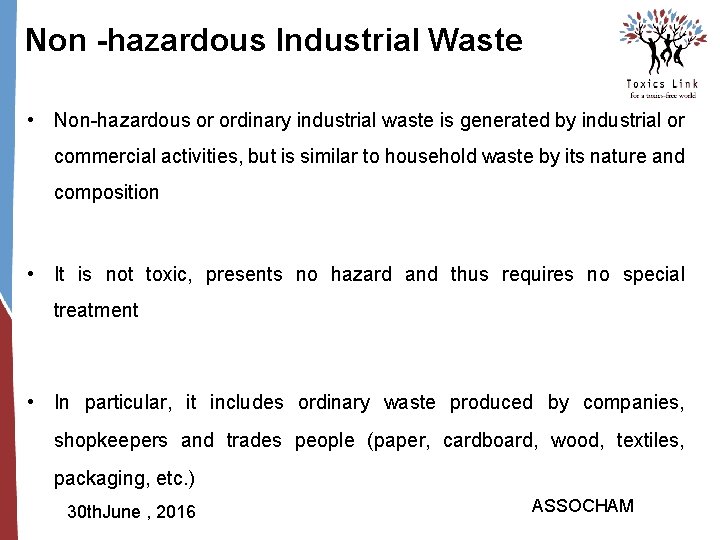
Non -hazardous Industrial Waste • Non-hazardous or ordinary industrial waste is generated by industrial or commercial activities, but is similar to household waste by its nature and composition • It is not toxic, presents no hazard and thus requires no special treatment • In particular, it includes ordinary waste produced by companies, shopkeepers and trades people (paper, cardboard, wood, textiles, packaging, etc. ) 30 th. June , 2016 ASSOCHAM
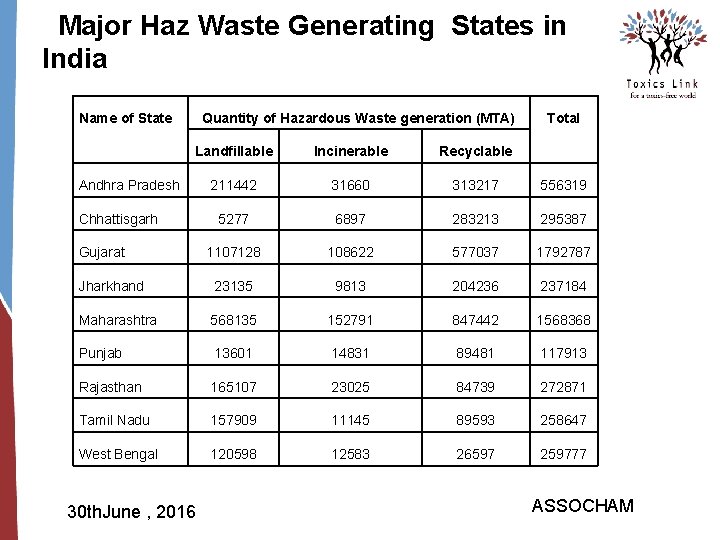
Major Haz Waste Generating States in India Name of State Quantity of Hazardous Waste generation (MTA) Total Landfillable Incinerable Recyclable 211442 31660 313217 556319 5277 6897 283213 295387 1107128 108622 577037 1792787 Jharkhand 23135 9813 204236 237184 Maharashtra 568135 152791 847442 1568368 Punjab 13601 14831 89481 117913 Rajasthan 165107 23025 84739 272871 Tamil Nadu 157909 11145 89593 258647 West Bengal 120598 12583 26597 259777 Andhra Pradesh Chhattisgarh Gujarat 30 th. June , 2016 ASSOCHAM
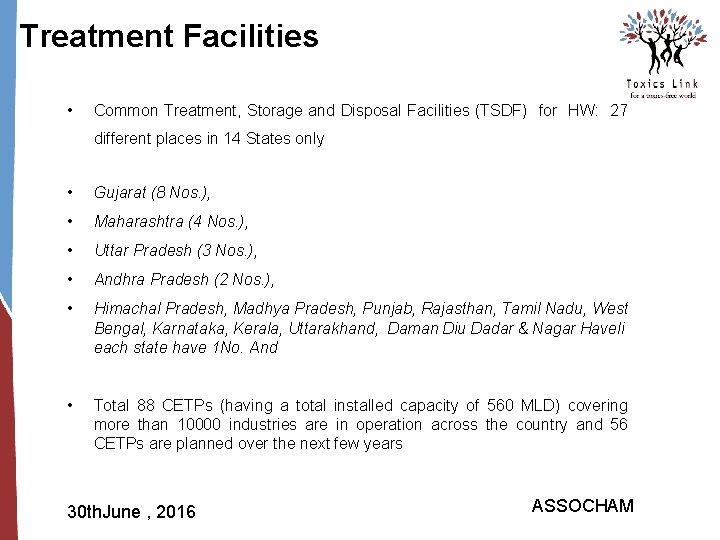
Treatment Facilities • Common Treatment, Storage and Disposal Facilities (TSDF) for HW: 27 different places in 14 States only • Gujarat (8 Nos. ), • Maharashtra (4 Nos. ), • Uttar Pradesh (3 Nos. ), • Andhra Pradesh (2 Nos. ), • Himachal Pradesh, Madhya Pradesh, Punjab, Rajasthan, Tamil Nadu, West Bengal, Karnataka, Kerala, Uttarakhand, Daman Diu Dadar & Nagar Haveli each state have 1 No. And • Total 88 CETPs (having a total installed capacity of 560 MLD) covering more than 10000 industries are in operation across the country and 56 CETPs are planned over the next few years 30 th. June , 2016 ASSOCHAM
Salient Features Hazardous and Other Wastes (Management and Transboundary) Rules, 2016 (India is also signatory to Basel, Stockholm and Rotterdam Conventions) • In the revised rules other waste has been added • The new Hazardous Waste Rules focus on resource recovery and disposal of hazardous waste in environmentally sound manner • The occupier will follow prevention, minimization, reuse, recycling, recovery, utilization including co-processing and safe disposal of hazardous and other wastes • Will provide specific information for safe storage and disposal to TSDF facility operator • The occupier will provide appropriate training, equipment to the person working in and the information necessary to ensure their safety • The Ministry of Environment, Forest and Climate Change or the Central Pollution Control Board may issue guidelines or standard operating procedures for environmentally sound management of hazardous and other wastes from time to time 30 th. June , 2016 ASSOCHAM
Additional Issues • Small and medium industries pose special challenges (over 3 million mt per anum) • Coastal dumping • Legal and quasi-legal imports • Radioactive wastes • Overall paucity of health related data. • Infrastructure 30 th. June , 2016 ASSOCHAM
Way ahead • Good inventorisation • Reduce, reuse, recycle and waste minimization s key. • Cleaner production and identifying clean technologies for each sector • Cost sharing basis for treatment and disposal based on polluter pays principle and PPP. • Collection mechanisms especially for highly hazardous waste, with on line tracking systems. • Setting up waste exchange banks and information sharing centers. • Gaps of TSDF to be filled • Industry associations to play a more active role. • Better harmonisation with Customs for illegal trade prevention. • Improved and stronger regulatory oversight. 30 th. June , 2016 ASSOCHAM