IMI Get Real Stakeholder views on the early
- Slides: 8
IMI Get. Real: Stakeholder views on the early use of pragmatic trials during medicine development to support assessment of new interventions Páll Jónsson 1, Maciej Czachorowski 1, Mike Chambers 2, Ryan Tomlinson 3, Helen Birch 4, Rob Thwaites 5, and Sarah Garner 1 on behalf of Work Package 1 of Get. Real 1 National Institute for Health and Care Excellence (NICE), United Kingdom; 2 MC Healthcare Evaluation, United Kingdom; 3 GSK, United States of America; 4 GSK, United Kingdom; 5 Takeda, United Kingdom The research leading to these results has received support from the Innovative Medicines Initiative Joint Undertaking under grant agreement no 115546, resources of which are composed of financial contribution from the European Union’s Seventh Framework Programme (FP 7/2007 -2013) and EFPIA companies’ in kind contribution. www. imi. europa. eu
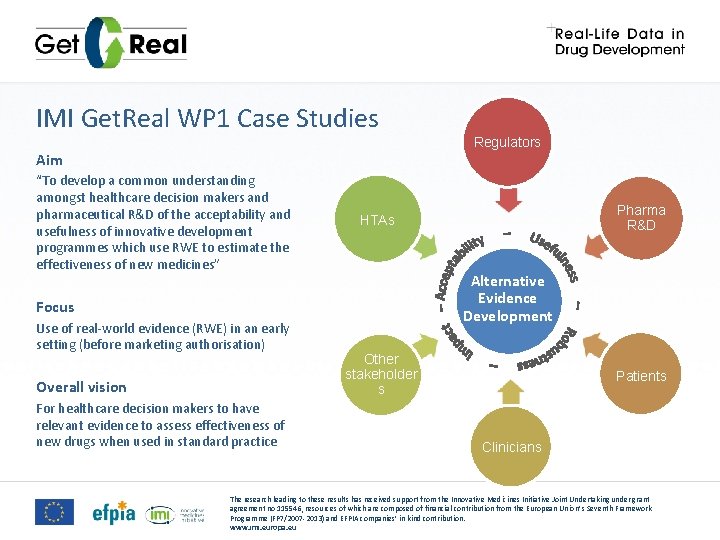
IMI Get. Real WP 1 Case Studies Aim “To develop a common understanding amongst healthcare decision makers and pharmaceutical R&D of the acceptability and usefulness of innovative development programmes which use RWE to estimate the effectiveness of new medicines” Overall vision For healthcare decision makers to have relevant evidence to assess effectiveness of new drugs when used in standard practice Pharma R&D HTAs Alternative Evidence Development Focus Use of real-world evidence (RWE) in an early setting (before marketing authorisation) Regulators Other stakeholder s Patients Clinicians The research leading to these results has received support from the Innovative Medicines Initiative Joint Undertaking under grant agreement no 115546, resources of which are composed of financial contribution from the European Union’s Seventh Framework Programme (FP 7/2007 -2013) and EFPIA companies’ in kind contribution. www. imi. europa. eu
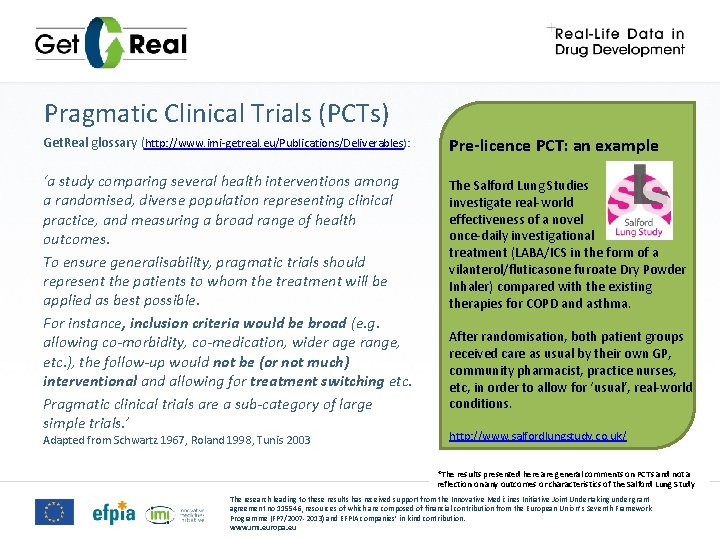
Pragmatic Clinical Trials (PCTs) Get. Real glossary (http: //www. imi-getreal. eu/Publications/Deliverables): Pre-licence PCT: an example ‘a study comparing several health interventions among a randomised, diverse population representing clinical practice, and measuring a broad range of health outcomes. To ensure generalisability, pragmatic trials should represent the patients to whom the treatment will be applied as best possible. For instance, inclusion criteria would be broad (e. g. allowing co-morbidity, co-medication, wider age range, etc. ), the follow-up would not be (or not much) interventional and allowing for treatment switching etc. Pragmatic clinical trials are a sub-category of large simple trials. ’ The Salford Lung Studies investigate real-world effectiveness of a novel once-daily investigational treatment (LABA/ICS in the form of a vilanterol/fluticasone furoate Dry Powder Inhaler) compared with the existing therapies for COPD and asthma. Adapted from Schwartz 1967, Roland 1998, Tunis 2003 After randomisation, both patient groups received care as usual by their own GP, community pharmacist, practice nurses, etc, in order to allow for ‘usual’, real-world conditions. http: //www. salfordlungstudy. co. uk/ *The results presented here are general comments on PCTs and not a reflection on any outcomes or characteristics of the Salford Lung Study The research leading to these results has received support from the Innovative Medicines Initiative Joint Undertaking under grant agreement no 115546, resources of which are composed of financial contribution from the European Union’s Seventh Framework Programme (FP 7/2007 -2013) and EFPIA companies’ in kind contribution. www. imi. europa. eu
Stakeholder Workshop on Pragmatic Clinical Trials Method Work package 1 of Get. Real conducted a workshop attended by key European and US stakeholders (regulators, HTAs, pharma, patients) to elicit views on the acceptability and usefulness of pragmatic clinical trials, conducted prior to market authorisation, for establishing relative effectiveness of new drugs The workshop combined presentations, structured breakout sessions and plenary discussions Objectives To elicit a comprehensive stakeholder view on the acceptability of early use (before marketing authorisation) of pragmatic clinical trials for informing relative effectiveness of new medicines in regulatory and HTA assessments The research leading to these results has received support from the Innovative Medicines Initiative Joint Undertaking under grant agreement no 115546, resources of which are composed of financial contribution from the European Union’s Seventh Framework Programme (FP 7/2007 -2013) and EFPIA companies’ in kind contribution. www. imi. europa. eu
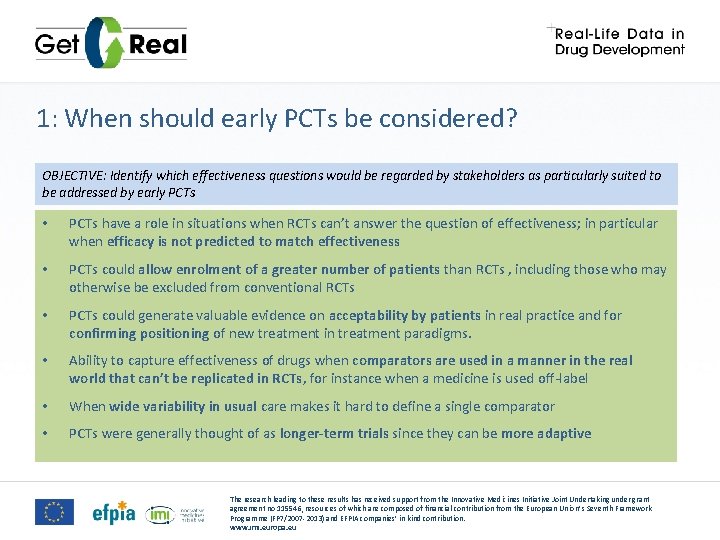
1: When should early PCTs be considered? OBJECTIVE: Identify which effectiveness questions would be regarded by stakeholders as particularly suited to be addressed by early PCTs • PCTs have a role in situations when RCTs can’t answer the question of effectiveness; in particular when efficacy is not predicted to match effectiveness • PCTs could allow enrolment of a greater number of patients than RCTs , including those who may otherwise be excluded from conventional RCTs • PCTs could generate valuable evidence on acceptability by patients in real practice and for confirming positioning of new treatment in treatment paradigms. • Ability to capture effectiveness of drugs when comparators are used in a manner in the real world that can’t be replicated in RCTs, for instance when a medicine is used off-label • When wide variability in usual care makes it hard to define a single comparator • PCTs were generally thought of as longer-term trials since they can be more adaptive The research leading to these results has received support from the Innovative Medicines Initiative Joint Undertaking under grant agreement no 115546, resources of which are composed of financial contribution from the European Union’s Seventh Framework Programme (FP 7/2007 -2013) and EFPIA companies’ in kind contribution. www. imi. europa. eu
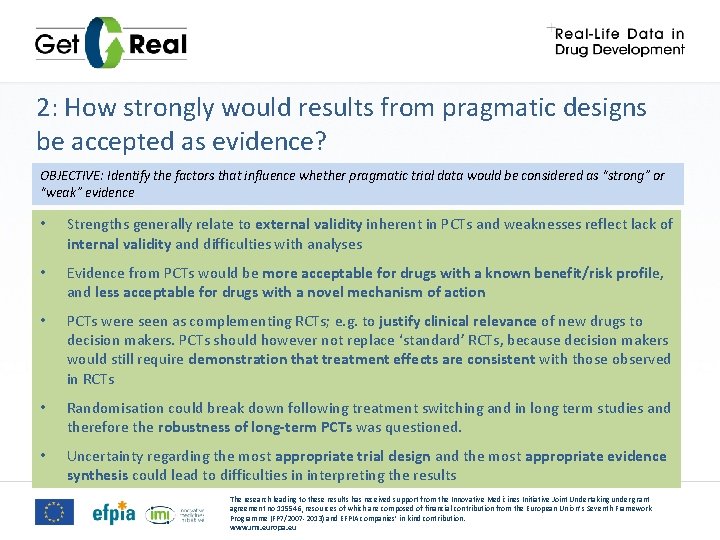
2: How strongly would results from pragmatic designs be accepted as evidence? OBJECTIVE: Identify the factors that influence whether pragmatic trial data would be considered as “strong” or “weak” evidence • Strengths generally relate to external validity inherent in PCTs and weaknesses reflect lack of internal validity and difficulties with analyses • Evidence from PCTs would be more acceptable for drugs with a known benefit/risk profile, and less acceptable for drugs with a novel mechanism of action • PCTs were seen as complementing RCTs; e. g. to justify clinical relevance of new drugs to decision makers. PCTs should however not replace ‘standard’ RCTs, because decision makers would still require demonstration that treatment effects are consistent with those observed in RCTs • Randomisation could break down following treatment switching and in long term studies and therefore the robustness of long-term PCTs was questioned. • Uncertainty regarding the most appropriate trial design and the most appropriate evidence synthesis could lead to difficulties in interpreting the results The research leading to these results has received support from the Innovative Medicines Initiative Joint Undertaking under grant agreement no 115546, resources of which are composed of financial contribution from the European Union’s Seventh Framework Programme (FP 7/2007 -2013) and EFPIA companies’ in kind contribution. www. imi. europa. eu
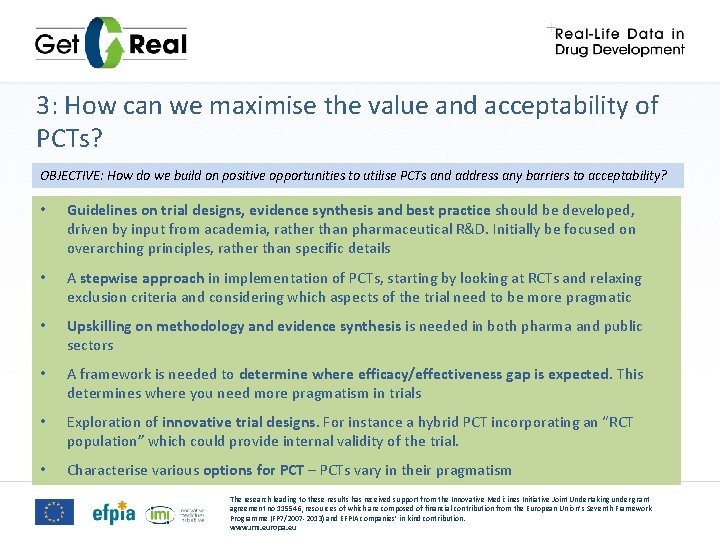
3: How can we maximise the value and acceptability of PCTs? OBJECTIVE: How do we build on positive opportunities to utilise PCTs and address any barriers to acceptability? • Guidelines on trial designs, evidence synthesis and best practice should be developed, driven by input from academia, rather than pharmaceutical R&D. Initially be focused on overarching principles, rather than specific details • A stepwise approach in implementation of PCTs, starting by looking at RCTs and relaxing exclusion criteria and considering which aspects of the trial need to be more pragmatic • Upskilling on methodology and evidence synthesis is needed in both pharma and public sectors • A framework is needed to determine where efficacy/effectiveness gap is expected. This determines where you need more pragmatism in trials • Exploration of innovative trial designs. For instance a hybrid PCT incorporating an “RCT population” which could provide internal validity of the trial. • Characterise various options for PCT – PCTs vary in their pragmatism The research leading to these results has received support from the Innovative Medicines Initiative Joint Undertaking under grant agreement no 115546, resources of which are composed of financial contribution from the European Union’s Seventh Framework Programme (FP 7/2007 -2013) and EFPIA companies’ in kind contribution. www. imi. europa. eu
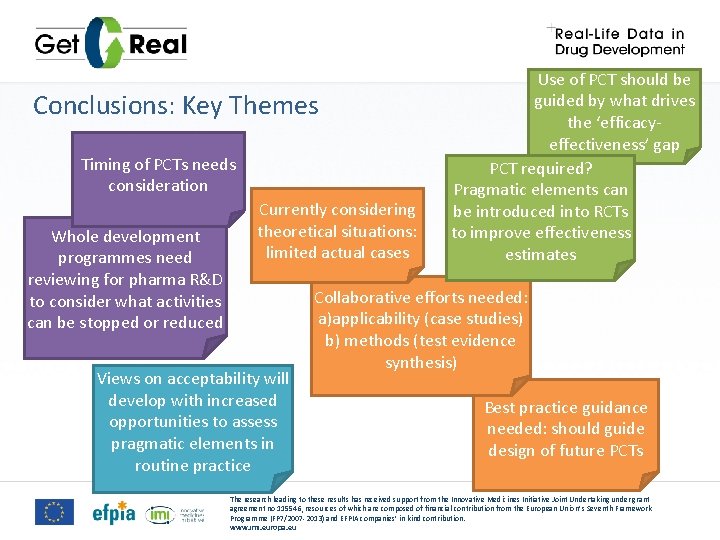
Conclusions: Key Themes Timing of PCTs needs consideration Whole development programmes need reviewing for pharma R&D to consider what activities can be stopped or reduced Currently considering theoretical situations: limited actual cases Views on acceptability will develop with increased opportunities to assess pragmatic elements in routine practice Use of PCT should be guided by what drives the ‘efficacyeffectiveness’ gap PCT required? Pragmatic elements can be introduced into RCTs to improve effectiveness estimates Collaborative efforts needed: a)applicability (case studies) b) methods (test evidence synthesis) Best practice guidance needed: should guide design of future PCTs The research leading to these results has received support from the Innovative Medicines Initiative Joint Undertaking under grant agreement no 115546, resources of which are composed of financial contribution from the European Union’s Seventh Framework Programme (FP 7/2007 -2013) and EFPIA companies’ in kind contribution. www. imi. europa. eu