Imagining Archives Against Annihilation Two Acts and a



- Slides: 34
Imagining Archives Against Annihilation: Two Acts and a Proposition Michelle Caswell, Ph. D Assistant Professor, Information Studies, UCLA Co-Founder, SAADA
ACT ONE
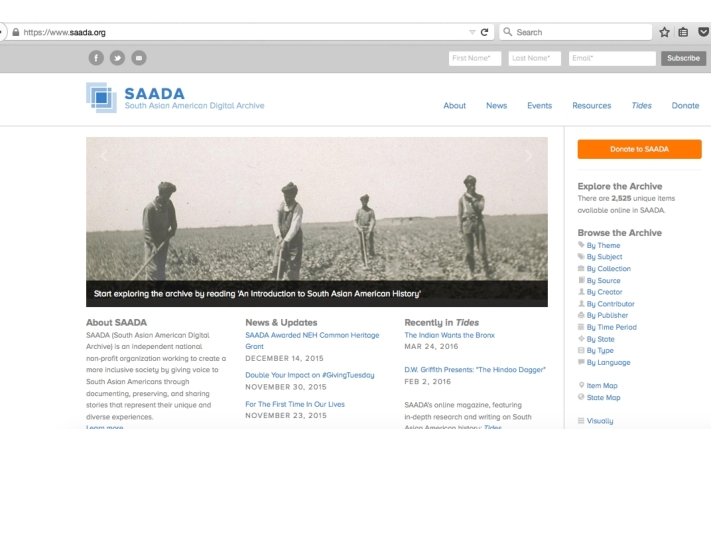
What is a Community Archive? “Any manner of people who come together and present themselves as such, and a ‘community archive’ is the product of their attempts to document the history of their commonality. ” Andrew Flinn, Mary Stevens, and Elizabeth Shepherd, “Whose Memories, Whose Archives? Independent Community Archives, Autonomy, and the Mainstream, ” Archival Science 9 (2009), 71 -86 • Independent, grassroots collections in which those who have been left out of mainstream archives document their own histories. • Power is central. • Autonomy & authority
Practical Problem: How do we assess the impact of community archives? • • • 2, 525 records (and growing) ~200, 000 unique visitors in 2014 3, 651 “likes” on Facebook ~$95, 000 annual budget in 2015 95% of funding from individuals • Or by affective impact?
Theoretical Concept: Symbolic Annihilation The ways in which members of marginalized groups are absent, grossly under-represented, maligned, or trivialized by mainstream media. Gaye Tuchman, “Introduction: The Symbolic Annihilation of Women by the Mass Media, ” in Hearth and Home: Images of Women in the Mass Media, Gaye Tuchman, Arlene Kaplan Daniels, and James Benet, eds. , New York: Oxford University Press, 1978, p. 3 -38
Method • Allina Migoni, Noah Geraci, Marika Cifor, Mario H. Ramirez • 2 sets of interview data: – 12 SAA academics who use SAADA – 17 community archives founders, staff and volunteers at 12 sites • Transcribe and code • Attribution
Challenge • Talk across difference without collapse • Acknowledge intersectionality
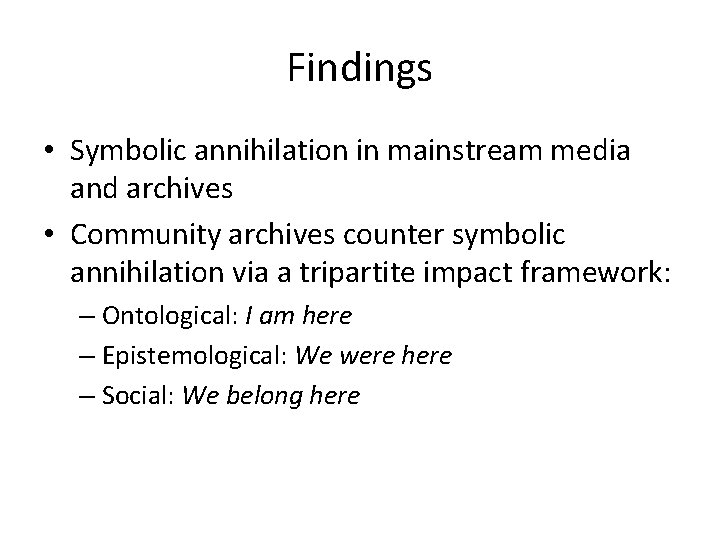
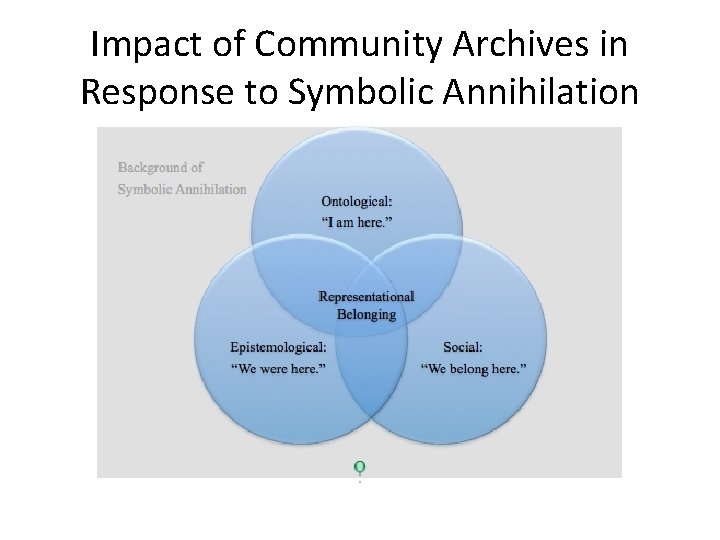
Findings • Symbolic annihilation in mainstream media and archives • Community archives counter symbolic annihilation via a tripartite impact framework: – Ontological: I am here – Epistemological: We were here – Social: We belong here
Symbolic Annihilation in Media “Representation to me is incredibly important because growing up as a… child, you rarely see [Asian Americans] in mainstream media… When you're a kid that's the easiest way that you can see what the world looks like. And when you don't see anyone that looks like you… you think, ‘Is there something wrong with me? Why are people like me missing in the world? ’” – Annie Tang, Chinese Historical Society of SC
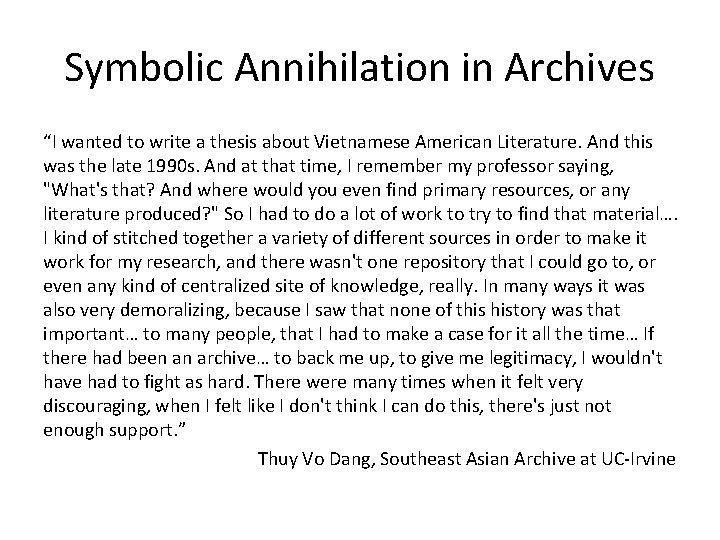
Symbolic Annihilation in Archives “I wanted to write a thesis about Vietnamese American Literature. And this was the late 1990 s. And at that time, I remember my professor saying, "What's that? And where would you even find primary resources, or any literature produced? " So I had to do a lot of work to try to find that material…. I kind of stitched together a variety of different sources in order to make it work for my research, and there wasn't one repository that I could go to, or even any kind of centralized site of knowledge, really. In many ways it was also very demoralizing, because I saw that none of this history was that important… to many people, that I had to make a case for it all the time… If there had been an archive… to back me up, to give me legitimacy, I wouldn't have had to fight as hard. There were many times when it felt very discouraging, when I felt like I don't think I can do this, there's just not enough support. ” Thuy Vo Dang, Southeast Asian Archive at UC-Irvine
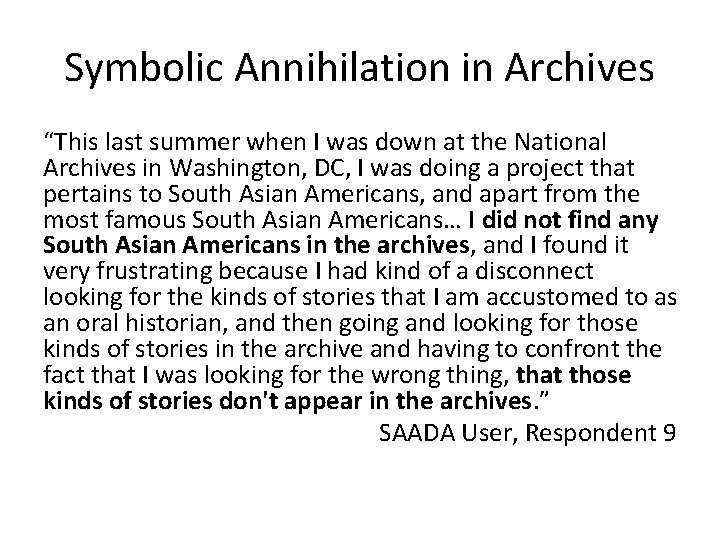
Symbolic Annihilation in Archives “This last summer when I was down at the National Archives in Washington, DC, I was doing a project that pertains to South Asian Americans, and apart from the most famous South Asian Americans… I did not find any South Asian Americans in the archives, and I found it very frustrating because I had kind of a disconnect looking for the kinds of stories that I am accustomed to as an oral historian, and then going and looking for those kinds of stories in the archive and having to confront the fact that I was looking for the wrong thing, that those kinds of stories don't appear in the archives. ” SAADA User, Respondent 9
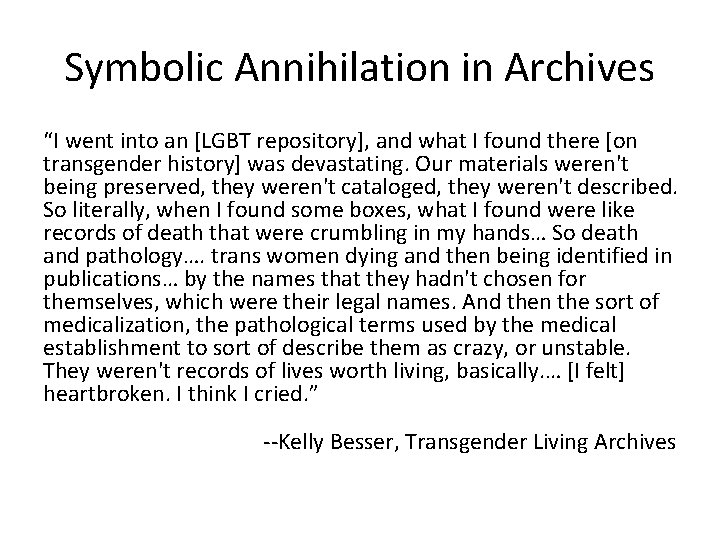
Symbolic Annihilation in Archives “I went into an [LGBT repository], and what I found there [on transgender history] was devastating. Our materials weren't being preserved, they weren't cataloged, they weren't described. So literally, when I found some boxes, what I found were like records of death that were crumbling in my hands… So death and pathology…. trans women dying and then being identified in publications… by the names that they hadn't chosen for themselves, which were their legal names. And then the sort of medicalization, the pathological terms used by the medical establishment to sort of describe them as crazy, or unstable. They weren't records of lives worth living, basically. … [I felt] heartbroken. I think I cried. ” --Kelly Besser, Transgender Living Archives
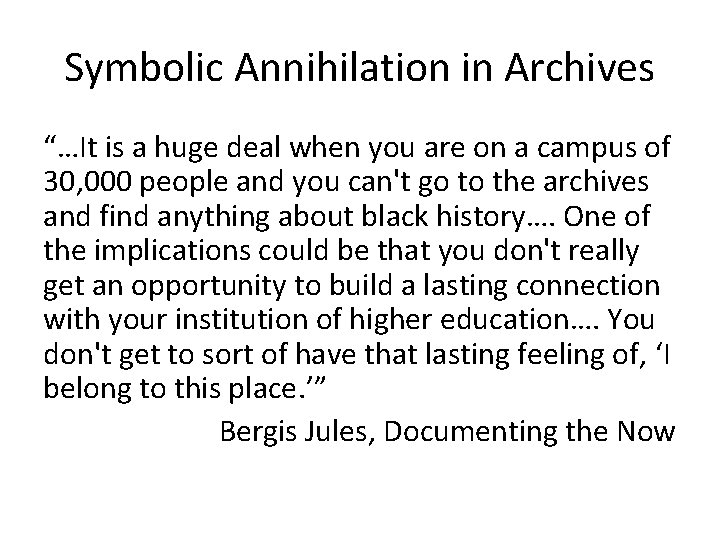
Symbolic Annihilation in Archives “…It is a huge deal when you are on a campus of 30, 000 people and you can't go to the archives and find anything about black history…. One of the implications could be that you don't really get an opportunity to build a lasting connection with your institution of higher education…. You don't get to sort of have that lasting feeling of, ‘I belong to this place. ’” Bergis Jules, Documenting the Now
Ontological Impact “Okay, I'm just gonna get emotional a little bit. My dad died…a little over a year ago. And the [oral history] interview that I did with him [for SAADA] was the only one that I did with him. And it's there. And that is a treasure to me. And I did it because I wanted to work with SAADA and to have a place for these oral histories. So, for me personally, the value of the archive is profound. And I think that may be true for a lot of people who suddenly are able to discover themselves, existing, being documented. ” Respondent 9, SAADA User
Epistemological Impact “…when you're a young person in this country and you don't see yourself represented elsewhere, there can be… a lack of self-esteem and a lack of grounded-ness. And I feel that at least in this area of history, we can be grounded by being symbolic, even… if it doesn't look like it has a lot of research value…. Let's say it’s Chinese pottery from the 1800 s from Los Angeles. And there's nothing even written on it, it's just, clay shards. But that in and of itself is incredibly symbolic that we were here 200 years ago, and we're not as foreign as a lot of Americans think we are. We've been here for a while, and we're here now. ” --Annie Tang, Chinese Historical Society of Southern California
Social Impact “SAADA is unique and it's such a treasure that we have. I mean, it's a resource that collects all of the pieces of our identity that we share together, right? I mean, one person may be from Bangladesh, another from Pakistan, another from Sri Lanka, but we have a shared history and we have a shared identity. How we're seen in the U. S. is similar, right? …I mean, how we are perceived is the same, and so that plays a huge part in how we sort of come together as a community. And so to have a resource like SAADA is amazing. A place where we can look up our history, we can see how people lived their lives and how they're doing so today, and how the past impacts the present, all of it. It's really incredible. ”– SAADA User, Respondent 5
Social Impact “From a young age I felt unsettled in my identity as an American…. I felt trapped between two worlds, feeling entirely at home in neither one…I felt a sense of displacement by not seeing myself reflected in the American story… Learning about South Asian American history was transformational for me…. [These] were not stories that I could learn about in school, read in textbooks or see covered in the media. But it was through learning about these stories and the many others like them that finally helped me see myself reflected in the American experience. For me knowing there is a long, rich and diverse history of South Asians in the U. S. counteracts that feeling of displacement. ” Samip Mallick, ED of SAADA
Social Impact “Well, I think ultimately [archival work contributes] to a better society, because it [involves] seeing a reflection of yourself. So if you have a community and a city that's full of immigrants, really, how do you create a really successful city or society? What bonds the people at that point? To be able to see a reflection of yourself in this foreign place, then you become more impassioned with it, you become more dedicated to it, you become a better citizen toward it. You have a mutual goal in creating a good society. ” --Pilar Castillo, Social and Public Art Resource Center
Representational Belonging The ways in which community archives empower people who have been marginalized by mainstream media outlets and memory institutions to have the autonomy and authority to establish, enact, and reflect on their presence in ways that are complex, meaningful, substantive, and positive to them in a variety of symbolic contexts.
Impact of Community Archives in Response to Symbolic Annihilation
ACT TWO
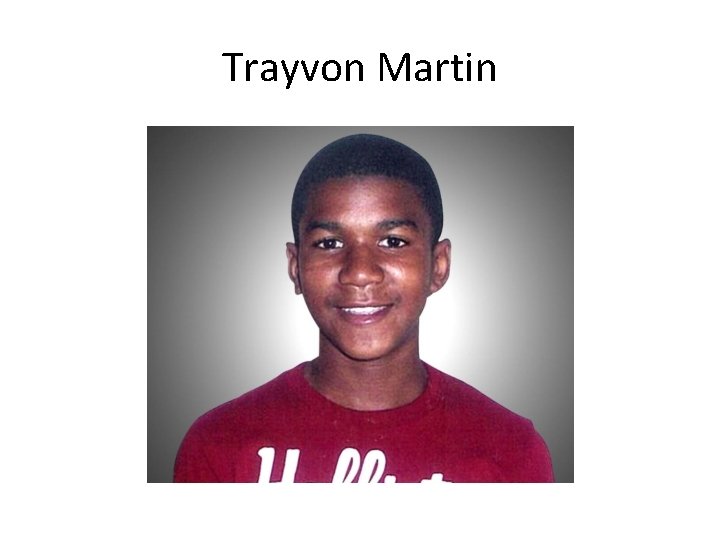
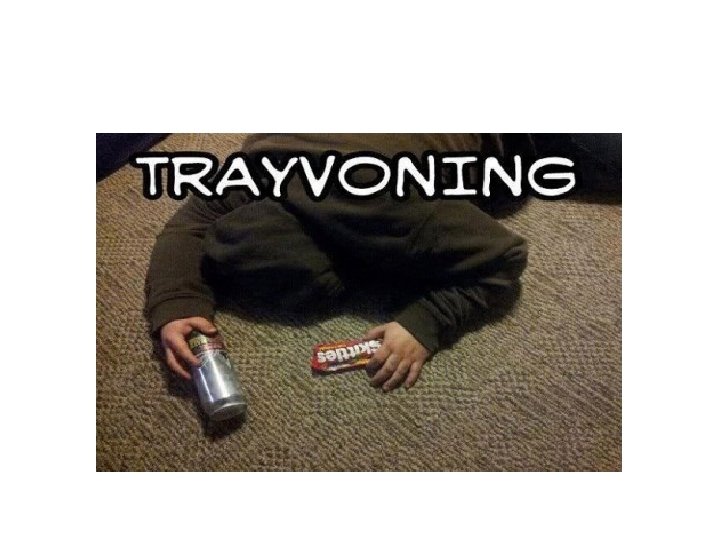
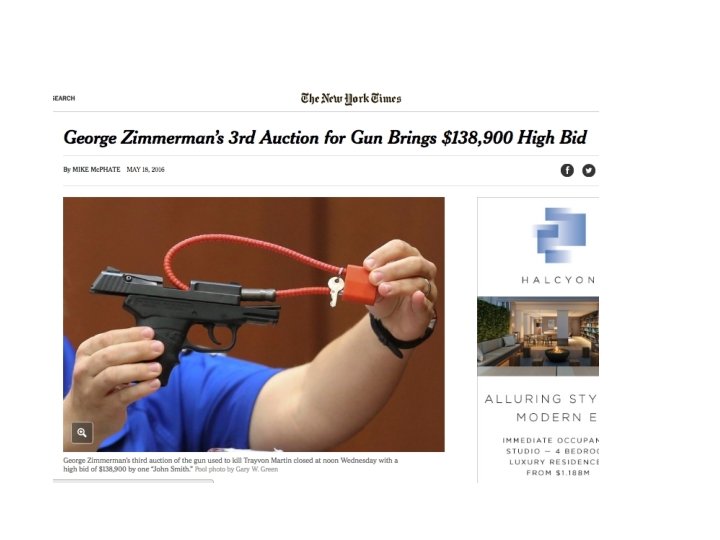
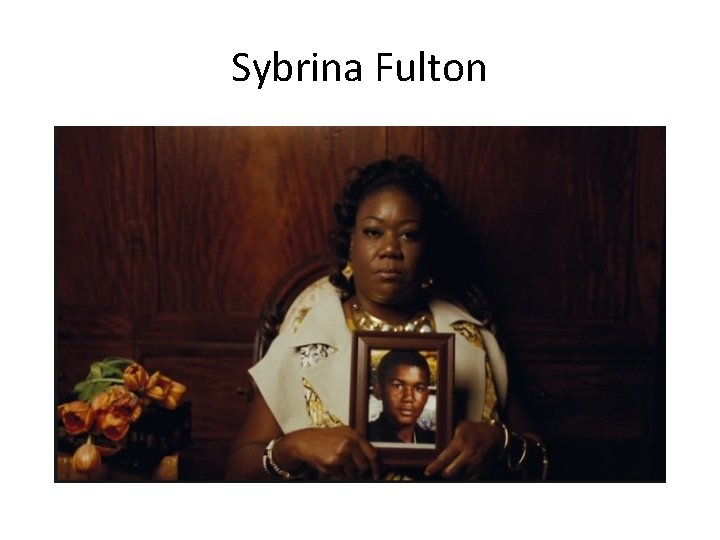
Trayvon Martin
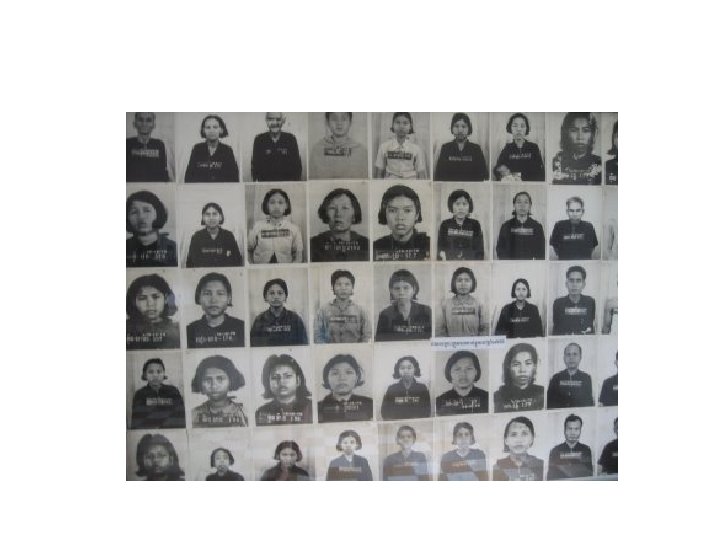
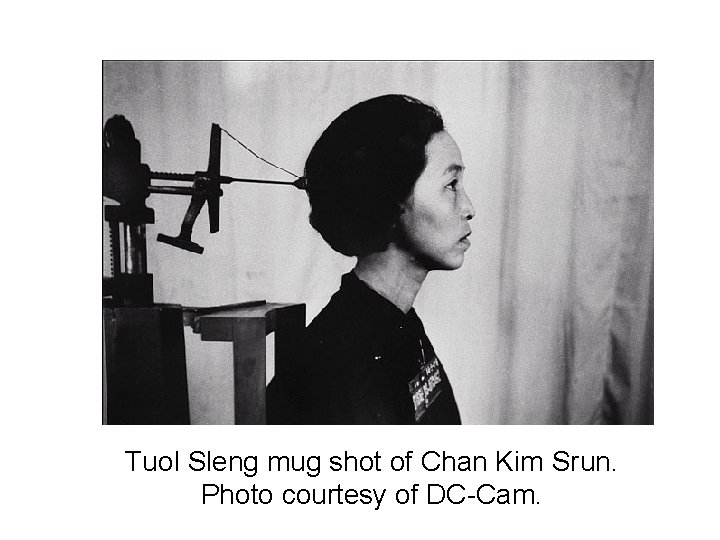
Tuol Sleng mug shot of Chan Kim Srun. Photo courtesy of DC-Cam.
Sybrina Fulton
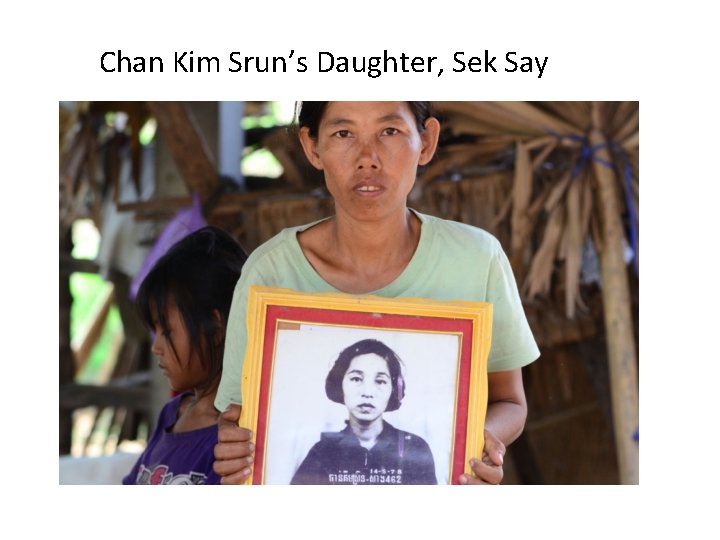
Chan Kim Srun’s Daughter, Sek Say
AND A PROPOSTION…
WHAT IF…?
“I think the ability for our community members to see our lives represented or to see that there is a history, and that there are moments in our history that, although they haven't been… made available, that are about life and love and things that are antithetical to what we know is out there already that we've witnessed…. The police abuse, the death, all of this pain and violence. To create a living archive that really is about life, while not excluding those other moments I mentioned-- violence is consistently a part of our community's life--but just to be able to imagine otherwise, and to see records that are life affirming I think would just be valuable for everyone. ” --Kelly Besser, Transgender Living Archives
THANK YOU! caswell@gseis. ucla. edu