Imaging in Exclusive Processes Tanja Horn INT 10
- Slides: 21
Imaging in Exclusive Processes Tanja Horn INT 10 -03 “Imaging QCD Matter”, Institute for Nuclear Theory, UW, Seattle Tanja Horn, Imaging in Exclusive Tanja Horn, CUA Colloquium Processes, INT 10 -3, Seattle 12 November 2010 1
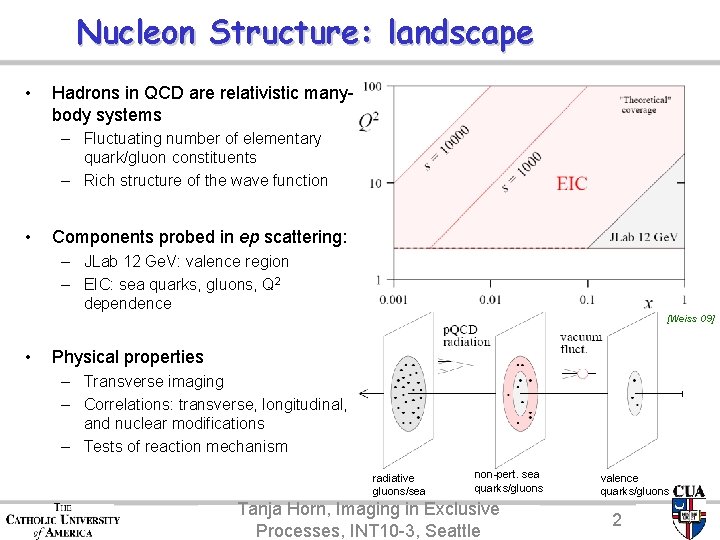
Nucleon Structure: landscape • Hadrons in QCD are relativistic manybody systems – Fluctuating number of elementary quark/gluon constituents – Rich structure of the wave function • Components probed in ep scattering: – JLab 12 Ge. V: valence region – EIC: sea quarks, gluons, Q 2 dependence [Weiss 09] • Physical properties – Transverse imaging – Correlations: transverse, longitudinal, and nuclear modifications – Tests of reaction mechanism radiative gluons/sea non-pert. sea quarks/gluons Tanja Horn, Imaging in Exclusive Processes, INT 10 -3, Seattle valence quarks/gluons 2
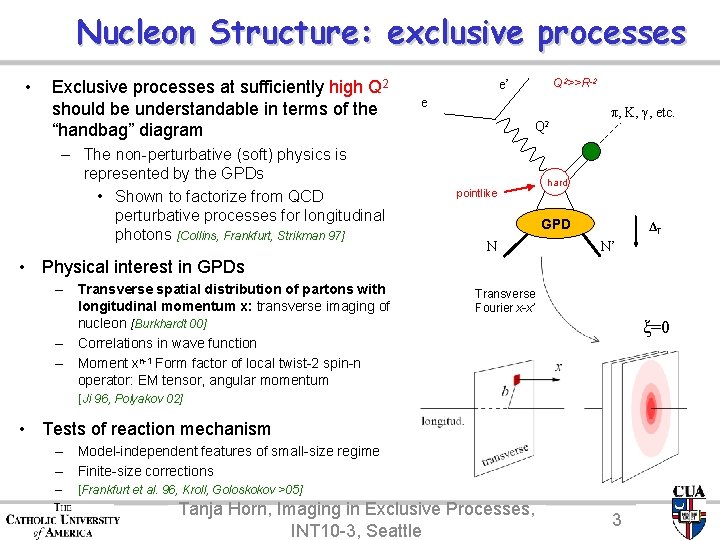
Nucleon Structure: exclusive processes • Exclusive processes at sufficiently high Q 2 should be understandable in terms of the “handbag” diagram – The non-perturbative (soft) physics is represented by the GPDs • Shown to factorize from QCD perturbative processes for longitudinal photons [Collins, Frankfurt, Strikman 97] Q 2>>R-2 e’ e Q 2 pointlike π, K, γ, etc. hard GPD N ΔT N’ • Physical interest in GPDs – Transverse spatial distribution of partons with longitudinal momentum x: transverse imaging of nucleon [Burkhardt 00] – Correlations in wave function – Moment xn-1 Form factor of local twist-2 spin-n operator: EM tensor, angular momentum Transverse Fourier x-x’ ξ=0 [Ji 96, Polyakov 02] • Tests of reaction mechanism – Model-independent features of small-size regime – Finite-size corrections – [Frankfurt et al. 96, Kroll, Goloskokov >05] Tanja Horn, Imaging in Exclusive Processes, INT 10 -3, Seattle 3
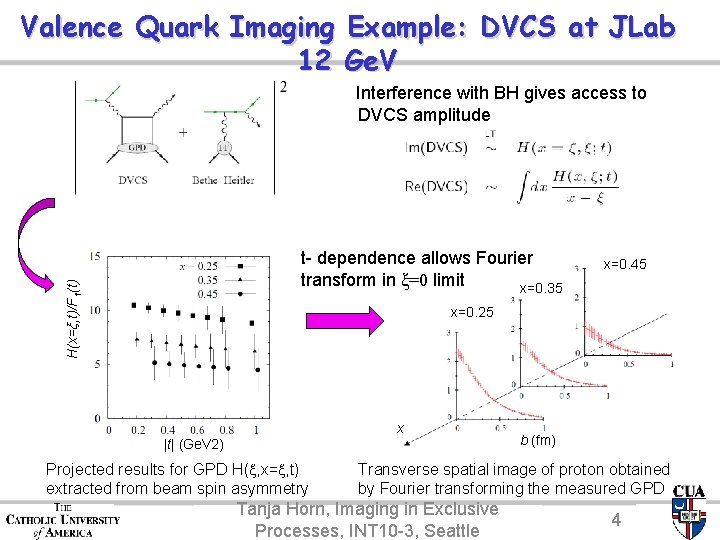
Valence Quark Imaging Example: DVCS at JLab 12 Ge. V Interference with BH gives access to DVCS amplitude H(x=ξ, t)/F 1(t) t- dependence allows Fourier transform in ξ=0 limit x=0. 35 x=0. 45 x=0. 25 x |t| (Ge. V 2) Projected results for GPD H(ξ, x=ξ, t) extracted from beam spin asymmetry b (fm) Transverse spatial image of proton obtained by Fourier transforming the measured GPD Tanja Horn, Imaging in Exclusive Processes, INT 10 -3, Seattle 4
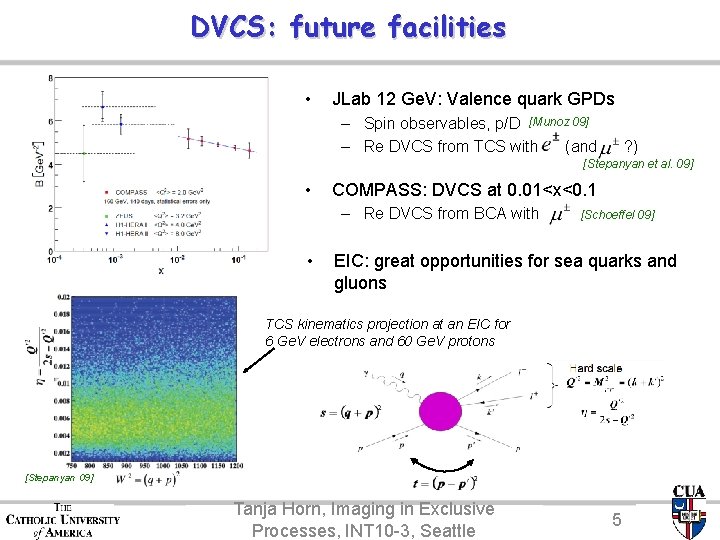
DVCS: future facilities • JLab 12 Ge. V: Valence quark GPDs – Spin observables, p/D [Munoz 09] – Re DVCS from TCS with (and ? ) [Stepanyan et al. 09] • COMPASS: DVCS at 0. 01<x<0. 1 – Re DVCS from BCA with • [Schoeffel 09] EIC: great opportunities for sea quarks and gluons TCS kinematics projection at an EIC for 6 Ge. V electrons and 60 Ge. V protons [Stepanyan 09] Tanja Horn, Imaging in Exclusive Processes, INT 10 -3, Seattle 5
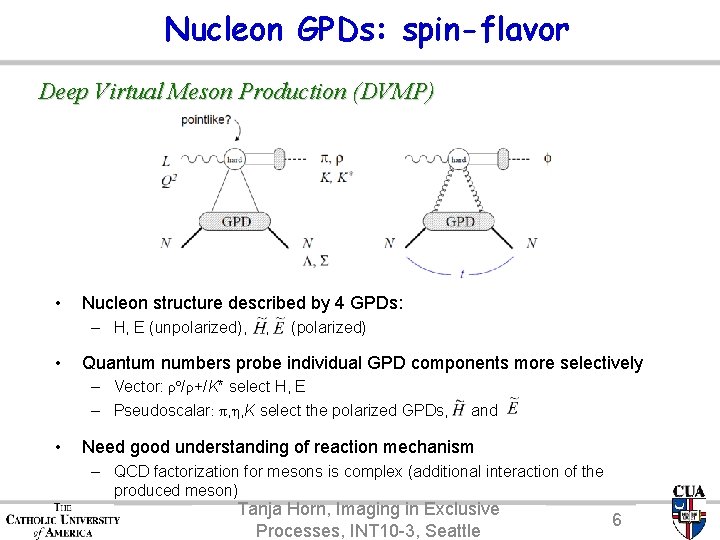
Nucleon GPDs: spin-flavor Deep Virtual Meson Production (DVMP) long. only • Nucleon structure described by 4 GPDs: – H, E (unpolarized), • , (polarized) Quantum numbers probe individual GPD components more selectively – Vector: ρº/ρ+/K* select H, E – Pseudoscalar: π, η, K select the polarized GPDs, • and Need good understanding of reaction mechanism – QCD factorization for mesons is complex (additional interaction of the produced meson) Tanja Horn, Imaging in Exclusive Processes, INT 10 -3, Seattle 6
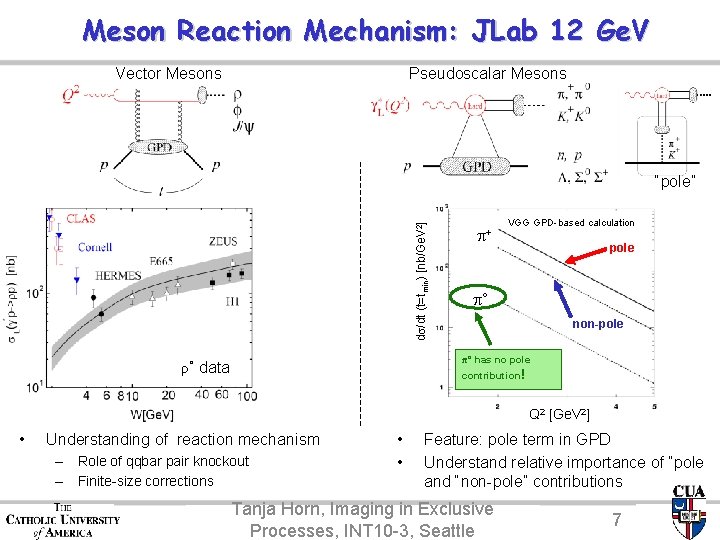
Meson Reaction Mechanism: JLab 12 Ge. V Vector Mesons Pseudoscalar Mesons dσ/dt (t=tmin) [nb/Ge. V 2] “pole” p+ VGG GPD-based calculation pole p° non-pole π° has no pole ρ˚ data contribution! Q 2 [Ge. V 2] • Understanding of reaction mechanism – Role of qqbar pair knockout – Finite-size corrections • • Feature: pole term in GPD Understand relative importance of “pole and “non-pole” contributions Tanja Horn, Imaging in Exclusive Processes, INT 10 -3, Seattle 7
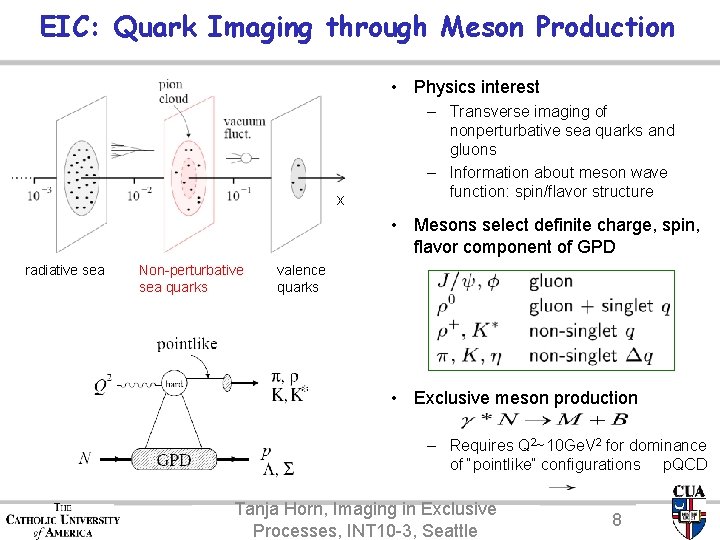
EIC: Quark Imaging through Meson Production • Physics interest x – Transverse imaging of nonperturbative sea quarks and gluons – Information about meson wave function: spin/flavor structure • Mesons select definite charge, spin, flavor component of GPD radiative sea Non-perturbative sea quarks valence quarks • Exclusive meson production – Requires Q 2~10 Ge. V 2 for dominance of “pointlike” configurations p. QCD Tanja Horn, Imaging in Exclusive Processes, INT 10 -3, Seattle 8
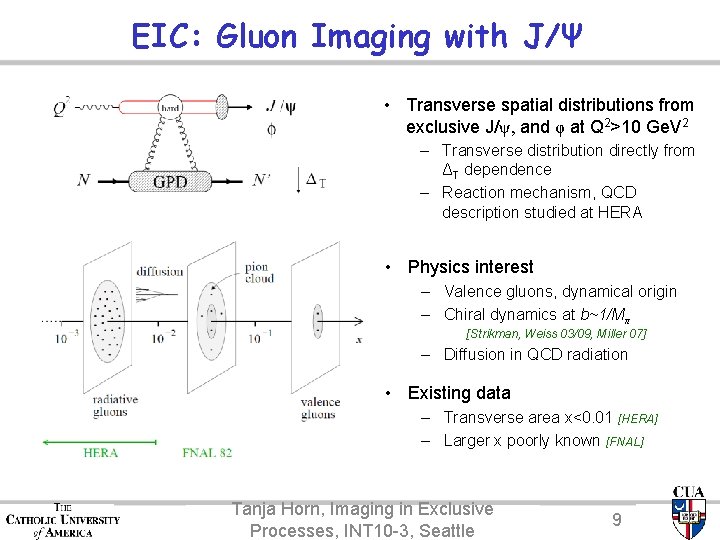
EIC: Gluon Imaging with J/Ψ • Transverse spatial distributions from exclusive J/ψ, and φ at Q 2>10 Ge. V 2 – Transverse distribution directly from ΔT dependence – Reaction mechanism, QCD description studied at HERA • Physics interest – Valence gluons, dynamical origin – Chiral dynamics at b~1/Mπ [Strikman, Weiss 03/09, Miller 07] – Diffusion in QCD radiation • Existing data – Transverse area x<0. 01 [HERA] – Larger x poorly known [FNAL] Tanja Horn, Imaging in Exclusive Processes, INT 10 -3, Seattle 9
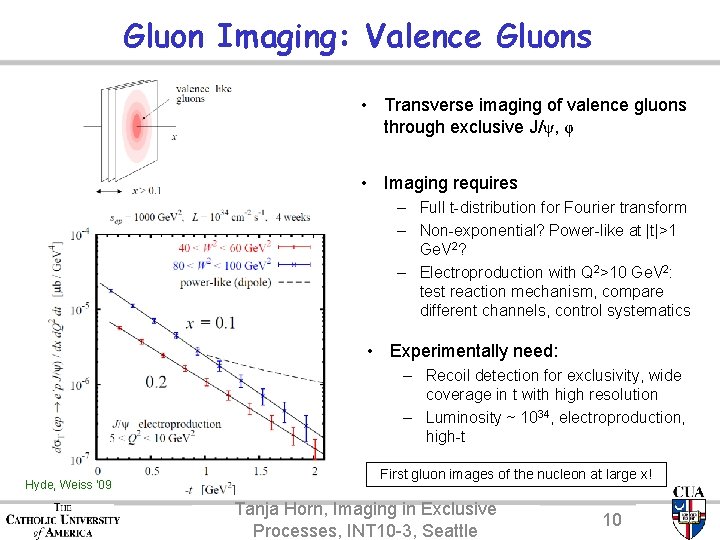
Gluon Imaging: Valence Gluons • Transverse imaging of valence gluons through exclusive J/ψ, φ • Imaging requires – Full t-distribution for Fourier transform – Non-exponential? Power-like at |t|>1 Ge. V 2? – Electroproduction with Q 2>10 Ge. V 2: test reaction mechanism, compare different channels, control systematics • Experimentally need: – Recoil detection for exclusivity, wide coverage in t with high resolution – Luminosity ~ 1034, electroproduction, high-t Hyde, Weiss ‘ 09 First gluon images of the nucleon at large x! Tanja Horn, Imaging in Exclusive Processes, INT 10 -3, Seattle 10
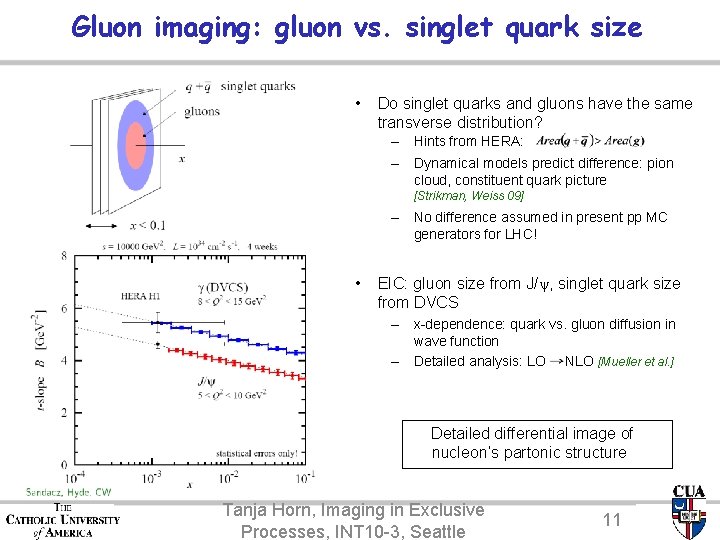
Gluon imaging: gluon vs. singlet quark size • Do singlet quarks and gluons have the same transverse distribution? – Hints from HERA: – Dynamical models predict difference: pion cloud, constituent quark picture [Strikman, Weiss 09] – No difference assumed in present pp MC generators for LHC! • EIC: gluon size from J/ψ, singlet quark size from DVCS – x-dependence: quark vs. gluon diffusion in wave function – Detailed analysis: LO NLO [Mueller et al. ] Detailed differential image of nucleon’s partonic structure Tanja Horn, Imaging in Exclusive Processes, INT 10 -3, Seattle 11
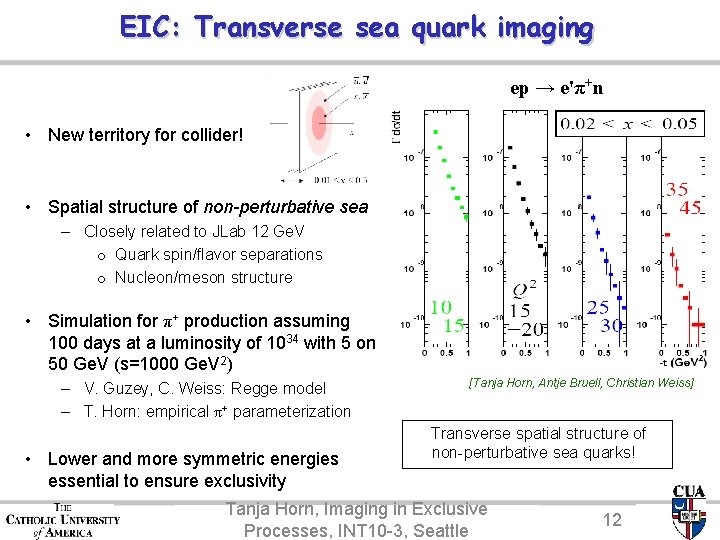
EIC: Transverse sea quark imaging ep → e'π+n • New territory for collider! • Spatial structure of non-perturbative sea – Closely related to JLab 12 Ge. V o Quark spin/flavor separations o Nucleon/meson structure • Simulation for π+ production assuming 100 days at a luminosity of 1034 with 5 on 50 Ge. V (s=1000 Ge. V 2) – V. Guzey, C. Weiss: Regge model – T. Horn: empirical π+ parameterization • Lower and more symmetric energies essential to ensure exclusivity [Tanja Horn, Antje Bruell, Christian Weiss] Transverse spatial structure of non-perturbative sea quarks! Tanja Horn, Imaging in Exclusive Processes, INT 10 -3, Seattle 12
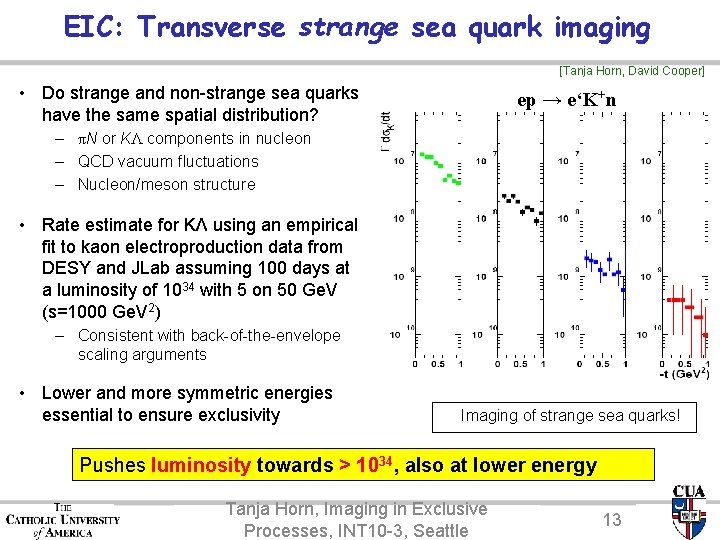
EIC: Transverse strange sea quark imaging [Tanja Horn, David Cooper] • Do strange and non-strange sea quarks have the same spatial distribution? ep → e‘K+n – πN or KΛ components in nucleon – QCD vacuum fluctuations – Nucleon/meson structure • Rate estimate for KΛ using an empirical fit to kaon electroproduction data from DESY and JLab assuming 100 days at a luminosity of 1034 with 5 on 50 Ge. V (s=1000 Ge. V 2) – Consistent with back-of-the-envelope scaling arguments • Lower and more symmetric energies essential to ensure exclusivity Imaging of strange sea quarks! Pushes luminosity towards > 1034, also at lower energy Tanja Horn, Imaging in Exclusive Processes, INT 10 -3, Seattle 13
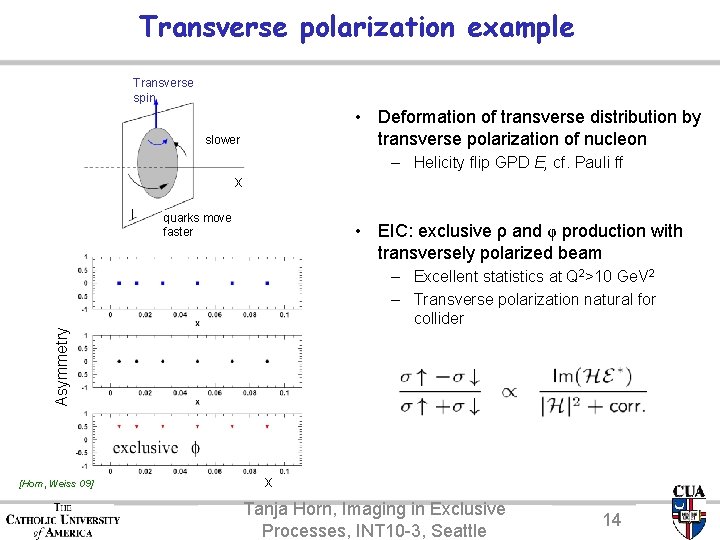
Transverse polarization example Transverse spin • Deformation of transverse distribution by transverse polarization of nucleon slower – Helicity flip GPD E, cf. Pauli ff x quarks move faster • EIC: exclusive ρ and φ production with transversely polarized beam Asymmetry – Excellent statistics at Q 2>10 Ge. V 2 – Transverse polarization natural for collider [Horn, Weiss 09] x Tanja Horn, Imaging in Exclusive Processes, INT 10 -3, Seattle 14
Beyond transverse imaging • Longitudinal correlations in nucleon – GPDs at x’≠x: correlated qqbar pairs in nucleon – QCD vacuum structure, relativistic nature of nucleon – EIC: reveal correlations through exclusive meson, γ at x>0. 1, Q 2 dependence …needs kinematic coverage way beyond JLab 12 Ge. V • Orbital motion of quarks/gluons – TMD and orbital motion from SIDIS – Major component of the EIC program – Connection with GPDs – Unintegrated distributions, Ji sum rule …should be discussed together Tanja Horn, Imaging in Exclusive Processes, INT 10 -3, Seattle 15
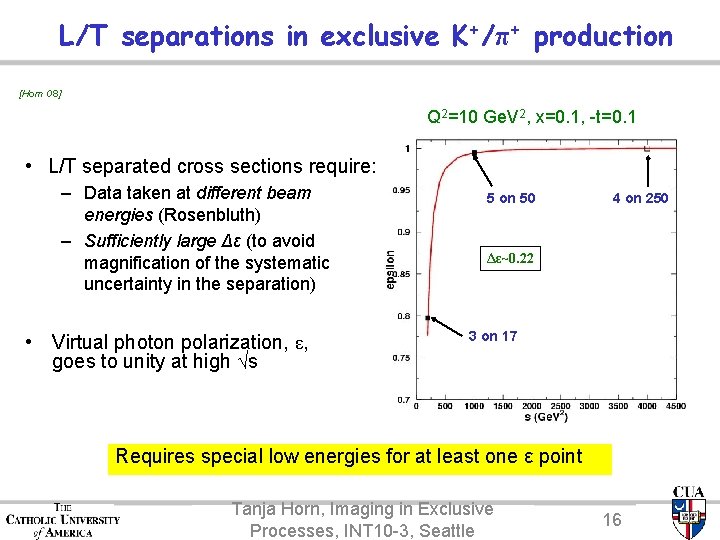
L/T separations in exclusive K+/π+ production [Horn 08] Q 2=10 Ge. V 2, x=0. 1, -t=0. 1 • L/T separated cross sections require: – Data taken at different beam energies (Rosenbluth) – Sufficiently large Δε (to avoid magnification of the systematic uncertainty in the separation) • Virtual photon polarization, ε, goes to unity at high √s 5 on 50 4 on 250 Δε~0. 22 3 on 17 Requires special low energies for at least one ε point Tanja Horn, Imaging in Exclusive Processes, INT 10 -3, Seattle 16
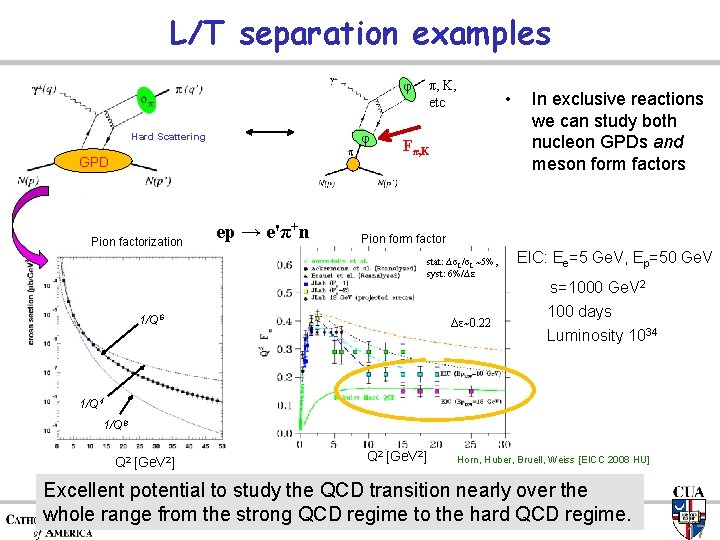
L/T separation examples φ φ Hard Scattering GPD Pion factorization ep → e'π+n π, K, etc • Fπ, K In exclusive reactions we can study both nucleon GPDs and meson form factors Pion form factor stat: ΔσL/σL ~5%, syst: 6%/Δε 1/Q 6 Δε~0. 22 EIC: Ee=5 Ge. V, Ep=50 Ge. V s=1000 Ge. V 2 100 days Luminosity 1034 1/Q 8 Q 2 [Ge. V 2] Horn, Huber, Bruell, Weiss [EICC 2008 HU] Excellent potential to study the QCD transition nearly over the whole range from the strong QCD regime to the hard QCD regime. 17
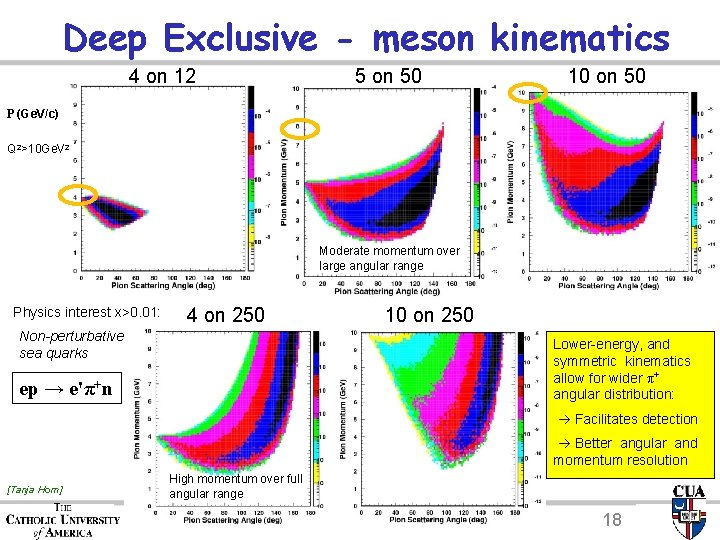
Deep Exclusive - meson kinematics 4 on 12 5 on 50 10 on 50 P (Ge. V/c) Q 2>10 Ge. V 2 Moderate momentum over large angular range Physics interest x>0. 01: 4 on 250 10 on 250 Non-perturbative sea quarks Lower-energy, and symmetric kinematics allow for wider π+ angular distribution: ep → e'π+n Facilitates detection Better angular and momentum resolution [Tanja Horn] High momentum over full angular range. Tanja Horn, Imaging in Exclusive Processes, INT 10 -3, Seattle 18
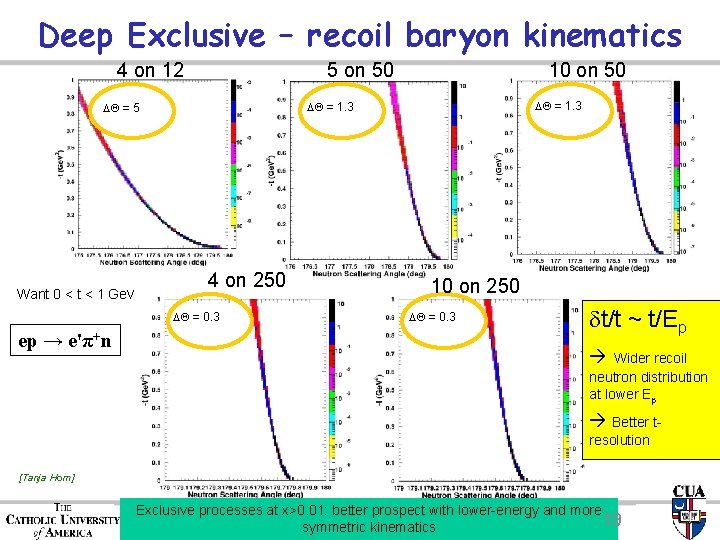
Deep Exclusive – recoil baryon kinematics 4 on 12 5 on 50 (Tanja Horn) ep → e'π+n DQ = 1. 3 DQ = 5 Want 0 < t < 1 Ge. V 10 on 50 4 on 250 DQ = 0. 3 10 on 250 DQ = 0. 3 dt/t ~ t/Ep Wider recoil neutron distribution at lower Ep Better tresolution [Tanja Horn] Exclusive processes at x>0. 01: betterin prospect with lower-energy and more Tanja Horn, Imaging Exclusive Processes, 19 symmetric kinematics INT 10 -3, Seattle
Exclusive Meson Production Perspectives • Energies – More symmetric energies favorable, 5 on 50 seems to be a sweet spot for exclusive meson production – Lower energies essential for ε range in pseudoscalar L/T separations (pion form factor) • Kinematic reach – Need Q 2>10 Ge. V 2 (pointlike configurations) – x range between 0. 001 and 0. 1 overlapping with HERA and JLab 12 Ge. V – s-range between 200 and 1000 Ge. V 2 • Luminosity – Non-diffractive proceses (exclusive π and K production) require high luminosity for low rates, differential measurements in x, t, Q 2 – Kaons push luminosity >1034 • Detection – Recoil detection for exclusivity, t-range Tanja Horn, Imaging in Exclusive Processes, INT 10 -3, Seattle 20
Summary • The EIC is an excellent tool to access nucleon structure • JLab 12 Ge. V – Main focus: valence quark imaging with DVCS – Also initial deep exclusive meson production studies • EIC: gluon and sea quarks – Transverse gluon and sea quark imaging through deep exclusive meson production Tanja Horn, Imaging Exclusive Processes, Horn, EIC@JLabin - taking nucleon structure beyond. INT 10 -3, the valence region, INT 09 -43 W Seattle 21