
EIC Detectors Tanja Horn INT 10 3 Science
- Slides: 29
EIC Detectors Tanja Horn INT 10 -3 “Science Case for an EIC”, Institute for Nuclear Theory, UW, Seattle Tanja Horn, Colloquium INT 10 -3 Tanja Horn, EICCUA Detectors, 16 November 2010 1
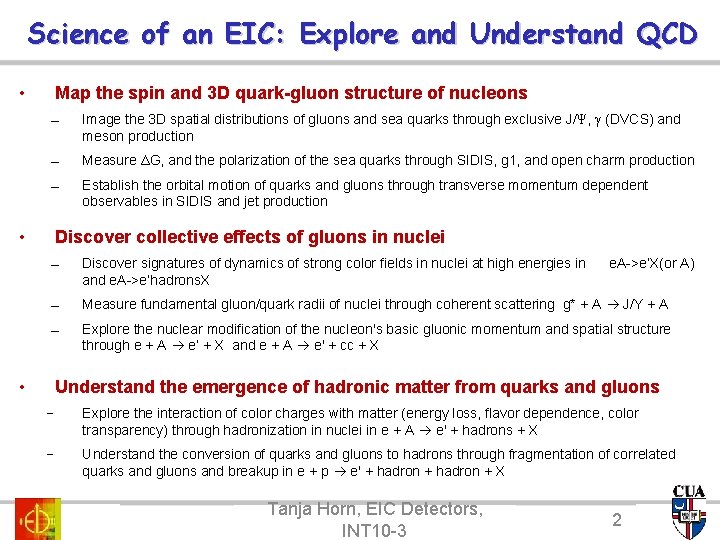
Science of an EIC: Explore and Understand QCD • Map the spin and 3 D quark-gluon structure of nucleons Image the 3 D spatial distributions of gluons and sea quarks through exclusive J/Ψ, γ (DVCS) and meson production Measure ΔG, and the polarization of the sea quarks through SIDIS, g 1, and open charm production Establish the orbital motion of quarks and gluons through transverse momentum dependent observables in SIDIS and jet production • Discover collective effects of gluons in nuclei • Discover signatures of dynamics of strong color fields in nuclei at high energies in and e. A->e’hadrons. X Measure fundamental gluon/quark radii of nuclei through coherent scattering g* + A J/Y + A Explore the nuclear modification of the nucleon's basic gluonic momentum and spatial structure through e + A e‘ + X and e + A e' + cc + X e. A->e’X(or A) Understand the emergence of hadronic matter from quarks and gluons − Explore the interaction of color charges with matter (energy loss, flavor dependence, color transparency) through hadronization in nuclei in e + A e' + hadrons + X − Understand the conversion of quarks and gluons to hadrons through fragmentation of correlated quarks and gluons and breakup in e + p e' + hadron + X Tanja Horn, EIC Detectors, INT 10 -3 2
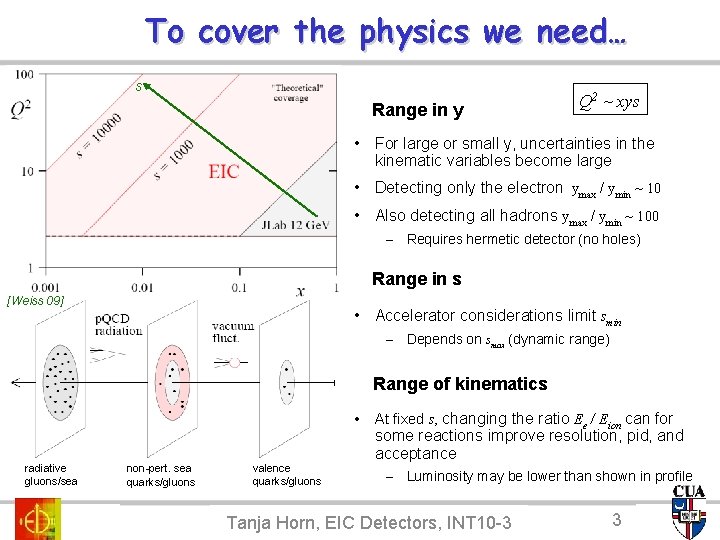
To cover the physics we need… ss Range in y Q 2 ~ xys • For large or small y, uncertainties in the kinematic variables become large • Detecting only the electron ymax / ymin ~ 10 • Also detecting all hadrons ymax / ymin ~ 100 – Requires hermetic detector (no holes) C. Weiss Range in s C. Weiss C. [Weiss 09] • Accelerator considerations limit smin – Depends on smax (dynamic range) Range of kinematics • radiative gluons/sea non-pert. sea quarks/gluons valence quarks/gluons At fixed s, changing the ratio Ee / Eion can for some reactions improve resolution, pid, and acceptance – Luminosity may be lower than shown in profile Tanja Horn, EIC Detectors, INT 10 -3 3
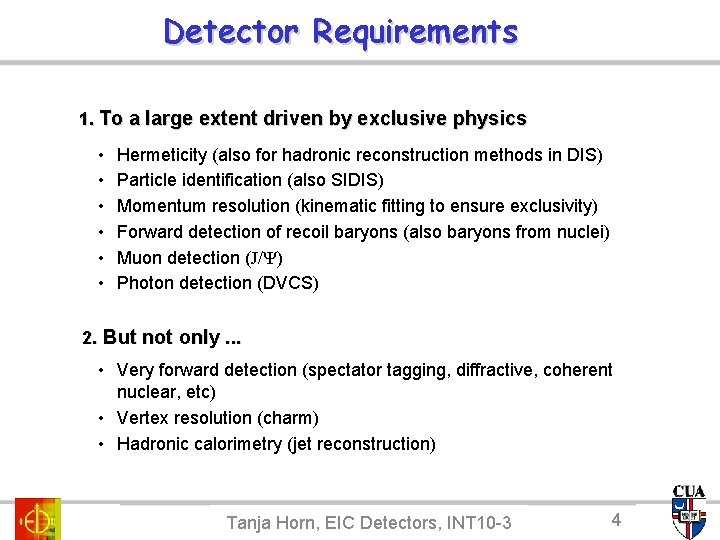
Detector Requirements 1. To a large extent driven by exclusive physics • • • Hermeticity (also for hadronic reconstruction methods in DIS) Particle identification (also SIDIS) Momentum resolution (kinematic fitting to ensure exclusivity) Forward detection of recoil baryons (also baryons from nuclei) Muon detection (J/Ψ) Photon detection (DVCS) 2. But not only. . . • Very forward detection (spectator tagging, diffractive, coherent nuclear, etc) • Vertex resolution (charm) • Hadronic calorimetry (jet reconstruction) Tanja Horn, EIC Detectors, INT 10 -3 4
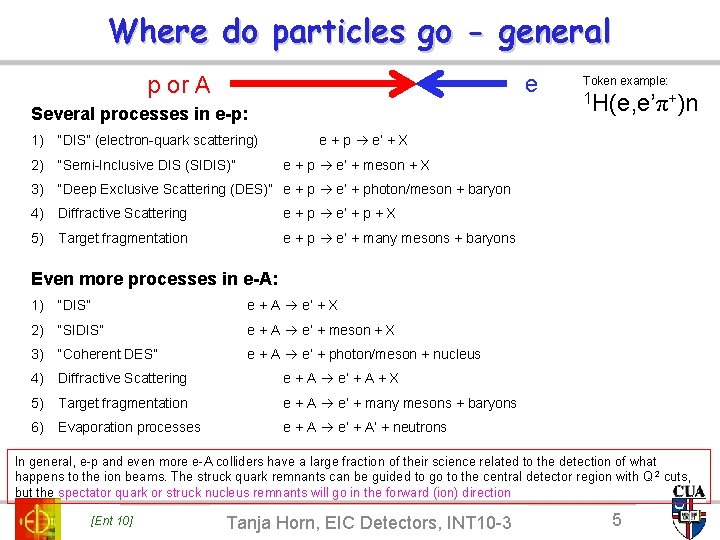
Where do particles go - general e p or A Several processes in e-p: 1) “DIS” (electron-quark scattering) 2) “Semi-Inclusive DIS (SIDIS)” Token example: 1 H(e, e’π+)n e + p e’ + X e + p e’ + meson + X 3) “Deep Exclusive Scattering (DES)” e + p e’ + photon/meson + baryon 4) Diffractive Scattering e + p e’ + p + X 5) Target fragmentation e + p e’ + many mesons + baryons Even more processes in e-A: 1) “DIS” e + A e’ + X 2) “SIDIS” e + A e’ + meson + X 3) “Coherent DES” e + A e’ + photon/meson + nucleus 4) Diffractive Scattering e + A e’ + A + X 5) Target fragmentation e + A e’ + many mesons + baryons 6) Evaporation processes e + A e’ + A’ + neutrons In general, e-p and even more e-A colliders have a large fraction of their science related to the detection of what happens to the ion beams. The struck quark remnants can be guided to go to the central detector region with Q 2 cuts, but the spectator quark or struck nucleus remnants will go in the forward (ion) direction. [Ent 10] Tanja Horn, EIC Detectors, INT 10 -3 5
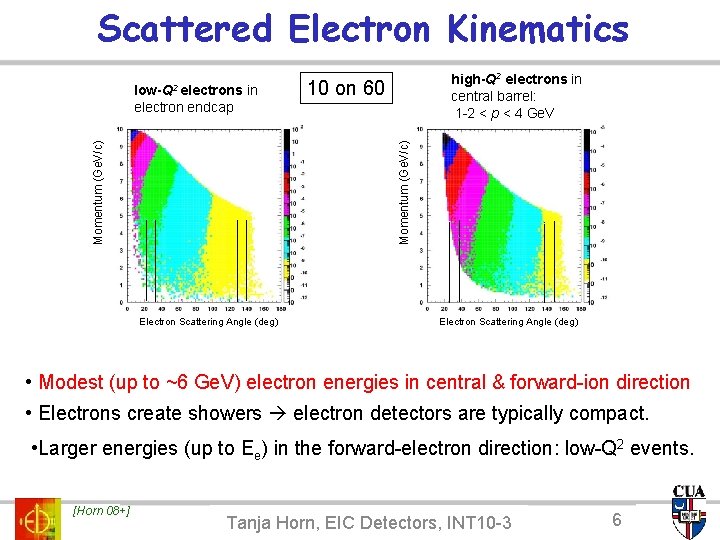
Scattered Electron Kinematics low-Q 2 electrons in high-Q 2 electrons in central barrel: 1 -2 < p < 4 Ge. V 10 on 60 Momentum (Ge. V/c) electron endcap Electron Scattering Angle (deg) • Modest (up to ~6 Ge. V) electron energies in central & forward-ion direction. • Electrons create showers electron detectors are typically compact. • Larger energies (up to Ee) in the forward-electron direction: low-Q 2 events. [Horn 08+] Tanja Horn, EIC Detectors, INT 10 -3 6
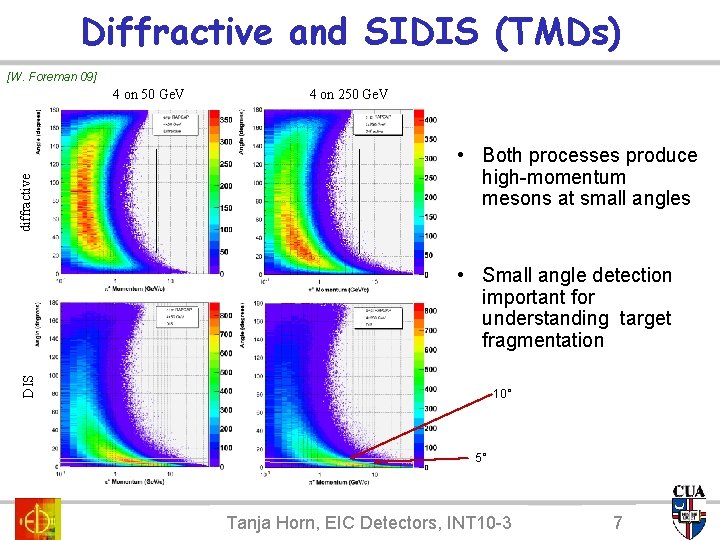
Diffractive and SIDIS (TMDs) [W. Foreman 09] diffractive 4 on 50 Ge. V 4 on 250 Ge. V • Both processes produce high-momentum mesons at small angles DIS • Small angle detection important for understanding target fragmentation 10° 5° Tanja Horn, EIC Detectors, INT 10 -3 7
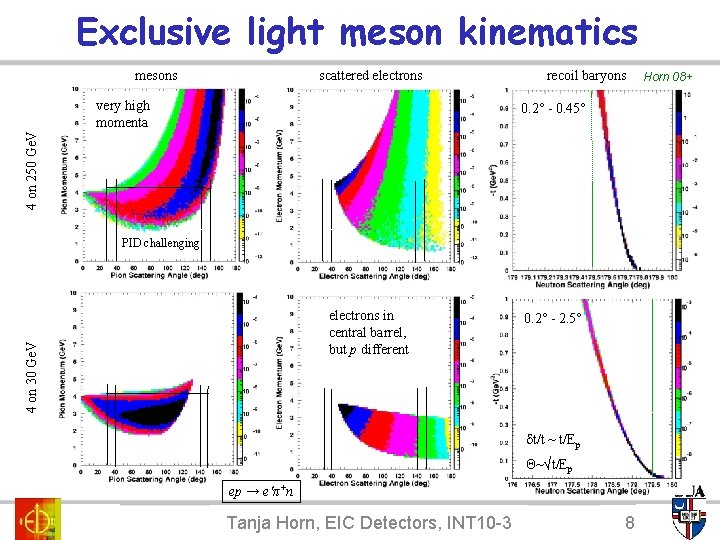
Exclusive light meson kinematics mesons scattered electrons very high momenta recoil baryons 4 on 250 Ge. V 0. 2° - 0. 45° PID challenging 4 on 30 Ge. V electrons in central barrel, but p different 0. 2° - 2. 5° t/t ~ t/Ep Θ~√t/Ep ep → e'π+n Tanja Horn, EIC Detectors, INT 10 -3 8 Horn 08+
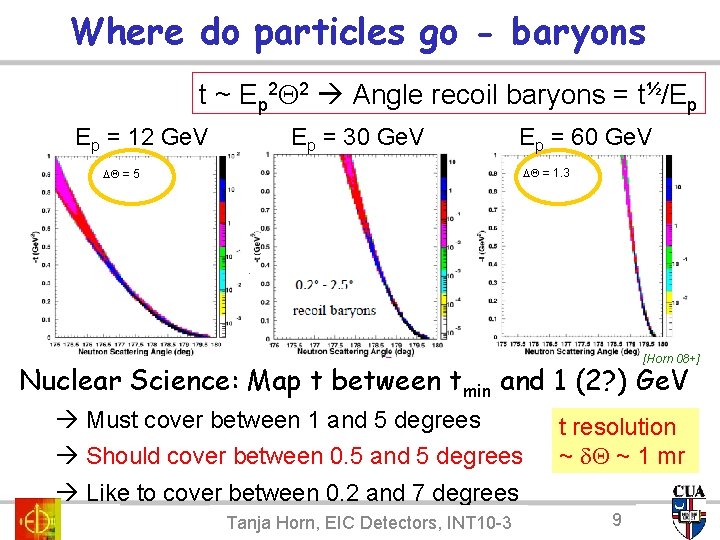
Where do particles go - baryons t ~ Ep 2 Q 2 Angle recoil baryons = t½/Ep Ep = 12 Ge. V Ep = 30 Ge. V Ep = 60 Ge. V DQ = 1. 3 DQ = 5 [Horn 08+] Nuclear Science: Map t between tmin and 1 (2? ) Ge. V Must cover between 1 and 5 degrees Should cover between 0. 5 and 5 degrees Like to cover between 0. 2 and 7 degrees Tanja Horn, EIC Detectors, INT 10 -3 t resolution ~ Q ~ 1 mr 9
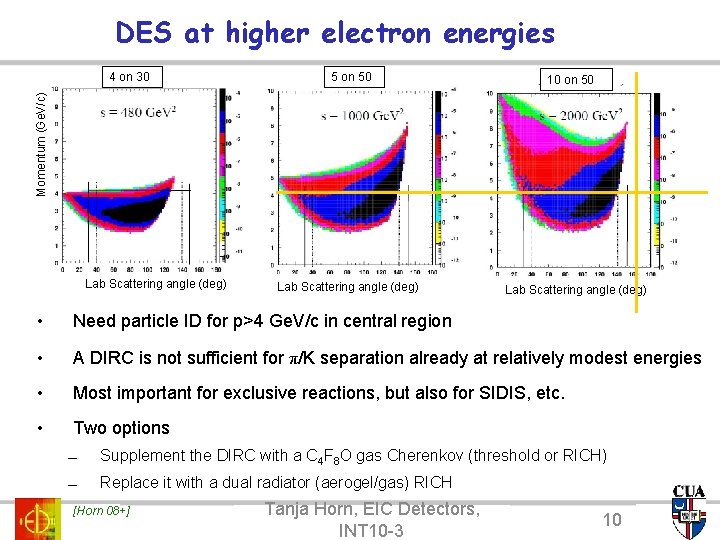
DES at higher electron energies 5 on 50 10 on 50 Momentum (Ge. V/c) 4 on 30 Lab Scattering angle (deg) • Need particle ID for p>4 Ge. V/c in central region • A DIRC is not sufficient for π/K separation already at relatively modest energies • Most important for exclusive reactions, but also for SIDIS, etc. • Two options Supplement the DIRC with a C 4 F 8 O gas Cherenkov (threshold or RICH) Replace it with a dual radiator (aerogel/gas) RICH [Horn 08+] Tanja Horn, EIC Detectors, INT 10 -3 10
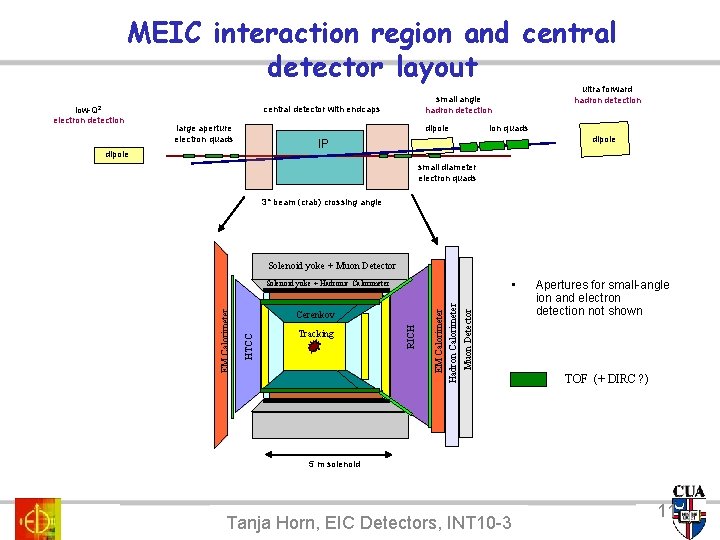
MEIC interaction region and central detector layout central detector with endcaps large aperture electron quads dipole ion quads dipole IP dipole small diameter electron quads 3° beam (crab) crossing angle Solenoid yoke + Muon Detector • Tracking EM Calorimeter Hadron Calorimeter Muon Detector Cerenkov HTCC EM Calorimeter Solenoid yoke + Hadronic Calorimeter RICH low-Q 2 electron detection ultra forward hadron detection small angle hadron detection Apertures for small-angle ion and electron detection not shown TOF (+ DIRC ? ) 5 m solenoid Tanja Horn, EIC Detectors, INT 10 -3 11
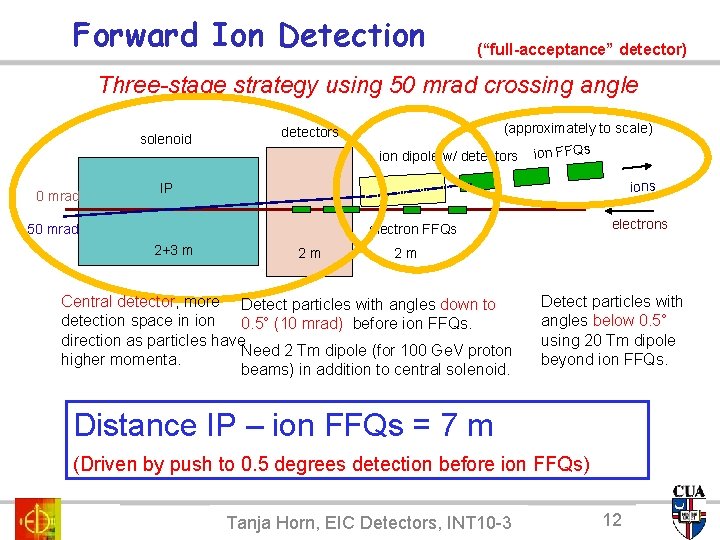
Forward Ion Detection (“full-acceptance” detector) Three-stage strategy using 50 mrad crossing angle solenoid (approximately to scale) detectors ion dipole w/ detectors 0 mrad ion FFQs ions IP 50 mrad electrons electron FFQs 2+3 m 2 m 2 m Central detector, more Detect particles with angles down to detection space in ion 0. 5° (10 mrad) before ion FFQs. direction as particles have Need 2 Tm dipole (for 100 Ge. V proton higher momenta. beams) in addition to central solenoid. Detect particles with angles below 0. 5° using 20 Tm dipole beyond ion FFQs. Distance IP – ion FFQs = 7 m (Driven by push to 0. 5 degrees detection before ion FFQs) Tanja Horn, EIC Detectors, INT 10 -3 12
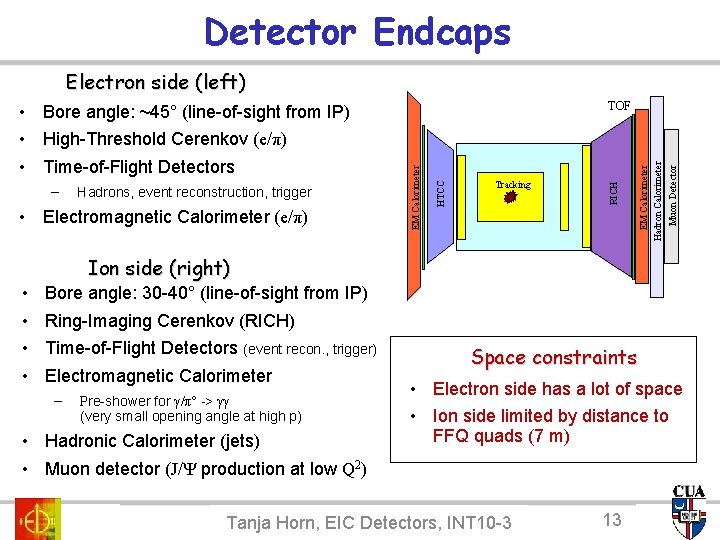
Detector Endcaps Electron side (left) EM Calorimeter Hadron Calorimeter Muon Detector • Electromagnetic Calorimeter (e/π) Tracking RICH Hadrons, event reconstruction, trigger HTCC TOF EM Calorimeter • Bore angle: ~45° (line-of-sight from IP) • High-Threshold Cerenkov (e/π) • Time-of-Flight Detectors Ion side (right) • • Bore angle: 30 -40° (line-of-sight from IP) Ring-Imaging Cerenkov (RICH) Time-of-Flight Detectors (event recon. , trigger) Electromagnetic Calorimeter Pre-shower for γ/π° -> γγ (very small opening angle at high p) • Hadronic Calorimeter (jets) • Muon detector (J/Ψ production at low Q 2) Space constraints • Electron side has a lot of space • Ion side limited by distance to FFQ quads (7 m) Tanja Horn, Introduction to EIC/detector concept, Tanja Exclusive Horn, EIC Detectors, INT 10 -3 Reactions Workshop 2010 13
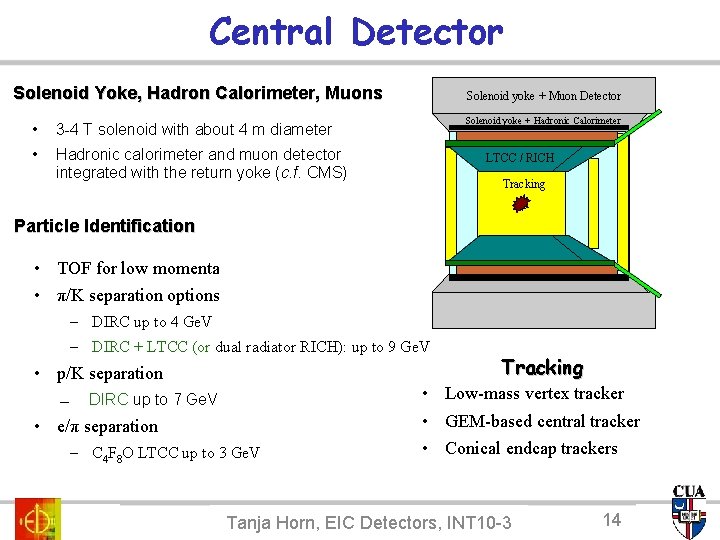
Central Detector Solenoid Yoke, Hadron Calorimeter, Muons • 3 -4 T solenoid with about 4 m diameter • Hadronic calorimeter and muon detector integrated with the return yoke (c. f. CMS) Solenoid yoke + Muon Detector Solenoid yoke + Hadronic Calorimeter LTCC / RICH Tracking Particle Identification • TOF for low momenta • π/K separation options – DIRC up to 4 Ge. V – DIRC + LTCC (or dual radiator RICH): up to 9 Ge. V • p/K separation DIRC up to 7 Ge. V • e/π separation – C 4 F 8 O LTCC up to 3 Ge. V Tracking • Low-mass vertex tracker • GEM-based central tracker • Conical endcap trackers Tanja Horn, Introduction to EIC/detector Tanja Horn, EIC Detectors, INT 10 -3 concept, Exclusive Reactions Workshop 2010 14
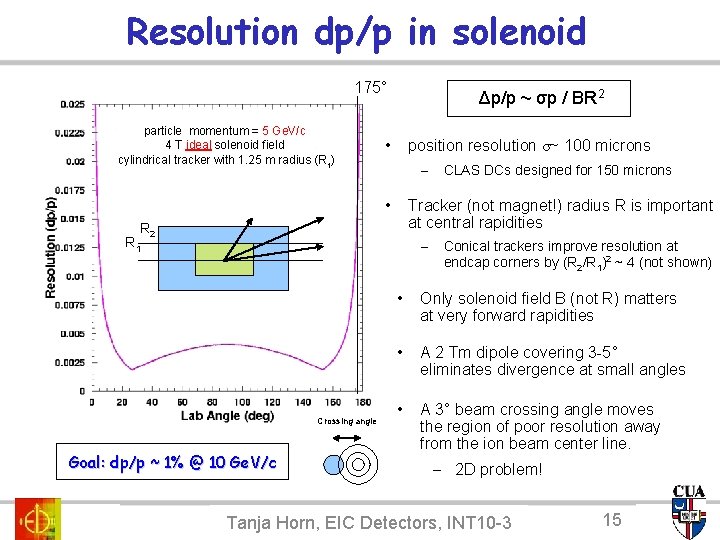
Resolution dp/p in solenoid 175° particle momentum = 5 Ge. V/c 4 T ideal solenoid field cylindrical tracker with 1. 25 m radius (R 1) Δp/p ~ σp / BR 2 • position resolution σ~ 100 microns – • Tracker (not magnet!) radius R is important at central rapidities R 2 R 1 – Crossing angle Goal: dp/p ~ 1% @ 10 Ge. V/c CLAS DCs designed for 150 microns Conical trackers improve resolution at endcap corners by (R 2/R 1)2 ~ 4 (not shown) • Only solenoid field B (not R) matters at very forward rapidities • A 2 Tm dipole covering 3 -5° eliminates divergence at small angles • A 3° beam crossing angle moves the region of poor resolution away from the ion beam center line. – 2 D problem! Tanja Horn, EIC Detectors, INT 10 -3 15
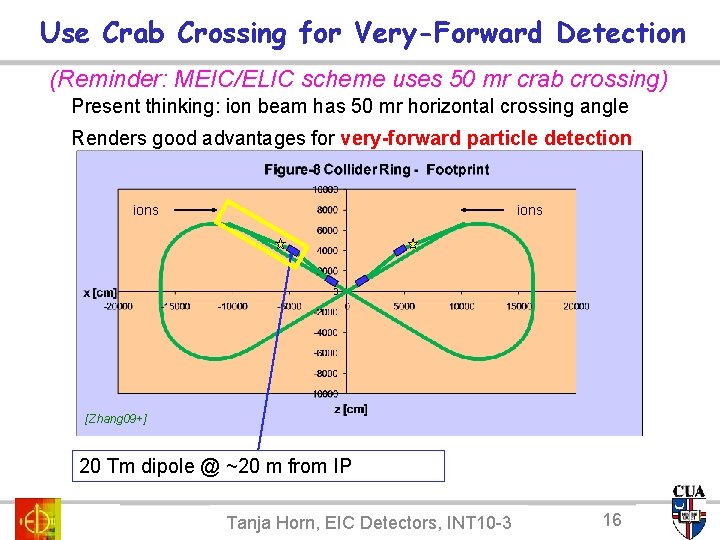
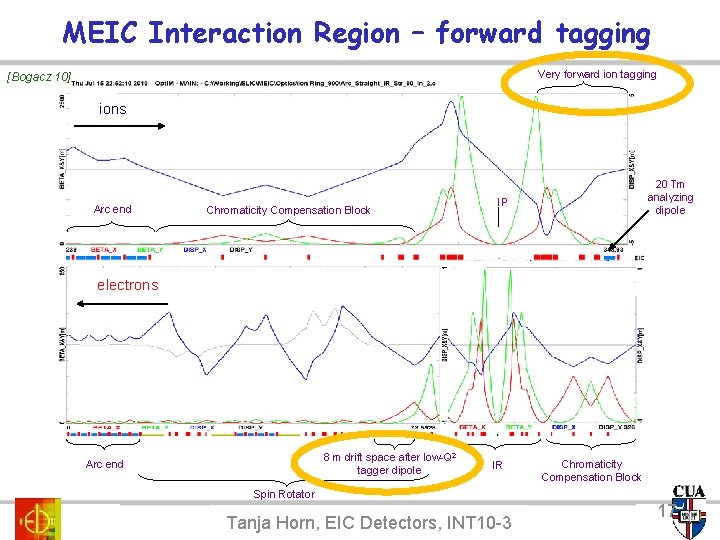
Use Crab Crossing for Very-Forward Detection (Reminder: MEIC/ELIC scheme uses 50 mr crab crossing) Present thinking: ion beam has 50 mr horizontal crossing angle Renders good advantages for very-forward particle detection ions [Zhang 09+] 20 Tm dipole @ ~20 m from IP Tanja Horn, EIC Detectors, INT 10 -3 16
MEIC Interaction Region – forward tagging Very forward ion tagging [Bogacz 10] ions Arc end Chromaticity Compensation Block 20 Tm analyzing dipole IP electrons 8 m drift space after low-Q 2 tagger dipole Arc end IR Chromaticity Compensation Block Spin Rotator Tanja Horn, EIC Detectors, INT 10 -3 17
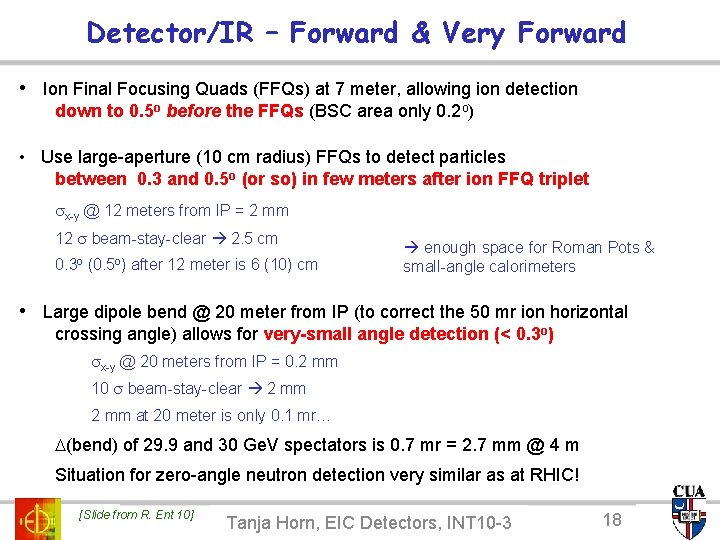
Detector/IR – Forward & Very Forward • Ion Final Focusing Quads (FFQs) at 7 meter, allowing ion detection down to 0. 5 o before the FFQs (BSC area only 0. 2 o) • Use large-aperture (10 cm radius) FFQs to detect particles between 0. 3 and 0. 5 o (or so) in few meters after ion FFQ triplet sx-y @ 12 meters from IP = 2 mm 12 s beam-stay-clear 2. 5 cm 0. 3 o (0. 5 o) after 12 meter is 6 (10) cm enough space for Roman Pots & small-angle calorimeters • Large dipole bend @ 20 meter from IP (to correct the 50 mr ion horizontal crossing angle) allows for very-small angle detection (< 0. 3 o) sx-y @ 20 meters from IP = 0. 2 mm 10 s beam-stay-clear 2 mm at 20 meter is only 0. 1 mr… D(bend) of 29. 9 and 30 Ge. V spectators is 0. 7 mr = 2. 7 mm @ 4 m Situation for zero-angle neutron detection very similar as at RHIC! [Slide from R. Ent 10] Tanja Horn, EIC Detectors, INT 10 -3 18
Backgrounds and detector placement Synchrotron radiation • From arc where electrons exit and magnets on straight section Random hadronic background • Dominated by interaction of beam ions with residual gas in beam pipe between arc and IP • Comparison of MEIC (at s = 4, 000) and HERA (at s = 100, 000) − Distance from ion exit arc to detector: 50 m / 120 m = 0. 4 − Average hadron multiplicity: (4000 / 100000)1/4 = 0. 4 − p-p cross section (fixed target): σ(90 Ge. V) / σ(920 Ge. V) = 0. 7 − At the same ion current and vacuum, MEIC background should be about 10% of HERA o Can run higher ion currents (0. 1 A at HERA) o Good vacuum is easier to maintain in a shorter section of the ring • Backgrounds do not seem to be a major problem for the MEIC − Placing high-luminosity detectors closer to ion exit arc helps with both background types − Signal-to-background will be considerably better at the MEIC than HERA o MEIC luminosity is more than 100 times higher (depending on kinematics) Tanja Horn, EIC Detectors, INT 10 -3 19
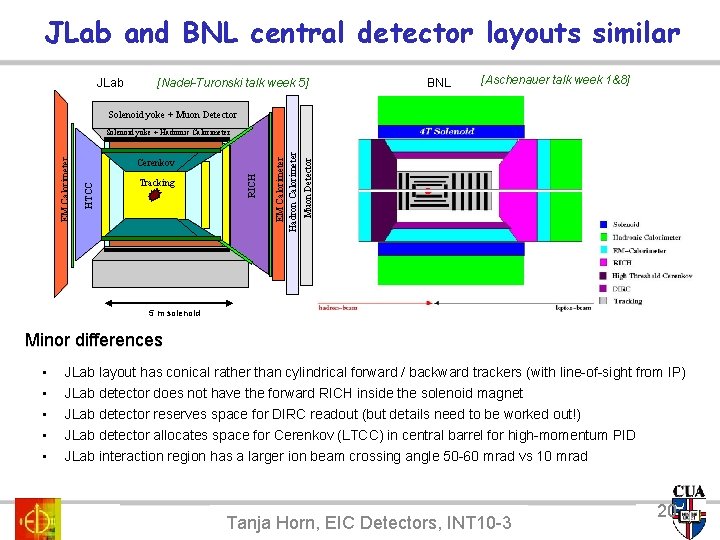
JLab and BNL central detector layouts similar JLab [Nadel-Turonski talk week 5] BNL [Aschenauer talk week 1&8] Solenoid yoke + Muon Detector EM Calorimeter Hadron Calorimeter Muon Detector Tracking RICH Cerenkov HTCC EM Calorimeter Solenoid yoke + Hadronic Calorimeter 5 m solenoid Minor differences • • • JLab layout has conical rather than cylindrical forward / backward trackers (with line-of-sight from IP) JLab detector does not have the forward RICH inside the solenoid magnet JLab detector reserves space for DIRC readout (but details need to be worked out!) JLab detector allocates space for Cerenkov (LTCC) in central barrel for high-momentum PID JLab interaction region has a larger ion beam crossing angle 50 -60 mrad vs 10 mrad Tanja Horn, EIC Detectors, INT 10 -3 20
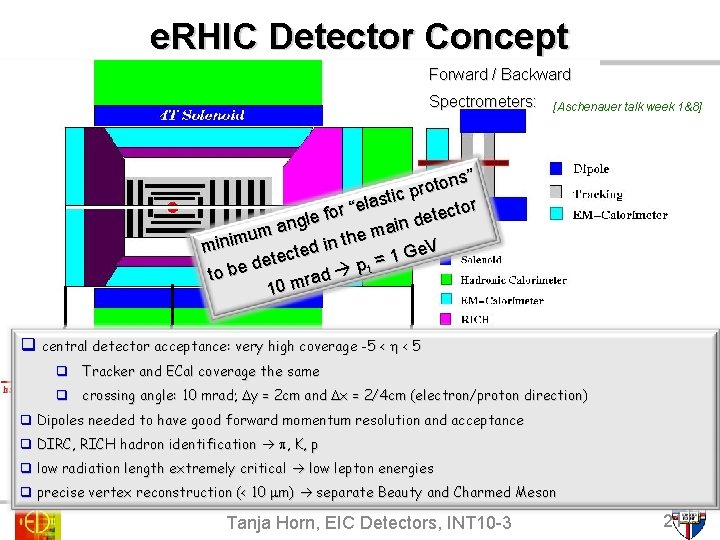
e. RHIC Detector Concept Forward / Backward Spectrometers: [Aschenauer talk week 1&8] ns” o t o r ic p t s a l “e tor r c o e f t e ngle in d a a m m u the n i minim d Ge. V cte 1 e t = e d pt to be d ra 10 m q central detector acceptance: very high coverage -5 < h < 5 q Tracker same 2 m and ECal coverage the 4 m q crossing angle: 10 mrad; Dy = 2 cm and Dx = 2/4 cm (electron/proton direction) q Dipoles needed to have good forward momentum resolution and acceptance q DIRC, RICH hadron identification p, K, p q low radiation length extremely critical low lepton energies q precise vertex reconstruction (< 10 mm) separate Beauty and Charmed Meson Tanja Horn, EIC Detectors, INT 10 -3 21
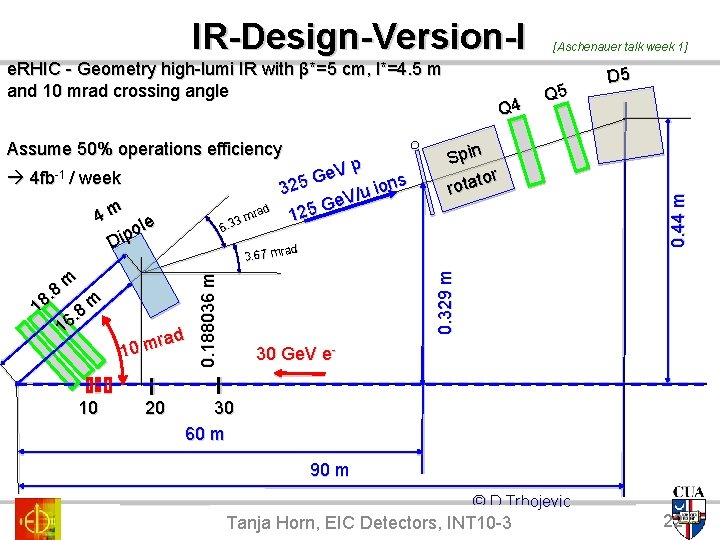
e. RHIC - Geometry high-lumi IR with β*=5 cm, l*=4. 5 m and 10 mrad crossing angle Assume 50% operations efficiency 4 fb-1 / week 4 m le o Dip m 10 rad m 0 1 20 Spin tor rota D 5 0. 329 m m . 8 6 1 Q 5 ad 3. 67 mr 0. 188036 m . 8 8 1 d mra 3 6. 3 Vp e G ns o i 325 u V/ e G 125 Q 4 [Aschenauer talk week 1] 0. 44 m IR-Design-Version-I 30 Ge. V e- 30 60 m 90 m © D. Trbojevic Tanja Horn, EIC Detectors, INT 10 -3 22
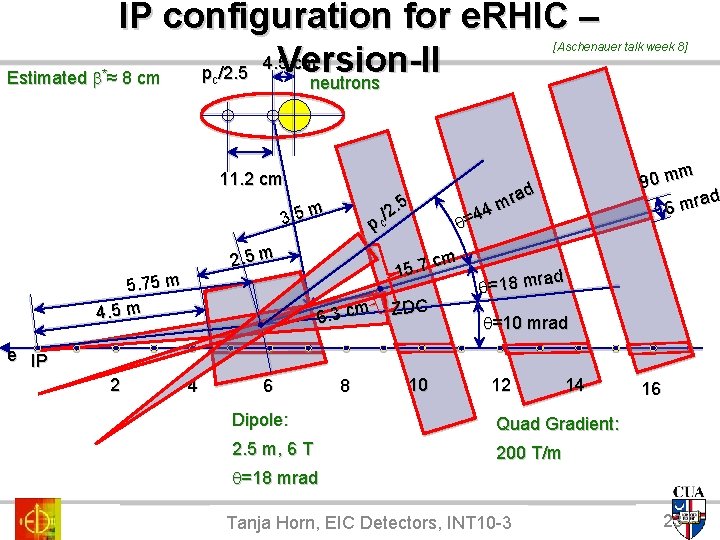
IP configuration for e. RHIC – 4. 5 cm Version-II p /2. 5 Estimated b ≈ 8 cm neutrons [Aschenauer talk week 8] * c 11. 2 cm . 5 /2 3. 5 m pc 2. 5 m 5. 75 m 4. 5 m rad m 4 q =4 cm 15. 7 6. 3 cm ZDC m 90 m ad 6 mr ad q=18 mr q=10 mrad e IP 2 4 6 8 10 12 14 Dipole: Quad Gradient: 2. 5 m, 6 T 200 T/m 16 q=18 mrad Tanja Horn, EIC Detectors, INT 10 -3 23
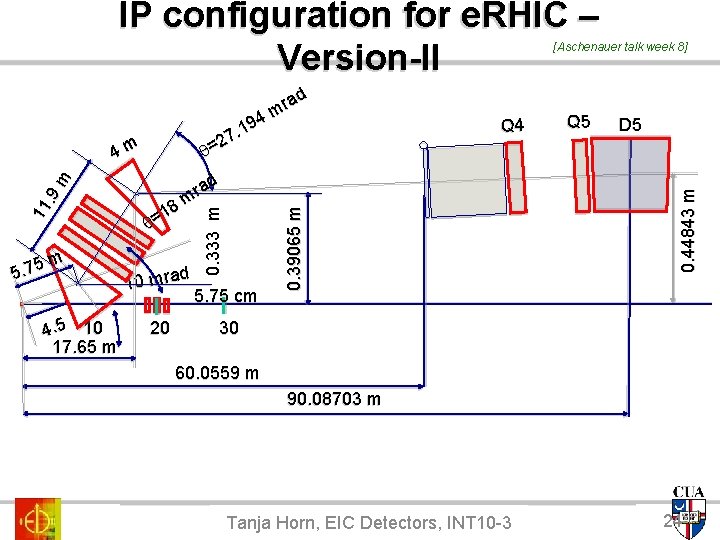
IP configuration for e. RHIC – Version-II [Aschenauer talk week 8] 4. 5 10 17. 65 m d 10 mra 20 5. 75 cm Q 5 D 5 0. 44843 m 5 m 7. 5 ad r 8 m 1 q= 0. 333 m 11. 9 m 4 m Q 4 0. 39065 m ad r 4 m 9. 1 7 2 q= 30 60. 0559 m 90. 08703 m Tanja Horn, EIC Detectors, INT 10 -3 24
Summary • JLab and BNL detector concepts generally similar • Goal: hermetic detector with high resolution over full acceptance • Emphasis on small-angle coverage Three stage approach forward hadron detection • Detector is well suited for a wide range of experiments • Integration with accelerator important Tanja Horn, EIC@JLab - taking nucleon structure Tanja Horn, EIC Detectors, INT 10 -3 beyond the valence region, INT 09 -43 W 25
Backup material Horn, -EIC Tanja Horn, EIC@JLab taking. Detectors, nucleon structure beyond the valence region, INT 10 -3 INT 09 -43 W 26
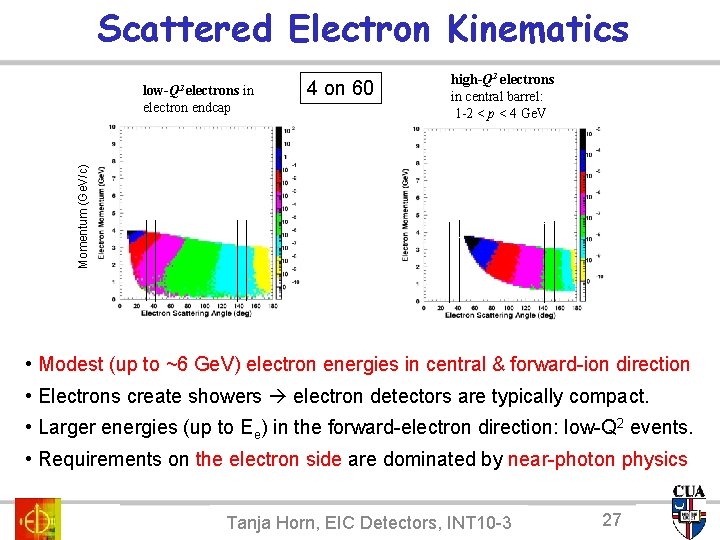
Scattered Electron Kinematics low-Q 2 electrons 4 on 60 Momentum (Ge. V/c) electron endcap in high-Q 2 electrons in central barrel: 1 -2 < p < 4 Ge. V • Modest (up to ~6 Ge. V) electron energies in central & forward-ion direction. • Electrons create showers electron detectors are typically compact. • Larger energies (up to Ee) in the forward-electron direction: low-Q 2 events. • Requirements on the electron side are dominated by near-photon physics: electrons need to be peeled away from beam by tagger magnet(s). Tanja Horn, EIC Detectors, INT 10 -3 27
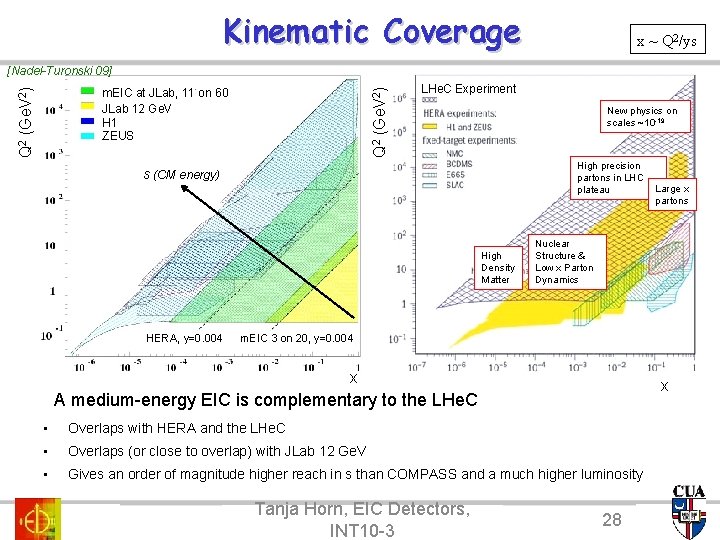
Kinematic Coverage x ~ Q 2/ys [Nadel-Turonski 09] Q 2 (Ge. V 2) m. EIC at JLab, 11 on 60 Ge. V JLab 12 Ge. V H 1 ZEUS LHe. C Experiment New physics on scales ~10 -19 High precision partons in LHC plateau s (CM energy) High Density Matter HERA, y=0. 004 Large x partons Nuclear Structure & Low x Parton Dynamics m. EIC 3 on 20, y=0. 004 x x A medium-energy EIC is complementary to the LHe. C • Overlaps with HERA and the LHe. C • Overlaps (or close to overlap) with JLab 12 Ge. V • Gives an order of magnitude higher reach in s than COMPASS and a much higher luminosity Tanja Horn, EIC Detectors, INT 10 -3 28
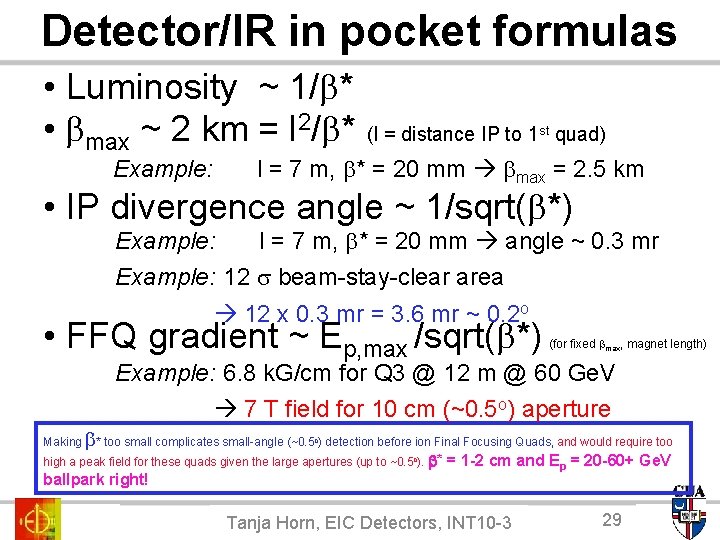
Detector/IR in pocket formulas • Luminosity ~ 1/b* • bmax ~ 2 km = l 2/b* (l = distance IP to 1 st quad) l = 7 m, b* = 20 mm bmax = 2. 5 km Example: • IP divergence angle ~ 1/sqrt(b*) Example: l = 7 m, b* = 20 mm angle ~ 0. 3 mr Example: 12 s beam-stay-clear area • 12 x 0. 3 mr = 3. 6 mr ~ 0. 2 o FFQ gradient ~ Ep, max /sqrt(b*) (for fixed b , magnet length) Example: 6. 8 k. G/cm for Q 3 @ 12 m @ 60 Ge. V max 7 T field for 10 cm (~0. 5 o) aperture Making b* too small complicates small-angle (~0. 5 ) detection before ion Final Focusing Quads, and would require too o high a peak field for these quads given the large apertures (up to ~0. 5 o). b* ballpark right! = 1 -2 cm and Ep = 20 -60+ Ge. V Tanja Horn, EIC Detectors, INT 10 -3 29