ICAT Status Alistair Mills Alistair Millsstfc ac uk
- Slides: 13
ICAT Status Alistair Mills Alistair. Mills@stfc. ac. uk Project Manager Scientific Computing Department
What is ICAT? • A metadata catalogue to manage data – Database (JPA+ support e. g. Oracle, My. Sql); – Web Service API (developed in Java, running in Glassfish, usable in various languages). • To allow high-quality – – Registration of data as it is collected in experiments; Discovery of data based on what it was collected for; Access to the data, according to some policy; Association of data with other resources. • Moving towards the ICAT Toolkit – Pluggable component architecture; – Supporting different tasks.
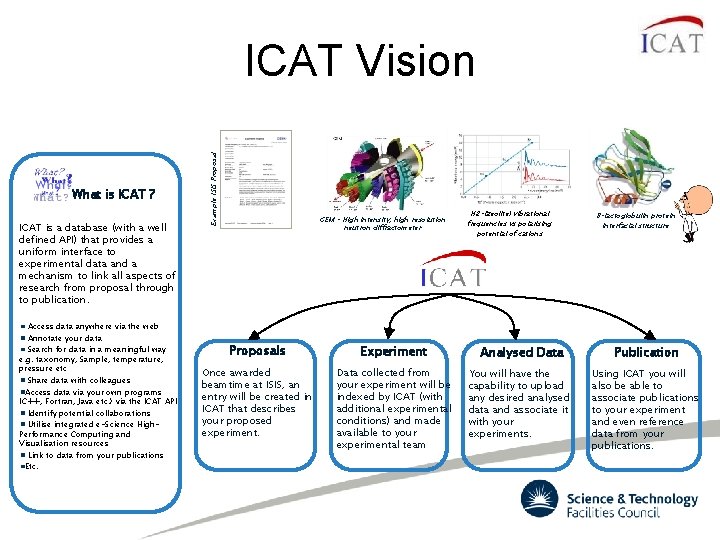
What is ICAT ? ICAT is a database (with a well defined API) that provides a uniform interface to experimental data and a mechanism to link all aspects of research from proposal through to publication. Access data anywhere via the web Annotate your data Search for data in a meaningful way e. g. taxonomy, Sample, temperature, pressure etc Share data with colleagues Access data via your own programs (C++, Fortran, Java etc. ) via the ICAT API Identify potential collaborations Utilise integrated e-Science High. Performance Computing and Visualisation resources Link to data from your publications Etc. ICAT Vision Example ISIS Proposal Damian Flannery GEM – High intensity, high resolution neutron diffractometer H 2 -(zeolite) vibrational frequencies vs polarising potential of cations B-lactoglobulin protein interfacial structure Proposals Experiment Analysed Data Publication Once awarded beamtime at ISIS, an entry will be created in ICAT that describes your proposed experiment. Data collected from your experiment will be indexed by ICAT (with additional experimental conditions) and made available to your experimental team You will have the capability to upload any desired analysed data and associate it with your experiments. Using ICAT you will also be able to associate publications to your experiment and even reference data from your publications.
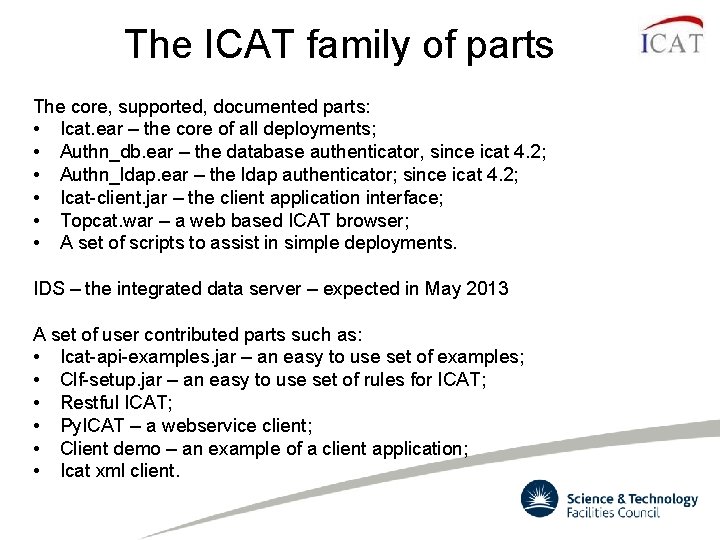
The ICAT family of parts The core, supported, documented parts: • Icat. ear – the core of all deployments; • Authn_db. ear – the database authenticator, since icat 4. 2; • Authn_ldap. ear – the ldap authenticator; since icat 4. 2; • Icat-client. jar – the client application interface; • Topcat. war – a web based ICAT browser; • A set of scripts to assist in simple deployments. IDS – the integrated data server – expected in May 2013 A set of user contributed parts such as: • Icat-api-examples. jar – an easy to use set of examples; • Clf-setup. jar – an easy to use set of rules for ICAT; • Restful ICAT; • Py. ICAT – a webservice client; • Client demo – an example of a client application; • Icat xml client.
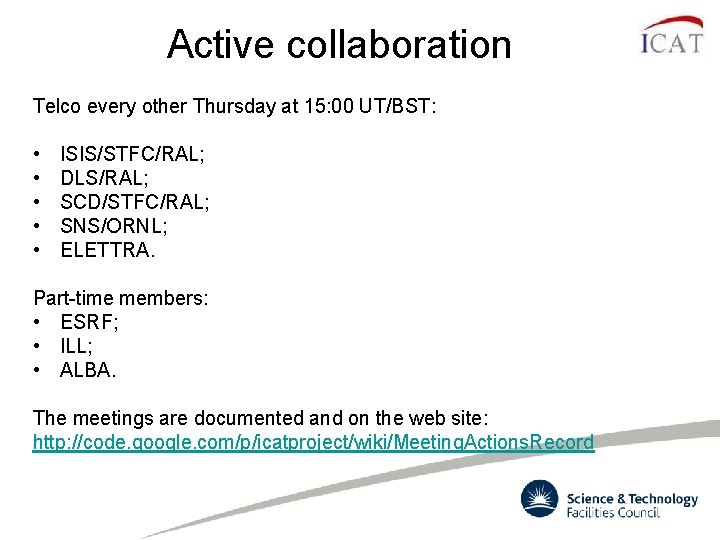
Active collaboration Telco every other Thursday at 15: 00 UT/BST: • • • ISIS/STFC/RAL; DLS/RAL; SCD/STFC/RAL; SNS/ORNL; ELETTRA. Part-time members: • ESRF; • ILL; • ALBA. The meetings are documented and on the web site: http: //code. google. com/p/icatproject/wiki/Meeting. Actions. Record
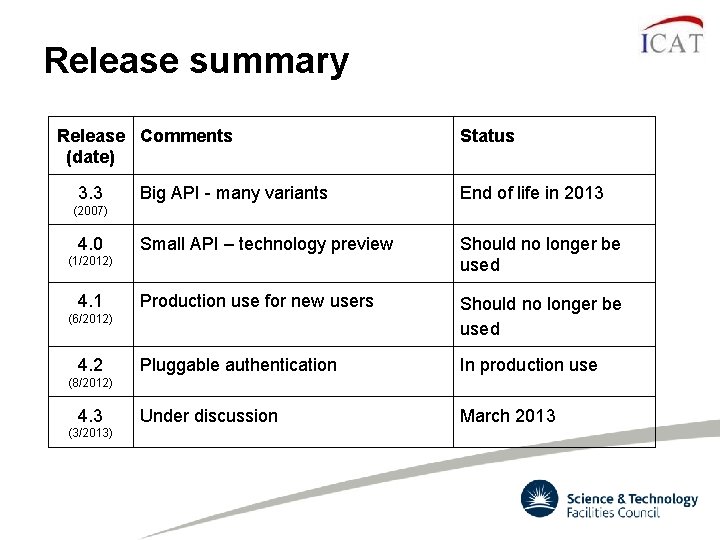
Release summary Release Comments (date) 3. 3 Status Big API - many variants End of life in 2013 Small API – technology preview Should no longer be used Production use for new users Should no longer be used Pluggable authentication In production use Under discussion March 2013 (2007) 4. 0 (1/2012) 4. 1 (6/2012) 4. 2 (8/2012) 4. 3 (3/2013)
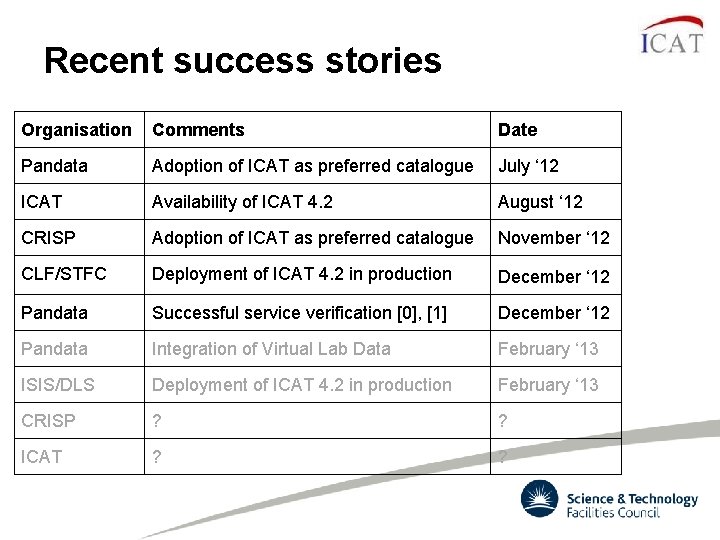
Recent success stories Organisation Comments Date Pandata Adoption of ICAT as preferred catalogue July ‘ 12 ICAT Availability of ICAT 4. 2 August ‘ 12 CRISP Adoption of ICAT as preferred catalogue November ‘ 12 CLF/STFC Deployment of ICAT 4. 2 in production December ‘ 12 Pandata Successful service verification [0], [1] December ‘ 12 Pandata Integration of Virtual Lab Data February ‘ 13 ISIS/DLS Deployment of ICAT 4. 2 in production February ‘ 13 CRISP ? ? ICAT ? ?
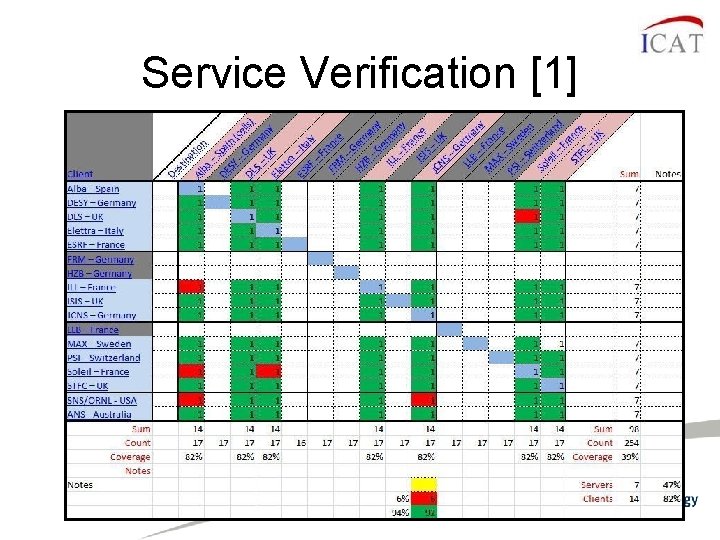
Service Verification [1]
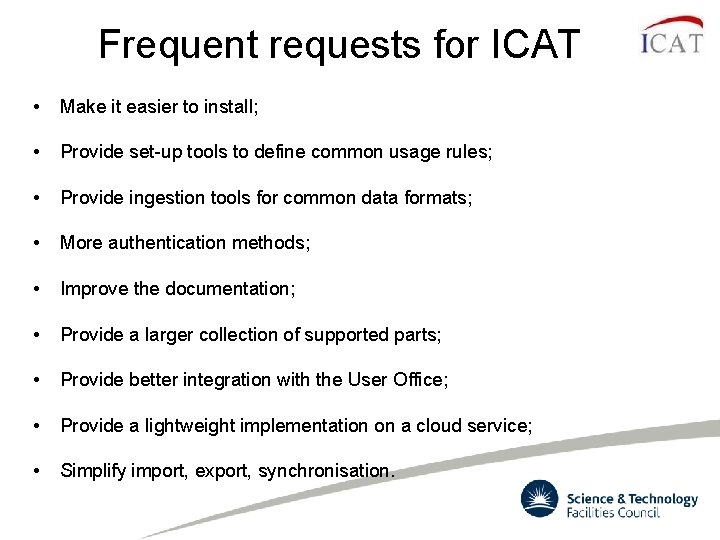
Frequent requests for ICAT • Make it easier to install; • Provide set-up tools to define common usage rules; • Provide ingestion tools for common data formats; • More authentication methods; • Improve the documentation; • Provide a larger collection of supported parts; • Provide better integration with the User Office; • Provide a lightweight implementation on a cloud service; • Simplify import, export, synchronisation.
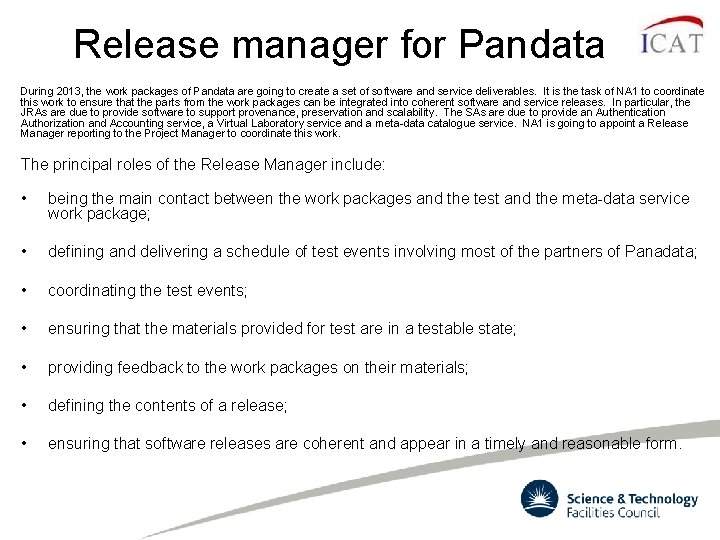
Release manager for Pandata During 2013, the work packages of Pandata are going to create a set of software and service deliverables. It is the task of NA 1 to coordinate this work to ensure that the parts from the work packages can be integrated into coherent software and service releases. In particular, the JRAs are due to provide software to support provenance, preservation and scalability. The SAs are due to provide an Authentication Authorization and Accounting service, a Virtual Laboratory service and a meta-data catalogue service. NA 1 is going to appoint a Release Manager reporting to the Project Manager to coordinate this work. The principal roles of the Release Manager include: • being the main contact between the work packages and the test and the meta-data service work package; • defining and delivering a schedule of test events involving most of the partners of Panadata; • coordinating the test events; • ensuring that the materials provided for test are in a testable state; • providing feedback to the work packages on their materials; • defining the contents of a release; • ensuring that software releases are coherent and appear in a timely and reasonable form.
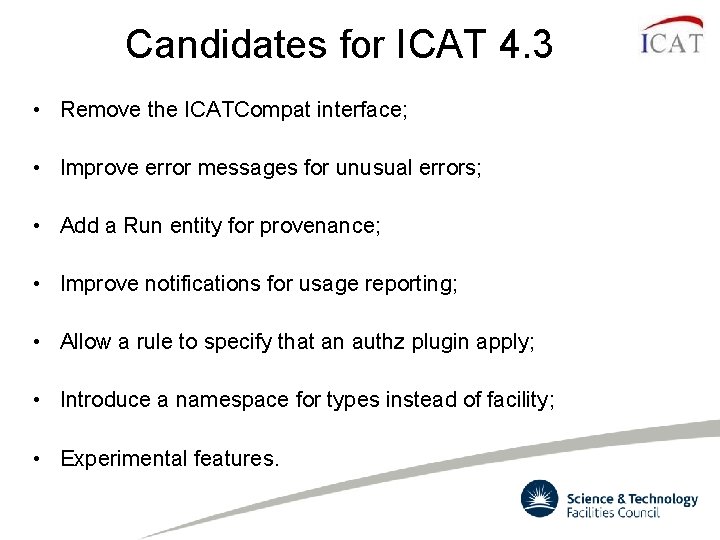
Candidates for ICAT 4. 3 • Remove the ICATCompat interface; • Improve error messages for unusual errors; • Add a Run entity for provenance; • Improve notifications for usage reporting; • Allow a rule to specify that an authz plugin apply; • Introduce a namespace for types instead of facility; • Experimental features.
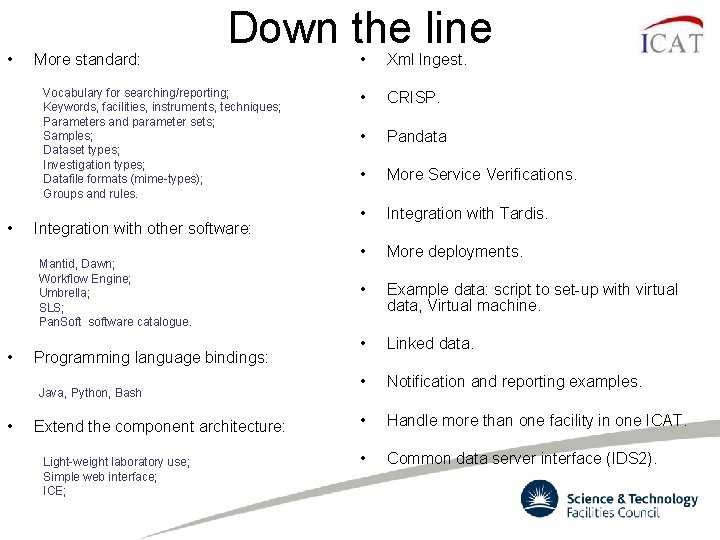
• More standard: Down the line Vocabulary for searching/reporting; Keywords, facilities, instruments, techniques; Parameters and parameter sets; Samples; Dataset types; Investigation types; Datafile formats (mime-types); Groups and rules. • Integration with other software: Mantid, Dawn; Workflow Engine; Umbrella; SLS; Pan. Soft software catalogue. • Programming language bindings: Java, Python, Bash • Extend the component architecture: Light-weight laboratory use; Simple web interface; ICE; • Xml Ingest. • CRISP. • Pandata • More Service Verifications. • Integration with Tardis. • More deployments. • Example data: script to set-up with virtual data, Virtual machine. • Linked data. • Notification and reporting examples. • Handle more than one facility in one ICAT. • Common data server interface (IDS 2).
Feedback • What do you need? • What would you like to see? • What can you contribute? http: //www. icatproject. org/ http: //code. google. com/p/icatproject/