Human Origins and Antiquity ANTH 1210 Section A
- Slides: 41
Human Origins and Antiquity ANTH 1210 Section A 01 Instructor: Dr. Amanda Blackburn
Syllabus • Available on JUMP • Login - Courses - ANTH 1210 – Files - Human Origins Syllabus A 01
Contact Info • Office Hours Tuesday 1: 00 – 2: 00 pm, or by appointment 448 University College • Email: Amanda. Blackburn@umanitoba. ca
Topics Covered • Physical anthropology and archaeology
Topics Covered • Biological evolution
Topics Covered • Evolution and comparative behaviour of nonhuman primates
Topics Covered • Human evolution
Topics Covered • Emergence of human culture
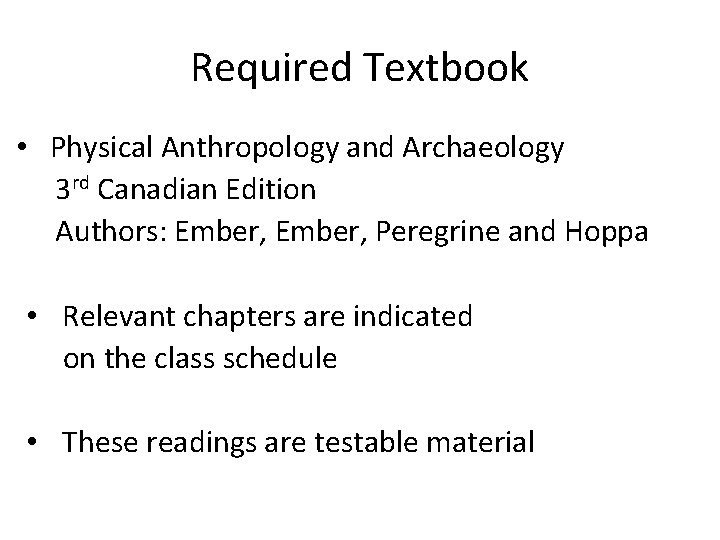
Required Textbook • Physical Anthropology and Archaeology 3 rd Canadian Edition Authors: Ember, Peregrine and Hoppa • Relevant chapters are indicated on the class schedule • These readings are testable material
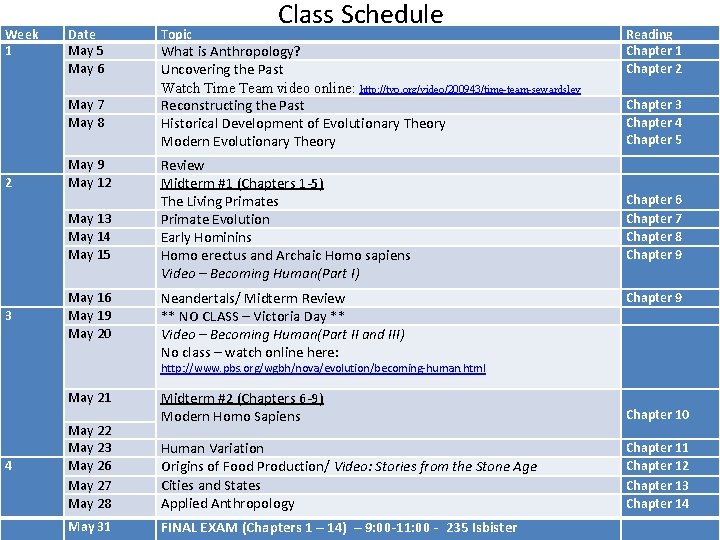
Week 1 Date May 5 May 6 May 7 May 8 2 May 9 May 12 May 13 May 14 May 15 3 May 16 May 19 May 20 Topic Class Schedule What is Anthropology? Uncovering the Past Watch Time Team video online: http: //tvo. org/video/200943/time-team-sewardsley Reconstructing the Past Historical Development of Evolutionary Theory Modern Evolutionary Theory Review Midterm #1 (Chapters 1 -5) The Living Primates Primate Evolution Early Hominins Homo erectus and Archaic Homo sapiens Video – Becoming Human(Part I) Neandertals/ Midterm Review ** NO CLASS – Victoria Day ** Video – Becoming Human(Part II and III) No class – watch online here: Reading Chapter 1 Chapter 2 Chapter 3 Chapter 4 Chapter 5 Chapter 6 Chapter 7 Chapter 8 Chapter 9 http: //www. pbs. org/wgbh/nova/evolution/becoming-human. html May 21 4 May 22 May 23 May 26 May 27 May 28 May 31 Midterm #2 (Chapters 6 -9) Modern Homo Sapiens Chapter 10 Human Variation Origins of Food Production/ Video: Stories from the Stone Age Cities and States Applied Anthropology Chapter 11 Chapter 12 Chapter 13 Chapter 14 FINAL EXAM (Chapters 1 – 14) – 9: 00 -11: 00 - 235 Isbister
Powerpoint • Check JUMP for lecture outlines…if you’re reading this you already have
Exams • Two 50 minute midterm exams during regular class time May 12 th (25%) May 21 st (25%) • Final exam, May 31 st 9: 00 -11: 00 am - 235 Isbister - (50%) – cumulative • Format is multiple choice for midterms and exam
Testable Material • Powerpoint notes • Lecture material • Assigned readings from chapters • Any videos watched in class or assigned on the syllabus
Midterm Results • Results will be available via the course site on Desire 2 Learn (D 2 L) • DO NOT contact me using the email function on D 2 L – use my regular email address • Tests will not be returned. If you wish to view your test, please make an appointment with the instructor.
Voluntary Withdrawal • May 22 th – last day to withdraw without academic penalty • You will receive 25% of your final grade by that date
How to do well in this class • • Show up Pay attention Take lecture notes Read the textbook • Academic Learning Center
As a Courtesy to Other Students in this Class • Please do not use your cellphones during class • Please only use laptops to take notes (not to check Facebook, Tweet how bored you are, etc) • Please try not to arrive late or leave early as it is distracting to everyone
Anthropology The study of humankind, viewed from a perspective of all people and all times • “Anthropos” and “Logos”
Franz Boas (1858 -1942) • Father of North American Anthropology • Understating populations from different perspectives (biological and cultural) • 1883 expedition to Baffin Island • Holistic approach → 4 fields of anthropology
Franz Boas’ Baffin Island Expedition
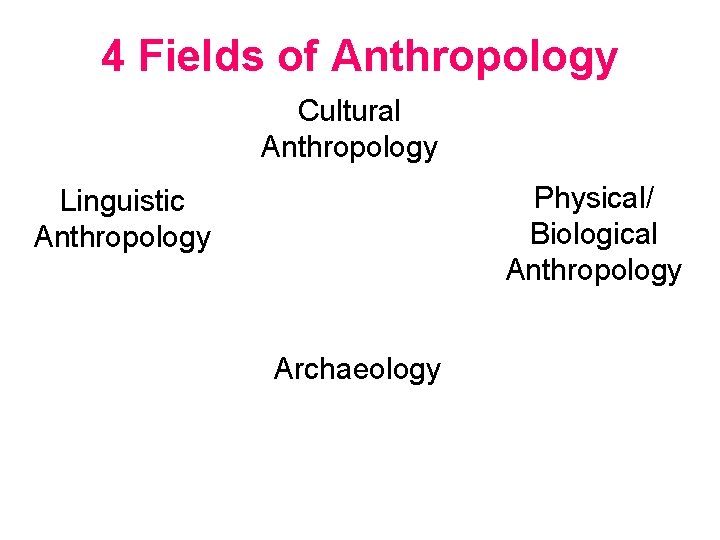
4 Fields of Anthropology Cultural Anthropology Physical/ Biological Anthropology Linguistic Anthropology Archaeology
Linguistic Anthropology The study of the construction and use of language by human societies • What is language? → set of written or spoken symbols that refer to things (people, places, concepts) → transfer of knowledge • Sociolinguistics
Cultural Anthropology The study of present day peoples and their culture • What is Culture? → learned behaviour that is transmitted from person to person • Margaret Mead 1978) (1901 -
“Never doubt that a small group of committed people can change the world. Indeed, it is the only thing that ever has. ”
Archaeology The study of past human societies, focusing specifically on material remains • Artifacts and settlements • Plant and animal remains • Behaviours • Cultural anthropologists the past of
Archaeology “Back From Yet Another Globetrotting Adventure, Indiana Jones Checks His Mail And Discovers That His Bid For Tenure Has Been Denied” http: //www. mcsweeneys. net/articles/back-from-yet-another-globetrotting-adventure-indiana-jones-checks-his-mail-and-discovers-that-his-bid-fortenure-has-been-denied
Physical/Biological Anthropology The study of all aspects of past and present human biology • Human evolution and variation among living and past humans and their ancestors • Skeletal studies, primatology, forensics, genetics, palaeoanthropology
Physical/Biological Anthropology • "I am a primate; nothing about primates is irrelevant to me. " ~ John Russell Napier (1917 -1987)
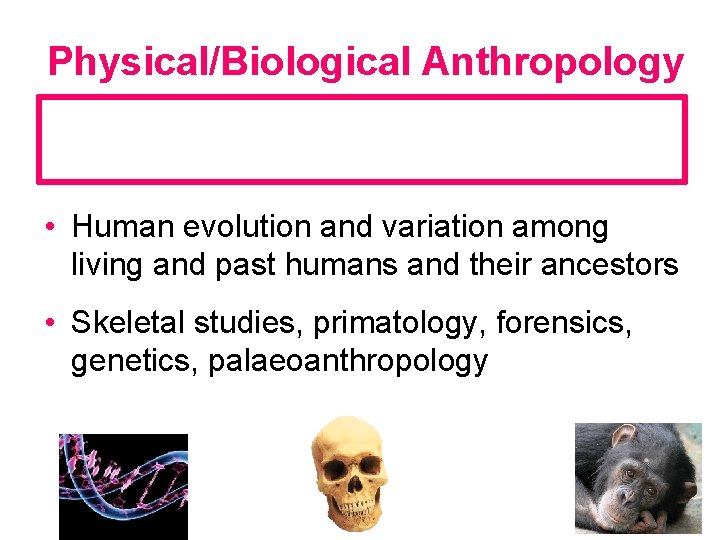
Physical/Biological Anthropology The study of all aspects of past and present human biology • Human evolution and variation among living and past humans and their ancestors • Skeletal studies, primatology, forensics, genetics, palaeoanthropology
Biocultural Approach
More Specifically. . . The study of human biological variation AND the study of human biocultural variation 1. Product of evolutionary history 2. Product of individual life history
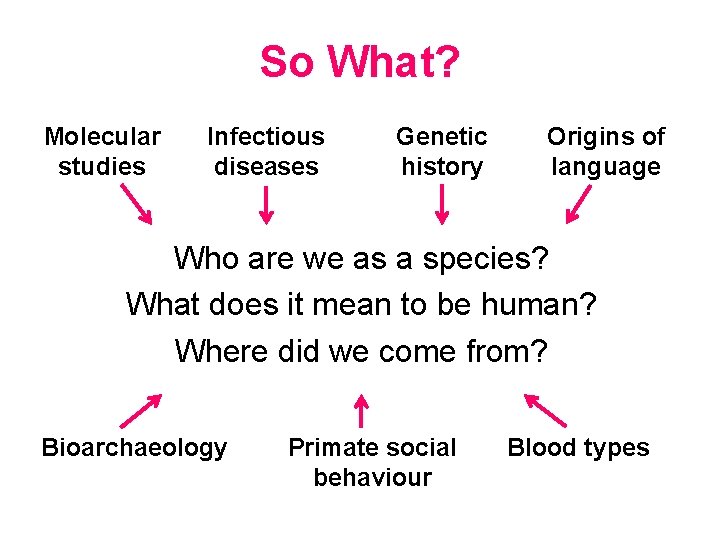
So What? Molecular studies Infectious diseases Genetic history Origins of language Who are we as a species? What does it mean to be human? Where did we come from? Bioarchaeology Primate social behaviour Blood types
What Makes Us Different? • Part of the animal kingdom NOT removed! • 6 key attributes that us unique make
1. Bipedalism • Upright walking on 2 feet • Most profound difference • Benefits? • Drawbacks?
2. Nonhoning Chewing • Loss of large canine, primates usually have this to shred their food • Ability to make and use tools led to its loss in human ancestors
3. Culture • Facilitates our survival by enabling us to adapt to different settings • Could we live without technology?
Culture in Other Primates
4. Hunting • Social behaviour • Organization that uses tools • Origins approximately 1 million years ago
5. Speech • Only animal to communicate by talking • Difficult to track history • Must rely on skeletal changes • Hyoid
6. Domestication of Food • 10, 000 – 11, 000 years before present • Plants and animals • Uniquely human • Profound effect on human biology and behaviour
Review • What is anthropology? • What is physical anthropology? • What is the biocultural approach? • What are the 6 attributes that make humans unique?