How To Preach Ps Claudius Morgan Preaching and












- Slides: 44
How To Preach Ps. Claudius Morgan
Preaching and the Spirit The Bible says that Jesus came preaching in the power of the Spirit. Luke 4: 18
To preach today in Jesus’ name and to do so with power, still requires the enabling presence of the Holy Spirit.
Before a person preaches he/she needs the anointing! Jesus had it and we need it too. Acts 10: 36 - 38
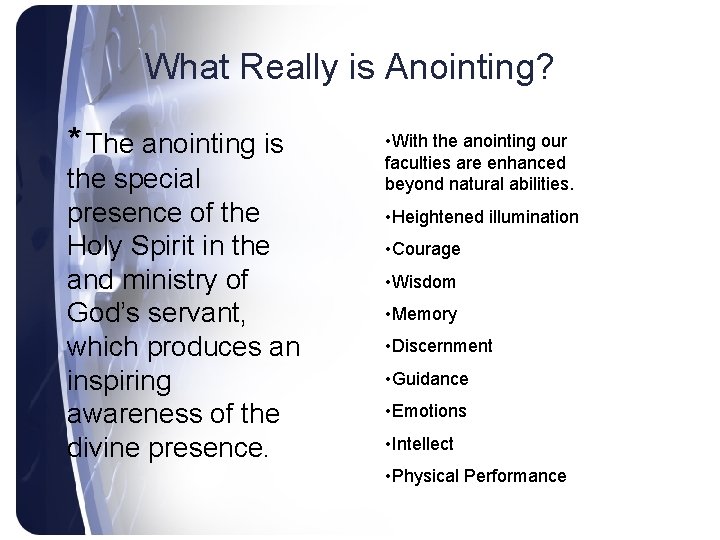
What Really is Anointing? * The anointing is the special presence of the Holy Spirit in the and ministry of God’s servant, which produces an inspiring awareness of the divine presence. • With the anointing our faculties are enhanced beyond natural abilities. • Heightened illumination • Courage • Wisdom • Memory • Discernment • Guidance • Emotions • Intellect • Physical Performance
With the full understanding of the anointing the question is not what Preaching is, but what it is supposed to be.
Preaching should be an event in which the living Word of God is proclaimed in the power of the Holy Spirit.
In addition, preaching is a dynamic, divine human interaction in which the people of God are nourished for the journey of life, challenged and empowered to serve and to celebrate the present and coming Kingdom of God.
The preparation of a sermon includes serious effort at effective reading of the Scriptures.
Approaching the Bible There are many ways to study the Bible. However, the one who plans to use the Bible as the main tool in preaching, should consider two approaches.
Inductive and Deductive Approach Induction • Discovers new knowledge • Accumulates the facts • Explores • Asks questions • Discovers the truth Deduction • Clarifies it • Asserts the general concepts • Explains • Asserts Answers • Declares propoganda
The Gospel Preacher holds truth in such high esteem, he must declare God’s message deductively after he has explored it inductively. Ralph L. Lewis, Inductive Preaching, 1985
In reality a sermon begins with an idea. This idea must drive you to the Bible to find a text (textual), a passage (expository) or several texts to support your theme (topical).
As soon as you identify the text(s) you wish to use, begin with Inductive study. You must not use any other secondary source until you have consulted thoroughly the primary source – Bible.
Inductive Bible Study consists of three components or parts. • Observation – • Interpretation – What does the passage say? What does the passage mean? • Application – How does the meaning of the passage apply to me?
Inductive Bible study is not writing the sermon. It is making preparations for its construction.
Accurate Interpretation And correct Application rest on The accuracy of your Observation. You must therefore begin your inductive study with prayer.
The prayer I recommend is called: Kenotic Meditation: I comes from the Greek word Kenosis found in Phil. 2: 5 – 7. It is the emptying of everything so that Christ can fill us.
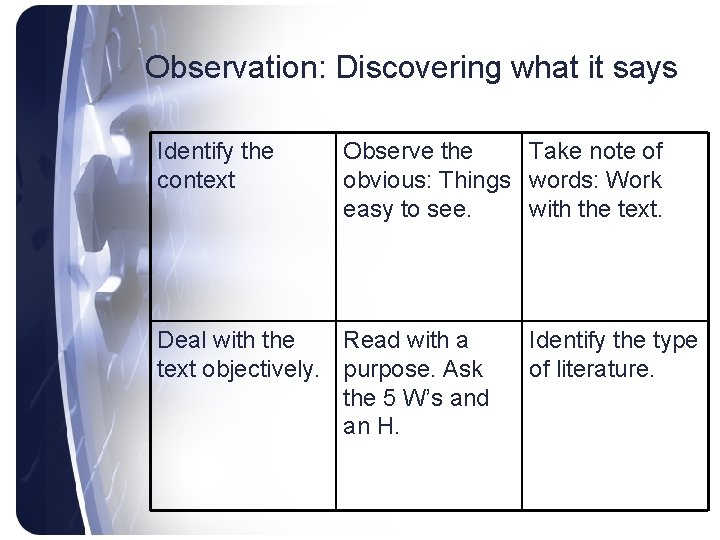
Observation: Discovering what it says Identify the context Observe the Take note of obvious: Things words: Work easy to see. with the text. Deal with the Read with a text objectively. purpose. Ask the 5 W’s and an H. Identify the type of literature.
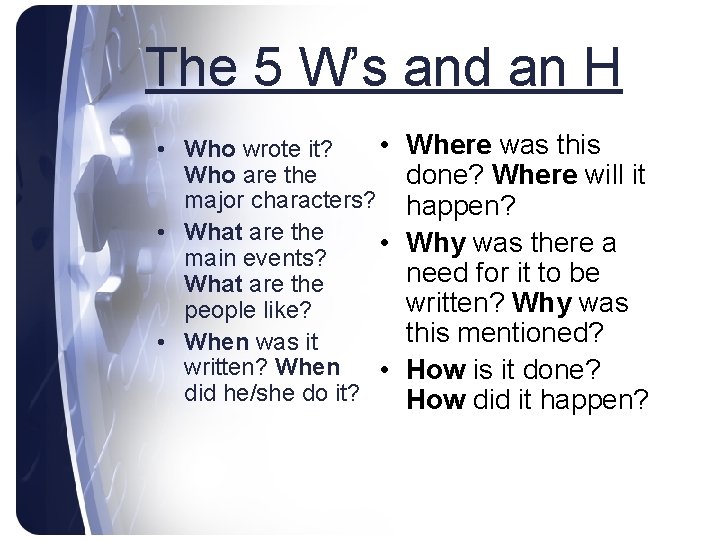
The 5 W’s and an H • • Who wrote it? Who are the major characters? • What are the • main events? What are the people like? • When was it written? When • did he/she do it? Where was this done? Where will it happen? Why was there a need for it to be written? Why was this mentioned? How is it done? How did it happen?
It is now time to write the sermon. What is the first thing you start with?
Objective or Aim What am I hoping to achieve in this Spiritual presentation?
After the objective comes the subject • The subject deals • The type of sermon with what aspect of that you will be writing the Bible you will determine when be focusing on. Example – Stewardship, 2 nd Coming Conversion you deal with your topic should follow. If it is expository, you’ll get a more explosive topic after completing the sermon.
Things to bear in mind • Illustrations. • Clarity and Coherence. One of the keys to clarity is simplicity. • Delivery EGW “The preacher should present the truth simple manner. ” GW pg. 170 in a clear
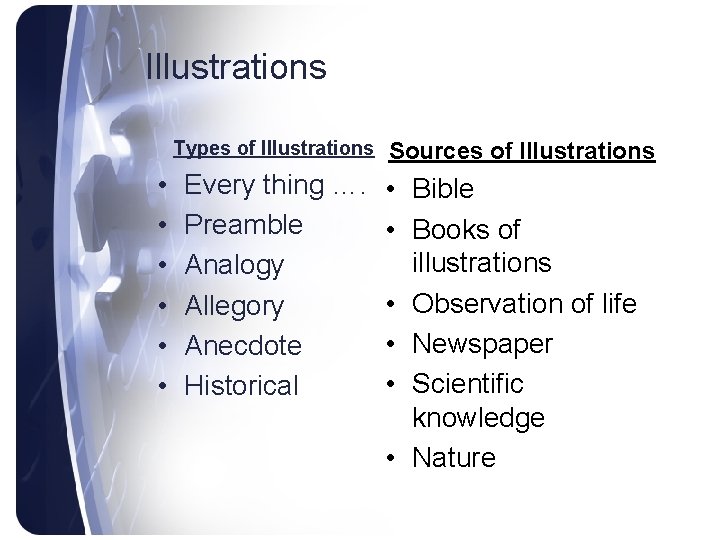
Illustrations Types of Illustrations • • • Every thing …. Preamble Analogy Allegory Anecdote Historical Sources of Illustrations • Bible • Books of illustrations • Observation of life • Newspaper • Scientific knowledge • Nature
Rules Concerning Illustrations Keep the dignity of the pulpit Avoid stale illustrations Never explain an illustration Seek variety. Be careful of allusions to people They are to crystallize the point, not to make people laugh.
Clarity and Coherence The greatest challenge of preaching is making the profound simple.
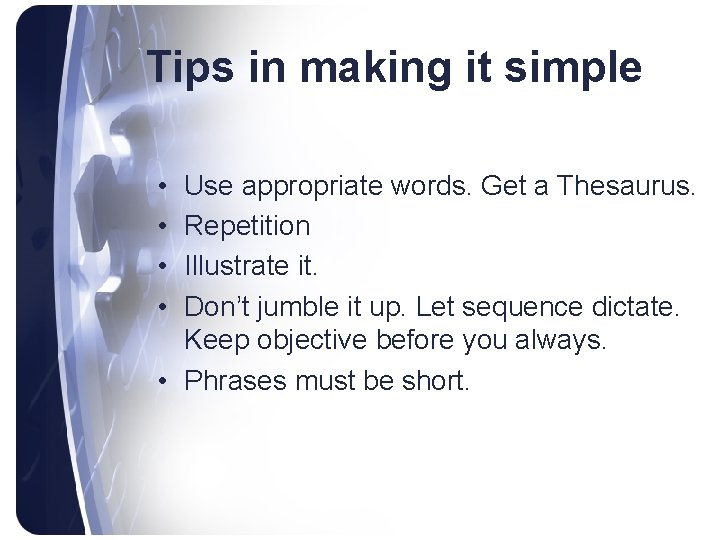
Tips in making it simple • • Use appropriate words. Get a Thesaurus. Repetition Illustrate it. Don’t jumble it up. Let sequence dictate. Keep objective before you always. • Phrases must be short.
Delivery • It is the most dynamic moment of the preaching experience. • It could be joyful or frustrating depending on how well you prepare. • Excellence in preparation does not carry with it excellence in delivery. • You are not Brooks or Dottin – The delivery of your sermon is a delivery of yourself.
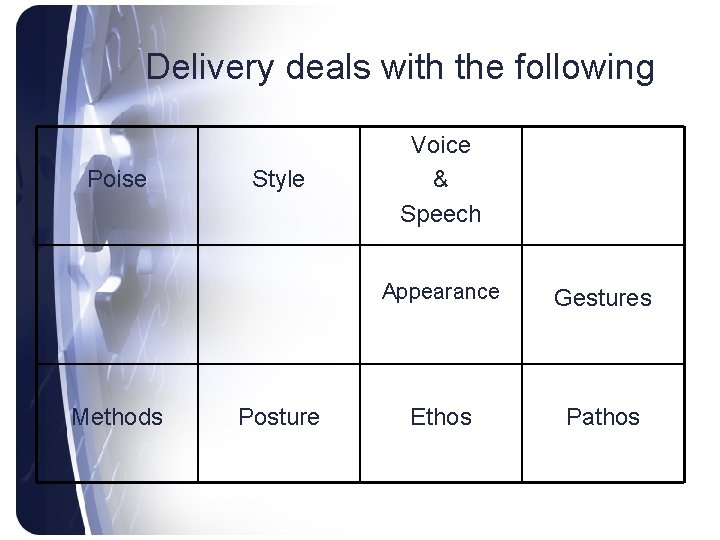
Delivery deals with the following Poise Methods Style Posture Voice & Speech Appearance Gestures Ethos Pathos
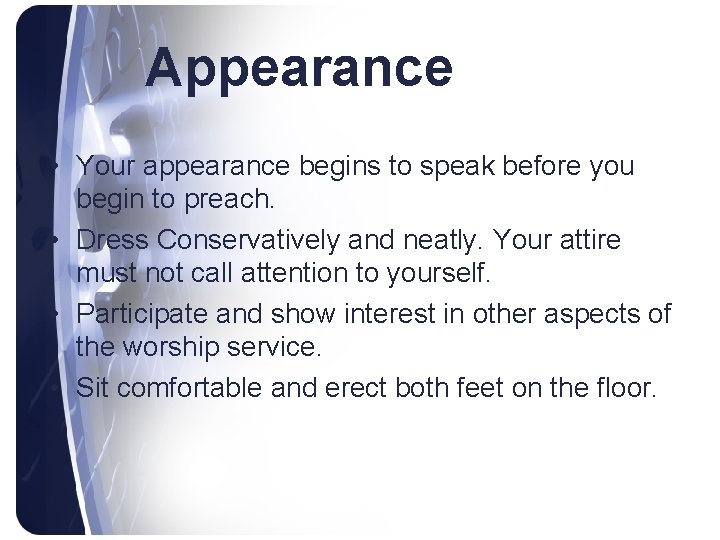
Appearance • Your appearance begins to speak before you begin to preach. • Dress Conservatively and neatly. Your attire must not call attention to yourself. • Participate and show interest in other aspects of the worship service. • Sit comfortable and erect both feet on the floor.
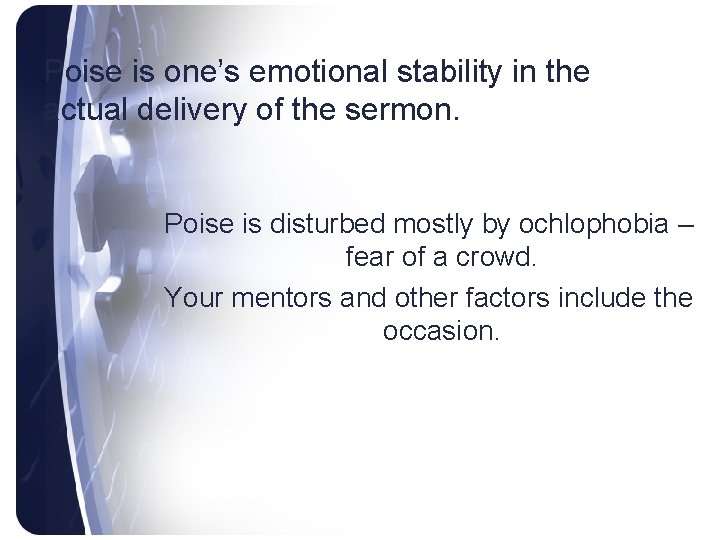
Poise is one’s emotional stability in the actual delivery of the sermon. Poise is disturbed mostly by ochlophobia – fear of a crowd. Your mentors and other factors include the occasion.
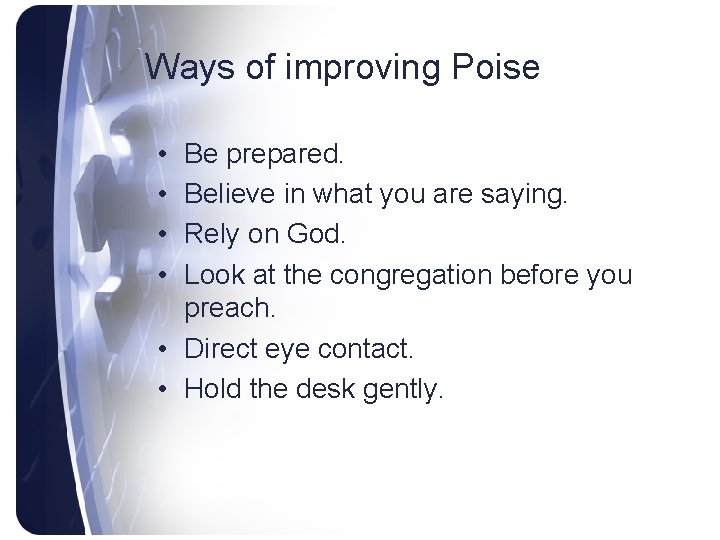
Ways of improving Poise • • Be prepared. Believe in what you are saying. Rely on God. Look at the congregation before you preach. • Direct eye contact. • Hold the desk gently.
Style is the manner of expressing thought. The use of the right words in the right place. A preacher’s style must be his personality.
Three kinds of style called “Completion of Eloquence” • Grand Style: Given to the moving of feelings and is characterized by energy. • Middle Style: Pleasing and consolidating. Characterized by gentleness. • Plain Style: That of stating the facts. Simple style. It should be clear that a preacher is a public speaker not a public reader.
Improvement of Style • By reading. • By writing. • Listening to good speakers. • Obeying the laws of language.
Voice and Speech Production • • • Deal With Rate Pace Tone Quality Emphasis Punches Volume Loudness Intonation Modulation
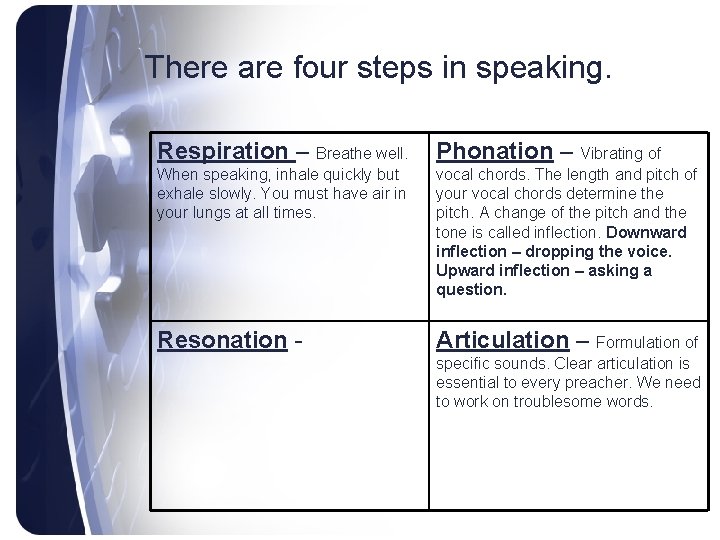
There are four steps in speaking. Respiration – Breathe well. Phonation – Vibrating of When speaking, inhale quickly but exhale slowly. You must have air in your lungs at all times. vocal chords. The length and pitch of your vocal chords determine the pitch. A change of the pitch and the tone is called inflection. Downward inflection – dropping the voice. Upward inflection – asking a question. Resonation - Articulation – Formulation of specific sounds. Clear articulation is essential to every preacher. We need to work on troublesome words.
Gestures Gesture is done with the: • Eyes • Head • Hand • Arms
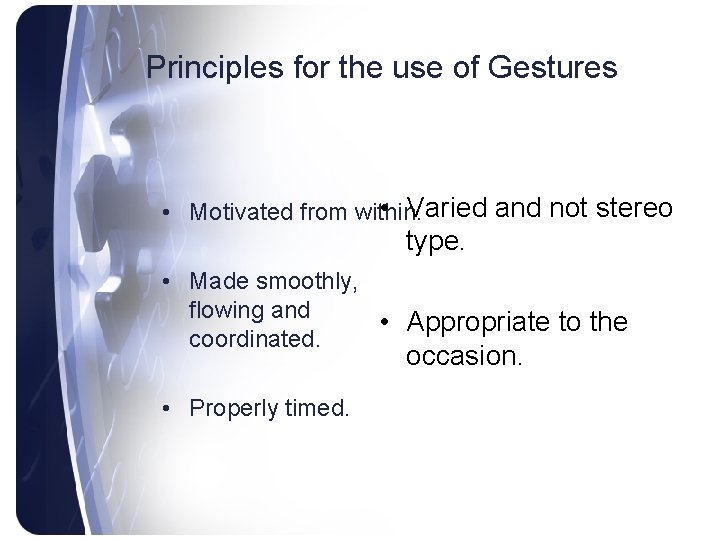
Principles for the use of Gestures • Varied and not stereo • Motivated from within. type. • Made smoothly, flowing and • Appropriate to the coordinated. occasion. • Properly timed.
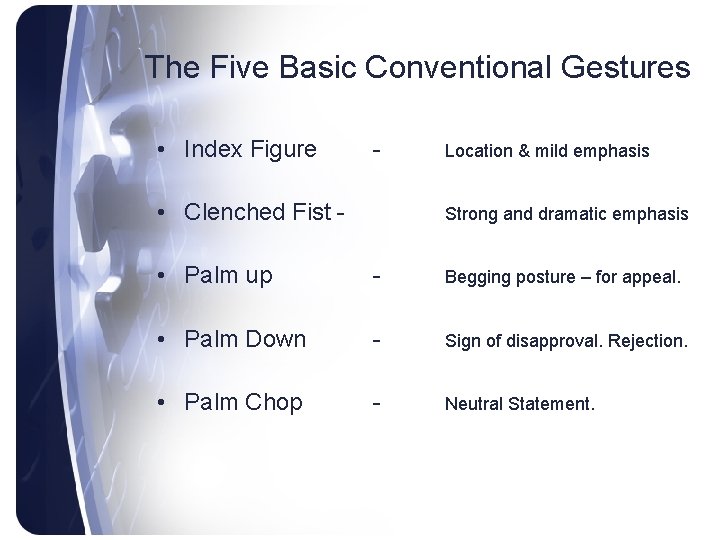
The Five Basic Conventional Gestures • Index Figure - • Clenched Fist - Location & mild emphasis Strong and dramatic emphasis • Palm up - Begging posture – for appeal. • Palm Down - Sign of disapproval. Rejection. • Palm Chop - Neutral Statement.
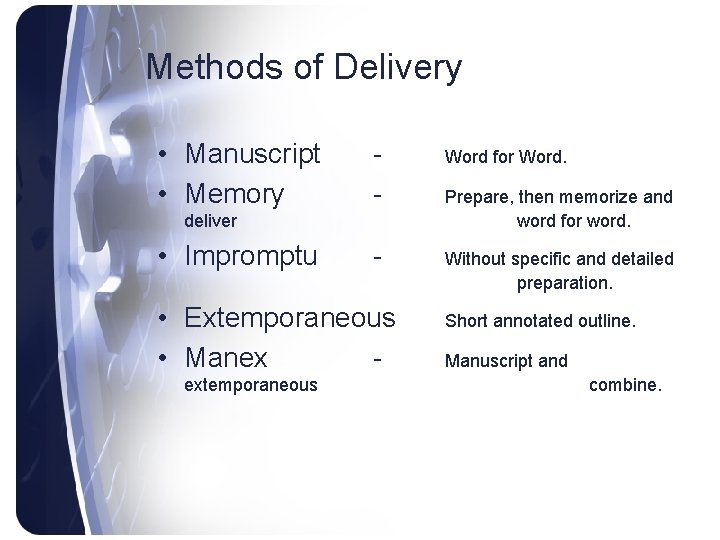
Methods of Delivery • Manuscript • Memory - deliver • Impromptu - • Extemporaneous • Manex extemporaneous Word for Word. Prepare, then memorize and word for word. Without specific and detailed preparation. Short annotated outline. Manuscript and combine.
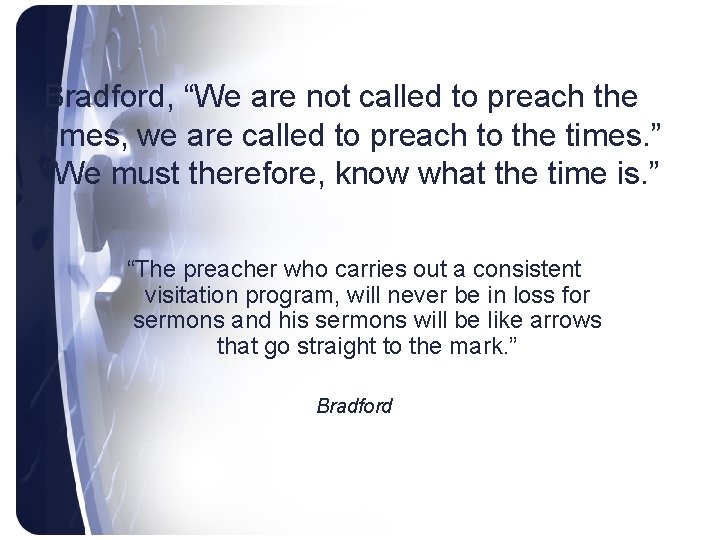
Bradford, “We are not called to preach the times, we are called to preach to the times. ” “We must therefore, know what the time is. ” “The preacher who carries out a consistent visitation program, will never be in loss for sermons and his sermons will be like arrows that go straight to the mark. ” Bradford
Finally The man who stands up to preach must have something to offer.