
Support Vector Machines The basics Michael Claudius Associate

. Support Vector Machines The basics Michael Claudius, Associate Professor, Roskilde 05. 04. 2020
What is Support Vector Machines (SVM) ? • A powerful versatile algorithm for both classification and regression • Classification predictions are based on a so called margin a street • Classification with a largest margin, a high way • Training is based on minimizing number of instances inside margins • Regression predictions are based on a so called margin street • Regression with smallest margin, a bikers lane • Training is based on minimizing number of instances outside margins • So its predicting something; lets look at that ! 2 0 1 d e c e m

Evaluation of SVM? • Advantages • Very good for complex small/medium sized data sets • White box; knows in details how it works • Easy to use • Many forms: Linear, non-linear, without kernel etc…. • Disadvantages • Slow prediction, • Complex, pipelining with scaling is needed • Greedy algorithm, (which must be stopped) • No probability outcome 3 0 1 d e c e m

The Iris flower case • Data set with 150 Iris pictures of 3 different species (50 each) 4 0 1 d e c e m
Choose and build classifier(s) • • Find margin interval (street edge) defined by support vectors Make a choice on the decision boundaries (Linear/curved) Apply scaling The aim is to find variables and values that split the data into groups • Maximizing the margin interval • The decision boundaries is based on petal length an petal width • Outcome is Iris Virginica OR Iris Setosa, BUT NOT probability • Using several training algorithm Lets see how it looks! But first watch an easy video introduction SVM Introduction (20 minutes) 5 0 1 d e c e m
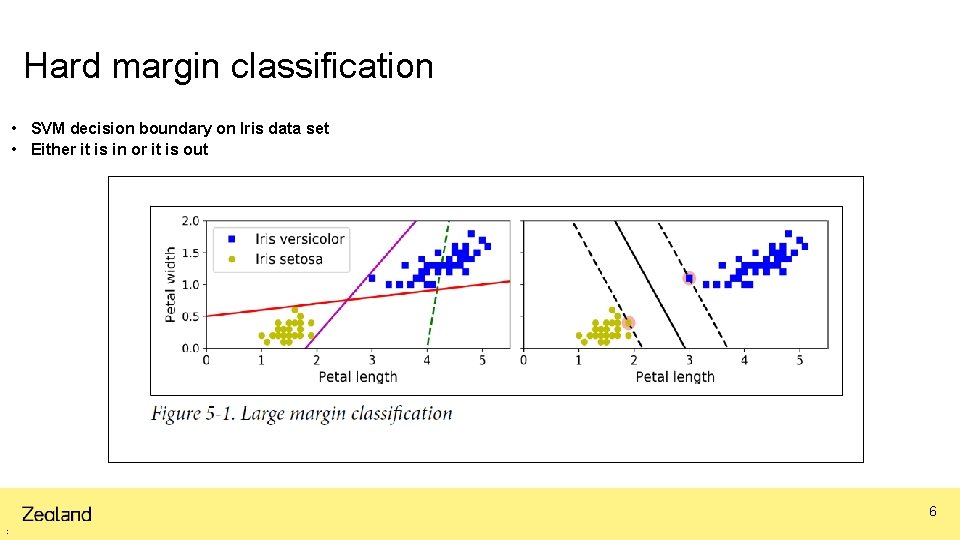
Hard margin classification • SVM decision boundary on Iris data set • Either it is in or it is out 6 0 1 d e c e m

SVM Scaling • Utilize scaling to solve the problem of sensitivity to feature scales 7 0 1 d e c e m
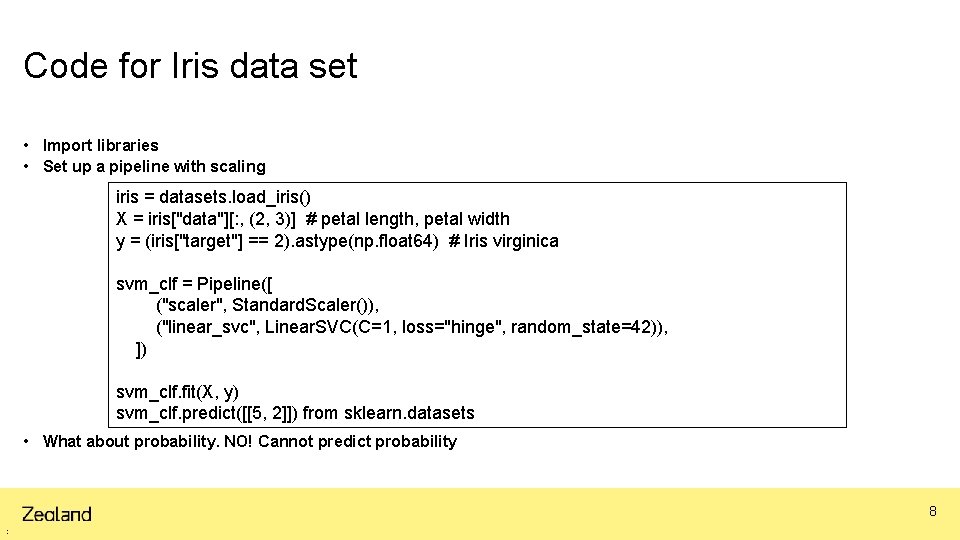
Code for Iris data set • Import libraries • Set up a pipeline with scaling iris = datasets. load_iris() X = iris["data"][: , (2, 3)] # petal length, petal width y = (iris["target"] == 2). astype(np. float 64) # Iris virginica svm_clf = Pipeline([ ("scaler", Standard. Scaler()), ("linear_svc", Linear. SVC(C=1, loss="hinge", random_state=42)), ]) svm_clf. fit(X, y) svm_clf. predict([[5, 2]]) from sklearn. datasets • What about probability. NO! Cannot predict probability 8 0 1 d e c e m
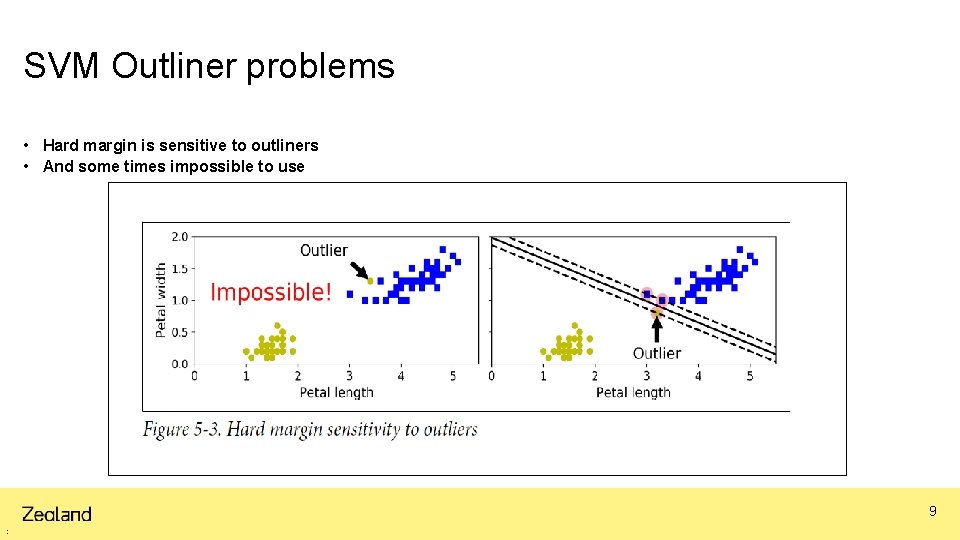
SVM Outliner problems • Hard margin is sensitive to outliners • And some times impossible to use 9 0 1 d e c e m
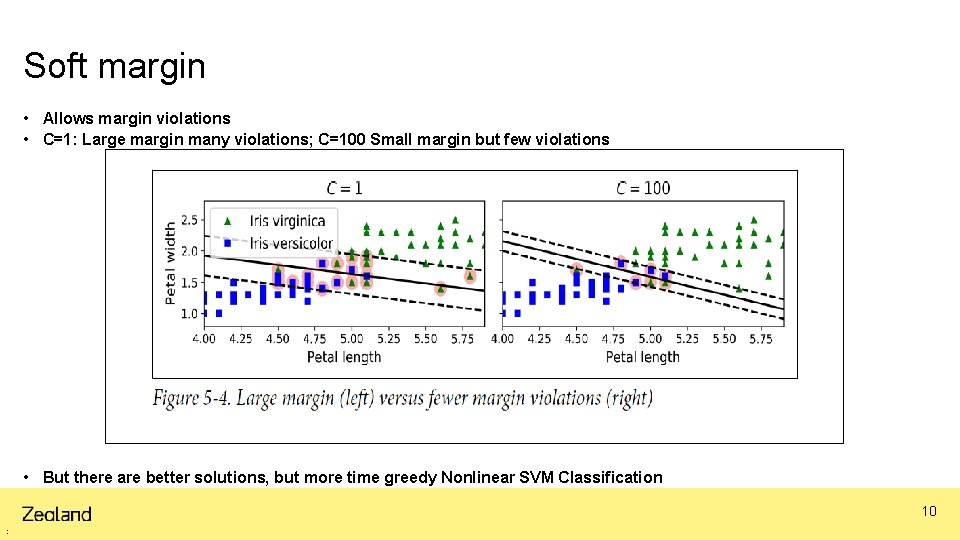
Soft margin • Allows margin violations • C=1: Large margin many violations; C=100 Small margin but few violations • But there are better solutions, but more time greedy Nonlinear SVM Classification 10 0 1 d e c e m
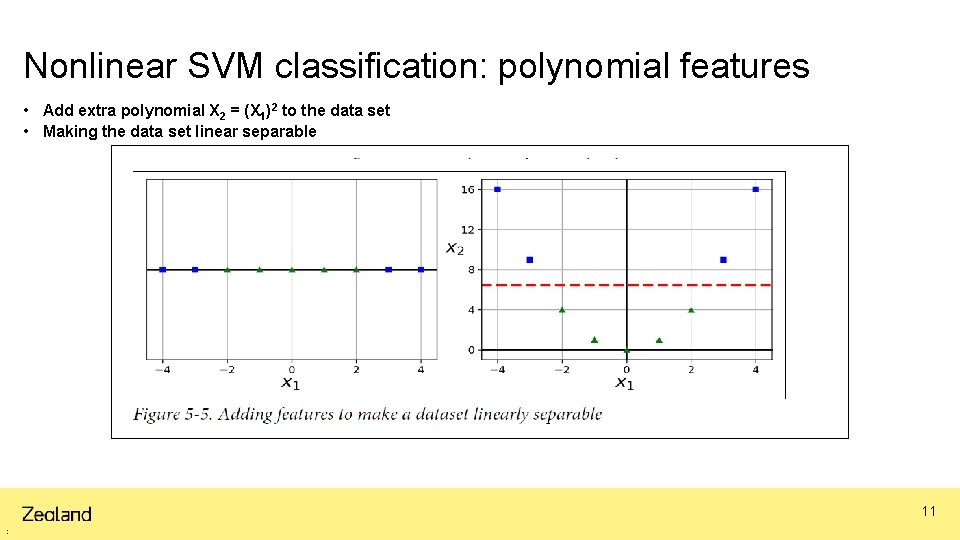
Nonlinear SVM classification: polynomial features • Add extra polynomial X 2 = (X 1)2 to the data set • Making the data set linear separable 11 0 1 d e c e m
Code for Moon data set • Import libraries • Set up a pipeline with polynomial features and scaling import make_moons X, y = make_moons(n_samples=100, noise=0. 15, random_state=42) polynomial_svm_clf = Pipeline([ ("poly_features", Polynomial. Features(degree=3)), ("scaler", Standard. Scaler()), ("svm_clf", Linear. SVC(C=10, loss="hinge", random_state=42)) ]) polynomial_svm_clf. fit(X, y) • What about probability. NO! Cannot predict probability 12 0 1 d e c e m
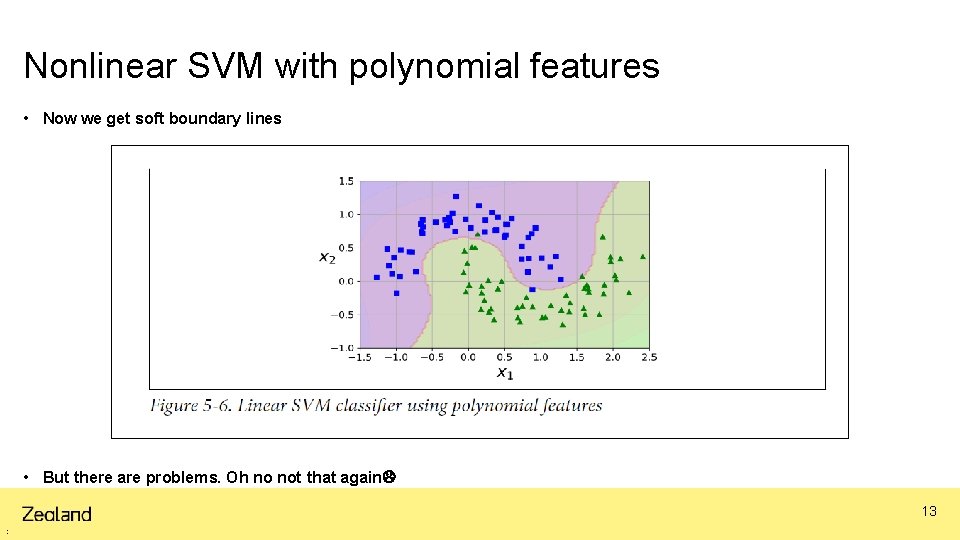
Nonlinear SVM with polynomial features • Now we get soft boundary lines • But there are problems. Oh no not that again 13 0 1 d e c e m
Problems with Polynomial features • Low degree cannot handle complex data set • High degree have too many features => very slow, if any regression • But we are lucky again. • The kernel trick • Solution A: Polynomial kernel • Solution B: Similarities features 14 0 1 d e c e m
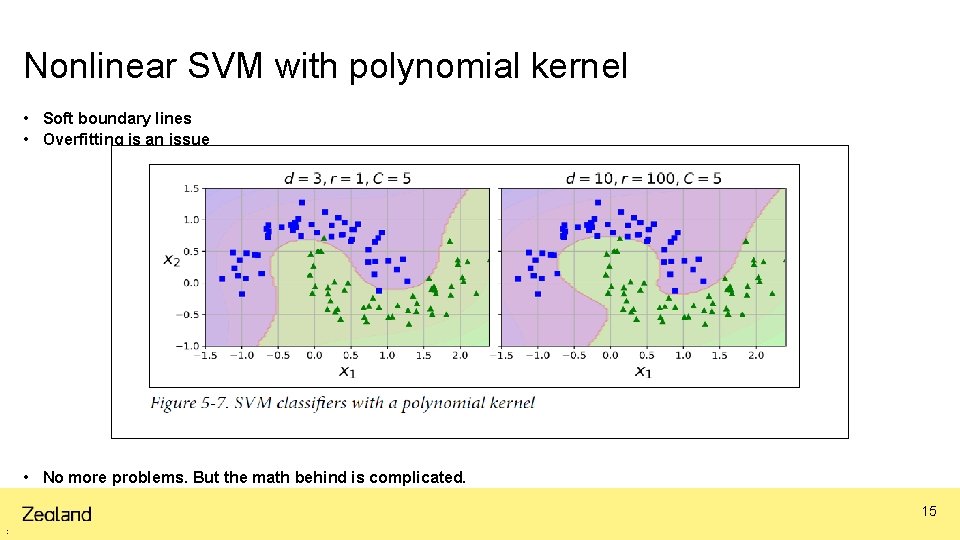
Nonlinear SVM with polynomial kernel • Soft boundary lines • Overfitting is an issue • No more problems. But the math behind is complicated. 15 0 1 d e c e m
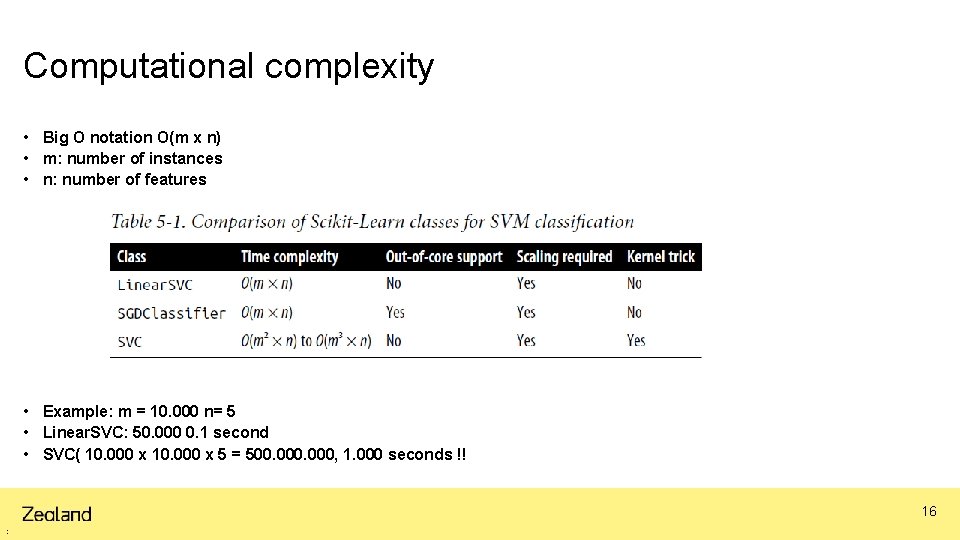
Computational complexity • Big O notation O(m x n) • m: number of instances • n: number of features • Example: m = 10. 000 n= 5 • Linear. SVC: 50. 000 0. 1 second • SVC( 10. 000 x 5 = 500. 000, 1. 000 seconds !! 16 0 1 d e c e m

Assignments • It is time for discussion and solving a few assignments in groups • Problems problems enjoy! • SVM Iris Exercise 17 0 1 d e c e m
- Slides: 17