How to find highquality information Introduction to Information

- Slides: 14
How to find highquality information Introduction to Information Retrieval 6. 11. 2018 Jaana Santala
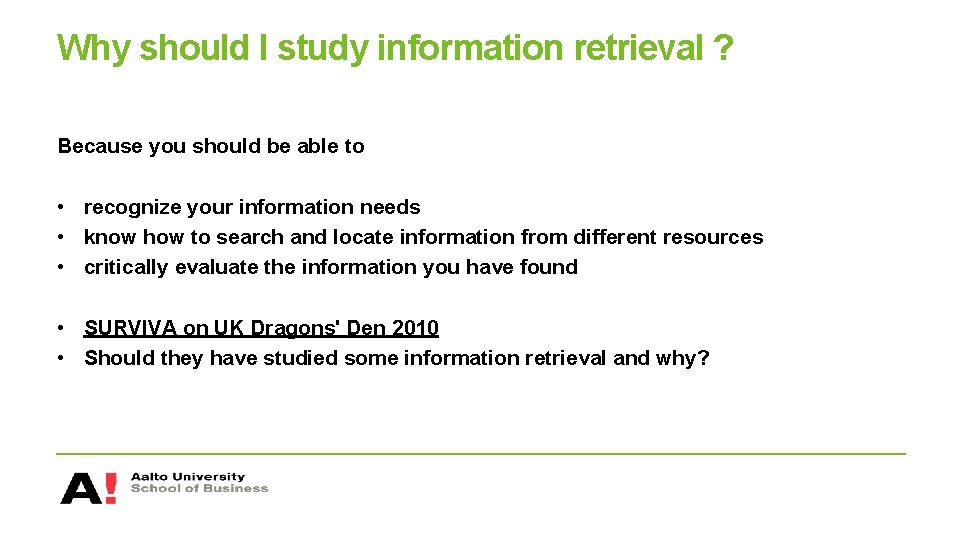
Why should I study information retrieval ? Because you should be able to • recognize your information needs • know how to search and locate information from different resources • critically evaluate the information you have found • SURVIVA on UK Dragons' Den 2010 • Should they have studied some information retrieval and why?
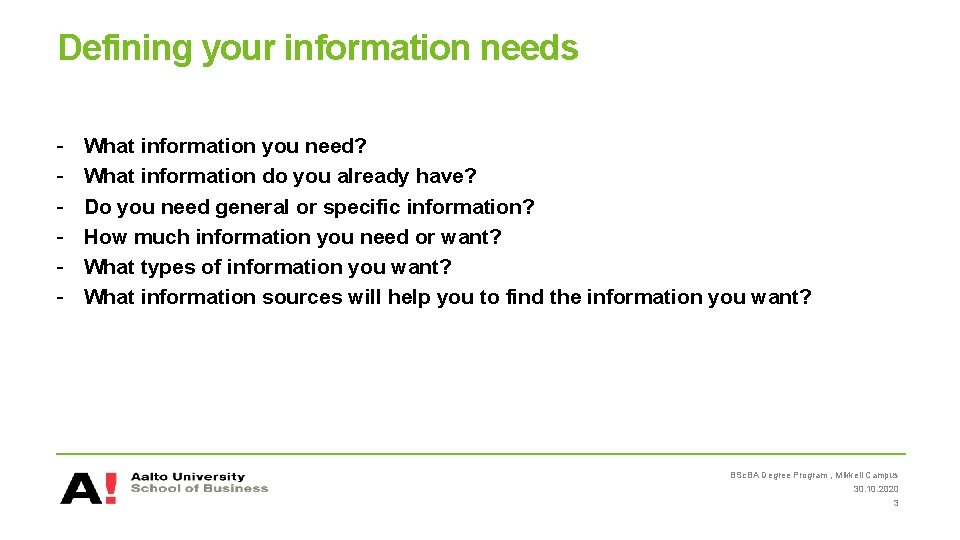
Defining your information needs - What information you need? What information do you already have? Do you need general or specific information? How much information you need or want? What types of information you want? What information sources will help you to find the information you want? BSc. BA Degree Program , Mikkeli Campus 30. 10. 2020 3
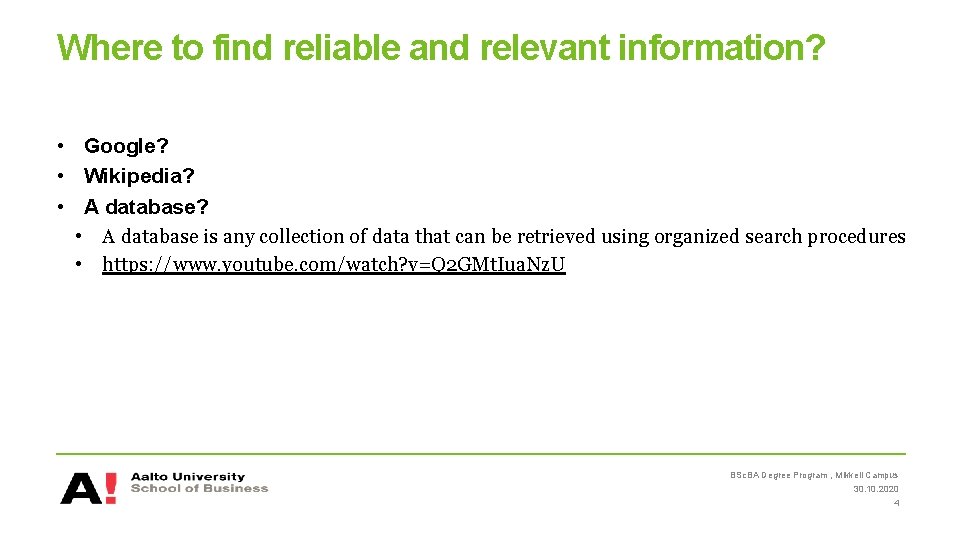
Where to find reliable and relevant information? • Google? • Wikipedia? • A database is any collection of data that can be retrieved using organized search procedures • https: //www. youtube. com/watch? v=Q 2 GMt. Iua. Nz. U BSc. BA Degree Program , Mikkeli Campus 30. 10. 2020 4
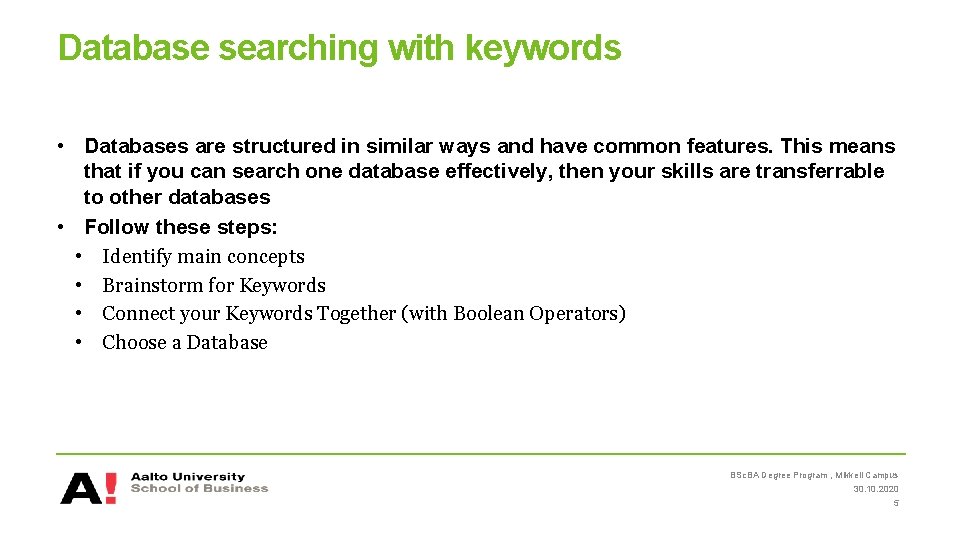
Database searching with keywords • Databases are structured in similar ways and have common features. This means that if you can search one database effectively, then your skills are transferrable to other databases • Follow these steps: • Identify main concepts • Brainstorm for Keywords • Connect your Keywords Together (with Boolean Operators) • Choose a Database BSc. BA Degree Program , Mikkeli Campus 30. 10. 2020 5
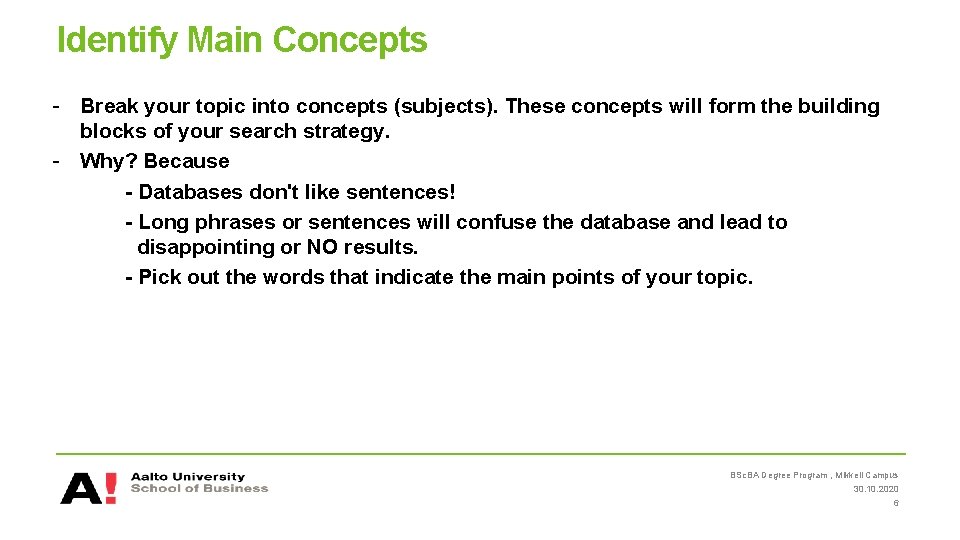
Identify Main Concepts - Break your topic into concepts (subjects). These concepts will form the building blocks of your search strategy. - Why? Because - Databases don't like sentences! - Long phrases or sentences will confuse the database and lead to disappointing or NO results. - Pick out the words that indicate the main points of your topic. BSc. BA Degree Program , Mikkeli Campus 30. 10. 2020 6
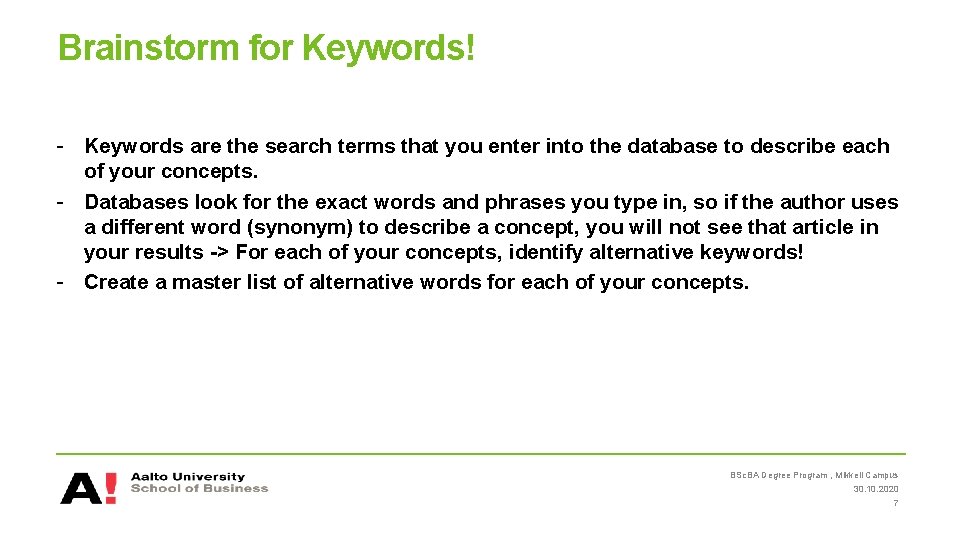
Brainstorm for Keywords! - Keywords are the search terms that you enter into the database to describe each of your concepts. - Databases look for the exact words and phrases you type in, so if the author uses a different word (synonym) to describe a concept, you will not see that article in your results -> For each of your concepts, identify alternative keywords! - Create a master list of alternative words for each of your concepts. BSc. BA Degree Program , Mikkeli Campus 30. 10. 2020 7
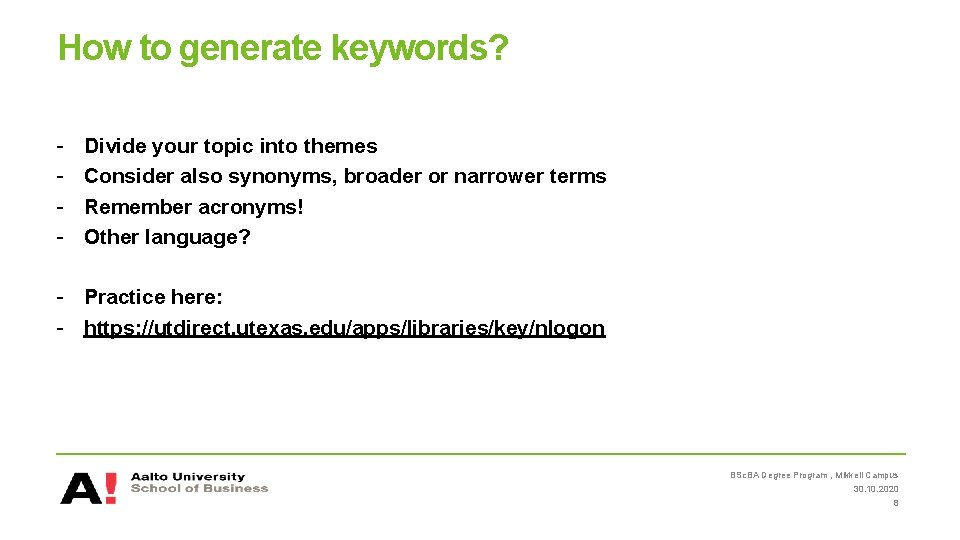
How to generate keywords? - Divide your topic into themes Consider also synonyms, broader or narrower terms Remember acronyms! Other language? - Practice here: - https: //utdirect. utexas. edu/apps/libraries/key/nlogon BSc. BA Degree Program , Mikkeli Campus 30. 10. 2020 8
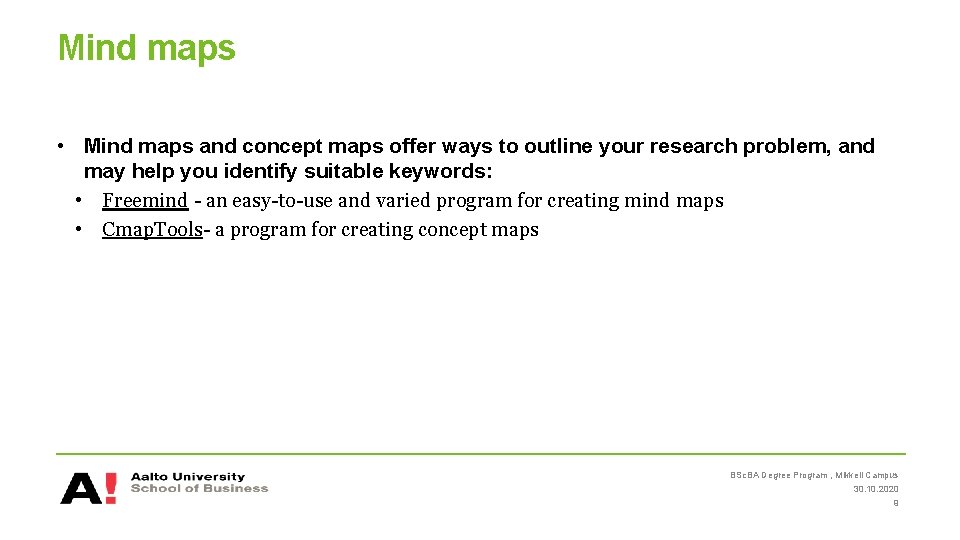
Mind maps • Mind maps and concept maps offer ways to outline your research problem, and may help you identify suitable keywords: • Freemind - an easy-to-use and varied program for creating mind maps • Cmap. Tools- a program for creating concept maps BSc. BA Degree Program , Mikkeli Campus 30. 10. 2020 9
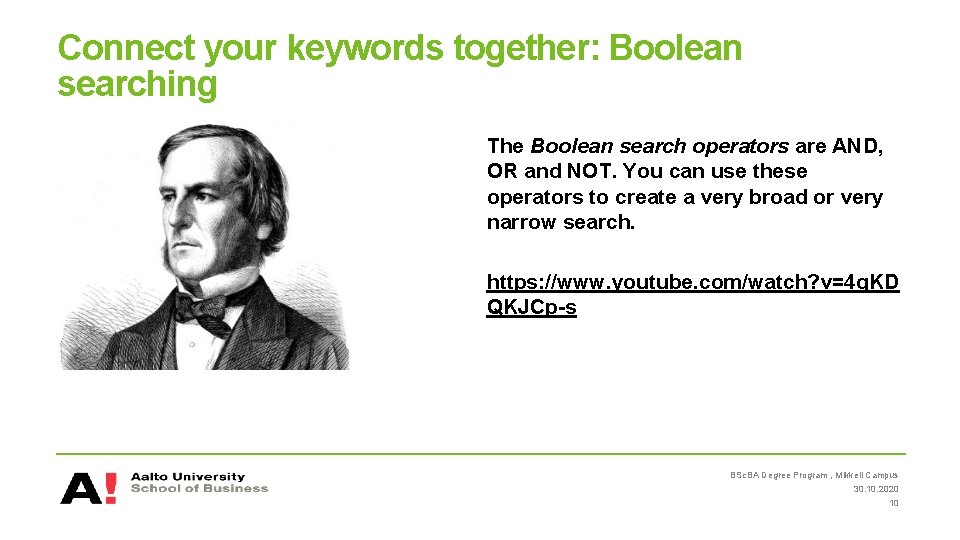
Connect your keywords together: Boolean searching The Boolean search operators are AND, OR and NOT. You can use these operators to create a very broad or very narrow search. https: //www. youtube. com/watch? v=4 q. KD QKJCp-s BSc. BA Degree Program , Mikkeli Campus 30. 10. 2020 10
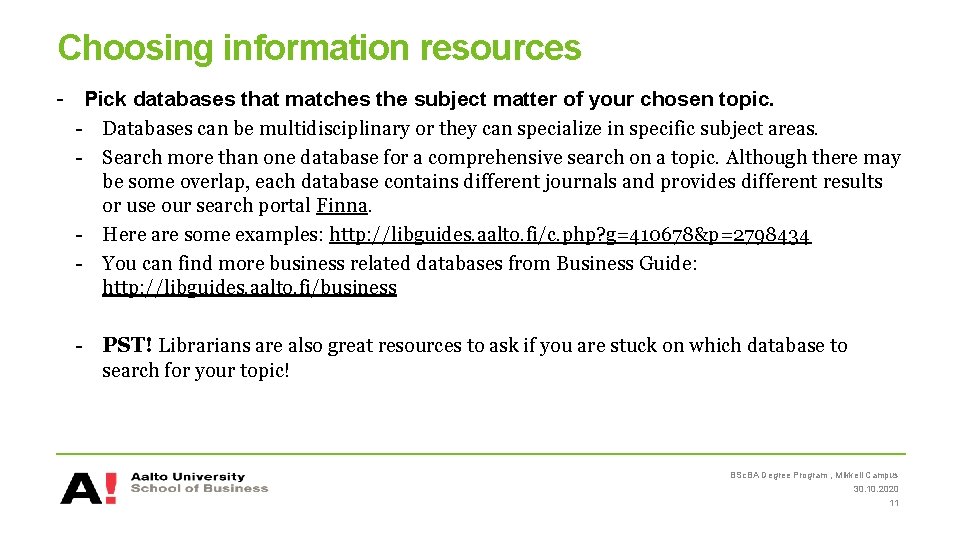
Choosing information resources - Pick databases that matches the subject matter of your chosen topic. - Databases can be multidisciplinary or they can specialize in specific subject areas. - Search more than one database for a comprehensive search on a topic. Although there may be some overlap, each database contains different journals and provides different results or use our search portal Finna. - Here are some examples: http: //libguides. aalto. fi/c. php? g=410678&p=2798434 - You can find more business related databases from Business Guide: http: //libguides. aalto. fi/business - PST! Librarians are also great resources to ask if you are stuck on which database to search for your topic! BSc. BA Degree Program , Mikkeli Campus 30. 10. 2020 11
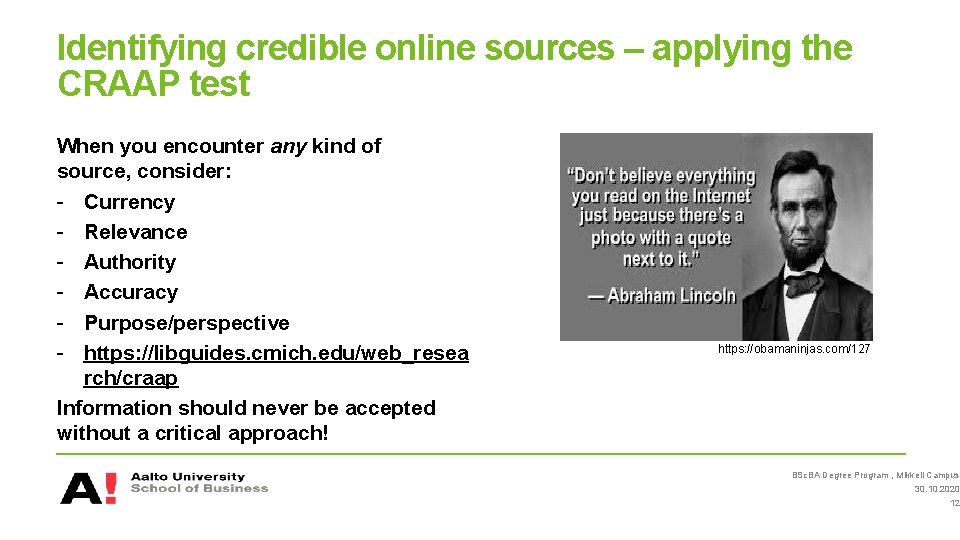
Identifying credible online sources – applying the CRAAP test When you encounter any kind of source, consider: - Currency - Relevance - Authority - Accuracy - Purpose/perspective - https: //libguides. cmich. edu/web_resea rch/craap Information should never be accepted without a critical approach! https: //obamaninjas. com/127 BSc. BA Degree Program , Mikkeli Campus 30. 10. 2020 12
Need help? • Contact the librarian: library-mikkeli@aalto. fi • Self-study guide to information retrieval BSc. BA Degree Program , Mikkeli Campus 30. 10. 2020 13
BSc. BA Degree Program , Mikkeli Campus 30. 10. 2020 14