How does a character develop Why is a


- Slides: 30
How does a character develop? Why is a character important? How do you develop sympathy for a character? How is a character presented? (40 mins)
Beginning – middle - end Duncan is only in Act I!
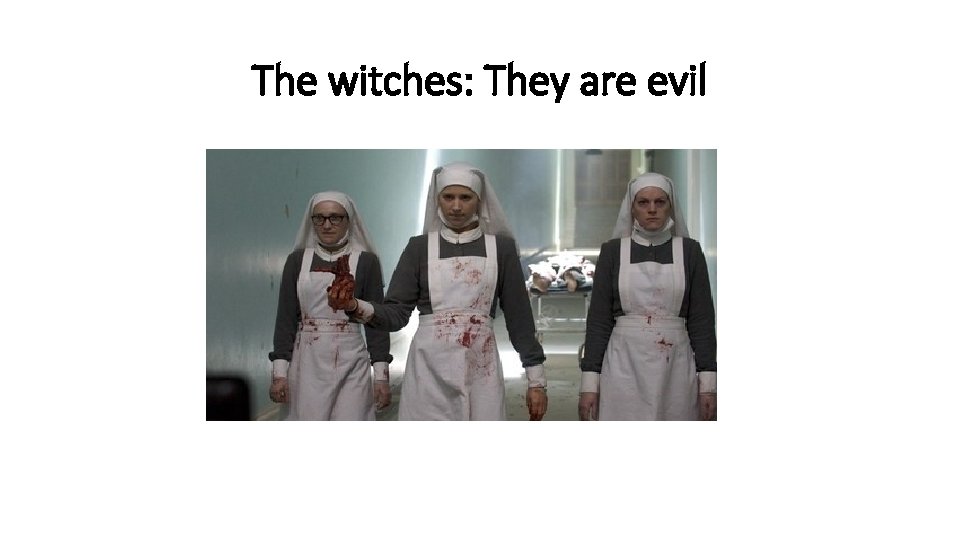
The witches: They are evil
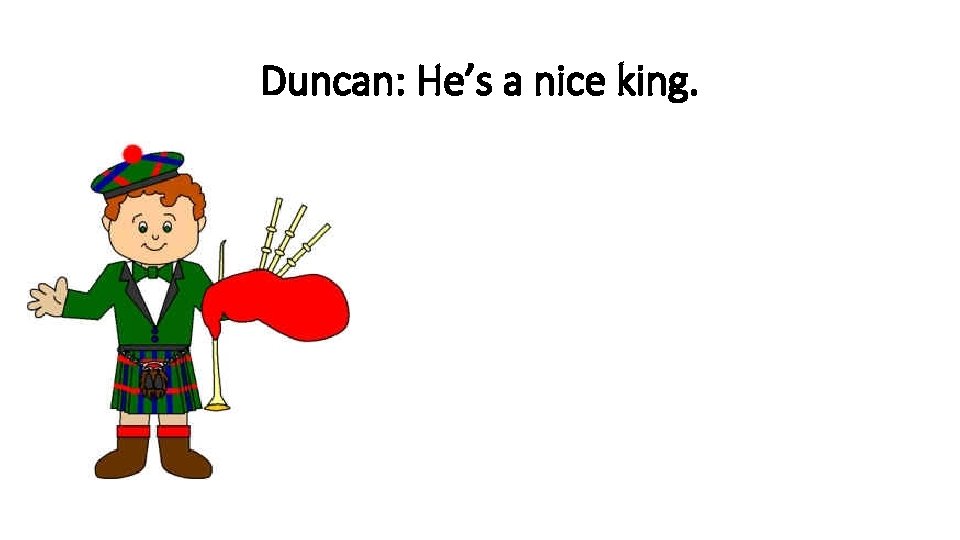
Duncan: He’s a nice king.
Act 1, sc. 2 Hearing of an account of battle – Norwegian invasion and rebel army led by Macdonald. ‘No more that Thane of Cawdor shall deceive/Our bosom interest’ In this scene, Duncan is keen to praise the efforts of Banquo and Macbeth on the battlefield. Sends for Thane of Cawdor to be executed but the line above is hugely ironic, given the fact that the new Thane of Cawdor (Macbeth) deceives him even more and murders him. At this point in the play, although we haven’t met Macbeth, we know that the witches intend to get involved with him, so the audience is apprehensive about the decision Duncan is making. Duncan is set up as a far too trusting character from the outset (it is a fatal ‘flaw’ that Macbeth seems to almost exploit).
‘What he hath lost, noble Macbeth hath won’ Again referring to the Thane of Cawdor, Duncan mirrors the words of the witches from the opening scene (‘When the battle’s lost and won’). His lines hint at the power of the witches to predict the future, as well as possibly suggesting that he can be easily manipulated.
Act 1, sc. 4: Duncan welcomes Macbeth and Banquo at his palace, and thanks them for defeating the enemy. Comments that you cannot trust ‘the mind’s construction in the face’ and that he had an ‘absolute trust’ in the Thane of Cawdor. There is dramatic irony at this point as the audience is aware that Macbeth has just had thoughts of murdering Duncan, voiced after a meeting with the witches. The character of Duncan is a major source of tension in the play.
‘I have begun to plant thee and will labour/To make thee full of growing’ Plant imagery here suggests that Duncan is a nurturing, benevolent King who genuinely wants the best for others. Suggests that Macbeth may well have had a prosperous future without having to do anything himself, making his ruthless ambition all the more abhorrent to the audience. Duncan’s murder is seen as all the more ghastly. Duncan serves as the model example of a king who will contrast with Macbeth’s tyrannical rule where he is both feared and hated. Macbeth puts his selfish desires before his country when he becomes king.
He is so full of joy – he displays ‘drops of sorrow’ (i. e. he cries!) Just before announcing that Malcolm will be his heir and announcing that other deserving people will receive ‘signs of nobleness’). This imagery shows that his version of masculinity is one where he can freely express his emotions. A stark contrast to how Lady Macbeth encourages Macbeth to think of masculinity – being brave enough to act violently and kill. Duncan isn’t a soldier at all – others fight for him in the play. Again, he serves as a contrast against Macbeth, illustrating that a leader does not need to rule through violence and causing fear. Possible link? Duncan to the Captain (Act I, sc. 2) ‘Thy words become they as thy wounds/They smack of honour both’
Act I, sc. 6 – Arrives at the castle-greeted by Macbeth and his wife Effusive, almost hyperbolic praise pushes the tension further!
Even when Duncan isn’t in the play he has a profound effect on others. . The very thought of him causes Macbeth to have serious doubts about his plan. Act I, sc. 7: ‘his virtues will plead like angels’ (in reference to him being killed) This use of language casts him almost as a religious, God-like figure such is his righteousness. This contrasts with the use of supernatural language Macbeth uses just before he goes to murder him. Shows how Macbeth’s own morality is becoming twisted in contrast to the moral perfection of Duncan.
After Duncan’s death. . Act 3, Scene 4 Duncan’s death has upset the natural order of things too. . After he dies the old man says to Rosse that a falcon was killed by an owl. It’s dark during the day – the evil that has come over Scotland. (dark night strangles the travelling lamp) Horses have been eating one another!
He’s remembered fondly! Malcolm comments on what a good king should be like in Act 4, sc. iii – should have ‘stableness’, ‘justice’ and ‘mercy’ – all qualities Duncan had and none of which apply to Macbeth. His presence therefore continues to the end of the play, to show Macbeth’s own attempt at being king is cruel and merciless.
Why is Duncan important? 1) Creates key moments of tension (often through dramatic irony) 2) Serves as a contrast to the kingship of Macbeth (showing how tyrannical Macbeth really is) 3) Shows how abhorrent Macbeth is becoming (to kill someone so saint-like!) 4) Shows the consequences of ambition/taking matters into one’s own hands.
Why are the witches important? 1) Deliver the line ‘Fair is foul and foul is fair’ and thus remind us that nothing is what it seems as we begin watching the play – a major source of tension! 2) Help to reveal the true characters of Duncan and Banquo through the way in which these two characters react to the witches. 3) Fuel a major source of tension in the whole play – is the supernatural really at work or is what is happening a self-fulfilling prophecy (i. e. it is all down to Macbeth? ) 4) Show wicked Macbeth has really become: ‘Something wicked this way comes’.
The Witches Act 1, sc. Open the play – therefore show their huge importance in terms of how we view the rest of the play. ‘Fair is foul and foul is fair’ (Usually accompanied by thunder and lightning to add to the tension) ‘So fair and foul a day I have not seen’ Macbeth, when he’s going to visit the witches.
Act I, sc. iii: ‘I’ll drain him dry as hay’
Act I, sc. 3 They meet with Duncan and Banquo 1) ‘instruments of darkness’ 2) Leaves him ‘rapt withall’ 1) Banquo regards them with real caution, ‘darkness’ suggests he sees their work as very sinister/work of the devil 2) Macbeth the adjective ‘rapt’ shows how entranced he is by them, almost as if under their spell They’re important as the reactions to the witches show the key paths that Banquo and Macbeth will take.
The witches speak in paradoxes to confuse Macbeth and Banquo and to confuse us too – increasing the overall tension in the play. ‘Lesser than Macbeth and greater’/’Not much happy, yet much happier’ (prophecy to Banquo) The audience is forced to take their potential power seriously from the outset though as, when they deliver the prophecy about Macbeth becoming Thane of Cawdor, we know this position has already been allocated to him by King Duncan.
Crucially, they never tell Macbeth to murder Duncan. In many ways, it seems to be a self-fulfilling prophecy. It’s not clear whether the witches are acting as messengers of fate, or whether their predictions simply inspire bad choices from Macbeth. You could argue that they take advantage of Macbeth’s weakness and use it to control his actions. His ‘vaulting ambition’
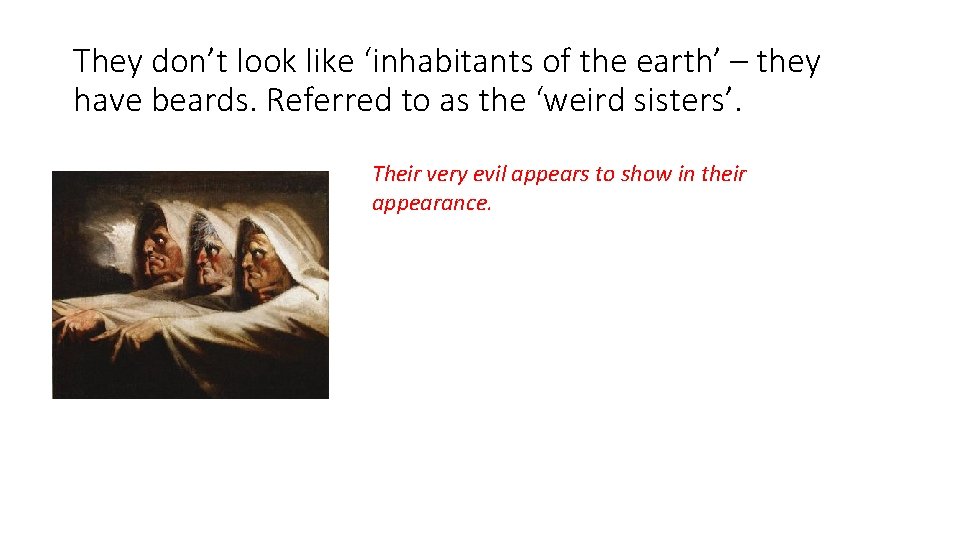
They don’t look like ‘inhabitants of the earth’ – they have beards. Referred to as the ‘weird sisters’. Their very evil appears to show in their appearance.
Act Four, Scene One Macbeth visits the Witches – a contrast from last time, where they came to him. (Concocting a potion at the beginning of this scene which again reinforces they’re evil – rhyming couplets and a rhythmic tone reinforce the chanting of the spell. They’re throwing body parts into a cauldron!) The witches announce the arrival of Macbeth by saying, ‘Something wicked this way comes’. They reveal the fact that he’s changed from the honourable hero we met at the start of the play – does the real wickedness lie with Macbeth rather than the witches?
Apparitions These apparitions are crucially to trick Macbeth – they know his lust for power and use this against him.
What on earth does Macduff do? 1) Finds Duncan 2) Refuses to go to Macbeth’s coronation 3) Doesn’t like the way Macbeth rules so goes to England to persuade Malcolm to help him. 4) Wife and children are murdered by Macbeth 5) Puts together an army to overthrow Macbeth 6) Kills Macbeth
What on earth does Malcolm do? 1) Escapes with Donalbain when he hears of his father’s death – he goes to England, Donalbain goes to Ireland. They don’t trust those around them, however, in escaping, they make themselves look suspicious of killing Duncan. 2) Macduff visits him to convince him to raise an army against Macbeth. 3) Malcolm tests his loyalty by pretending to be more evil than Macbeth! 4) Returns to Scotland with army. Proves he’s good in battle as he disguises soldiers with branches. 5) Becomes king
What on earth does Banquo do? 1) Encounters the witches and is informed he will be ‘Lesser than Macbeth and greater’ and that his descendants will become kings 2) Just before Macbeth kills Duncan, he promises to ‘honour’ Banquo says he’s keen to keep his ‘allegiance clear’. 3) Suspects that Macbeth murdered Duncan after the event. 4) Hired killers murder him (son Fleance escapes) 5) Returns as a ghost when Macbeths are holding a feast – does this show Macbeth’s guilty conscience? 6) Returns as an apparition before battle, followed by many descendants
How are the witches presented in ‘Macbeth’? Avoid saying ‘They’re evil’ again and again. An introduction is useful if it gives an important general point straight away. If it’s ‘waffle’, get stuck straight in. Beginning, middle, end Don’t just tell the story – answer the question.
What could you call the following bits. . ? How does the writer present the relationship between Arthur and Jake? Jake ‘runs’ to the edge of the bridge and ‘grabbed’ hold of the pole – when Arthur moves the cow he pulled ‘gently’ and walked ‘slowly’. Jake is described ‘grinning up at Arthur’ ‘He turned everything – into a competition’
Lady Macbeth