HOW CONTINUOUS TEMPERATURE MONITORING HAS AIDED COLD CHAIN


- Slides: 10
HOW CONTINUOUS TEMPERATURE MONITORING HAS AIDED COLD CHAIN MANAGEMENT THE NATIONAL VACCINES AND IMMUNIZATION (NVIP), KENYA THE 15 TH TECHNET CONFERENCE FROM 16 TH TO 20 TH IN CASCAIS, PORTUGAL
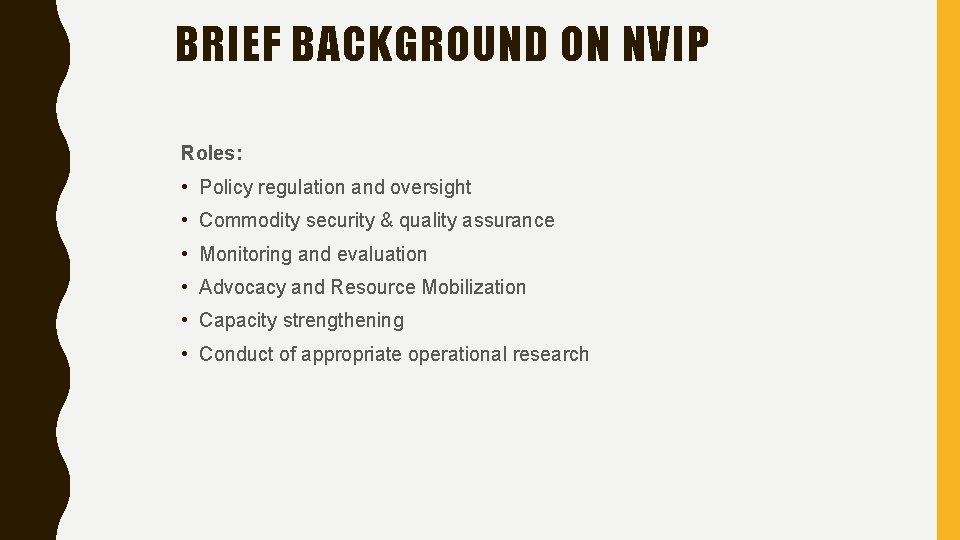
BRIEF BACKGROUND ON NVIP Roles: • Policy regulation and oversight • Commodity security & quality assurance • Monitoring and evaluation • Advocacy and Resource Mobilization • Capacity strengthening • Conduct of appropriate operational research
PROGRAM GOAL The Goal of the National Vaccines and Immunization Program is: • To ensure potent vaccines and supplies are available at SDPs when needed to serve the clients • To this end, NVIP and partners have put great efforts in working towards achieving this goal through developing and implementing strategies to strengthen the immunization supply chain at all levels of the healthcare service delivery • Long term and medium term interventions • High and low financial investment
IMMUNIZATION SUPPLY CHAIN • 1 Central Vaccine Store • 9 Regional Vaccine stores • 47 Counties (administrative only; no stores) • 292 Sub-county Vaccine stores • Approximately 6, 700 Immunizing HFs • Approximately 20, 000 HR • Over 10, 000 ( Refrigeration equipment) and 30, 000 passive CCE • Standby generators • Temperature monitoring devices; 30 DTRs, RTMs, CTMs • Documentation tools • Monitoring tools • etc
SUCCESS STORY Continuous temperature monitoring Prior to 2013 EVM assessment, thermometers in use. No 30 DTRs IP recommended continuous temperature monitoring • Introduction of 30 DTRs – Successful introduction of FT 2 in all immunizing facilities (>6000) and 9 Regional vaccine stores – Staff from Immunizing HFs trained on how to read and record temperature and respond to ALARMs – A new monthly temperature monitoring chart was developed in line with the indicators being monitored i. e. AM/PM temperature, heat/freeze alarms recorded – 1 year assessment was conducted to ensure proper utilisation. Experiences identified, OJT • Installation of central temperature monitoring systems in all cold rooms and freezer rooms at the Central and Regional Vaccine stores – with auto-dialer ( sends sms alerts) • Development and dissemination of cold chain maintenance SOPs – ongoing (poster)
SUCCESS STORY Capacity strengthening of core staff on cold chain management ü Training of HF staff: q EPI Operation level management training: National and county specific q EPI microplanning: ongoing q Mentorship program for all HWs from immunizing facilities initiated by Nairobi county ü Training of Medical engineering technicians on equipment management: q 100 trained q Whats. App group formed to share experiences and for consultation on CC issues ü Training of University of Nairobi student doctors and nurses on EVM • Remote temperature monitoring study using CT 5 – a 1 year mini project ü Month 1 to 3 – baseline data collected ü Training of staff on the use of data for decision making • Cold chain management components integrated in Chanjo (see dashboard) • Data quality assessment and support supervision • Joint data review meetings
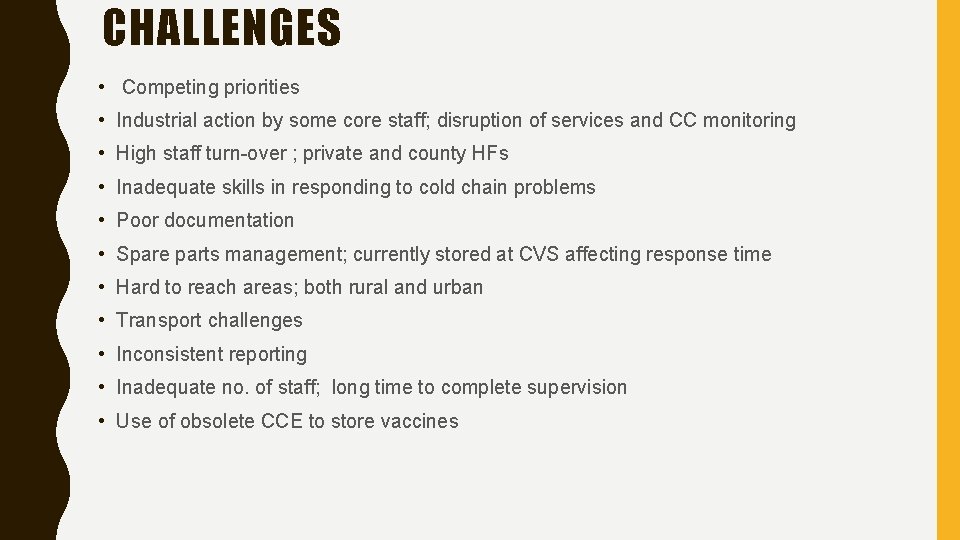
CHALLENGES • Competing priorities • Industrial action by some core staff; disruption of services and CC monitoring • High staff turn-over ; private and county HFs • Inadequate skills in responding to cold chain problems • Poor documentation • Spare parts management; currently stored at CVS affecting response time • Hard to reach areas; both rural and urban • Transport challenges • Inconsistent reporting • Inadequate no. of staff; long time to complete supervision • Use of obsolete CCE to store vaccines
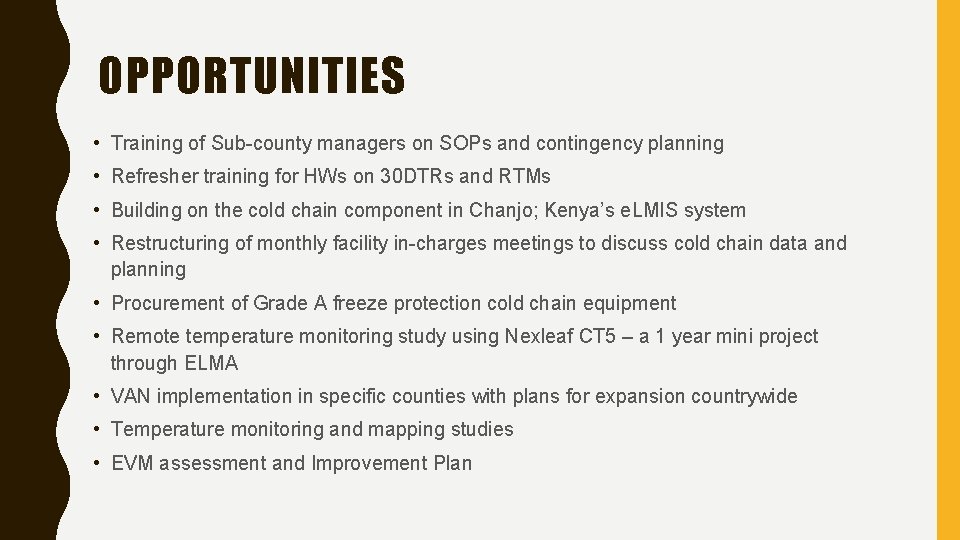
OPPORTUNITIES • Training of Sub-county managers on SOPs and contingency planning • Refresher training for HWs on 30 DTRs and RTMs • Building on the cold chain component in Chanjo; Kenya’s e. LMIS system • Restructuring of monthly facility in-charges meetings to discuss cold chain data and planning • Procurement of Grade A freeze protection cold chain equipment • Remote temperature monitoring study using Nexleaf CT 5 – a 1 year mini project through ELMA • VAN implementation in specific counties with plans for expansion countrywide • Temperature monitoring and mapping studies • EVM assessment and Improvement Plan
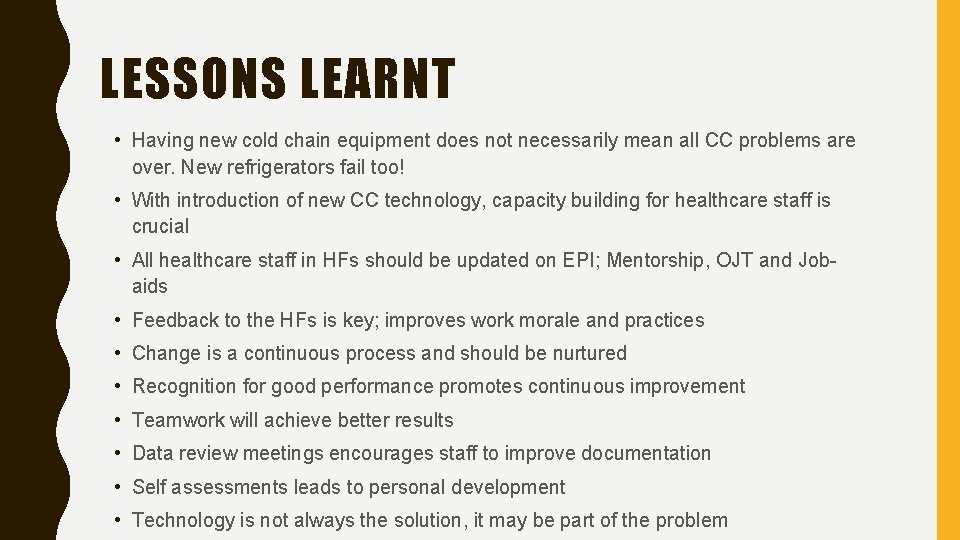
LESSONS LEARNT • Having new cold chain equipment does not necessarily mean all CC problems are over. New refrigerators fail too! • With introduction of new CC technology, capacity building for healthcare staff is crucial • All healthcare staff in HFs should be updated on EPI; Mentorship, OJT and Jobaids • Feedback to the HFs is key; improves work morale and practices • Change is a continuous process and should be nurtured • Recognition for good performance promotes continuous improvement • Teamwork will achieve better results • Data review meetings encourages staff to improve documentation • Self assessments leads to personal development • Technology is not always the solution, it may be part of the problem
ASANTENI!