Homonyms Lecture 8 Grigoryeva M Homonymy Definition of




- Slides: 37
Homonyms Lecture # 8 Grigoryeva M.
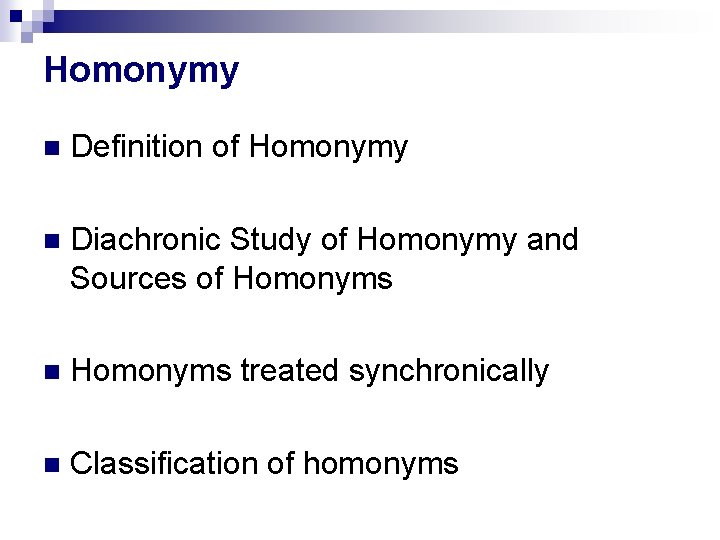
Homonymy Definition of Homonymy Diachronic Study of Homonymy and Sources of Homonyms treated synchronically Classification of homonyms
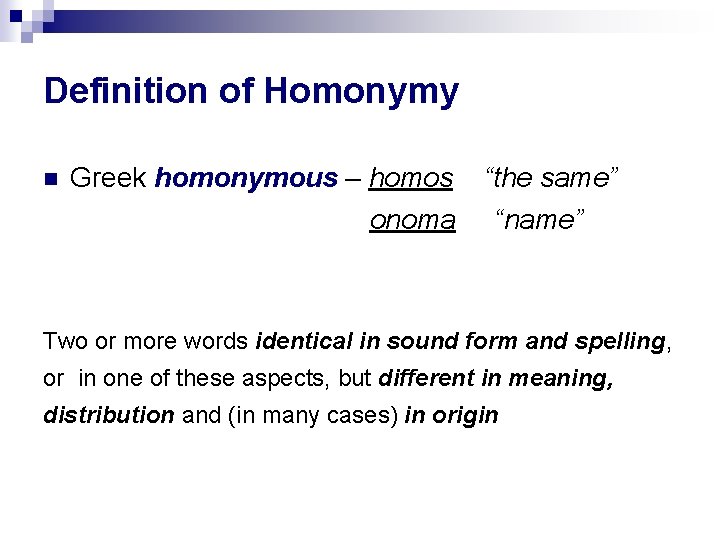
Definition of Homonymy Greek homonymous – homos onoma “the same” “name” Two or more words identical in sound form and spelling, or in one of these aspects, but different in meaning, distribution and (in many cases) in origin
Classification of homonyms by Walter Skeat identical in sound form and spelling but different in meaning Perfect homonyms • Ball Any spherical body A large dancing party
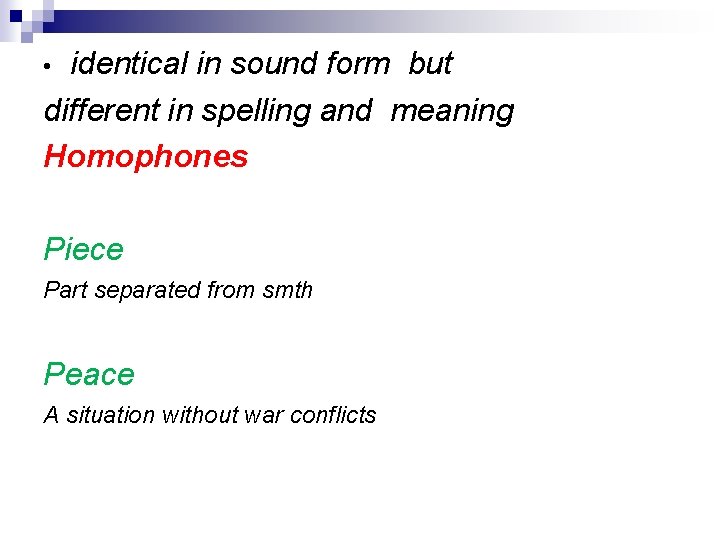
identical in sound form but different in spelling and meaning Homophones • Piece Part separated from smth Peace A situation without war conflicts
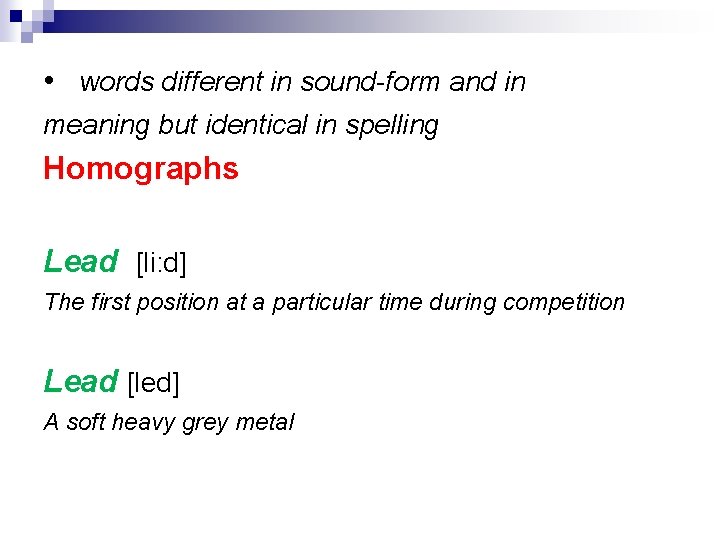
• words different in sound-form and in meaning but identical in spelling Homographs Lead [li: d] The first position at a particular time during competition Lead [led] A soft heavy grey metal
Classification of homonyms by A. I. Smirnitsky • full homonyms • partial homonyms
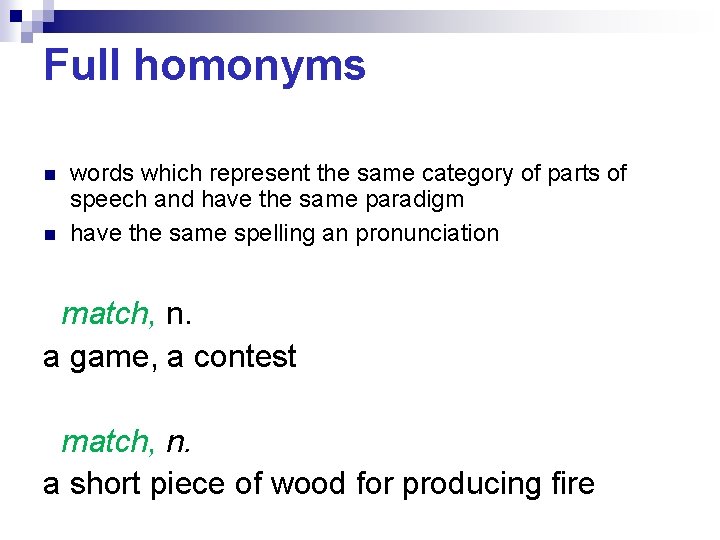
Full homonyms words which represent the same category of parts of speech and have the same paradigm have the same spelling an pronunciation match, n. a game, a contest match, n. a short piece of wood for producing fire
Partial homonyms • Simple lexico-grammatical • Complex lexico-grammatical • Partial lexical
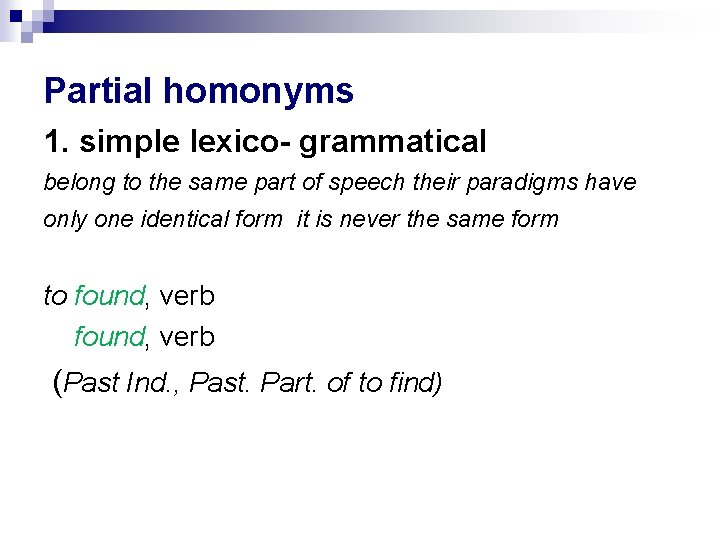
Partial homonyms 1. simple lexico- grammatical belong to the same part of speech their paradigms have only one identical form it is never the same form to found, verb (Past Ind. , Past. Part. of to find)
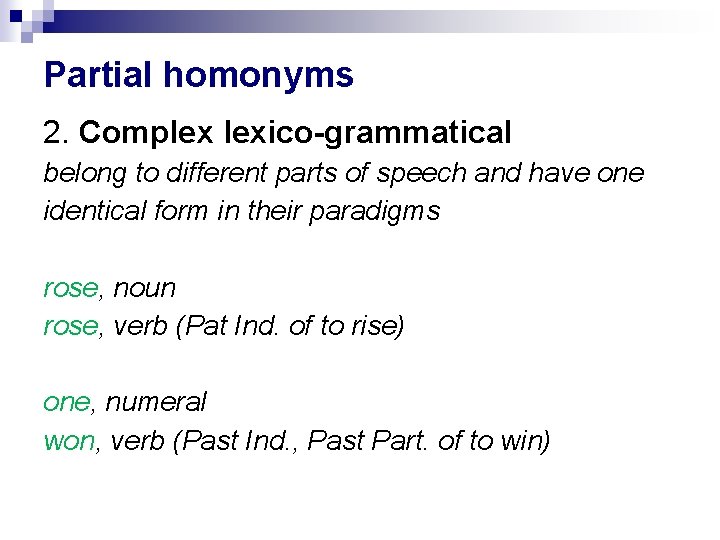
Partial homonyms 2. Complex lexico-grammatical belong to different parts of speech and have one identical form in their paradigms rose, noun rose, verb (Pat Ind. of to rise) one, numeral won, verb (Past Ind. , Past Part. of to win)
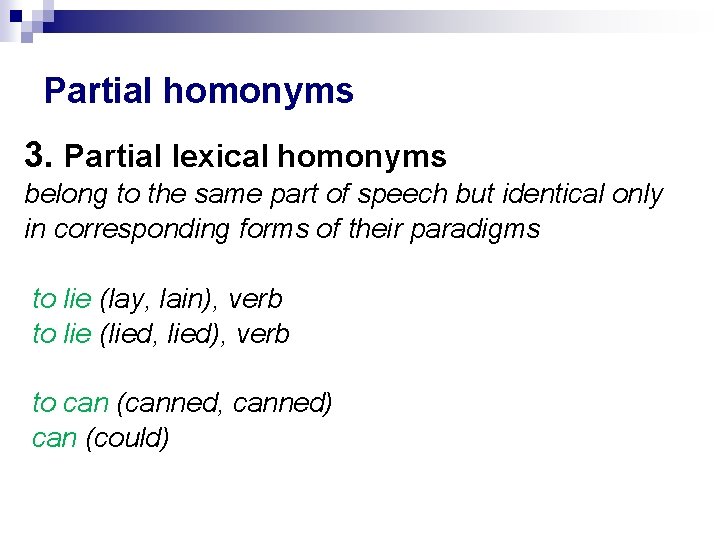
Partial homonyms 3. Partial lexical homonyms belong to the same part of speech but identical only in corresponding forms of their paradigms to lie (lay, lain), verb to lie (lied, lied), verb to can (canned, canned) can (could)
Classification of homonyms by I. V. Arnold Only one group of homonyms. Perfect homonyms 4 criteria for their classification: • Lexical meaning • Grammatical meaning • Basic form • Paradigm
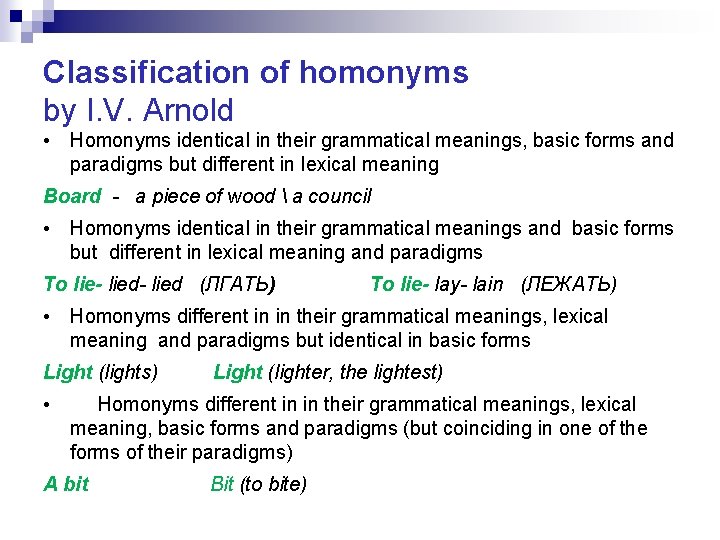
Classification of homonyms by I. V. Arnold • Homonyms identical in their grammatical meanings, basic forms and paradigms but different in lexical meaning Board - a piece of wood a council • Homonyms identical in their grammatical meanings and basic forms but different in lexical meaning and paradigms To lie- lied (ЛГАТЬ) To lie- lay- lain (ЛЕЖАТЬ) • Homonyms different in in their grammatical meanings, lexical meaning and paradigms but identical in basic forms Light (lights) • Light (lighter, the lightest) Homonyms different in in their grammatical meanings, lexical meaning, basic forms and paradigms (but coinciding in one of the forms of their paradigms) A bit Bit (to bite)
Classification of homonyms according to their meaning lexical homonyms – words that differ in their lexical meaning but identical in their grammatical meaning e. g. a seal (тюлень) – a seal (печать)
Synonyms and antonyms are regarded as the treasure of the language’s expressive resources. They are created by the vocabulary system with a particular purpose Homonyms are of no interest in this respect. They are accidental creations, and therefore purposeless. In the process of communication they lead sometimes to confusion and misunderstanding
Classification of homonyms according to their meaning grammatical homonyms – different wordforms of one and the same word are identical e. g. a seal – seals – seal’s – seals’
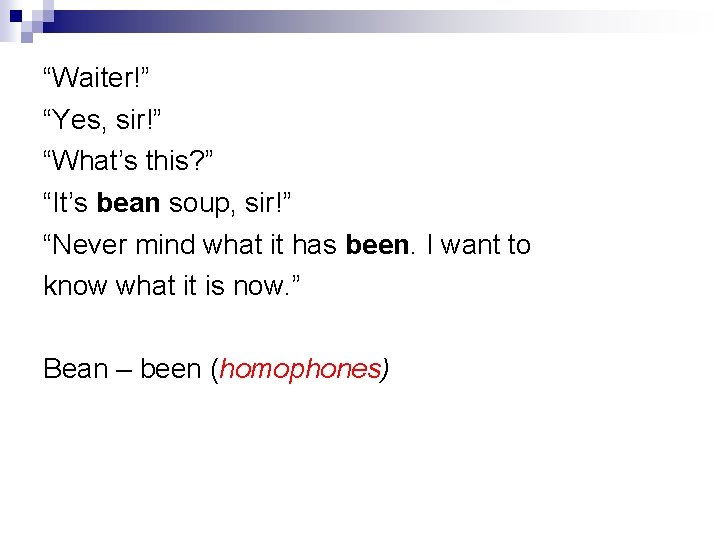
“Waiter!” “Yes, sir!” “What’s this? ” “It’s bean soup, sir!” “Never mind what it has been. I want to know what it is now. ” Bean – been (homophones)
Reasons for intense development of homonyms in English monosyllabic character of the language analytic structure of English predominance of free forms in English high-developed polysemy
Sources of Homonyms • • • Phonetic changes Borrowing Conversion Shortening Split polysemy
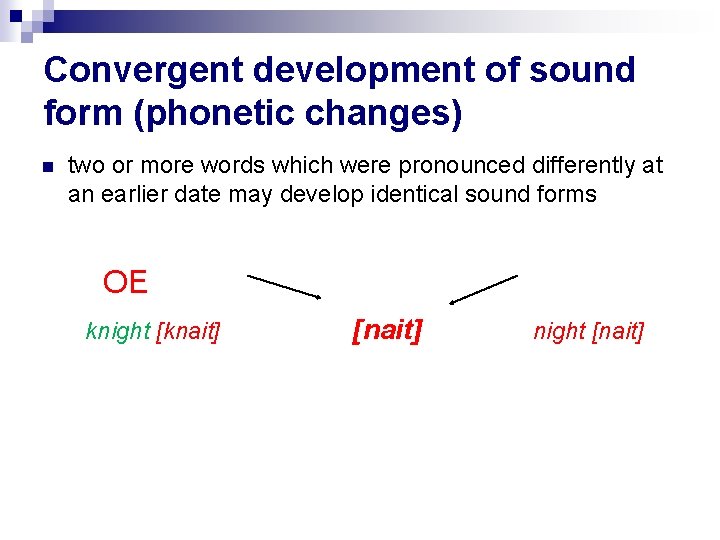
Convergent development of sound form (phonetic changes) two or more words which were pronounced differently at an earlier date may develop identical sound forms OE knight [knait] [nait] night [nait]
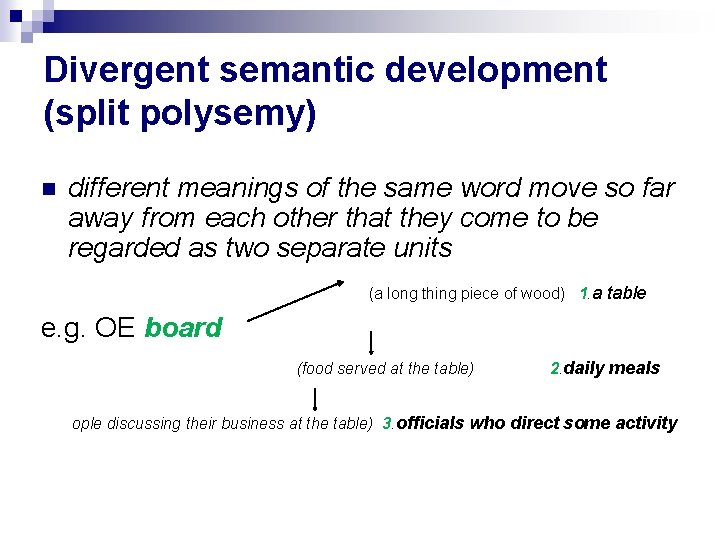
Divergent semantic development (split polysemy) different meanings of the same word move so far away from each other that they come to be regarded as two separate units (a long thing piece of wood) 1. a table e. g. OE board (food served at the table) 2. daily meals ople discussing their business at the table) 3. officials who direct some activity
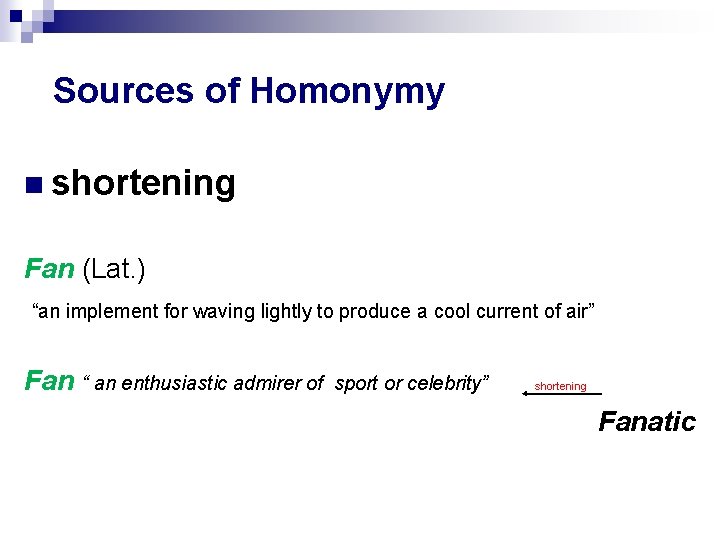
Sources of Homonymy shortening Fan (Lat. ) “an implement for waving lightly to produce a cool current of air” Fan “ an enthusiastic admirer of sport or celebrity” shortening Fanatic
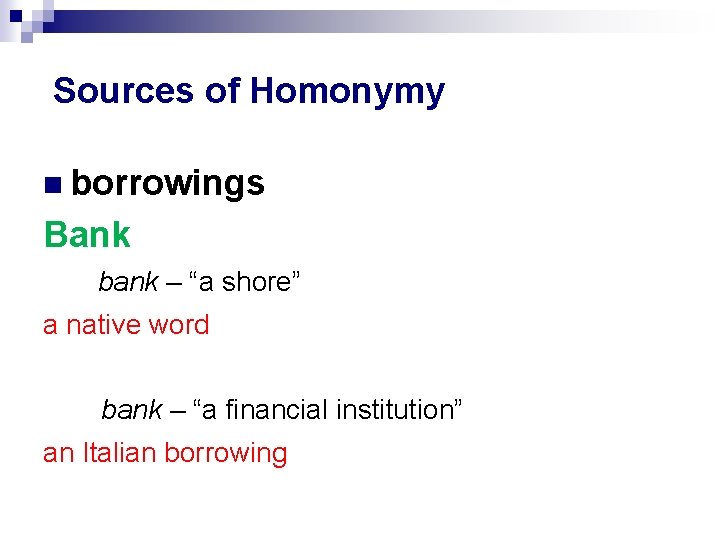
Sources of Homonymy borrowings Bank bank – “a shore” a native word bank – “a financial institution” an Italian borrowing
Sources of Homonymy sound-imitation mew ‘the sound a cat makes’ ‘a sea gull’ ‘small terraced houses in London’
Synchronic Approach to Homonymy 1. 2. the criteria distinguishing homonymy from polysemy the formulation of rules for recognizing different meanings of homonyms in terms of their distribution
Homonymy and Polysemy Semantic criterion of related and unrelated meanings connections between the various meanings are apprehended by speakers or not apprehended
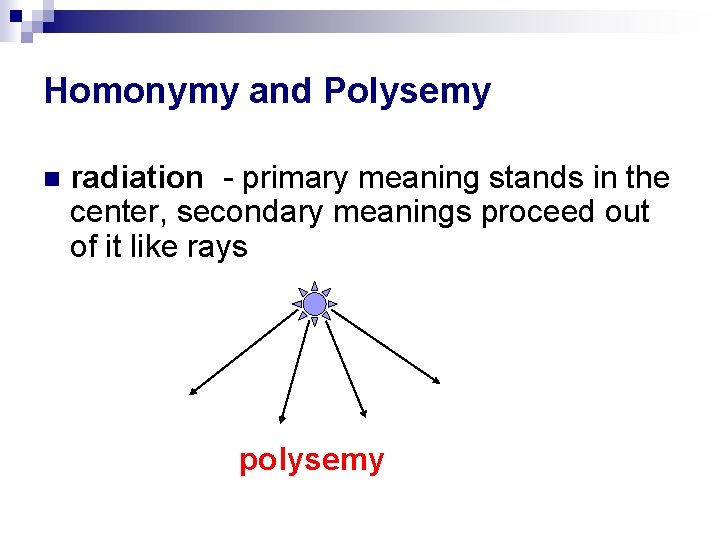
Homonymy and Polysemy radiation - primary meaning stands in the center, secondary meanings proceed out of it like rays polysemy
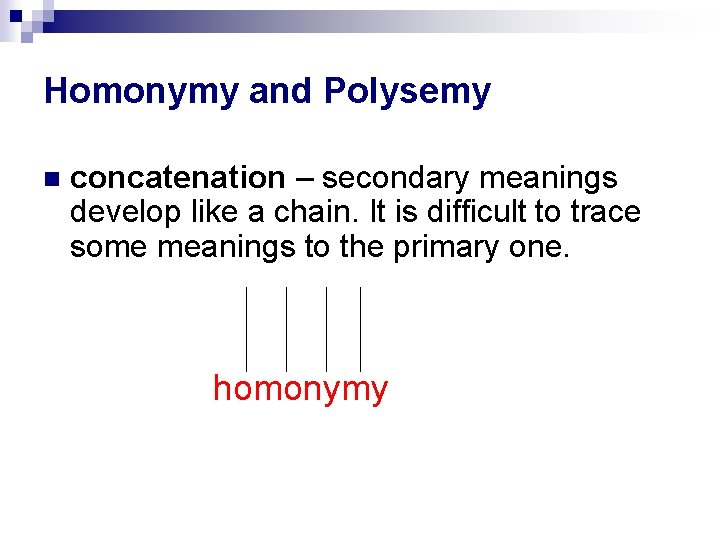
Homonymy and Polysemy concatenation – secondary meanings develop like a chain. It is difficult to trace some meanings to the primary one. homonymy
Distribution Criterion homonyms differ in their syntactic function e. g. I think that this “that” is a conjunction but that “that” that man used was a pronoun.
Classification of homonyms according to their meaning lexical homonyms – words that differ in their lexical meaning but identical in their grammatical meaning a seal (тюлень) a seal (печать)
Classification of homonyms according to their meaning grammatical homonyms – different wordforms of one and the same word are identical a seal – seals – seal’s – seals’
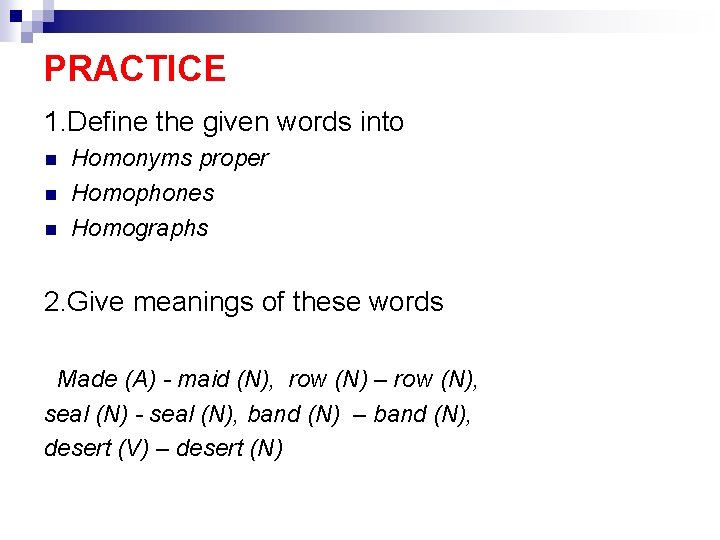
PRACTICE 1. Define the given words into Homonyms proper Homophones Homographs 2. Give meanings of these words Made (A) - maid (N), row (N) – row (N), seal (N) - seal (N), band (N) – band (N), desert (V) – desert (N)
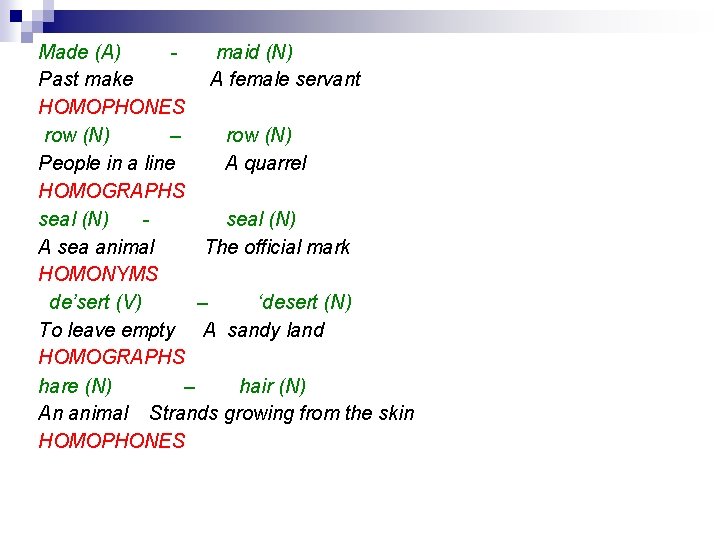
Made (A) maid (N) Past make A female servant HOMOPHONES row (N) – row (N) People in a line A quarrel HOMOGRAPHS seal (N) A sea animal The official mark HOMONYMS de’sert (V) – ‘desert (N) To leave empty A sandy land HOMOGRAPHS hare (N) – hair (N) An animal Strands growing from the skin HOMOPHONES
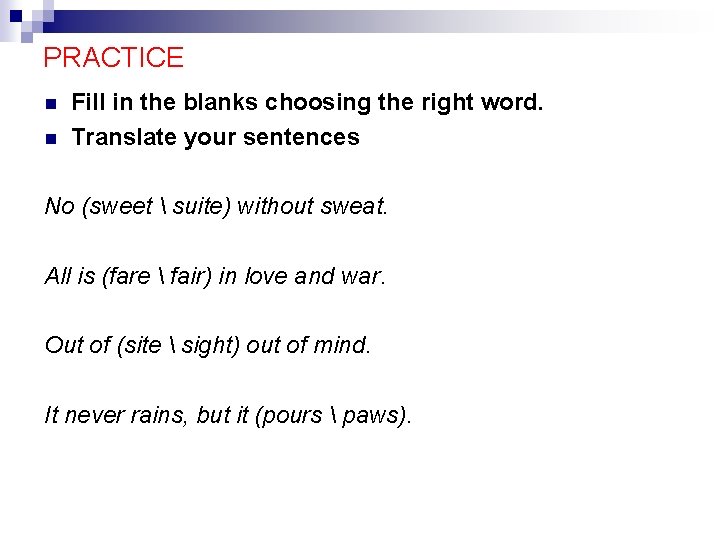
PRACTICE Fill in the blanks choosing the right word. Translate your sentences No (sweet suite) without sweat. All is (fare fair) in love and war. Out of (site sight) out of mind. It never rains, but it (pours paws).
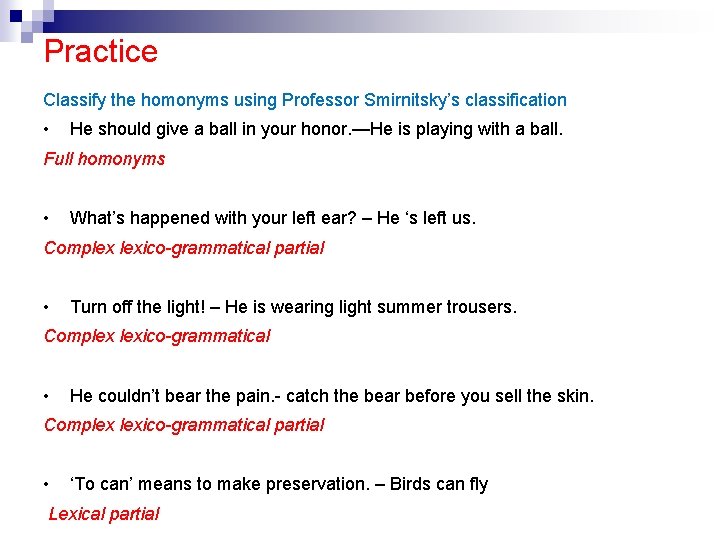
Practice Classify the homonyms using Professor Smirnitsky’s classification • He should give a ball in your honor. —He is playing with a ball. Full homonyms • What’s happened with your left ear? – He ‘s left us. Complex lexico-grammatical partial • Turn off the light! – He is wearing light summer trousers. Complex lexico-grammatical • He couldn’t bear the pain. - catch the bear before you sell the skin. Complex lexico-grammatical partial • ‘To can’ means to make preservation. – Birds can fly Lexical partial
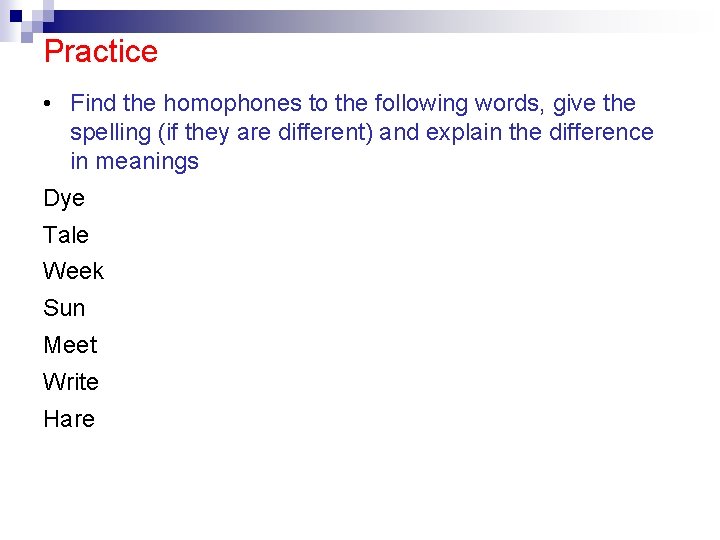
Practice • Find the homophones to the following words, give the spelling (if they are different) and explain the difference in meanings Dye Tale Week Sun Meet Write Hare