HOMOEOPATHIC MEDICAL REPERTORY MURPHYS REPERTORY DR CHANDRA HASAN

- Slides: 30
HOMOEOPATHIC MEDICAL REPERTORY (MURPHY’S REPERTORY) DR CHANDRA HASAN C M, M. D(Hom), ASSOCIATE PROFESSOR, DEPT OF REPERTORY, SARADA KRISHNA HOMOEOPATHIC MEDICAL COLLEGE, KULASEKHARAM
HOMOEOPATHIC MEDICAL REPERTORY Title : Homoeopathic medical repertory ‘A modern alphabetical and practical repertory’ Author : Dr. Robin murphy. N. D. Contents of the repertory : Acknowledgement : Here the author is providing gratitude to persons those who contributed and helped for the compilation of this repertory. Preface to third edition : In this it is mentioned about the plan and construction of the repertory, editions, gradation, chapters, additions and corrections. By author. Table of the contents : Contents of the repertory are mentioned.
Repertory proper : repertory part is mentioned. Homoeopathic references : The major sources for additions, updates and new rubrics. Homoeopathic remedy list : Abbreviations of medicines. Full name and common names are mentioned. (third edition at the front) Word index : Important words are arranged alphabetically. (more in third improved edition) Introduction : An urgent and constant need was strongly felt by the professionals for a repertory which could meet the pace of development of modern pathology and internal medicine. This need was fairly and squarely met by emergence of homoeopathic medical repertory.
While going through the various medical literatures Robin murphy came across some Homoeopathic journals from 1800’s, which were lying idea. He was shocked to see the plethora of literature available in homoeopathy. As he went through them he developed more and more interest in the system. Initially he learned Homoeopathy on his own way from the study of journals, books and various case materials, later he went to do a regular course in Homoeopathy. And started to practice homoeopathy. Editions : There is three editions, first edition was published in 1993, the second edition was published in April 1996 at Colorado U. S. A, third edition was
published in 2009 at Blscksburg, Virginia U. S. A. The first Indian edition was in 1994, second edition in 2002, third edition in 2010. The contents of the repertory are collected from 56 sources. (improved edition approximately 190) Philosophical background : This repertory is based on principles of clinical and classical Homoeopathic practice. Gradation : In the third edition. BOLD CAPITALS – SULPH – 3 points Bold small italics – sulph – 2 points plain small - sulph – 1 point
In improved third edition. BOLD CAPITALS UNDERLINED – CALC – 4 points BOLD CAPITALS – CALC – 3 points. Bold italics – calc – 2 points. Plain – calc – 1 point. Plan and construction : the Homoeopathic medical repertory was designed to be a complete rewrite and major upgrade of the second edition. It contains hundreds of new remedies and thousands of new rubrics, in addition to many thousands of updates and additions. The third edition was updated to be more
clinical practice and easy to use reference guide to the vast Homoeopathic materia medica. After editing the second edition added more terminology, cross references, and corrected many errors. The final step was to systematically survey the Homoeopathic literature for reliable additions. Highest priority was to find more clinical information relevant to modern Homoeopathic practice. The first edition contain 67 chapters, the second edition contain 70 chapters, the third edition contain 74 chapters. Modern terminology and diseases, as well as consistent alphabetical formatting of chapters, rubrics and sub rubrics. Over 20, 000 new rubrics, and more than 1, 000 new additions and updates.
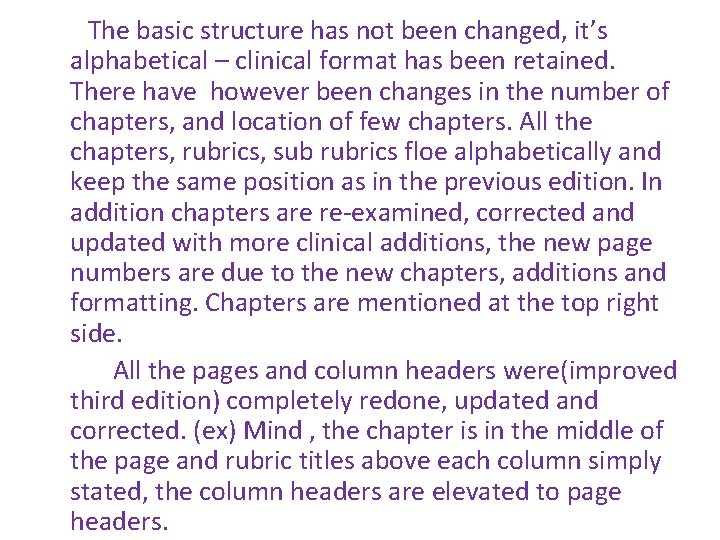
The basic structure has not been changed, it’s alphabetical – clinical format has been retained. There have however been changes in the number of chapters, and location of few chapters. All the chapters, rubrics, sub rubrics floe alphabetically and keep the same position as in the previous edition. In addition chapters are re-examined, corrected and updated with more clinical additions, the new page numbers are due to the new chapters, additions and formatting. Chapters are mentioned at the top right side. All the pages and column headers were(improved third edition) completely redone, updated and corrected. (ex) Mind , the chapter is in the middle of the page and rubric titles above each column simply stated, the column headers are elevated to page headers.
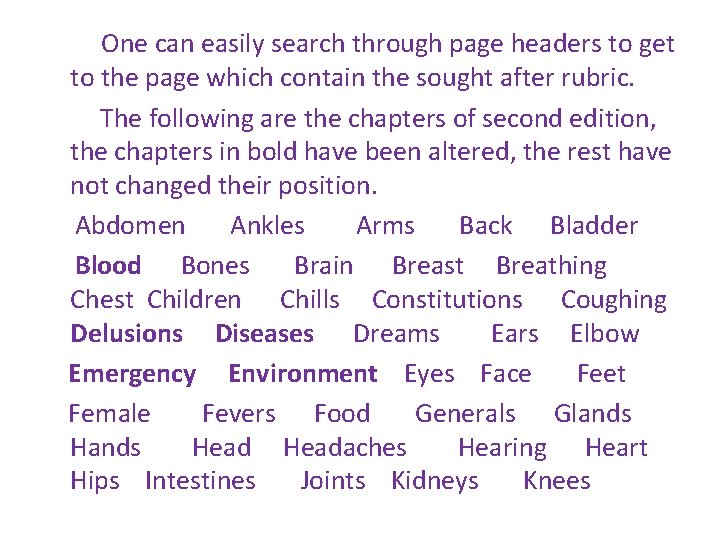
One can easily search through page headers to get to the page which contain the sought after rubric. The following are the chapters of second edition, the chapters in bold have been altered, the rest have not changed their position. Abdomen Ankles Arms Back Bladder Blood Bones Brain Breast Breathing Chest Children Chills Constitutions Coughing Delusions Diseases Dreams Ears Elbow Emergency Environment Eyes Face Feet Female Fevers Food Generals Glands Headaches Hearing Heart Hips Intestines Joints Kidneys Knees
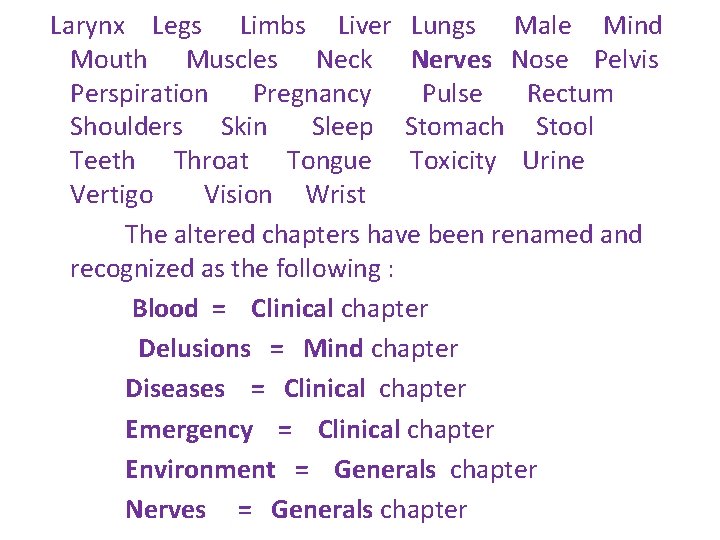
Larynx Legs Limbs Liver Lungs Male Mind Mouth Muscles Neck Nerves Nose Pelvis Perspiration Pregnancy Pulse Rectum Shoulders Skin Sleep Stomach Stool Teeth Throat Tongue Toxicity Urine Vertigo Vision Wrist The altered chapters have been renamed and recognized as the following : Blood = Clinical chapter Delusions = Mind chapter Diseases = Clinical chapter Emergency = Clinical chapter Environment = Generals chapter Nerves = Generals chapter
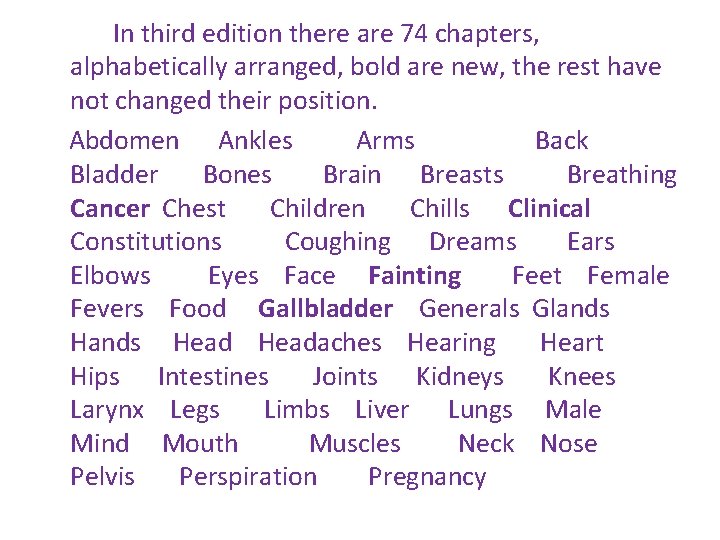
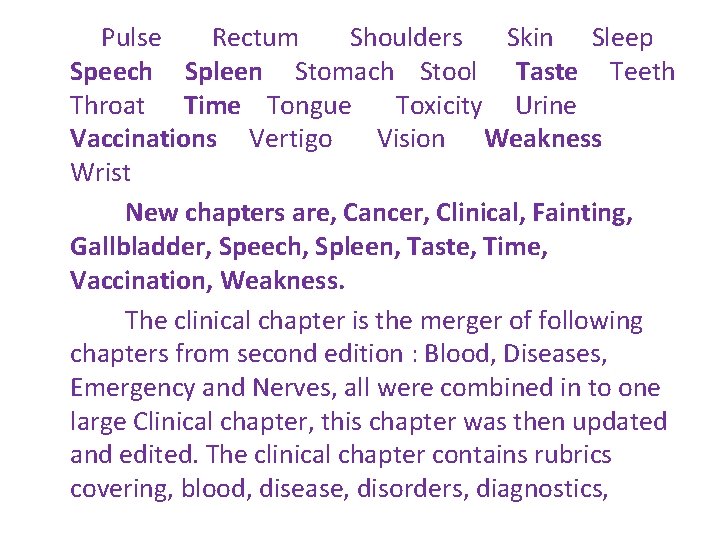
In third edition there are 74 chapters, alphabetically arranged, bold are new, the rest have not changed their position. Abdomen Ankles Arms Back Bladder Bones Brain Breasts Breathing Cancer Chest Children Chills Clinical Constitutions Coughing Dreams Ears Elbows Eyes Face Fainting Feet Female Fevers Food Gallbladder Generals Glands Headaches Hearing Heart Hips Intestines Joints Kidneys Knees Larynx Legs Limbs Liver Lungs Male Mind Mouth Muscles Neck Nose Pelvis Perspiration Pregnancy
Pulse Rectum Shoulders Skin Sleep Speech Spleen Stomach Stool Taste Teeth Throat Time Tongue Toxicity Urine Vaccinations Vertigo Vision Weakness Wrist New chapters are, Cancer, Clinical, Fainting, Gallbladder, Speech, Spleen, Taste, Time, Vaccination, Weakness. The clinical chapter is the merger of following chapters from second edition : Blood, Diseases, Emergency and Nerves, all were combined in to one large Clinical chapter, this chapter was then updated and edited. The clinical chapter contains rubrics covering, blood, disease, disorders, diagnostics,
emergencies, nerves, pathologies and tissue changes. The majority of additions came from Mac repertory and reference work of other software's, produced by the Kent Homoeopathic associates. Reference work contains hundreds of volumes of Homoeopathic books, provings and journals. Additions also made from Knerr’s repertory and Allen’s symptom index of the encyclopedia of pure materia medica. The reference list have been expanded and updated. Many clinical and therapeutic Homoeopathic books were consulted for this edition. Contents of repertory (third edition) are taken from fifty six sources. (approximately 190 in improved edi)
Homoeopathic remedy list : (improved edition) The remedy list have been moved to the back of the book (third edition front page) for easy access to the names and abbreviations of many homoeopathic and herbal remedies used in this book. This expanded list includes remedy abbreviations used in this repertory and homoeopathic materia medicas plus full Latin names and common names. Many remedy abbreviations are changed in order to make them more consistent with other repertories (complete and synthesis). The general homoeopathic remedy list contains many remedies that are not yet included in this edition. The word index : Located at the back of the repertory and also expanded to include many more clinical
conditions and states. This list is used to find particular words and clinical references such as ‘hepatitis or ‘influenza’. Common words found in most chapters such as ‘burning’ are not emphasized in the word index, because they are easily accessible alphabetically with in each chapter. Abbreviations : agg = aggravated by, worse from or symptoms increased by. amel = ameliorated by, better from or symptoms decreased by. Clinical and pathological rubrics: Because of availability of more clinical and pathological rubrics and new diseases these type of rubrics are included in the repertory.
Arrangement of rubrics : First rubric in general (Brain, general), then rubrics are arranged alphabetically, the general rubrics contain large group of medicines followed by sub rubrics. Arranged alphabetically. General rubrics are in bold capital letters, sub rubrics are bold small letters, sub-sub rubrics are in ordinary letters. Chapters are in capital bold letters, cross references are in brackets after rubrics. Concept of totality is based on classical and clinical symptoms. Using this repertory we can repertorise the cases by Kentian, Boenninghausen and Boger’s methods, according to the availability of symptoms.
Adaptability: 1, Where mental generals and physical generals are prominent. 2, Where clinical symptoms / diagnosis is available. 3, Pathological generals / constitutions are available. 4, Where complete symptoms are available. 5, Where the case has paucity of symptoms. Special features: 1, The third edition has more than 20, 000 new rubrics and 1, 000 new additions and updates.
2, It contain valuable information from standard Homoeopathic literatures and repertories. 3, It has total of 74 chapters alphabetically arranged. New chapters are very useful to professionals. 4, Many clinical rubrics are added to each chapter. It includes mental disorders, infections and pathologies in modern nomenclature. 5, This repertory follows the four grading of remedies. 6, There are more than 1602 drugs in this repertory. 7, This repertory can be utilized for repertorising all type of cases.
Important rubrics of Homoeopathic medical repertory ABDOMEN(verities of pains sensations are mentioned) Abscess, abdomen Air hypochondria as if filed with. Aneurism(see clinical chapter) Anxiety abdomen in Ascitis-dropsy Bleeding peritoneum Bubo abdomen Cancer, abdomen Clothing, sensitive to. Discolouration general Enlarged, abdomen. Eruption, abdomen. Gangrene, abdomen. Hardness, abdomen. Heat, abdomen. Heaviness, abdomen. Inflammation, abdomen enteritis. Itching, abdomen. Movements, abdomen in. Nausea, abdomen felt in. Noises in. Pain, abdomen. Pain, umbilicus.
Pain, umbilicus region. Peritonitis, enteritis. Perspiration, abdomen. Portal system, general. Restlessness, abdomen, uneasiness. Sensitive, tenderness. Swelling, abdomen. Twitching, abdomen. Weakness, sensation. ANKLES: (varieties of pains and sensations). Ankles, general. Achilles tendon. Eruptions, ankle. Inflammation, ankles. Injuries, ankles. Rheumatic pain. Swelling, ankles. Ulcer, ankles. Weak, ankles. ARMS: (various pains and sensations). Coldness, arms. Constriction. Convulsion. Discolouration, arms. Emaciation, arms.
Eruptions, arms. Formication, arms. Herpes, arms. Numbness, arms. Pain, arms. Paralysis, arms. Stiffness, arms. Ulcer, arms. Urticaria, arms. Vaccination, side effects. Veins, arms. Weakness, arms. BACK: Different kinds of pains and sensations are mentioned. Back, general. Back, abscess. Boils, back. Heaviness. Haemorrhage, of spinal cord. Inflammation of, spinal cord. Injuries, back. Myotrophy. Opisthotonos, back. Pain, back/ Pain, scapula under. Pain, spine. Pain, thoracic middle of. Rheumatic pain, Spinal, curvature. Spinal, pain after injection. Weak, back spine. Etc. BLADDER : Various types of pain and sensations. Bladder, general. Atony, bladder. Bedwetting, enuresis. Bleeding, bladder. Bleeding, urethra. Caruncle urethra
Catarrh, bladder. Catheter, ailments from. Chordae, urethra. Haemorrhoids, bladder. Inactivity, bladder. Induration, bladder. Irritability, bladder. Itching, urethra. Pain, bladder. Paralysis, bladder. Polypus, bladder. Prolapse, bladder. Retention, of urine. Urethritis, inflammation. Urging, to urinate. Urination, general. Weak, bladder. BONES : Verities of pain and sensations. Bones, in general. Brittle, bones. Cancer, bones. Curving, curvature of bones. Decay, of bones. Exotoses. Fistula, bone. Growth, of bone affected. Hypertrophy, bones. Inflammation, bones. Iijuries bones, bruised blows. Osteomalacia. Osteoporus. Pain, bones. Periostitis, inflammation. Periosteum.
Rheumatism, of bones. Rickets, rachitis. Scorbutic, scurvy complaints of bones. Scrofulous complaints of, bones. Sensitive, bones. Swelling, bones. Syphilitic bones, ailments from. Tuberculosis, bones. Tumor, bones. Weak, bones. BRAIN : Various pains and sensations. Brain, general. Abscess, brain. Acromegaly. Alzhemer’s disease. Anemia, brain. Anesthesia, brain. Anurism, brain. Atrophy, sclerosis, of brain. Catalepsy. Catatonia. Cerebellar, disease. Cerebral, haemorrhage. Cerebral palsy. Cerebrospinal axis, ailments of. Concussion, brain. Congestion, brain (see head chapter). Convulsion, brain problems from. Coordination disturbed. Edema, brain dropsy. Encephalitis, brain (see meningitis). Encephaloma (see tumor brain). Hematoma, brain. Hydrocephalus, brain. Inflammation, brain (see
encephalitis). Irritation of, brain. Medulla, problems. Meningitis infection. Pain, brain. Paralysis, brain. Senses, general. Softening, of brain. Stroke, apoplexy. Syphilitic, brain affections. Tongue protruded in, brain affections. Tumor brain, encephaloma. Weak, brain. BREASTS : Breasts, general. Abscess, breasts. Atrophy, breasts. Bleeding, nipple from. Breast feeding, nursing lactation. Breast, milk general. Cancer, breasts (scirrhus cancer). Cicatrices (see scars). Cracks, fissures breasts. Discolourations, breasts. Discolouration, nipples. Emaciation, breasts. Eruption, breasts. Excoriation, breasts, from rubbing. Fistulae openings in. Flabby, breasts.
Formication, breasts. Fullness, breasts. Inflammation, breasts (see mastitis). Injuries, breasts to. Inverted , nipples. Lumps, breasts (see induration, nodules, tumor). Nipples, complaints of. Nodule, breasts (see lumps, tumors). Nursing (see breast feeding). Pain, breasts. Perspiration, breasts, Retraction of, nipples. Sensitive, breasts. Smaller, one breast than another. Swelling, breasts. Ulceration, breasts. Undeveloped, small. BREATHING : Abdominal breathing. Accelerated, breathing. Asphyxia(see stopped breathing). Asthmatic, breathing(see lung chapter). Breath, cold(see mouth chapter). Breath, hot. Cheyne stroke. Cyanosis, breathing. Difficult, breathing. Forcible, breathing. Gasping, for breath. Intermittant, unequal. Irregular, breathing. Loud, breathing. Moaning,
breathing. Painful, breathing. Paroxysmal, breathing. Rattling, breathing. Sighing, breathing. Slow, breathing. Sneezing, breathing. Sobbing, breathing. Stertorous, breathing. Superficial, breathing. Wheezing, breathing. Whistling, breathing. CANCER : Cancer, general. Abdomen, cancer. Adenocarcinoma. (see cancer glands). Basal cell carcinoma(see epithelioma, melanoma, squamous). Bladder, cancer. Bone, cancer. Brain tumor, cephaloma. Breast, cancer. Cachexia, emaciation, with cancer. Cervix, cancer, of uterus. Chemotherapy, treatment, ailments from. Colon, cancer. Constitutions, cancer. Delusion, that they have or will get, cancer. Epithelioma. Esophagus, cancer. Eyelids,
cancer. Eyes, cancer. Face, cancer. Fear, cancer of. Female genitalia, cancer. Fungus haematodes. Ganglia, cancer. Head, cancer, fore head. Hodgkin’s disease. Intestines, cancer. Jaws, cancer. Larynx, vocal cord, cancer. Leukemia, blood. Lips, cancer. Lungs, cancer. Lupus carcinomatous. Lymphoma, lymphatic glands, cancer. Male genitalia, cancer. Ovarian, cancer. Pains from, cancer. Periosteum, cancer. Pharynx, cancer. Prostate, cancer. Radiation, sickness from side effects. Rectum, cancer. Sarcoma cutis. Scirrhus, cancer. Scrotum, cancer. Skin, cancer. Smoking, cancer, from tobacco. Spleen, cancer. Squamous cell, cancer. Stomach, cancer. Testes, cancer. Thyroid, cancer. Tongue, cancer. Vagina, cancer. Wound, cancer from.
CHEST : Various pains and sensations. Abscess, axilla, chest. Anginapectoris. Anxiety, chest in. Bleeding, chest and lungs from. Coldness, chest. Congestion, chest, hyperema of. Diaphragm, general. Dropsy, chest(see oedema). Eruption, chest. Fluttering, chest in. Herpes, chest. Nodules, chest. Oppression, chest. Orgasm of blood. Pain, chest. Perspiration, chest. Pulsation, chest. Rheumatic, pain. Sensitive, chest. Trembling, chest. Tumors, chest. Weak, chest. CHILDREN : Children, general(see constitutions general) Abdomen, general. Abused, general, ailments from being. Acetonemia. Acromegaly. Adenoids, problems with. Angry, children. Anorexia nervosa. Asphyxia, infants(see clinical chapter). Asthma, children.
Autistic, children. Bashful, children. Bedwetting. Biting, finger nail habits. Boys, general. Breast feeding, general. Bronchitis. Bulimia. Bronchitis, infants. Capricious, children. Carried desire to be. Cephalomatoma. Chorea. Colic, infants(see intestines cramping). Concentration difficult. Confidence lacking of self esteem. Concientious child about trifles. Constipation, children. Constipation, infants. Convulsion, children. Convulsion, infants. Cowardice, children. Cretinism. Crying, children. Cursing, swearing, children. Curvature of spine. Curving and bowing of limbs. Cyanosis, infants in. Dentition, difficult, teething. Depressed, children. Destructive behavior. Development delayed or arrested. Diaper
rash buttocks. Diarrhoea, children. Diarrhoea, infants. Dirty, children. Down’s syndrome.