Historical perspective Introduction The acclaimed Czech playwright Karel

- Slides: 34
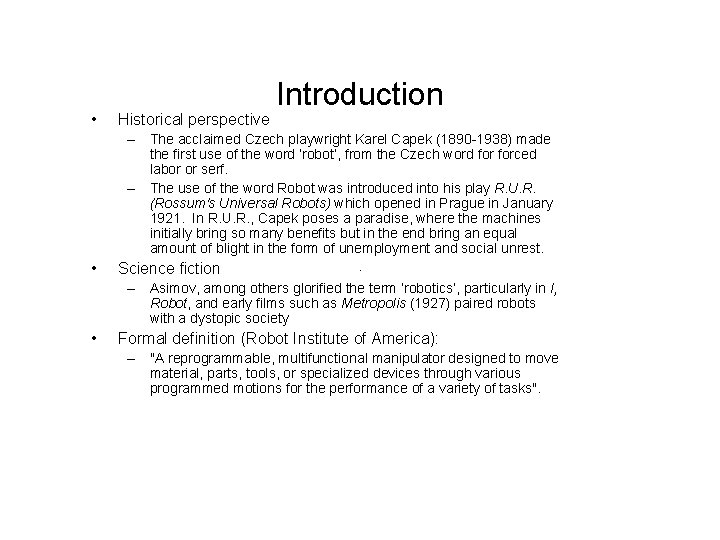
• Historical perspective Introduction – The acclaimed Czech playwright Karel Capek (1890 -1938) made the first use of the word ‘robot’, from the Czech word forced labor or serf. – The use of the word Robot was introduced into his play R. U. R. (Rossum's Universal Robots) which opened in Prague in January 1921. In R. U. R. , Capek poses a paradise, where the machines initially bring so many benefits but in the end bring an equal amount of blight in the form of unemployment and social unrest. • Science fiction – Asimov, among others glorified the term ‘robotics’, particularly in I, Robot, and early films such as Metropolis (1927) paired robots with a dystopic society • Formal definition (Robot Institute of America): – "A reprogrammable, multifunctional manipulator designed to move material, parts, tools, or specialized devices through various programmed motions for the performance of a variety of tasks".
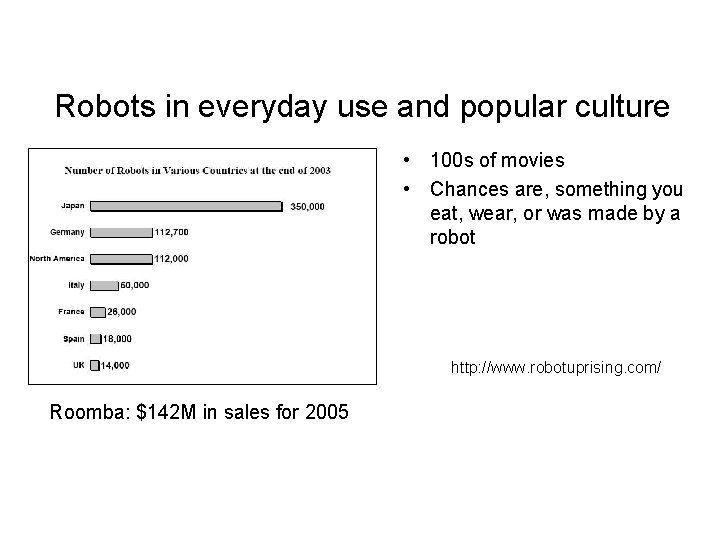
Robots in everyday use and popular culture • 100 s of movies • Chances are, something you eat, wear, or was made by a robot http: //www. robotuprising. com/ Roomba: $142 M in sales for 2005
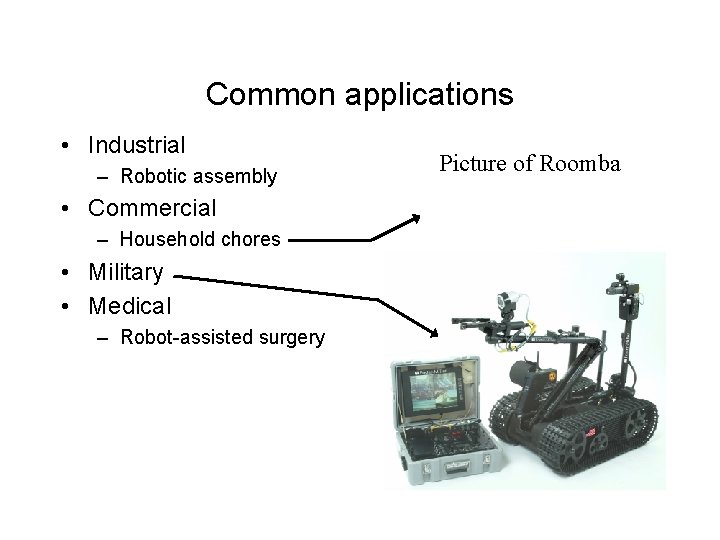
Common applications • Industrial – Robotic assembly • Commercial – Household chores • Military • Medical – Robot-assisted surgery Picture of Roomba
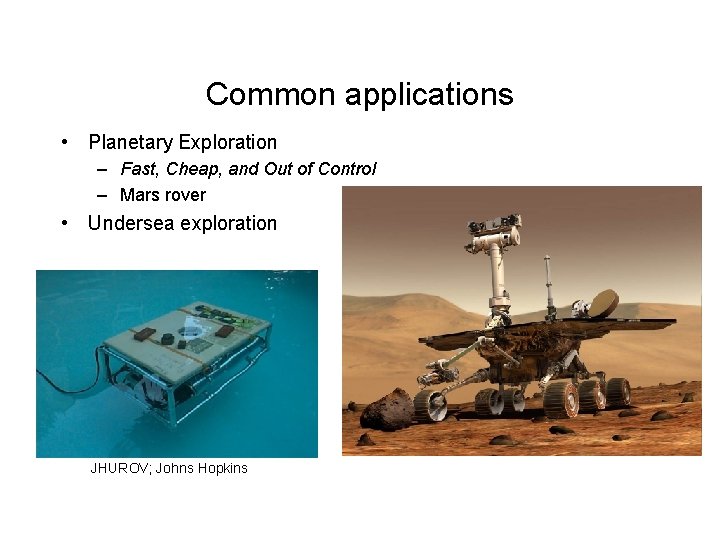
Common applications • Planetary Exploration – Fast, Cheap, and Out of Control – Mars rover • Undersea exploration JHUROV; Johns Hopkins
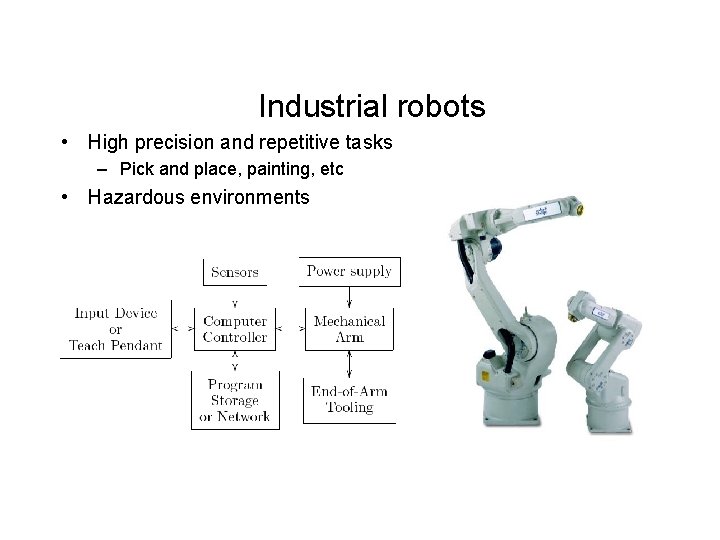
Industrial robots • High precision and repetitive tasks – Pick and place, painting, etc • Hazardous environments
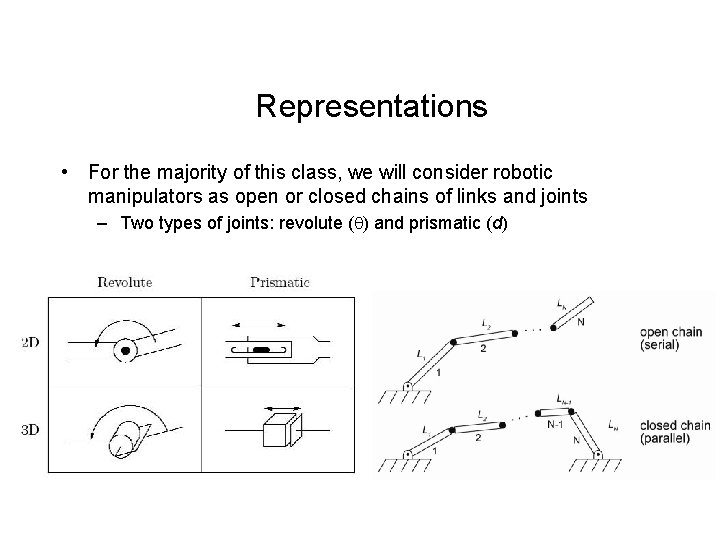
Representations • For the majority of this class, we will consider robotic manipulators as open or closed chains of links and joints – Two types of joints: revolute (q) and prismatic (d)
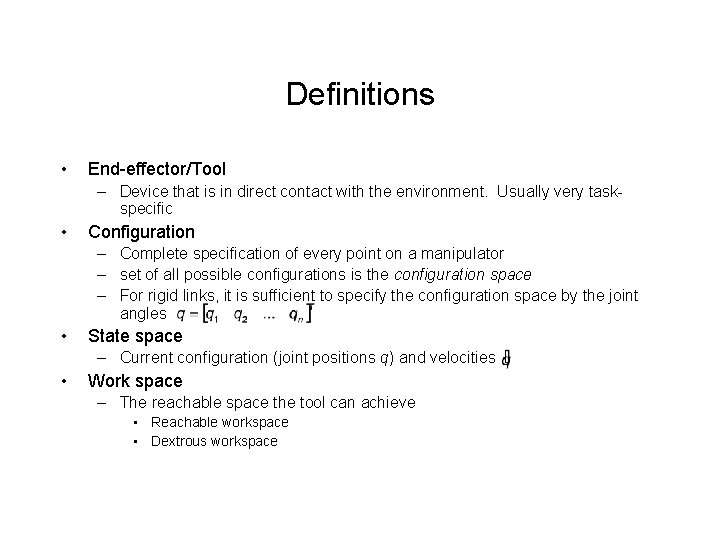
Definitions • End-effector/Tool – Device that is in direct contact with the environment. Usually very taskspecific • Configuration – Complete specification of every point on a manipulator – set of all possible configurations is the configuration space – For rigid links, it is sufficient to specify the configuration space by the joint angles • State space – Current configuration (joint positions q) and velocities • Work space – The reachable space the tool can achieve • Reachable workspace • Dextrous workspace
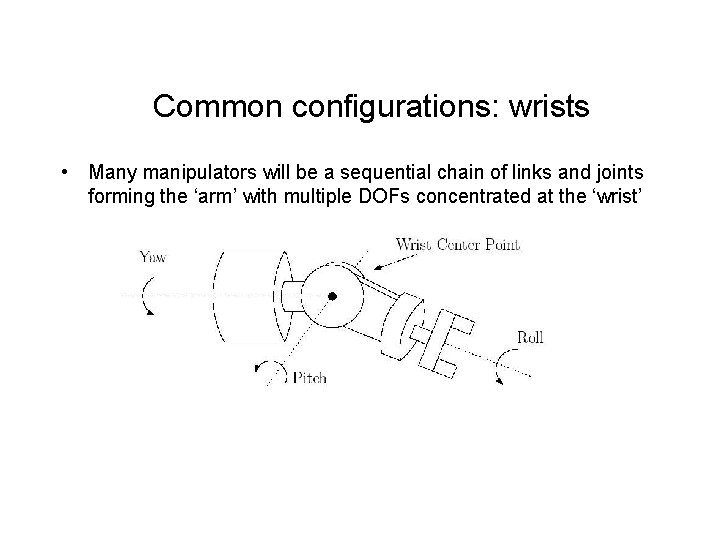
Common configurations: wrists • Many manipulators will be a sequential chain of links and joints forming the ‘arm’ with multiple DOFs concentrated at the ‘wrist’
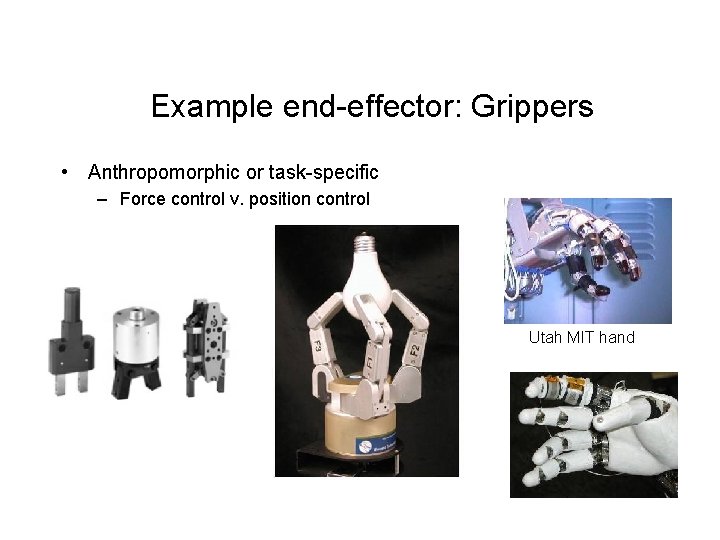
Example end-effector: Grippers • Anthropomorphic or task-specific – Force control v. position control Utah MIT hand
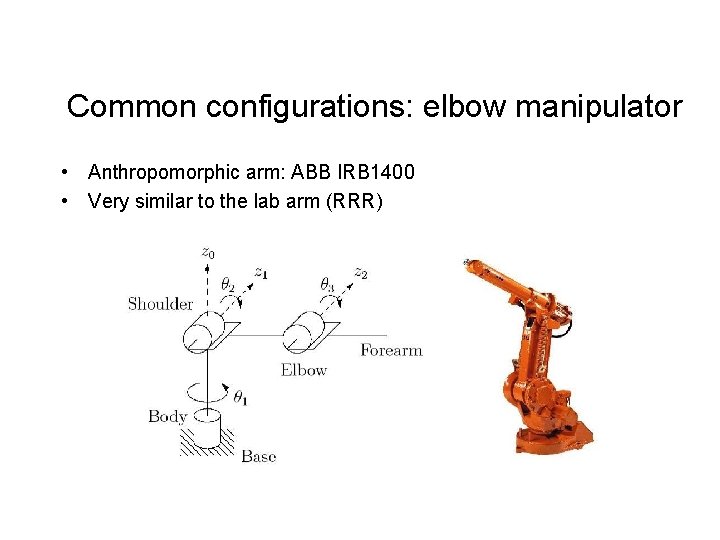
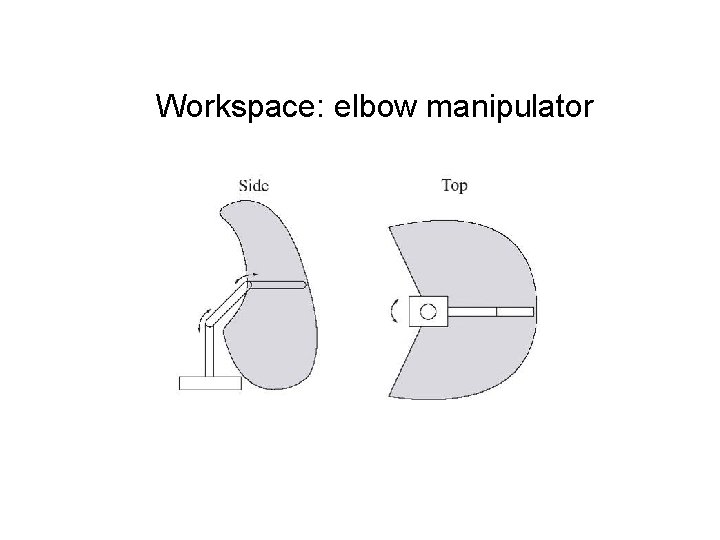
Common configurations: elbow manipulator • Anthropomorphic arm: ABB IRB 1400 • Very similar to the lab arm (RRR)
Workspace: elbow manipulator
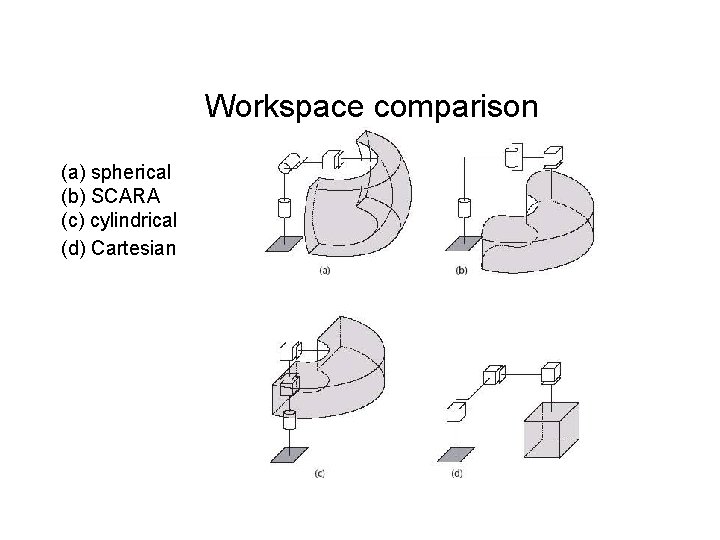
Common configurations: Stanford arm (RRP) • Spherical manipulator (workspace forms a set of concentric spheres)
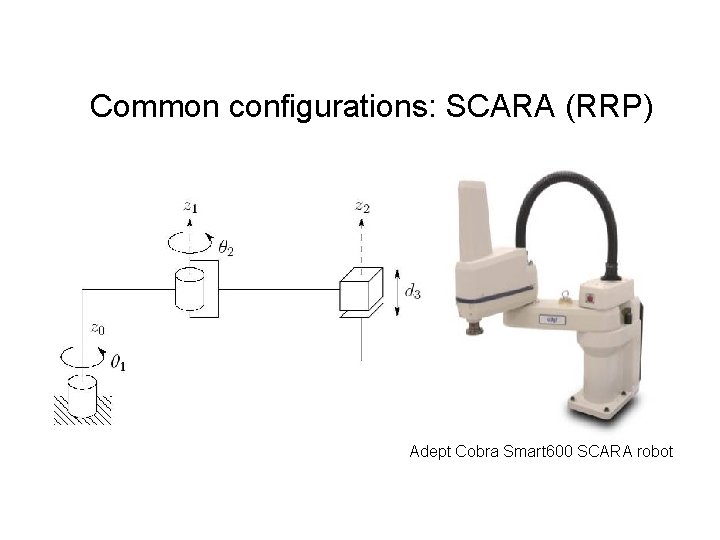
Common configurations: SCARA (RRP) Adept Cobra Smart 600 SCARA robot
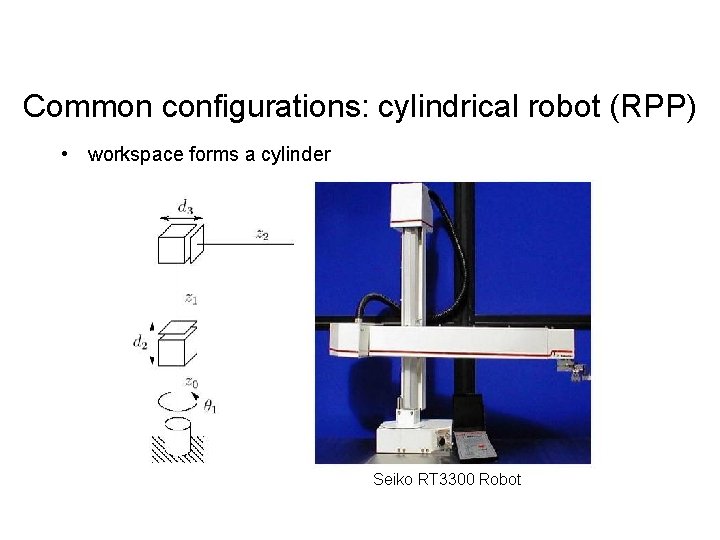
Common configurations: cylindrical robot (RPP) • workspace forms a cylinder Seiko RT 3300 Robot
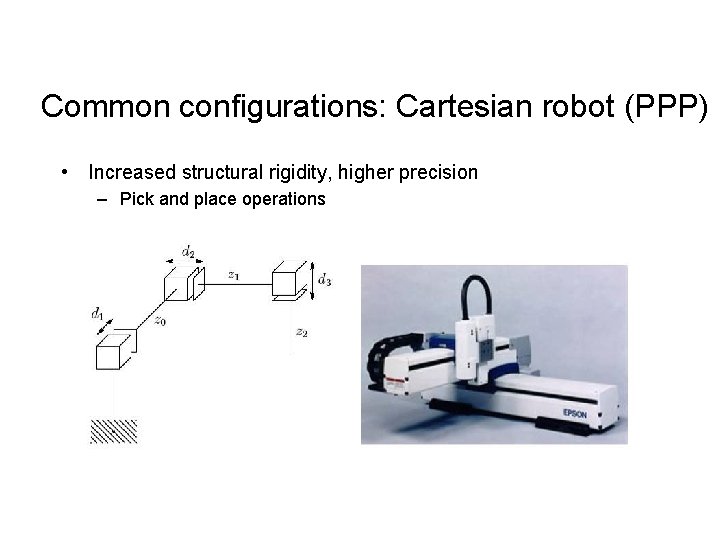
Common configurations: Cartesian robot (PPP) • Increased structural rigidity, higher precision – Pick and place operations
Workspace comparison (a) spherical (b) SCARA (c) cylindrical (d) Cartesian
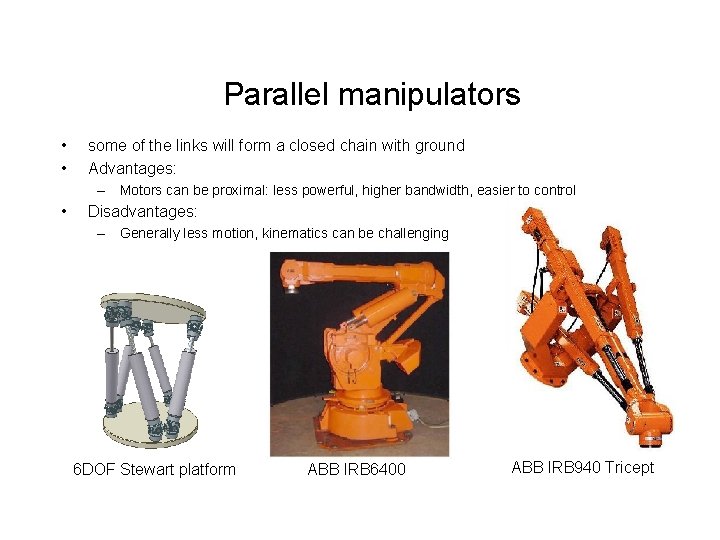
Parallel manipulators • • some of the links will form a closed chain with ground Advantages: – Motors can be proximal: less powerful, higher bandwidth, easier to control • Disadvantages: – Generally less motion, kinematics can be challenging 6 DOF Stewart platform ABB IRB 6400 ABB IRB 940 Tricept
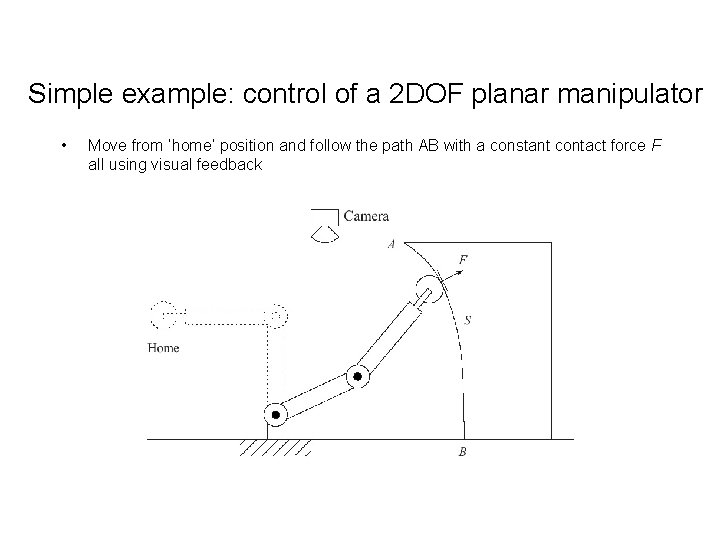
Simple example: control of a 2 DOF planar manipulator • Move from ‘home’ position and follow the path AB with a constant contact force F all using visual feedback
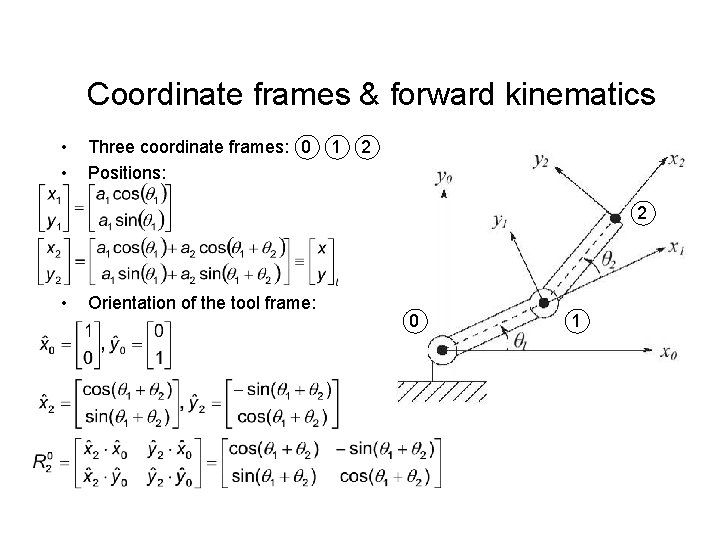
Coordinate frames & forward kinematics • • Three coordinate frames: 0 Positions: 1 2 2 • Orientation of the tool frame: 0 1
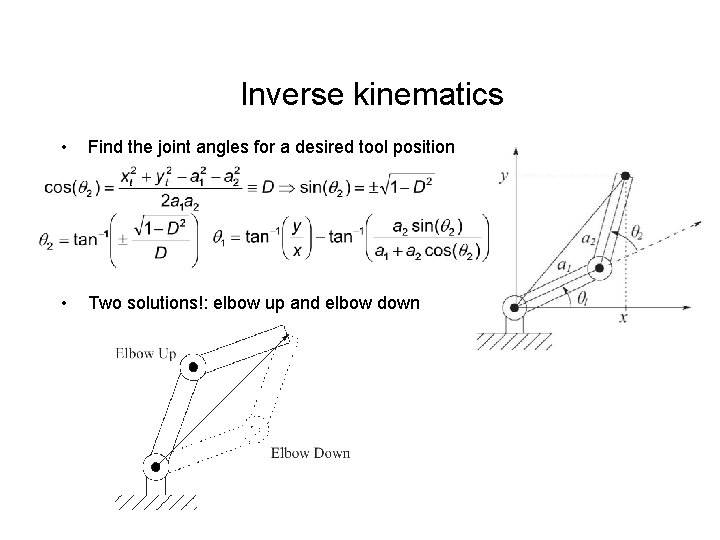
Inverse kinematics • Find the joint angles for a desired tool position • Two solutions!: elbow up and elbow down
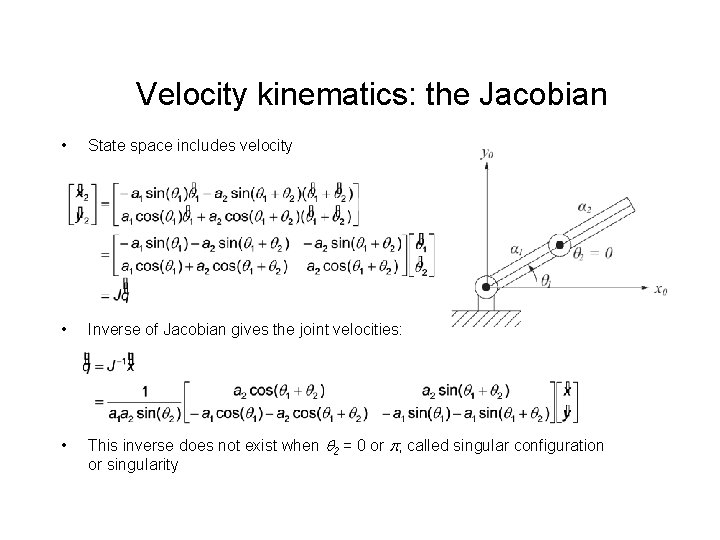
Velocity kinematics: the Jacobian • State space includes velocity • Inverse of Jacobian gives the joint velocities: • This inverse does not exist when q 2 = 0 or p, called singular configuration or singularity
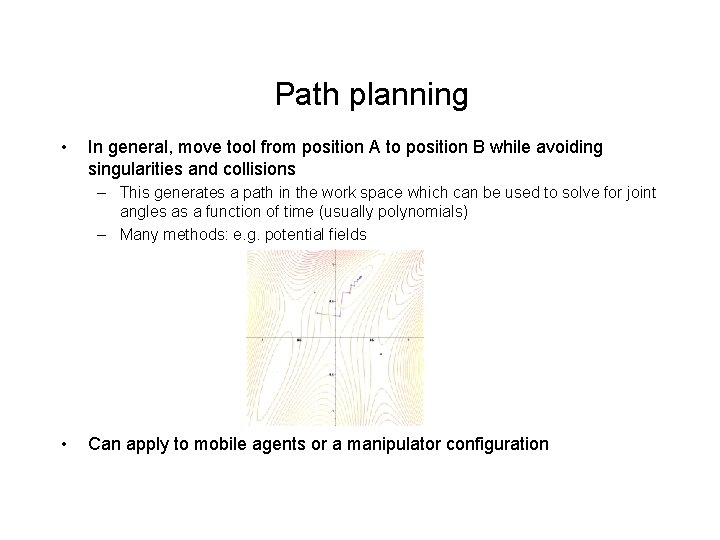
Path planning • In general, move tool from position A to position B while avoiding singularities and collisions – This generates a path in the work space which can be used to solve for joint angles as a function of time (usually polynomials) – Many methods: e. g. potential fields • Can apply to mobile agents or a manipulator configuration
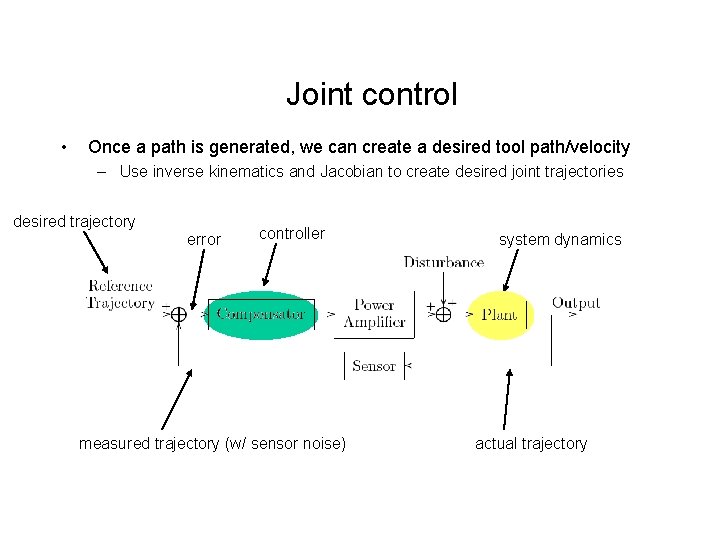
Joint control • Once a path is generated, we can create a desired tool path/velocity – Use inverse kinematics and Jacobian to create desired joint trajectories desired trajectory error controller measured trajectory (w/ sensor noise) system dynamics actual trajectory
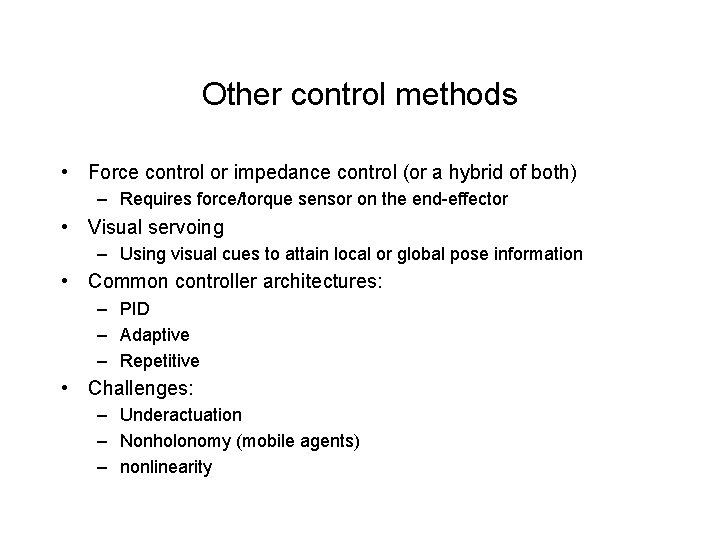
Other control methods • Force control or impedance control (or a hybrid of both) – Requires force/torque sensor on the end-effector • Visual servoing – Using visual cues to attain local or global pose information • Common controller architectures: – PID – Adaptive – Repetitive • Challenges: – Underactuation – Nonholonomy (mobile agents) – nonlinearity
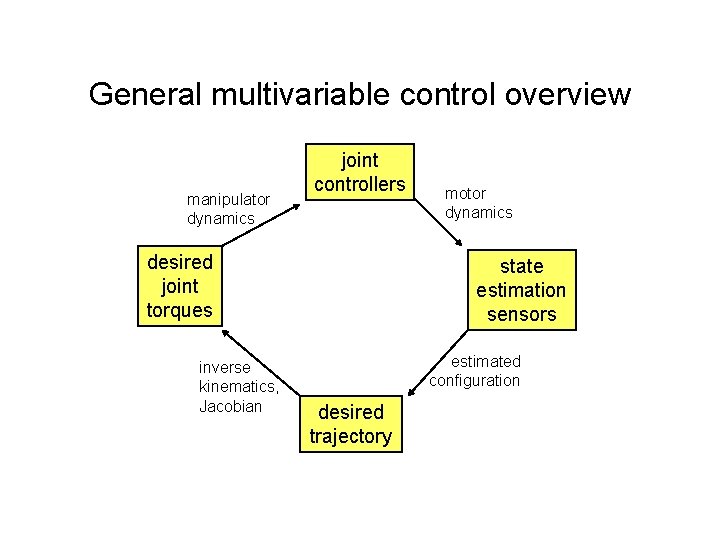
General multivariable control overview manipulator dynamics joint controllers desired joint torques inverse kinematics, Jacobian motor dynamics state estimation sensors estimated configuration desired trajectory
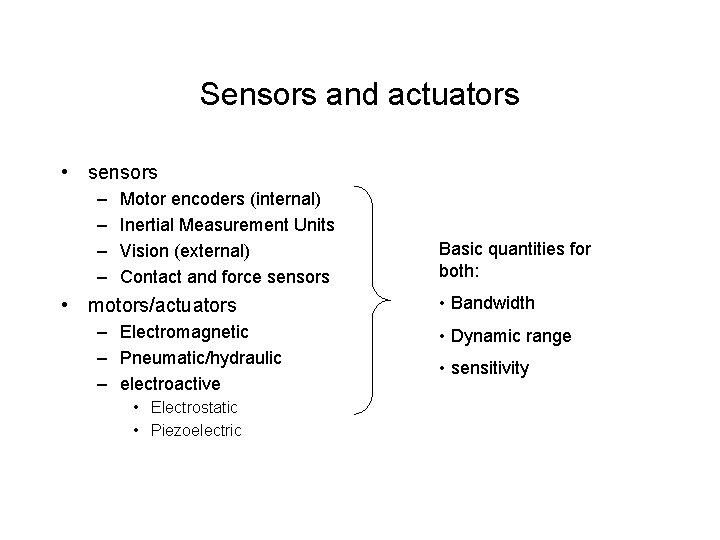
Sensors and actuators • sensors – – Motor encoders (internal) Inertial Measurement Units Vision (external) Contact and force sensors • motors/actuators – Electromagnetic – Pneumatic/hydraulic – electroactive • Electrostatic • Piezoelectric Basic quantities for both: • Bandwidth • Dynamic range • sensitivity
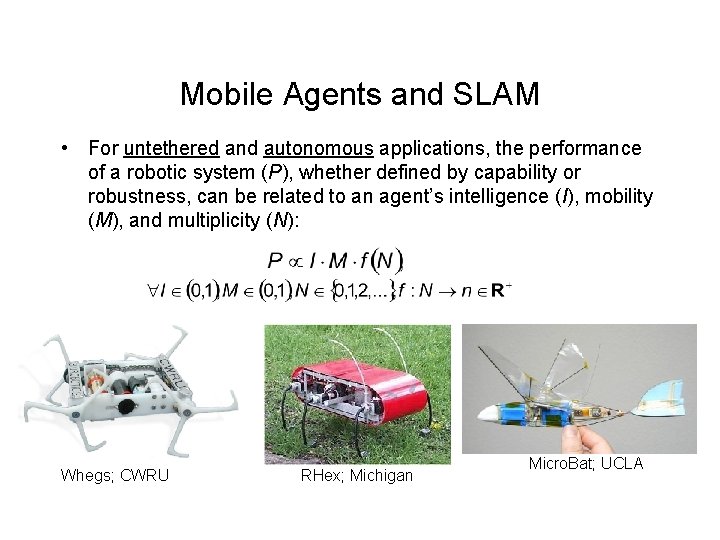
Mobile Agents and SLAM • For untethered and autonomous applications, the performance of a robotic system (P), whether defined by capability or robustness, can be related to an agent’s intelligence (I), mobility (M), and multiplicity (N): Whegs; CWRU RHex; Michigan Micro. Bat; UCLA
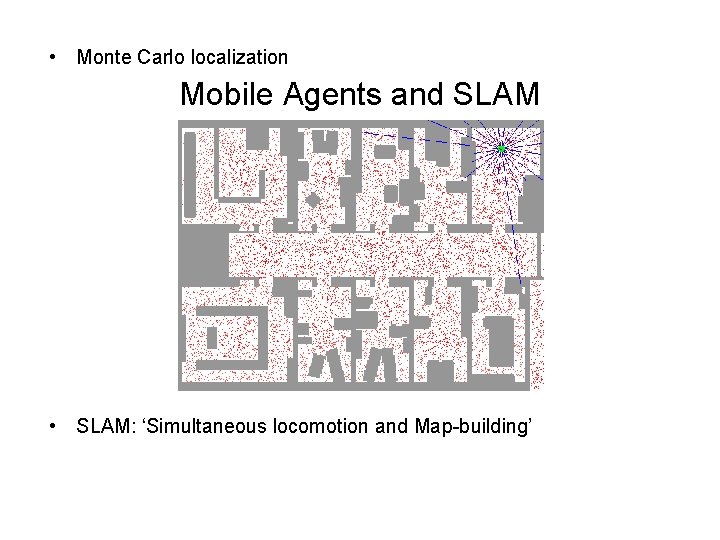
• Monte Carlo localization Mobile Agents and SLAM • SLAM: ‘Simultaneous locomotion and Map-building’
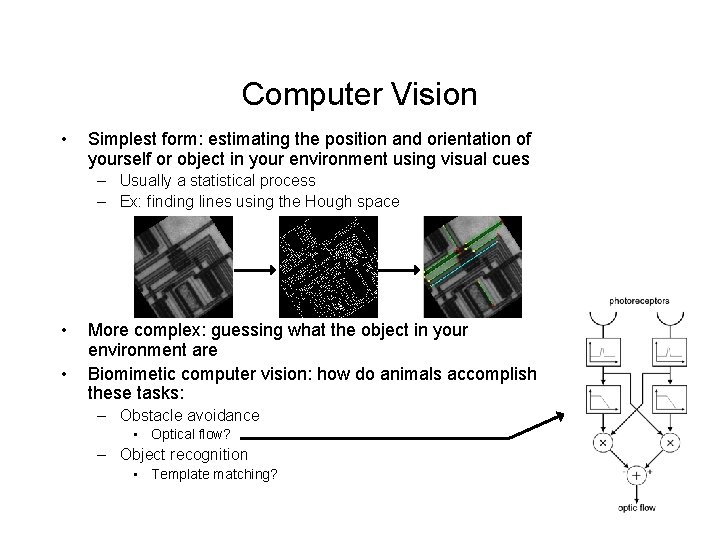
Computer Vision • Simplest form: estimating the position and orientation of yourself or object in your environment using visual cues – Usually a statistical process – Ex: finding lines using the Hough space • • More complex: guessing what the object in your environment are Biomimetic computer vision: how do animals accomplish these tasks: – Obstacle avoidance • Optical flow? – Object recognition • Template matching?
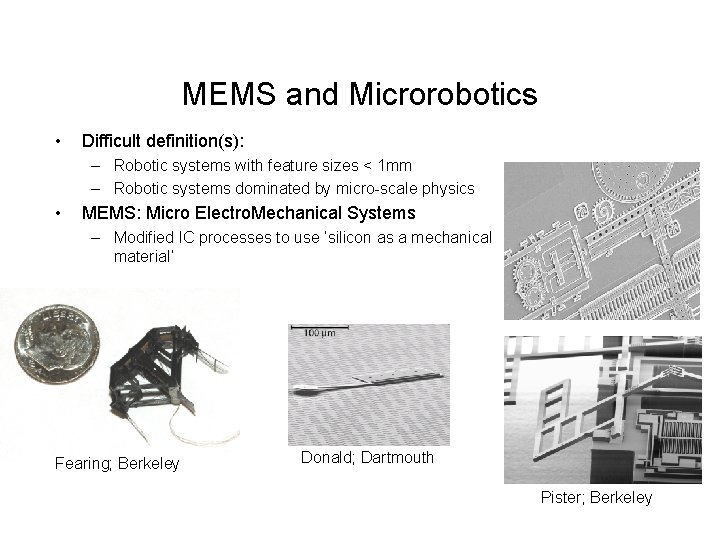
MEMS and Microrobotics • Difficult definition(s): – Robotic systems with feature sizes < 1 mm – Robotic systems dominated by micro-scale physics • MEMS: Micro Electro. Mechanical Systems – Modified IC processes to use ‘silicon as a mechanical material’ Fearing; Berkeley Donald; Dartmouth Pister; Berkeley
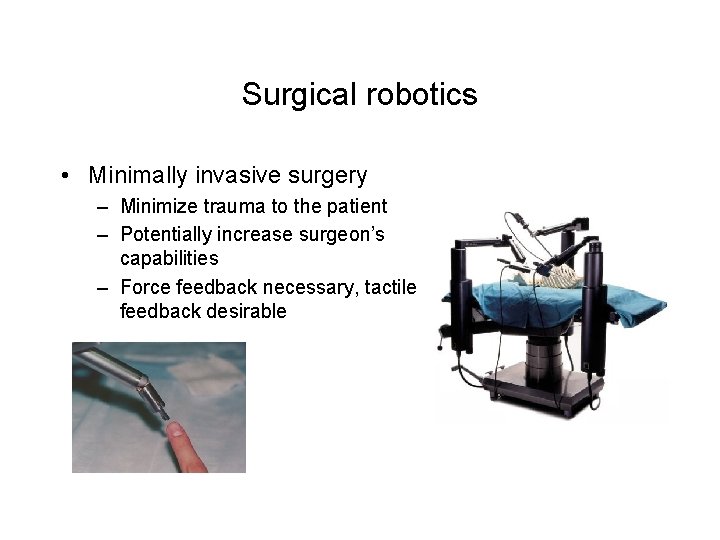
Surgical robotics • Minimally invasive surgery – Minimize trauma to the patient – Potentially increase surgeon’s capabilities – Force feedback necessary, tactile feedback desirable
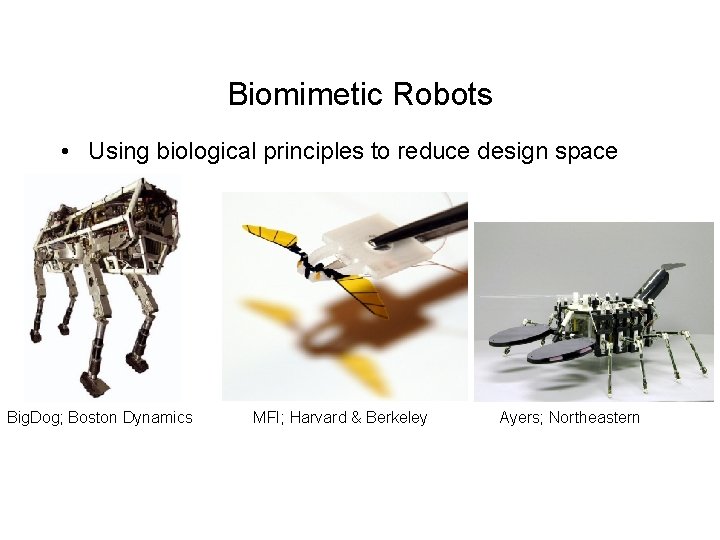
Biomimetic Robots • Using biological principles to reduce design space Big. Dog; Boston Dynamics MFI; Harvard & Berkeley Ayers; Northeastern
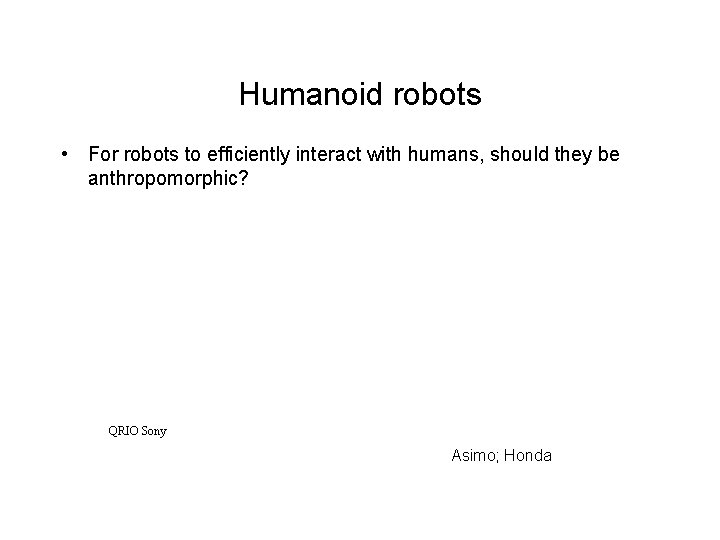
Humanoid robots • For robots to efficiently interact with humans, should they be anthropomorphic? QRIO Sony Asimo; Honda
Next class… • Homogeneous transforms as the basis forward and inverse kinematics • Come talk to me if you have questions or concerns!