
Chapter 6 The Playwright and the Script Playwrite

- Slides: 68
Chapter 6 The Playwright and the Script
Playwrite or Playwright • Write = mark on a surface, typically paper, with pen, pencil, or similar implement. • Wright = A maker or builder • Playwrite would be someone who transcribes a play. • Playwright someone who crafts, makes and builds plays.
The Playwright • Most of the time the Playwright works alone • The most time consuming of all of theatre artists • Film: Director has the most influence and gets “top billing” • Stage: Playwright has most influence and gets “top billing”
Unions • Writers Guild of America (WGA) – Closed shop union – Can call strike – Screen and television writers sell their copyright • Dramatists Guild of America (DGA) – Open shop union – Cannot call strikes – Playwrights keep their copyright • Playwright’s pay = Royalty
Need for Structure • Structure exists to keep the play together, to provide a framework • Two Principles of Dramatic Structure – Every theatrical event must have an underlying pattern or organization – Once a pattern or organization is established, it must remain true to itself • Structure usually takes the form of plot
Plot vs. Story • Story – Usually a full account of the events – Usually in chronological order • Plot – Selection and arrangement of scenes taken from a story – What happens onstage – Responsibility of the playwright
Subject and Verb of Drama • The subject of drama is people • Drama – Greek verb: dran to do, or to act. • Action: Act – Perform • Playwright aka Dramatist
Crucible of Drama • Conflict – People are frequently defined by how they respond to challenge and conflict – Conflict is the energy source of the play – Intellectual conflict is harder to present, but none-the-less possible – Theatre is about action – Action is driven by the desire to resolve conflict
The game of theatre • Just like a sporting event – theatre has rules • Theatre may be more or less complex than a sport • Rules may be less obvious • Rules exist none the less
Rules of Theatre • Limited Space – In sports the playing field is clearly defined – Stage space is limited – World of the play is limited • City, town, country, room • Limited Time – Sporting events are rigidly timed – Performance length is finite (Typ 1 -3 hours) – Story length is finite – Lifetime, day, hours, years
Rules of Theatre • Strongly opposed forces – Provides conflict – Good vs. Evil – Right vs. Wrong • Balanced Forces – Struggle provides action – A “slaughter” is boring – A “photo finish” is exciting
Rules of Theatre • Incentive and Motivation – Prize or carrot – There must be a reason to fight – There must be something to be gained
Framework of Dramatic Structure • Opening Scene – Sets the tone for the play – Some imbalance or disturbance is presented • Obstacles and Complications – Objectives and Super-objectives – Two steps forward – one step back
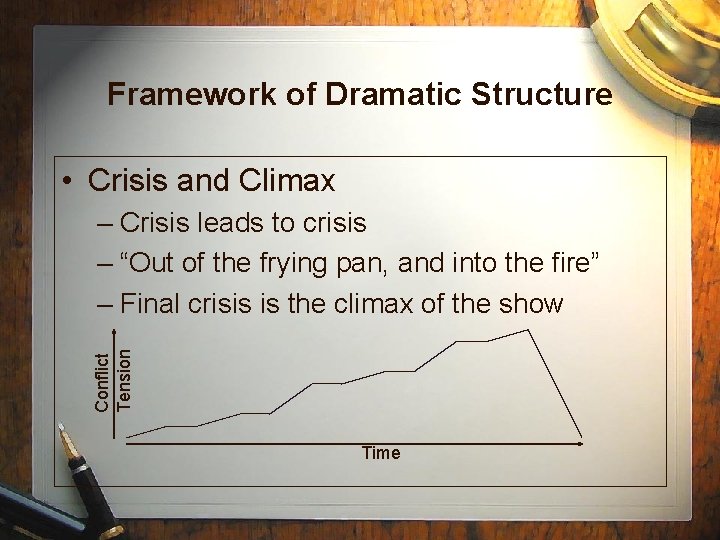
Framework of Dramatic Structure • Crisis and Climax Conflict Tension – Crisis leads to crisis – “Out of the frying pan, and into the fire” – Final crisis is the climax of the show Time
Dramatic Characters • Created in the mind of the playwright • Revealed and displayed for the benefit of the audience • Know and understand the characters quickly and completely
Types of Characters • Extraordinary Characters – Kings, Queens, etc… – Men and Women at their best (or worst) – People at the outer limits • Representational or Quintessential Characters – Ordinary, but notable as representatives of a group – Not at best or worst – but as a “norm”
Types of Characters • Stock Characters – Stereotypical characters – Actions are predictable • Characters with a Dominant Trait – Similar to stock characters, but not so commonplace – Invented stereotypes
Types of Characters • Minor Characters – Servants, soldiers, etc… – Dukes, judges, etc… – Social roles • Narrators and choruses – Speaks directly to the audience – Comments on the action of the play
Types of Characters • Non-human Characters – Animals, Lion, Tin Man, Scarecrow, etc… – Machines, Androids, Robots, etc… – Ideas – Greed, Good Deeds, Envy, etc… – Used to comment on Man
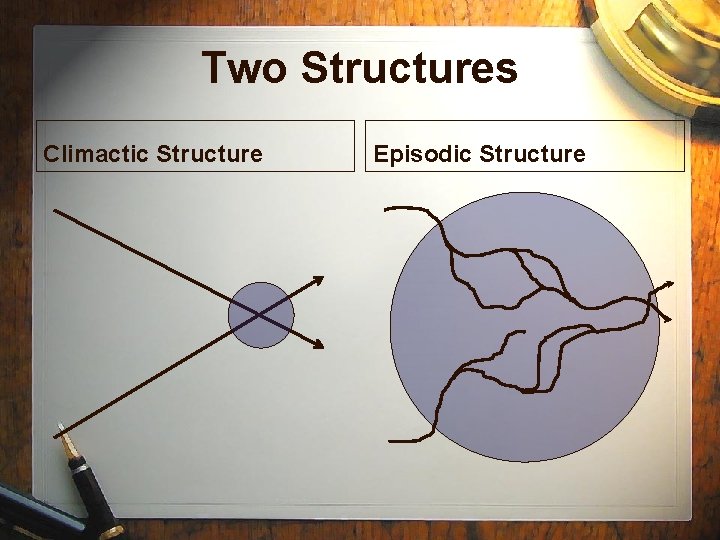
Climactic Structure • The plot begins late in the story • There is a history for the characters that exists before the play begins • This history is now converging in a climactic manner. • Characters report this history via extensive exposition
Climactic Structure • Time span of the play is usually short • Real-time and stage-time are frequently equivalent • A few long scenes • Few locations • A few characters presented in great detail
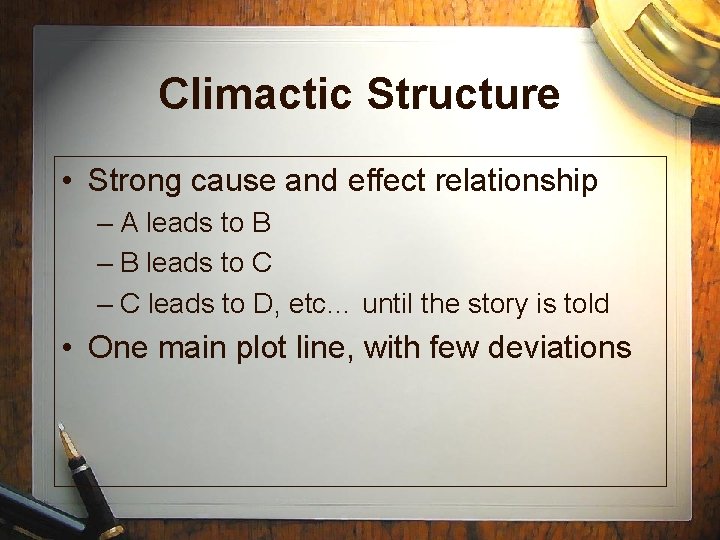
Climactic Structure • Strong cause and effect relationship – A leads to B – B leads to C – C leads to D, etc… until the story is told • One main plot line, with few deviations
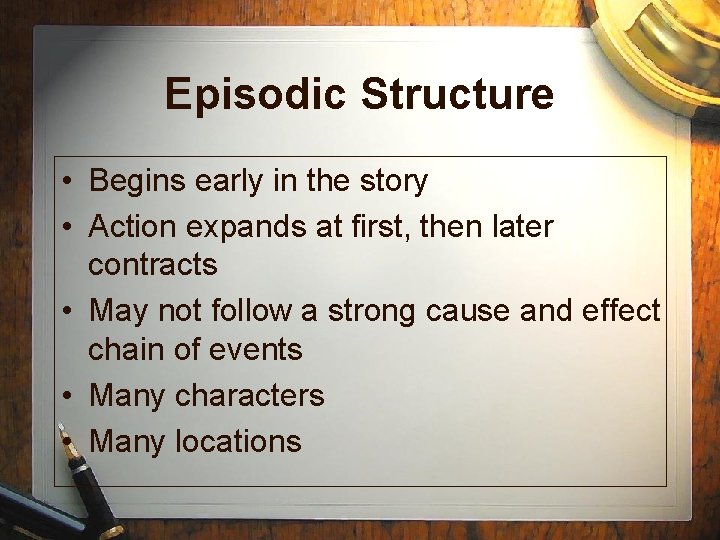
Episodic Structure • Begins early in the story • Action expands at first, then later contracts • May not follow a strong cause and effect chain of events • Many characters • Many locations
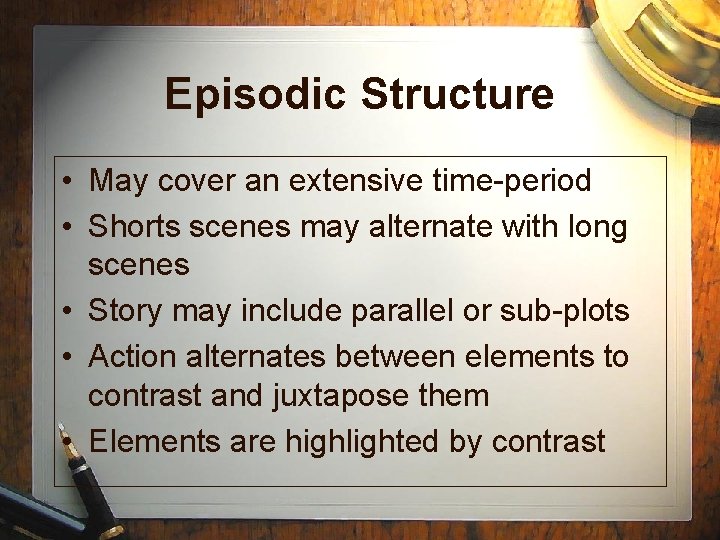
Episodic Structure • May cover an extensive time-period • Shorts scenes may alternate with long scenes • Story may include parallel or sub-plots • Action alternates between elements to contrast and juxtapose them • Elements are highlighted by contrast
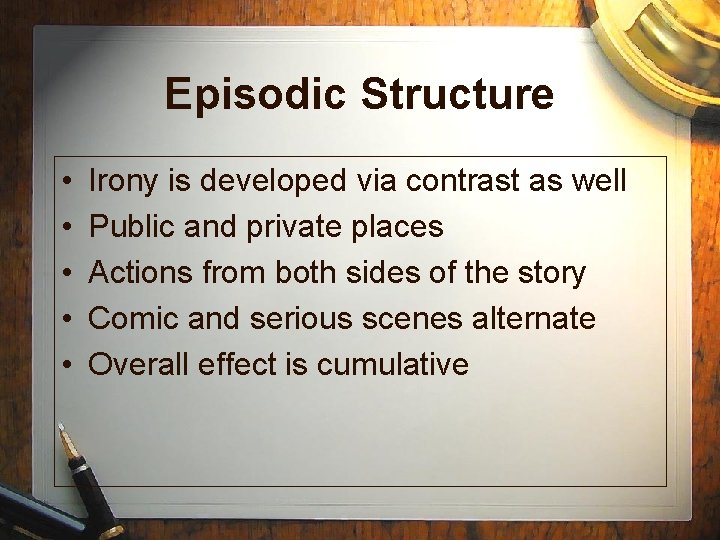
Episodic Structure • • • Irony is developed via contrast as well Public and private places Actions from both sides of the story Comic and serious scenes alternate Overall effect is cumulative
Two Structures Climactic Structure Episodic Structure
Theatre of the Absurd • • Emerged following WW II Lack of reason to the universe Waiting for Godot Absurdist Plot – Embody a lack of reason – Actions and words may be disconnected – Title may have little or no connection to the story
Theatre of the Absurd • Language of the play may be structurally unstructured • Characters as Existential Beings – Have no past – Have no future – Have no pattern to their lives
Serial Structure • Series of events tied together by a common thread • Musical Reviews • One Act companion pieces • Laundry and Bourbon, Smokey Joe’s Café, 2 x 5, A My Name is Alice…
Theatre Genre • Genre: A category of artistic composition characterized by similarities in form, style or subject matter • Useful to categorize different types of theatre, but not all plays will fit into “neat” categories • Some plays refuse to be “pigeonholed”
Serious Drama • Takes a thoughtful and sober attitude toward its subject matter. • Audience becomes involved and connected to the drama • Audience thinks about the subject and themes of the play.
Tragedy • Basic Questions of Human Existence – Why are people so cruel to one another? – Why are men and women called upon to endure suffering? – What are the limits of such endurance? – In the midst of cruelty and suffering, what are the possibilities for achievement? – To what height of courage, strength, generosity and integrity can humans arise?
Universe of Tragedy • • Indifferent to human concerns Often cruel and malevolent Innocents suffer while evil prospers Some humans are capable of despicable things, while others confront and overcome adversity
Traditional Tragedy • Peak time Periods: – Greece 500 BC – England Late 16 th and 17 th Century – France 17 th Century • Story frequently deals with grand, cosmic, and universal themes and conflicts.
Traditional Tragedy • Tragic Heroes and Heroines – Extraordinary people: Kings, Queens, Generals – Characters are important: Therefore their story is important • Tragic Circumstances – Things go wrong – The universe seems to fight against the characters
Traditional Tragedy • Tragic Irretrievability – There is no way out – “You can run, but you can’t hide” • Acceptance of Responsibility – Characters (good and bad) accept responsibility for their actions – Oedipus
Traditional Tragedy • Tragic Verse – Poetry is used to convey the feelings and emotion – Because of the magnitude of the subject matter, nothing less than poetry can adequately capture the feelings and emotions
Traditional Tragedy • The Effect of Tragedy – Pessimistic • Characters can not escape • Characters can not “win” • Characters are Damned if they do, and Damned if they don’t – Optimistic • Meet fate with dignity and determination • “I will not go quietly” • Characters fight for what is right, no matter the consequence
Modern Tragedy • Key differences from Traditional Tragedy – Does not use extraordinary central characters – Tends to use representational or quintessential central characters – Text is not written in verse – Text is written in prose – or everyday language
Tragic Debate Traditional Tragedy Modern Tragedy • Non-Noble characters lack the grandeur needed for tragedy • Non-Noble characters lack the control of their own lives to be able to Choose • Ideas of tragedy can not be expressed through prose • There is no modern equivalent for Kings and Queens • Audience can not identify with Kings and Queens • Audience does not connect when the language is “artificial”
Universal Tragedy • All tragedy asks the same kinds of questions • The Effect of Tragedy remains constant • The Effect is the Key
Heroic Drama • Like traditional tragedy, but differs in some key areas • Happy ending • Optimistic view of the world, but with sad ending • Death of hero or heroine, but not tragic • In Death, they win or triumph
Melodrama • • • Music Drama or Song Drama Music underscores the scenes Exaggerated theatre At its extreme = Laughable Dedicated to engaging the audience and evoking a response at all costs • Logic and Realism are expendable
Melodrama Characteristics • Audience is drawn into the action • Issues are clear-cut – Right vs. Wrong – Good vs. Evil • Characters are “simple” – Clearly “good” or “bad”
Melodrama Characteristics • Action is exaggerated – Characters are living on the edge of danger – Strong emphasis on suspense • Frequently plays upon the fears of the audience. • “The Deck is Stacked”
Melodrama is Alive and Well • • Westerns Action Movies Science Fiction Horror Movies Soap Operas Detective Stories TV
Comedy • • Subject is not necessarily less serious Comedy is not without a message Comedy takes a different approach Holds things up to ridicule – Don’t be like this.
Laughter and Humor • Elusive and difficult to define • Uniquely human • Wide range: – Grin to ROTFL • Theatre encompasses all types of comedy and all types of situations
Characteristics of Comedy • Suspension of Natural Laws and Logic – Actions do not have the same consequences of “real” life – No real injuries – “Slapstick” – Cartoons – Coyote physics – Home Alone – Any subject is fair game – Murder – Politically Incorrect
Characteristics of Comedy • Contrast between Social Order and the Individual – Society Ordered – Contrast between a normal, rational, and balanced society and the excesses of a group of characters – Comedy: World OK – Characters excessive or out of step – Tragedy: Characters OK – World excessive or out of step
Characteristics of Comedy • Contrast between Social Order and the Individual – Individual is viewed as ridiculous not the institutions – Modern comedy frequently reverses this contrast • Comic Premise – How are the rules of this world different than the “real” world
Techniques of Comedy • Exaggeration and Incongruity – Verbal Humor • Incongruity in the language • Pun – Substitution of a word which sounds like the correct word, but is not – The speaker is aware of the substitution – Lowest form of wit (Shakespeare)
Techniques of Comedy • Malapropism – Substitution of a word which sounds like the correct word, but is not – The speaker is not aware of the substitution – Frequently the substituted word has a opposite meaning – Also can be a statement which reveals that the speaker is confused about what they are talking about. – Mrs. Malaprop, Sheridan’s The Rivals
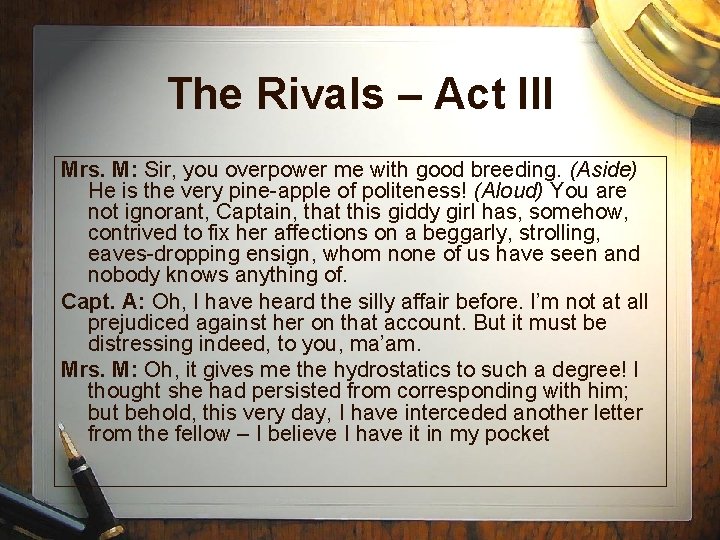
The Rivals – Act III Mrs. M: Sir, you overpower me with good breeding. (Aside) He is the very pine-apple of politeness! (Aloud) You are not ignorant, Captain, that this giddy girl has, somehow, contrived to fix her affections on a beggarly, strolling, eaves-dropping ensign, whom none of us have seen and nobody knows anything of. Capt. A: Oh, I have heard the silly affair before. I’m not at all prejudiced against her on that account. But it must be distressing indeed, to you, ma’am. Mrs. M: Oh, it gives me the hydrostatics to such a degree! I thought she had persisted from corresponding with him; but behold, this very day, I have interceded another letter from the fellow – I believe I have it in my pocket
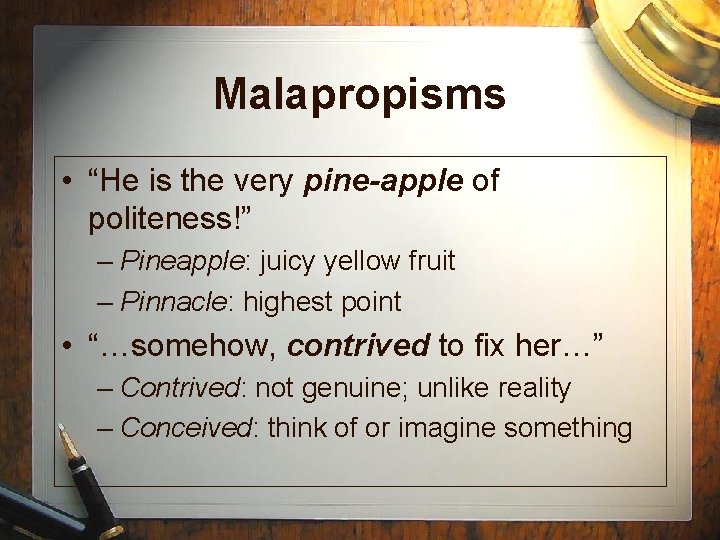
Malapropisms • “He is the very pine-apple of politeness!” – Pineapple: juicy yellow fruit – Pinnacle: highest point • “…somehow, contrived to fix her…” – Contrived: not genuine; unlike reality – Conceived: think of or imagine something
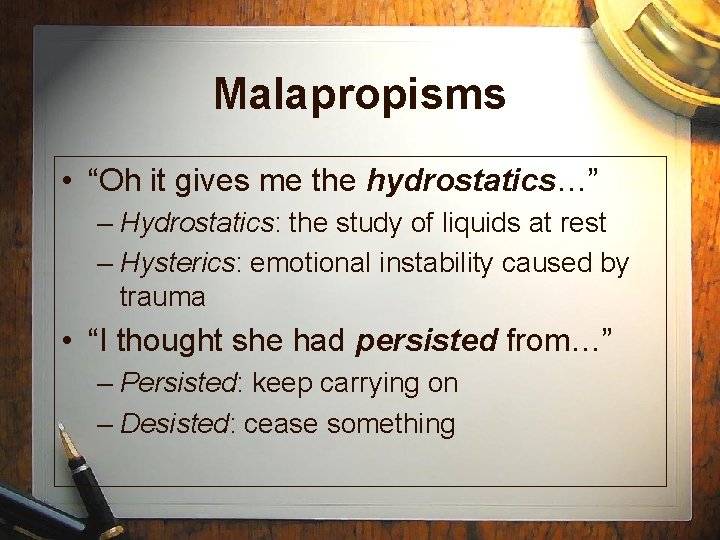
Malapropisms • “Oh it gives me the hydrostatics…” – Hydrostatics: the study of liquids at rest – Hysterics: emotional instability caused by trauma • “I thought she had persisted from…” – Persisted: keep carrying on – Desisted: cease something
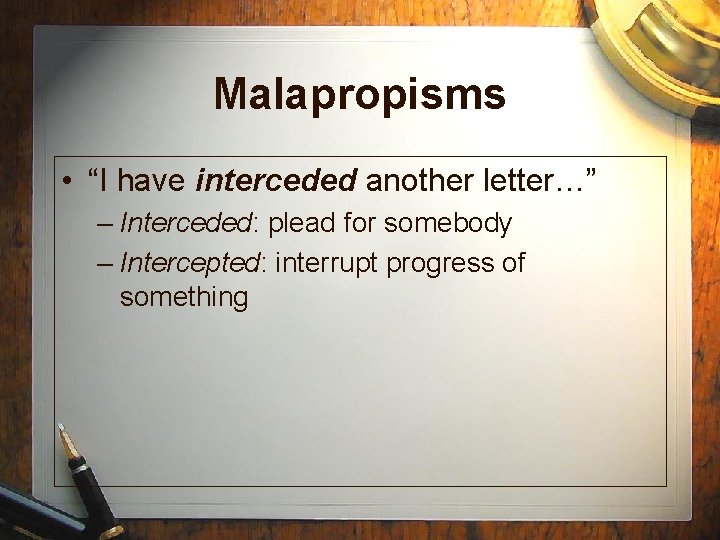
Malapropisms • “I have interceded another letter…” – Interceded: plead for somebody – Intercepted: interrupt progress of something
The Rivals – Act III Mrs. M: Sir, you overpower me with good breeding. (Aside) He is the very pine-apple of politeness! (Aloud) You are not ignorant, Captain, that this giddy girl has, somehow, contrived to fix her affections on a beggarly, strolling, eaves-dropping ensign, whom none of us have seen and nobody knows anything of. Capt. A: Oh, I have heard the silly affair before. I’m not at all prejudiced against her on that account. But it must be distressing indeed, to you, ma’am. Mrs. M: Oh, it gives me the hydrostatics to such a degree! I thought she had persisted from corresponding with him; but behold, this very day, I have interceded another letter from the fellow – I believe I have it in my pocket.
Modern Malapropisms “Always go to other people’s funerals, otherwise they won’t come to yours. ” – Yogi Berra “Republicans understand the importance of bondage between a mother and child” – Dan Quayle “I might just fade into Bolivian, you know what I mean? ” – Mike Tyson “Abraham Lincoln became America's greatest Precedent. ” - from Student Bloopers
Epigram • “a pithy saying or remark expressing an idea in a clever and amusing way. ” • Juxtaposition of two ideas which on the surface seem to be in conflict, but also contains a “truth” • A Paradoxical “truth”
Epigrams A man can not be too careful in choosing his enemies. Although beauty is only skin deep, many have drowned there. There is no short-cut to experience. Man has a many-sided nature, and like the moon reveals certain phases at certain times.
Techniques of Comedy (cont. ) • Comedy of Character – Incongruity between the view the character has of themselves, and the view that the audience or world has of them • Plot Complications – Mistaken identities – Falling “house of cards”
Forms of Comedy • Farce – Broad physical humor – Plot complications – Stereotypical characters – No intellectual pretentions – Least reliant on verbal humor – Sex and Marriage are frequent themes/backdrops, but many other themes are used – Three’s Company
Forms of Comedy (cont. ) • Burlesque – “Knockout” physical humor – Gross exaggerations – Distortion of accepted forms or material – Risqué – Vulgarity – Benny Hill
Forms of Comedy (cont. ) • Satire – Like burlesque, but more intellectual – Wit, Irony and Exaggeration used to attack something – Pokes fun at something or someone – Saturday Night Live
Forms of Comedy (cont. ) • Comedy of Manners – Pokes fun at those who are attempting to fit in where they “do not belong” – Pokes fun at elite groups who are so “uptight” that they lose sight of the “big picture” – Old English Drama – The Rivals – Teen coming of age movies - Clueless
Tragedy vs. Comedy Tragedy Comedy • Sad • Hero lives • Frequently has comic moments • Frequently ends with a fight to the death • Funny • Hero dies • Frequently has serious moments • Frequently ends with a wedding • While frequently mixed, strong imbalance. (80/20) • Two different views of the same world. • What about plays that don’t fit – “Problem Plays”
Tragicomedy • Intermix and Balance of Comedy and Tragedy • Natural laws and consequences are not so quickly dismissed • The Visit