Government Purpose Theories Categories of Government Types of
- Slides: 14
Government -Purpose -Theories -Categories of Government -Types of Government Learning Targets: • I can describe the purpose of government • I can compare and contrast the different theories of government • I can compare and contrast the different types of government
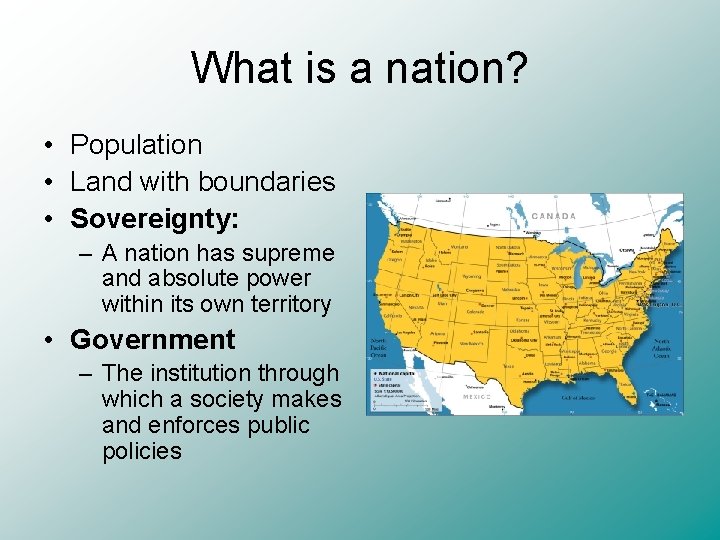
What is a nation? • Population • Land with boundaries • Sovereignty: – A nation has supreme and absolute power within its own territory • Government – The institution through which a society makes and enforces public policies
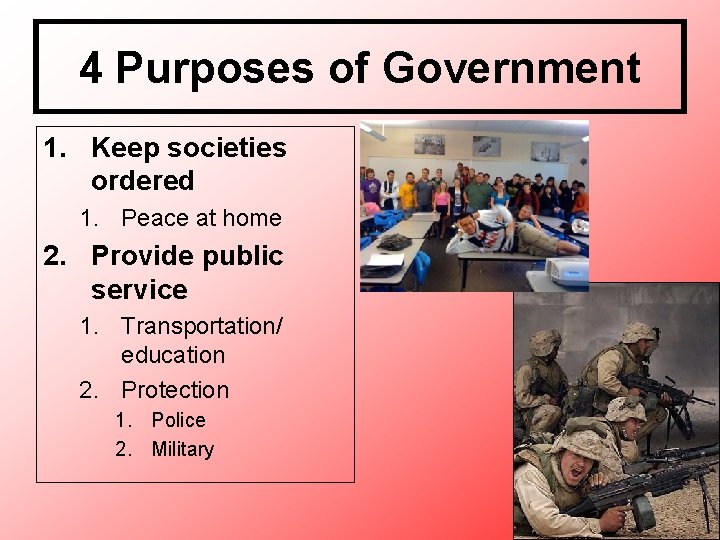
4 Purposes of Government 1. Keep societies ordered 1. Peace at home 2. Provide public service 1. Transportation/ education 2. Protection 1. Police 2. Military
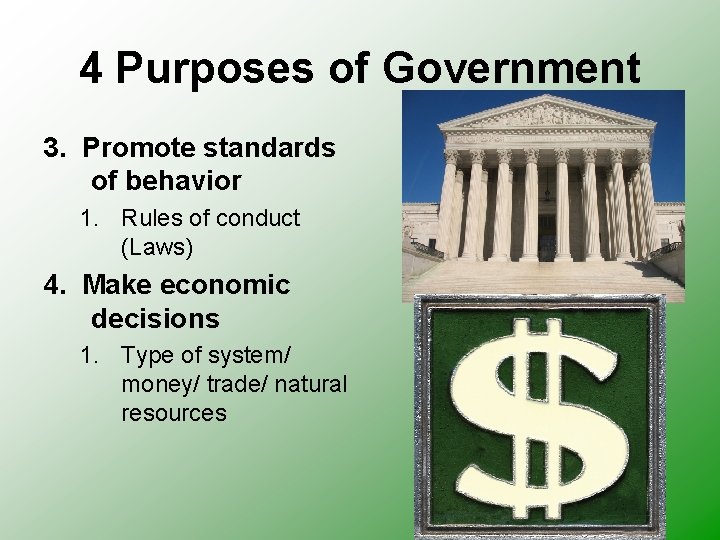
4 Purposes of Government 3. Promote standards of behavior 1. Rules of conduct (Laws) 4. Make economic decisions 1. Type of system/ money/ trade/ natural resources
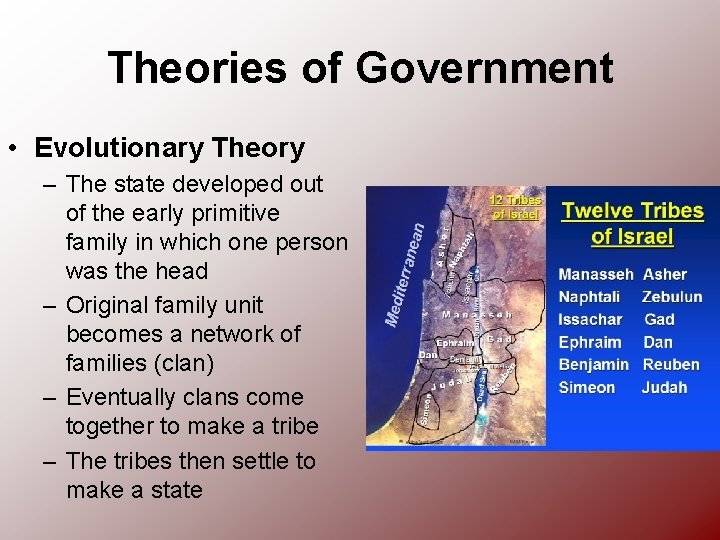
Theories of Government • Evolutionary Theory – The state developed out of the early primitive family in which one person was the head – Original family unit becomes a network of families (clan) – Eventually clans come together to make a tribe – The tribes then settle to make a state
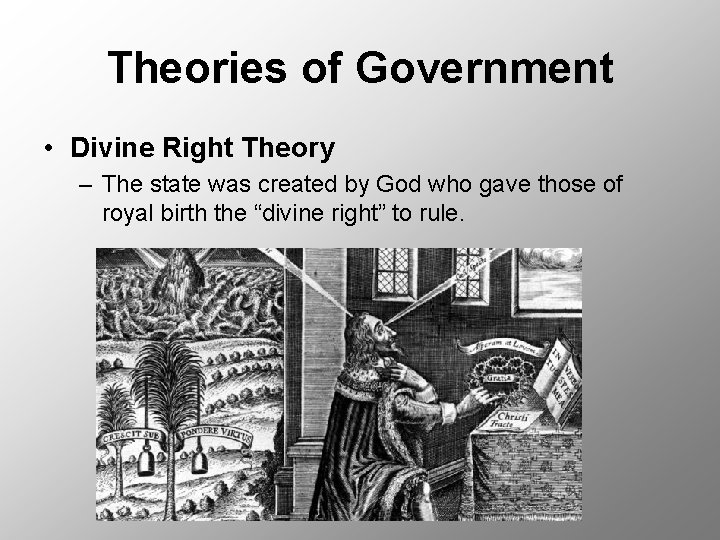
Theories of Government • Divine Right Theory – The state was created by God who gave those of royal birth the “divine right” to rule.
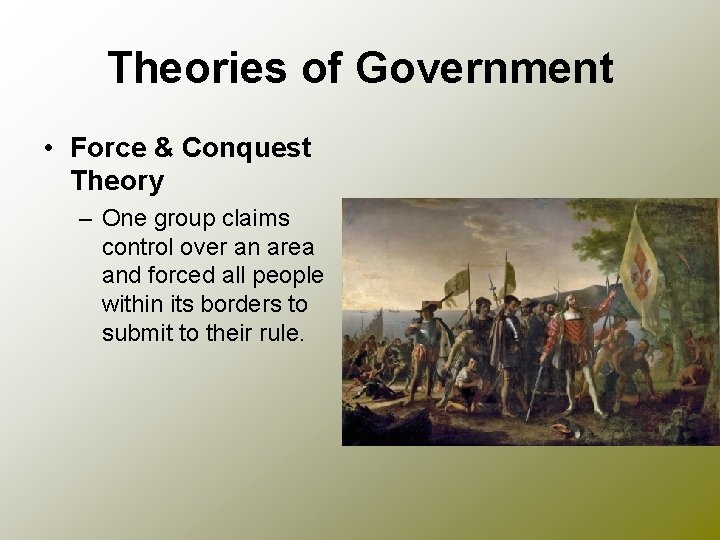
Theories of Government • Force & Conquest Theory – One group claims control over an area and forced all people within its borders to submit to their rule.
Theories of Government • Social Contract Theory – People lived in a “state of nature” • No government or order – People gave up freedom in exchange for protection and security – As long as the state protects the peoples “natural rights” (life, liberty, & property), the people will give up freedoms and abide by the laws
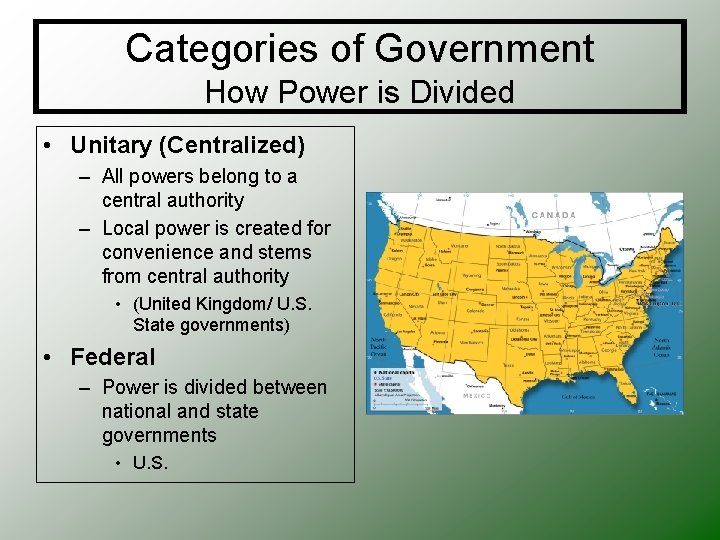
Categories of Government How Power is Divided • Unitary (Centralized) – All powers belong to a central authority – Local power is created for convenience and stems from central authority • (United Kingdom/ U. S. State governments) • Federal – Power is divided between national and state governments • U. S.
Types of Government: Autocracy • Autocracy – Power and authority to rule are in the hands of a single ruler • Totalitarian Dictatorship • Leader exercises absolute control aspects of social and economic life • People lack the power to limit their rule. • Examples: Germany under Hitler/ Soviet Union under Stalin
Types of Government: Autocracy • Monarchy – King, Queen, Emperor, or Tsar exercises supreme power of government – Complete and unlimited power (divine right) – Power usually inherited – Example: Saudi Arabia/ Kuwait/ Old England
Types of Government: Oligarchy • Small group holds power • Power comes from wealth, military power, social power or a combination of these • Communist Totalitarianism – Total control over all aspects of life • Reinforced by propaganda – Sometimes having seeming democratic institutions such as assemblies and elections – All opposition is suppressed – Example: China/ Cuba
Types of Government: Democracy • Direct Democracy – All citizens have a vote on all topics – (does not exist in today’s world) • Indirect Democracy (Democratic Republic) – People elect representatives giving them power to govern • Responsible to carry out the peoples will – Regularly scheduled elections make representatives responsible to the people
Environment That Promotes Democracy • Freedom of Economic Decisions – Freedom to own property and private control of money leads to free political decisions • Large Middle Class – Economic comfort leads to more confident to make political decisions – Those in poverty are less likely to vote or make political decisions • Educated Public