Government Intervention Chapter 9 Mc GrawHillIrwin Copyright 2011






- Slides: 48
Government Intervention Chapter 9 Mc. Graw-Hill/Irwin Copyright © 2011 by The Mc. Graw-Hill Companies, Inc. All Rights Reserved.
Laissez Faire • Adam Smith coined the phrase laissez faire in the late 1700 s as a doctrine of “leave it alone, ” of nonintervention by government in the market mechanism. LO-1 9 -2
Market Failure • The market mechanism may fail to provide the optimal mix of output: – The optimal mix of output is the most desirable combination of output attainable with existing resources, technology, and social values. LO-1 9 -3
The Nature of Market Failure • Market failure is an imperfection in the market mechanism that prevents optimal outcomes: – Market mechanism–the use of market prices and sales to signal desired outputs (or resource allocations). LO-1 9 -4
The Nature of Market Failure • Market failure implies that the forces of supply and demand have not led to the best point on the production possibilities curve. • It also establishes a basis for government intervention. LO-1 9 -5
Sources of Market Failure • There are four specific sources of microeconomic market failure: – Public goods – Externalities – Market power – Inequity LO-1 9 -6
Market failure I: Public Good • A public good is a good or service whose consumption by one person does not exclude consumption by others. – Examples include national defense and flood-control dams. LO-2 9 -7
Private Good • A private good is a good or service whose consumption by one person excludes consumption by others. – Examples include donuts and soda. LO-2 9 -8
The Free-Rider Dilemma • A free rider is an individual who reaps direct benefits from someone else’s purchases (consumption) of a public good. LO-2 9 -9
Exclusion • The distinction between public goods and private goods is based on the nature of the goods, not who produces them. • Free riders of public goods upset the customary practice of paying for what you get. LO-2 9 -10
Market Failure II: Externalities • Externalities are costs (or benefits) of a market activity borne by a third party. – The difference between the social and private costs (benefits) of a market activity. LO-3 9 -11
Externalities • The market will underproduce goods that yield external benefits. • The market will overproduce goods that generate external costs. LO-3 9 -12
Consumption Decisions • In trying to maximize their own satisfaction, consumers often do not consider how their consumption affects the well-being of others. LO-3 9 -13
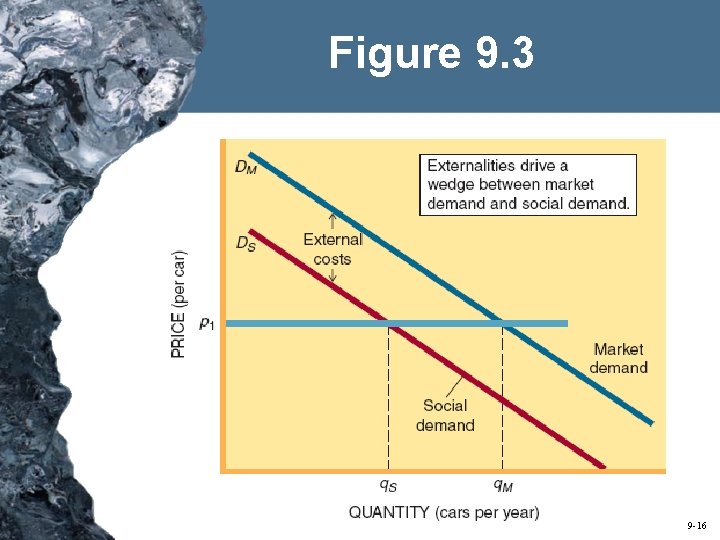
External Costs • Market demand expresses only the anticipated private benefits of consumption. • External costs must be taken into account to fully account for collective well-being. LO-3 9 -14
Social Demand • Social demand includes not only private benefits but also accounts for any externalities: Social demand = market demand + externalities LO-3 9 -15
Figure 9. 3 9 -16
Social Demand • If the externality is a negative one, the activity imposes external costs. • Whenever external costs exist, market demand overstates social demand. LO-3 9 -17
External Benefits • An external benefit augments private demand. • Whenever external benefits exist, the social demand exceeds the market demand. LO-1 9 -18
Production Decisions • When external costs exist, firms will produce more of the good than is socially desirable. LO-3 9 -19
Profit Maximization • A producer has an incentive to continue polluting using cheaper technology as long as doing so is more profitable. LO-3 9 -20
External Cost • People tend to maximize their personal welfare, balancing private benefits against private costs. • When external costs exist, a private firm will not allocate its resources and operate its plant in such a way as to maximize social welfare. LO-3 9 -21
Social versus Private Costs • Social costs are the full resource costs of an economic activity, including externalities. • Private costs are the costs of an economic activity directly borne by the immediate producer or consumer (excluding externalities). LO-3 9 -22
External Costs • External costs are equal to the difference between social and private costs: External costs = social costs – private costs • If pollution costs are external, firms will produce too much of a polluting good. LO-3 9 -23
Policy Options • The goal is to discourage production and consumption activities that impose external costs on society. • We can do this in one of two ways: – Alter market incentives. – Bypass market incentives. LO-3 9 -24
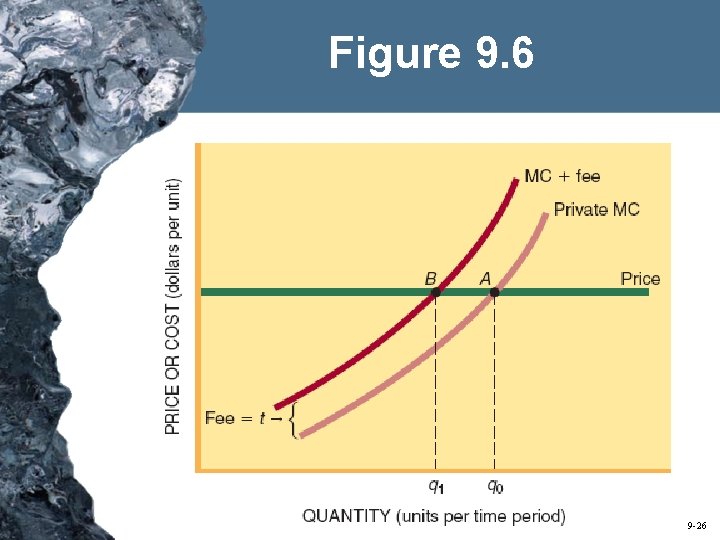
Emission Fees • Market incentives can be altered via emission charges: – An emission charge is a fee imposed on polluters, based on the quantity of pollution. • An emission fee increases private marginal cost and thus encourages lower output. LO-3 9 -25
Figure 9. 6 9 -26
Regulation • Market incentives can be bypassed through direct regulation. • Government specifies the required outcome and the process by which it is to be achieved. • The Clean Air Act of 1970 mandated fewer auto emissions and the processes to reduce those emissions. LO-3 9 -27
Regulation • Excessive process regulation may raise the costs of environmental protection and discourage cost-saving innovation. LO-3 9 -28
Market Failure III: Market Power • Market power is the ability to alter the market price of a good or service. • The response to price signals, rather than the signals themselves, may be flawed. LO-4 9 -29
Restricted Supply • Market power results from restricted supply due to: – Copyrights – Patents – Control of resources – Restrictive production agreements – Efficiencies of large-scale production LO-4 9 -30
Restricted Supply • The direct consequence of market power is that one or more producers attain discretionary power over the market’s response to price signals. LO-4 9 -31
Antitrust Policy • The goal of government intervention is to prevent or dismantle concentrations of market power. • Antitrust policy–government intervention to alter market structure or prevent abuse of market power. LO-5 9 -32
The Sherman Act (1890) • Prohibits “conspiracies in restraint of trade, ” including mergers, contracts, or acquisitions that threaten to monopolize an industry. • Violators are subject to fines of up to $1 million. LO-5 9 -33
The Clayton Act (1914) • Outlaws specific antitrust behavior not covered by the Sherman Act. • Principal aim of the Act was to prevent the development of monopolies. LO-5 9 -34
The Federal Trade Commission Act (1914) • Created an agency to study industry structures and behavior so as to identify anticompetitive practices. LO-5 9 -35
Antitrust Decisions • Antitrust legislation has been used: – To break up the steel and tobacco monopolies in the early 1900 s. – To break up the AT&T monopoly in the 1980 s. – Recently against Microsoft. LO-5 9 -36
Market Failure IV: Inequity • Inequality entails lack of equitable distribution in the market. • The government alters the distribution of income with taxes and transfers. • Income transfers–payments to individuals for which no current goods or services are exchanged. LO-5 9 -37
Figure 9. 7 9 -38
Equality • Equity concerns the FOR WHOM question. • Is the distribution of goods and services generated by the market “fair”? • Government intervention may be needed to redistribute income if the market fails to reflect our notion of fairness. LO-5 9 -39
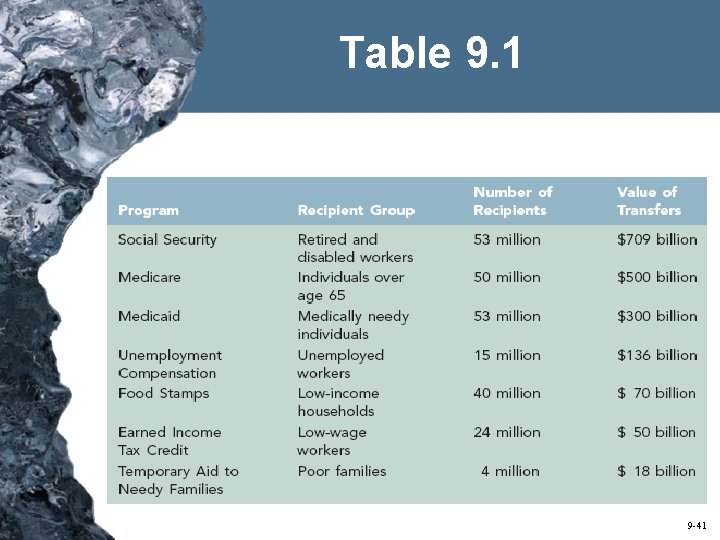
Income Transfers • Examples of income transfers include Social Security, welfare, and unemployment benefits. • Social Security is the largest transfer program. LO-5 9 -40
Table 9. 1 9 -41
Macro Instability • Micro failures of the marketplace differ from macro failures. • Micro failures concern producing at the wrong point on the productionpossibilities curve or inequitably distributing the output produced. LO-5 9 -42
Macro Instability The goals of macro intervention: • To foster economic growth. • To get us on the productionpossibilities curve (full employment). • To maintain a stable price level (price stability). • To increase our capacity to produce (growth). LO-5 9 -43
Trust in Government? • The potential micro and macro failures of the marketplace can be used to justify government intervention. • Can we trust the government to fix the shortcomings of the market? LO-5 9 -44
Information and Vested Interests • Government intervention typically entails a lot of groping in the dark for better, if not optimal, outcomes. • Vested interests often try to steer the government away from the social optimum. LO-5 9 -45
Government Failure • Government intervention might worsen, rather than improve market outcomes: – Government failure–government intervention that fails to improve economic outcomes. LO-5 9 -46
Government Failure • The challenge for public policy is to decide when any government intervention is justified, then intervene in a way that improves outcomes in the least costly way. LO-5 9 -47
End of Chapter 9