GOLF CROQUET RULES COURSE th WCF 5 EDITION



- Slides: 36
GOLF CROQUET RULES COURSE th WCF 5 EDITION GC RULES 2018 Including October 2018 Official Rulings (OR’s) and Commentary PREPARED BY: GOLF CROQUET REFEREE SUB-COMMITTEE SOUTH AUSTRALIA CROQUET ASSOCIATION
GOLF CROQUET RULES COURSE SESSION FIVE PART 4 – OTHER MATTERS LEARNING OUTCOMES: Rule 14 – Information and Advice Rule 15 – Refereeing Rule 16 – Behaviour
SESSION FIVE RULE 14 – INFORMATION, ADVICE AND USE OF MARKERS 14. 1 INFORMATION REQUESTED BY THE OPPOSING SIDE 14. 1. 1 If asked and able to do so, a player is to inform the opposing side promptly about the Rules relating to any matter and anything relating to the state of the game, such as the score, which hoop is next in order, which ball was played last, the colour of any ball on the court, how any ball over the halfway line reached its position, how much time remains in a time-limited game or, in handicap play, how many extra strokes remain.
SESSION FIVE RULE 14 – INFORMATION, ADVICE AND USE OF MARKERS (Cont: ) 14. 1 INFORMATION REQUESTED BY THE OPPOSING SIDE 14. 1. 2 If a side plays a stroke acting on incorrect information given by the opposing side in a way that they would not otherwise have played and this is discovered before the affected side plays the same ball again, the affected side may choose to replace the balls in the positions they occupied before the start of the affected stroke and to replay that stroke. Any points scored in the affected stroke and any later strokes are cancelled. Otherwise, the affected stroke and any later stroke are valid. See Rule 19. 9 for the restoration of extra strokes in handicap play.
SESSION FIVE RULE 14 – INFORMATION, ADVICE AND USE OF MARKERS (Cont: ) 14. 2 NO REFERENCE TO WRITTEN INFORMATION During a game, players are not permitted to refer to information in the form of printed, handwritten, electronic or other prepared material except for the purpose of clarifying the Rules that apply to a circumstance that has arisen or may be about to arise.
SESSION FIVE RULE 14 – INFORMATION, ADVICE AND USE OF MARKERS (Cont: ) 14. 3 NO TACTICAL ADVICE TO THE OPPOSING SIDE A side should not give tactical advice to the opposing side. However, the opposing side is entitled to act on such advice.
SESSION FIVE RULE 14 – INFORMATION, ADVICE AND USE OF MARKERS (Cont: ) 14. 4 NO TACTICAL ADVICE FROM OUTSIDE THE GAME Tactical advice should not be given to either side by anyone from outside the game. However, the sides are entitled to act on such advice unless, in a team event, it was given by a member or official of their team.
SESSION FIVE RULE 14 – INFORMATION, ADVICE AND USE OF MARKERS (Cont: ) 14. 5 ADVICE IN DOUBLES In doubles, partners may advise each other and a partner may assist in the preparation for playing a stroke, including indicating to the player the direction in which the mallet should be swung. However, when the stroke is played, the partner is to stand well away from the player or any position which might assist the player in gauging the strength or direction of the stroke.
SESSION FIVE RULE 14 – INFORMATION, ADVICE AND USE OF MARKERS (Cont: ) 14. 6 USE OF MARKERS No mark or marker may be made or placed inside or outside the court to assist a player in gauging the strength or direction of a stroke except as follows: 14. 6. 1 the player’s mallet or, in doubles, their partner or their partner’s mallet, may be used as a marker before the stroke starts; or 14. 6. 2 ball markers used to mark the position of a ball that is to be temporarily removed.
SESSION FIVE RULE 15 – REFEREEING 15. 1 REFEREES INVOLVED IN A GAME 15. 1. 1 All the players in a match are joint referees of the game and responsible for the fair and correct application of these Rules. 15. 1. 2 A referee may be placed in charge of a match, or may be called on to assist, or may in specific instances intervene to ensure the match proceeds according to these Rules but the presence of such a referee does not remove the player’s responsibilities under Rule 15. 1. 1.
SESSION FIVE RULE 15 – REFEREEING (Cont: ) 15. 1 REFEREES INVOLVED IN A GAME 15. 1. 3 Where a stroke is to be played that may result in the commission of a fault or a ball leaving the court in a critical position, the player should first request the opposing side (or a referee, if present) to watch the stroke. If the player does not make the request, the opposing side may forestall play and require the stroke to be watched.
SESSION FIVE RULE 15 – REFEREEING (Cont: ) 15. 1 REFEREES INVOLVED IN A GAME 15. 1. 4 In the absence of a referee, or if Rule 15. 1. 3 does not apply, if there is a difference of opinion on a matter of fact, the opinion of the player with the best view is to be preferred, but if the two views are equal, the opinion of the player who played the stroke prevails. 15. 1. 5 A player is to warn the opposing side (or a referee, if present) before playing a forceful stroke if a ball may travel towards them.
SESSION FIVE RULE 15 – REFEREEING (Cont: ) 15. 2 REGULATIONS Regulations governing the appointment, powers and duties of referees are contained in the WCF Refereeing Regulations. Commentary Rule 15. 2 References in the Rules to “a referee (if present)” mean a Supervising Referee, a Referee in Charge, a Referee on Request who is already active or an Inactive Referee who intervenes in accordance with the WCF Refereeing Regulations.
SESSION FIVE RULE 15 – REFEREEING (Cont: ) 15. 3 OVERRIDING RULE If a situation does not appear to be adequately covered by these Rules, or their interpretation appears to be uncertain in relation to a situation, the issue shall be decided by the players (or a referee, if present) in a manner which best meets the justice of the case.
GC REFEREES – ROLES ACA & WCF Refereeing Regulations TOURNAMENT REFEREE THE OFFICIAL WITH RESPONSIBILITY FOR NOMINATING AND ALLOCATING AUTHORISED REFEREES, AND HEARING APPEALS. ALSO AN AUTHORISED REFEREE
GC REFEREES – ROLES ACA & WCF Refereeing Regulations (cont: ) (1) REFEREE ON REQUEST A referee on request, who generally may act only at the invitation of a player. A referee on request is said to be inactive when first authorised. He becomes active when he responds to a request by a player to exercise a power or a duty or, exceptionally, intervenes in a game. He becomes inactive again when he quits the court believing that his duties have been discharged.
GC REFEREES – ROLES ACA & WCF Refereeing Regulations (cont: ) AUTHORISED REFEREE: A person nominated or permitted under WCF Refereeing Regulations to assist players by making decisions on laws and facts. An Authorised Referee can be performing one of several roles:
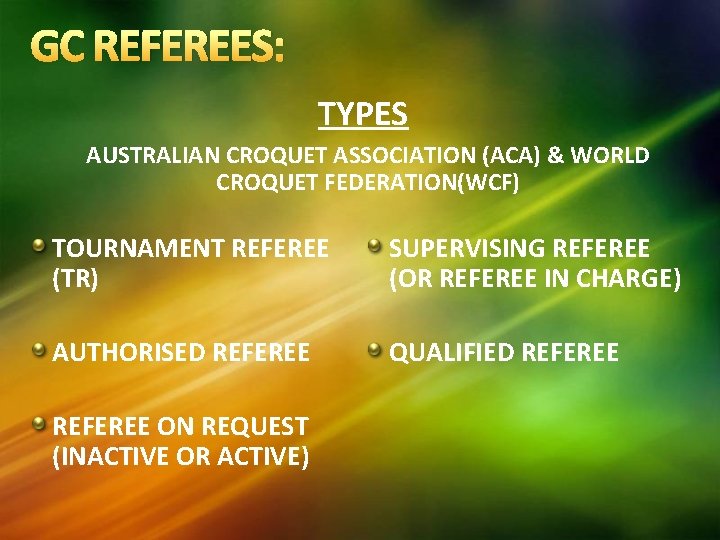
GC REFEREES: TYPES AUSTRALIAN CROQUET ASSOCIATION (ACA) & WORLD CROQUET FEDERATION(WCF) TOURNAMENT REFEREE (TR) SUPERVISING REFEREE (OR REFEREE IN CHARGE) AUTHORISED REFEREE QUALIFIED REFEREE ON REQUEST (INACTIVE OR ACTIVE)
GC REFEREES – ROLES ACA & WCF Refereeing Regulations (cont: ) (2) SUPERVISING REFEREE (or REFEREE IN CHARGE (Ri. C)) A supervising referee, who may act on his own initiative and thus is always active for games he is supervising. A supervising referee who looks after only one game is also called a referee in charge. QUALIFIED REFEREE: A person on an official list of referees, but not necessarily authorised for the tournament.
SESSION FIVE RULE 16 – BEHAVIOUR 16. 1 GENERAL Players are responsible for maintaining good standards of behaviour towards other players, officials, equipment, courts and spectators. 16. 2 UNACCEPTABLE BEHAVIOUR A player contravenes Rule 16. 1 by behaving unacceptably. Examples of unacceptable behaviour for which players may be penalised include, but are not limited to, cases where a player:
SESSION FIVE RULE 16 – BEHAVIOUR (Cont: ) 16. 2 UNACCEPTABLE BEHAVIOUR 16. 2. 1 leaves the vicinity of the court during a match without permission from the opposing side or, in tournament and match play, from a referee (if present) or from the manager. 16. 2. 2 contravenes any part of Rule 14. 16. 2. 3 physically abuses their mallet or other equipment or deliberately or repeatedly damages the court surface.
SESSION FIVE RULE 16 – BEHAVIOUR (Cont: ) 16. 2 UNACCEPTABLE BEHAVIOUR 16. 2. 4 disturbs other players during the match by talking, making noises, standing or moving in front of a player who is about to play a stroke, except as permitted or required by the Rules. 16. 2. 5 argues aggressively or continuously with or is aggressive towards another player. 16. 2. 6 fails to accept a decision of a referee on a matter of fact or shows lack of respect for a referee.
SESSION FIVE RULE 16 – BEHAVIOUR (Cont: ) 16. 2 UNACCEPTABLE BEHAVIOUR 16. 2. 7 deliberately or repeatedly: (a) interferes with a ball; or (b) plays a wrong ball or tries to cause the opposing side to play a wrong ball; or (c) commits a fault or tries to cause the opposing side to commit a fault; or (d) plays a stroke with the wrong mallet.
SESSION FIVE RULE 16 – BEHAVIOUR (Cont: ) 16. 2 UNACCEPTABLE BEHAVIOUR 16. 2. 8 fails to reply promptly to a request (see Rules 8. 4. 3, 14. 1. 1 and 19. 5. 3), fails to announce a decision promptly (see Rules 10. 3. 1 and 11. 4. 2), wastes time or fails to play their strokes with reasonable dispatch (see Rule 16. 3). 16. 2. 9 plays after the opposing side has asked, in a manner capable of conveying the request to a person with normal hearing, that play is stopped to enable a stroke to be watched, a ball to be placed or an action to be investigated.
SESSION FIVE RULE 16 – BEHAVIOUR (Cont: ) 16. 2 UNACCEPTABLE BEHAVIOUR 16. 2. 10 touches a hoop or the peg when a ball lies in contact with it or while a player is playing a stroke. 16. 2. 11 except with the permission of the opposing side (or a referee, if present), attempts to perform a physical test to determine whether a point has been scored or may be scored or whether a ball has left the court (see Rule 6. 5. 1).
SESSION FIVE RULE 16 – BEHAVIOUR (Cont: ) 16. 2 UNACCEPTABLE BEHAVIOUR 16. 2. 12 attempts to repair damage to the court surface that may indicate a fault under Rule 11. 2. 10 before it is ruled on by the opposing side (or a referee, if present). 16. 2. 13 acts in a manner that may bring the game into disrepute.
SESSION FIVE RULE 16 – BEHAVIOUR (Cont: ) 16. 3 PLAYING WITH REASONABLE DISPATCH 16. 3. 1 In tournament or match play, a match may be made subject to a requirement that each player is to play a stroke or declare that a stroke has been played within one minute of the end of the last turn, except when the game is held up while a ball is retrieved, or a referee is called or another example of justifiable delay exists. 16. 3. 2 If a requirement under Rule 16. 3. 1 is to apply throughout a match at the direction of the organising body, the players are to be informed before the match starts that such a requirement applies.
SESSION FIVE RULE 16 – BEHAVIOUR (Cont: ) 16. 3 PLAYING WITH REASONABLE DISPATCH 16. 3. 3 In exceptional circumstances, a referee in charge of a match or a referee called under Rule 16. 5. 2 may: (a) impose a requirement under Rule 16. 3. 1 after the match has started; or (b) in a time-limited game, increase the time remaining to compensate for time lost through breaches of Rule 16. 2. 8. 16. 3. 4 If a match is subject to a requirement under Rule 16. 3. 1, the existence of the requirement does not permit players to wait for one minute before
SESSION FIVE RULE 16 – BEHAVIOUR (Cont: ) 16. 4 PENALTIES WHEN A REFEREE IS IN CHARGE 16. 4. 1 When a referee is in charge of a match and, in the opinion of the referee, a player has contravened Rule 16. 1, the referee is to draw attention to the contravention and warn the player not to contravene Rule 16. 1 in any way again. 16. 4. 2 If, in the opinion of the referee, a side contravenes Rule 16. 1 for a second time in the same match, the referee is to stop the match and rule that the offending side is to lose their next stroke.
SESSION FIVE RULE 16 – BEHAVIOUR (Cont: ) 16. 4 PENALTIES WHEN A REFEREE IS IN CHARGE 16. 4. 3 If, in the opinion of the referee, a side contravenes Rule 16. 1 for a third time in the same match, the referee is to stop the match and award it to the opposing side. In this case the score in the match in progress is recorded as the winning total (4, 7 or 10) to the winner and the score already recorded by the loser when the game is stopped. Any subsequent games in the match are won to zero.
SESSION FIVE RULE 16 – BEHAVIOUR (Cont: ) 16. 4 PENALTIES WHEN A REFEREE IS IN CHARGE 16. 4. 4 If the referee decides that a contravention of Rule 16. 1 is sufficiently serious, even if it is the first contravention in the match, they are entitled to stop the match and either rule that the offending side is to lose their next stroke or award the match to the opposing side.
SESSION FIVE RULE 16 – BEHAVIOUR (Cont: ) 16. 5 PENALTIES WHEN A REFEREE IS NOT IN CHARGE 16. 5. 1 In the absence of a referee in charge of the match, the players are responsible for monitoring behaviour during the match. If, in the opinion of the opposing side, a player has contravened Rule 16. 1, the opposing side is to draw attention to the contravention and warn the player not to contravene Rule 16. 1 in any way again.
SESSION FIVE RULE 16 – BEHAVIOUR (Cont: ) 16. 5 PENALTIES WHEN A REFEREE IS NOT IN CHARGE 16. 5. 2 If the players are unable to agree that the first player has contravened Rule 16. 1, the game should be stopped until a referee has been called to rule on the situation. The referee should rule whether Rule 16. 1 has been contravened and, if so, has all the powers of a referee in charge of a match set out in Rule 16. 4.
SESSION FIVE REVISION WHEN CAN MARKERS BE USED? RULE 14. 6 WHO IS RESPONSIBLE FOR THE FAIR AND CORRECT APPLICATION OF THE RULES? RULE 15. 1 WHAT ARE FIVE EXAMPLES OF UNACCEPTABLE BEHAVIOUR BY PLAYERS? RULE 16. 2
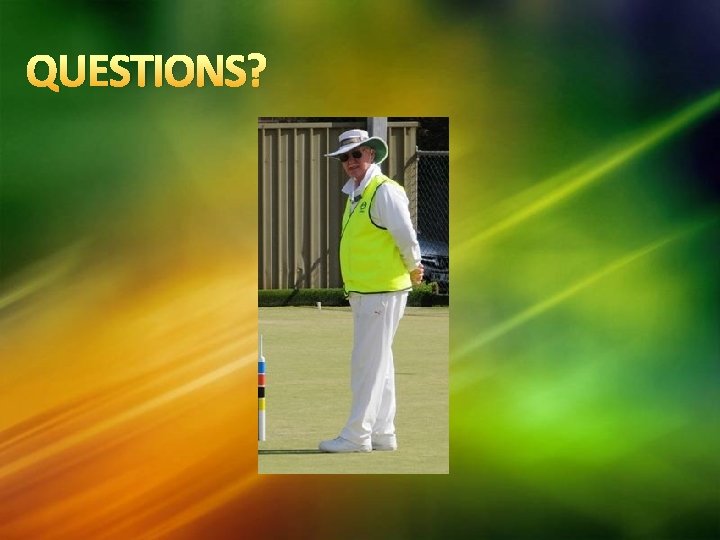
QUESTIONS?
GOLF CROQUET RULES COURSE REFERENCES The World Croquet Federation (WCF) 5 th Edition Golf Croquet Rules – 2018 Official Rulings and Commentary to the WCF Golf Croquet Rules – 2018 World Croquet Federation and ACA Refereeing Regulations NEXT SESSION: SESSION SIX – Rules, 17, 18 and 19