GOAL ORIENTED PROJECT PLANNING GOPP WORKSHOPS 10 12
- Slides: 15
GOAL ORIENTED PROJECT PLANNING GOPP WORKSHOPS 10. 12. 2008 1
GOPP IS BASED ON TWO METHODS • Project Cycle Management (PCM) • Logical Framework Approach (LFA) 10. 12. 2008 2
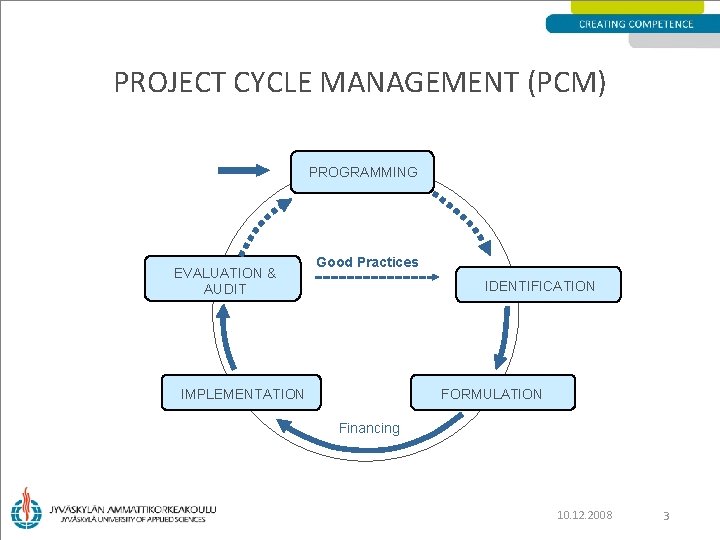
PROJECT CYCLE MANAGEMENT (PCM) PROGRAMMING EVALUATION & AUDIT Good Practices IDENTIFICATION IMPLEMENTATION FORMULATION Financing 10. 12. 2008 3
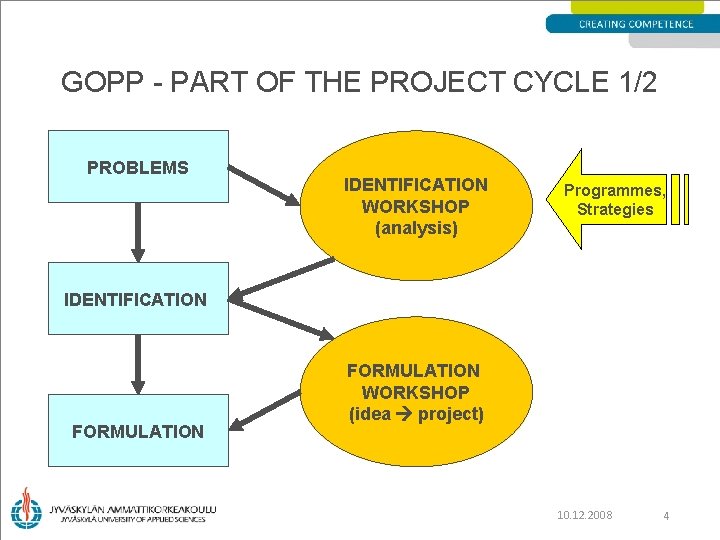
GOPP - PART OF THE PROJECT CYCLE 1/2 PROBLEMS IDENTIFICATION WORKSHOP (analysis) Programmes, Strategies IDENTIFICATION FORMULATION WORKSHOP (idea project) 10. 12. 2008 4
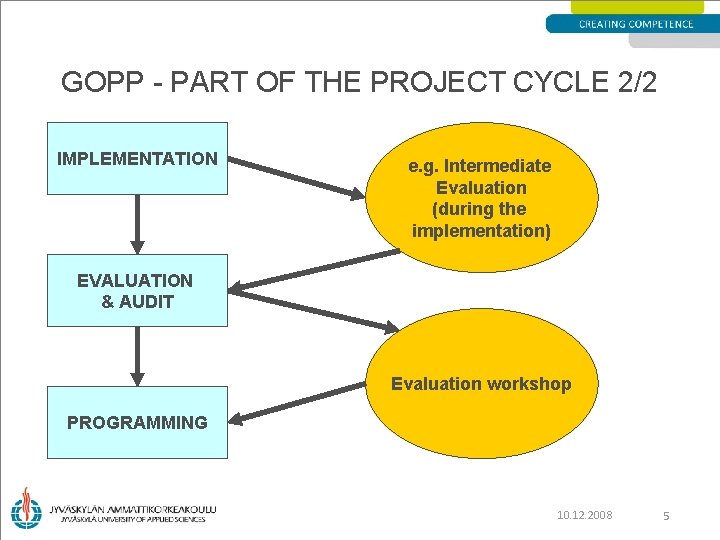
GOPP - PART OF THE PROJECT CYCLE 2/2 IMPLEMENTATION e. g. Intermediate Evaluation (during the implementation) EVALUATION & AUDIT Evaluation workshop PROGRAMMING 10. 12. 2008 5
WHY GOPP WORKSHOP? • Gathering all important parties together. • Way to achieve understanding about problems, benefits and needs. • Way to make agreement about objectives, results and activities. • Intensify project planning, improve quality and decrease risks. à Better commitment! • Effective way to plan a project; 1 – 5 days depending on the subject. • Suitable for all phases in a the project cycle. 10. 12. 2008 6
PARTICIPANTS • Represent various parties or interest groups of the subject. • Some participants of the key partners should be decision-makers or they should have sufficient authorisation. • Participants are equal in the workshop. • An ideal number of participants is 10 -20 persons. 10. 12. 2008 7
FACILITATOR • Trained and experienced. • External representative, she/he doesn’t have to be an expert of the subject. • Neutral person, she/he don’t take part of the discussion. • Leading discussion and decide schedule. • Helps participants to achieve workshop objectives. • Provides materials. 10. 12. 2008 8
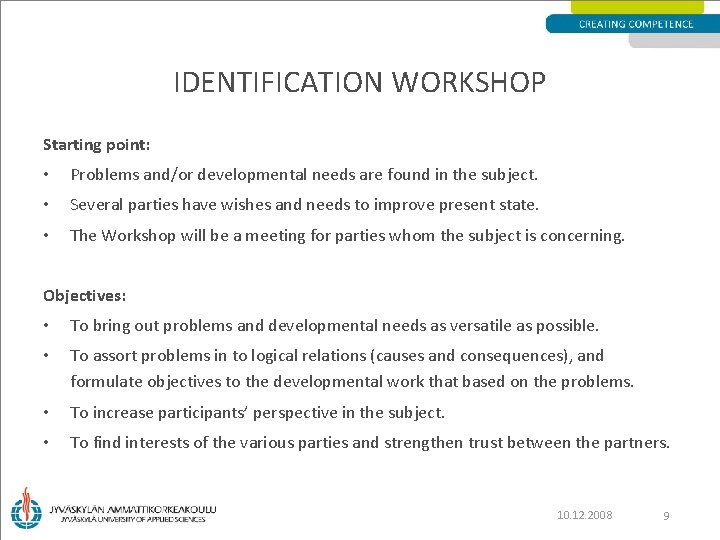
IDENTIFICATION WORKSHOP Starting point: • Problems and/or developmental needs are found in the subject. • Several parties have wishes and needs to improve present state. • The Workshop will be a meeting for parties whom the subject is concerning. Objectives: • To bring out problems and developmental needs as versatile as possible. • To assort problems in to logical relations (causes and consequences), and formulate objectives to the developmental work that based on the problems. • To increase participants’ perspective in the subject. • To find interests of the various parties and strengthen trust between the partners. 10. 12. 2008 9
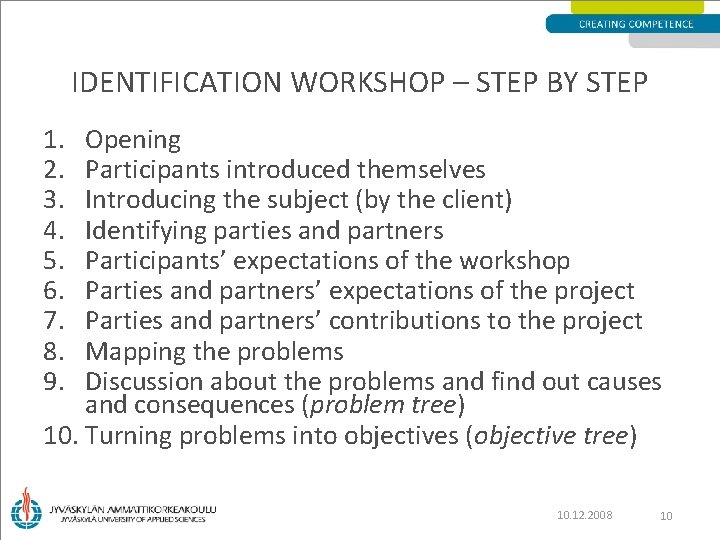
IDENTIFICATION WORKSHOP – STEP BY STEP 1. 2. 3. 4. 5. 6. 7. 8. 9. Opening Participants introduced themselves Introducing the subject (by the client) Identifying parties and partners Participants’ expectations of the workshop Parties and partners’ expectations of the project Parties and partners’ contributions to the project Mapping the problems Discussion about the problems and find out causes and consequences (problem tree) 10. Turning problems into objectives (objective tree) 10. 12. 2008 10
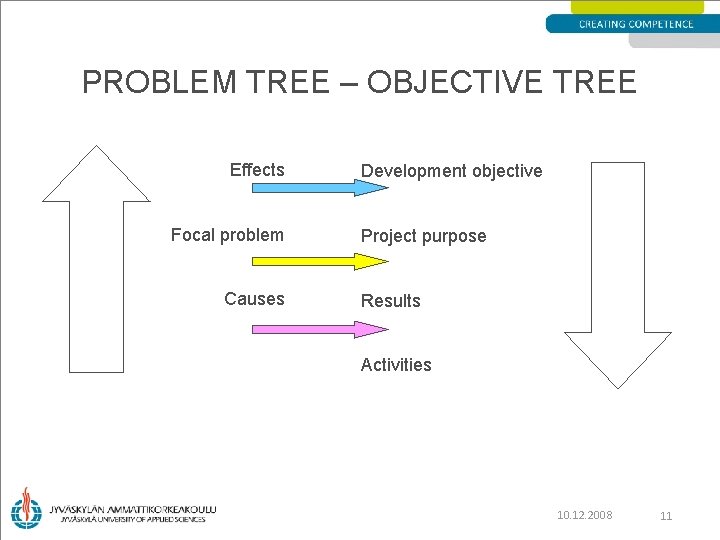
PROBLEM TREE – OBJECTIVE TREE Effects Focal problem Causes Development objective Project purpose Results Activities 10. 12. 2008 11
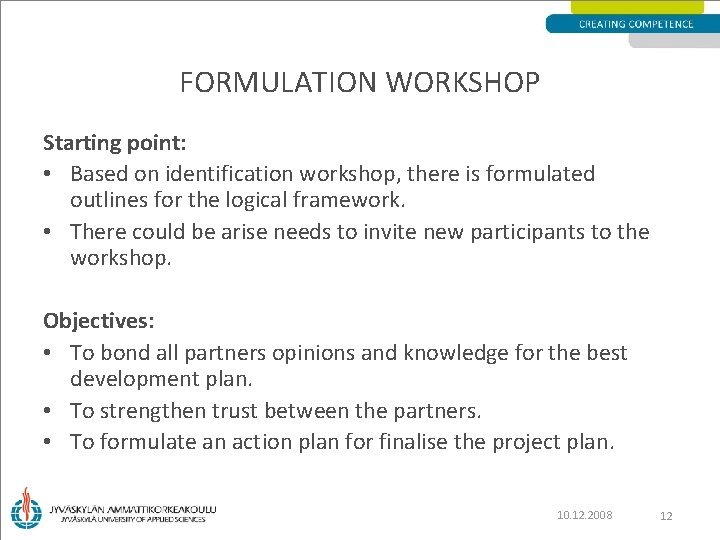
FORMULATION WORKSHOP Starting point: • Based on identification workshop, there is formulated outlines for the logical framework. • There could be arise needs to invite new participants to the workshop. Objectives: • To bond all partners opinions and knowledge for the best development plan. • To strengthen trust between the partners. • To formulate an action plan for finalise the project plan. 10. 12. 2008 12
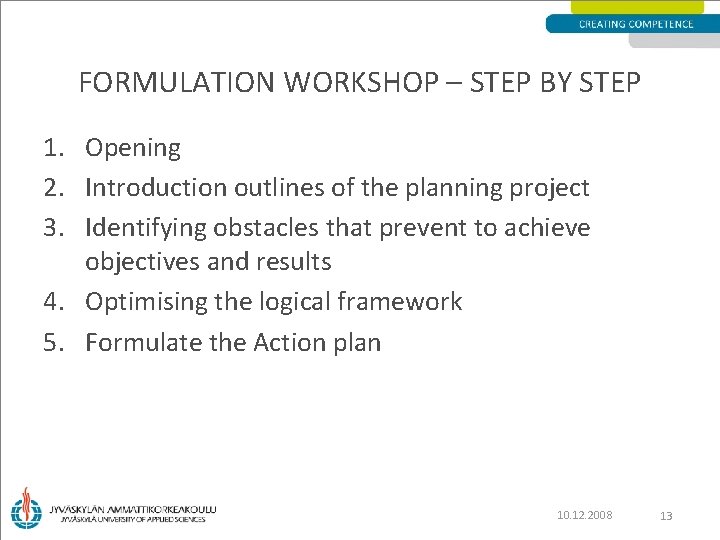
FORMULATION WORKSHOP – STEP BY STEP 1. Opening 2. Introduction outlines of the planning project 3. Identifying obstacles that prevent to achieve objectives and results 4. Optimising the logical framework 5. Formulate the Action plan 10. 12. 2008 13
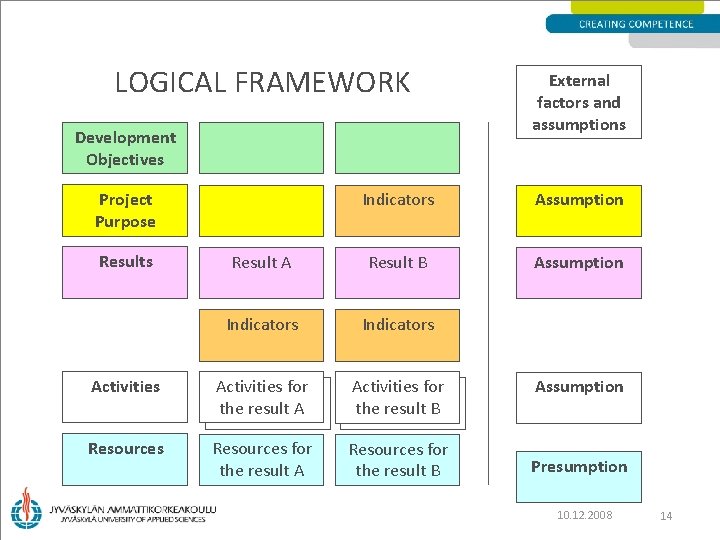
LOGICAL FRAMEWORK Development Objectives Project Purpose External factors and assumptions Indicators Assumption Result A Result B Assumption Indicators Activities for Toimenpiteet the result AA tulokselle Activities for Toimenpiteet the result BA tulokselle Resources for the result A Resources for the result B Results Assumption Presumption 10. 12. 2008 14
FURTHER INFORMATION Tarja Huttunen, R&D Planner Research and Development Services Jyväskylä University of Applied Sciences tarja. huttunen@jamk. fi Mob. +358 40 565 9295 10. 12. 2008 15