General Education Quality AnalysisDiagnosis Framework GEQAFPhaseII Madhya Pradesh
- Slides: 30
General Education Quality Analysis/Diagnosis Framework (GEQAF)-Phase-II Madhya Pradesh (MP) & Meghalaya National Council of Educational Research and Training (NCERT)
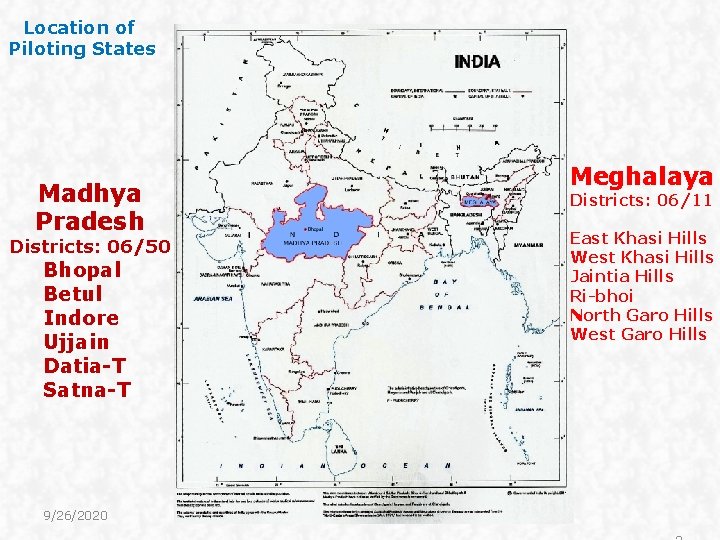
Location of Piloting States Madhya Pradesh Districts: 06/50 Bhopal Betul Indore Ujjain Datia-T Satna-T 9/26/2020 Meghalaya Districts: 06/11 East Khasi Hills West Khasi Hills Jaintia Hills Ri-bhoi North Garo Hills West Garo Hills
Why Quality Analysis of Education? • Huge infrastructure in place • Are the levels of learning matching? • Quality? Effectiveness? • SWOT analysis needed
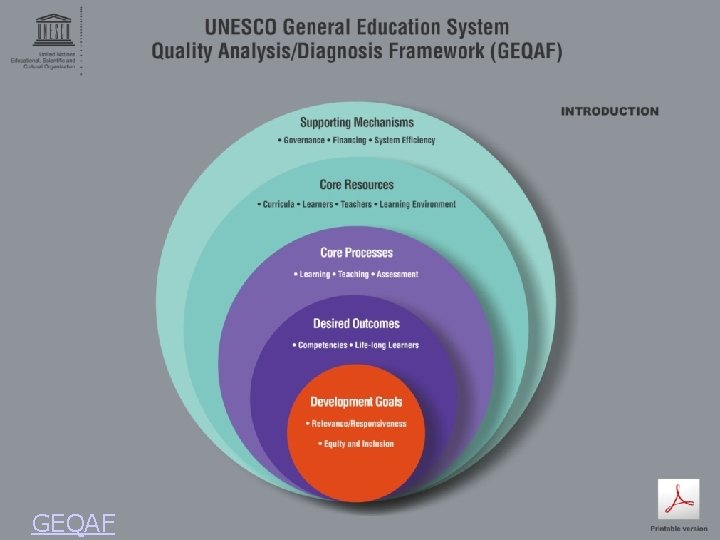
GEQAF
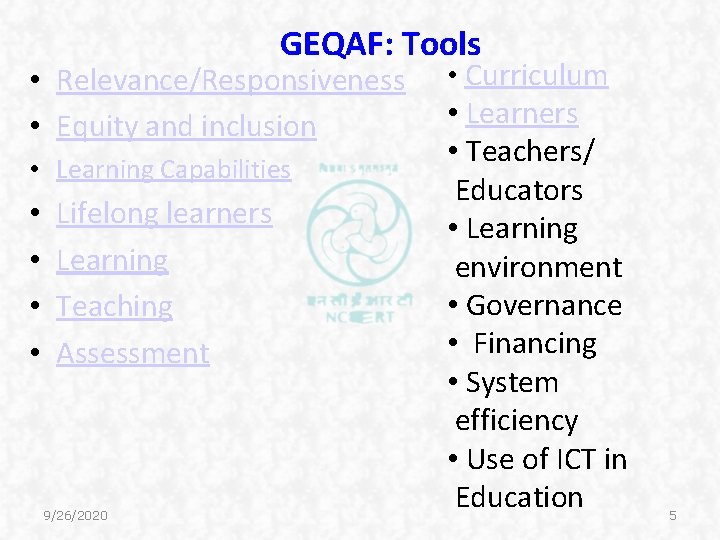
GEQAF: Tools • Relevance/Responsiveness • Equity and inclusion • Learning Capabilities • • Lifelong learners Learning Teaching Assessment 9/26/2020 • Curriculum • Learners • Teachers/ Educators • Learning environment • Governance • Financing • System efficiency • Use of ICT in Education 5
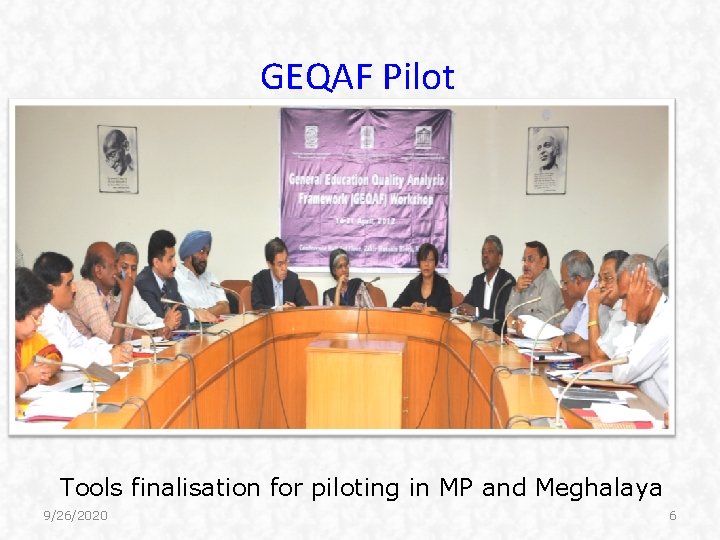
GEQAF Pilot Tools finalisation for piloting in MP and Meghalaya 9/26/2020 6
GEQAF Pilot Conti… • Tools finalised, Hindi Translation done for MP • Planning meeting organised with, and in, states: July, 2012 • Workshops with stakeholders in states: Sept 2012 • District level consultations 9/26/2020 7
Contextualisation of Tools: Modifications • T. 1. “Job market” instead of “Labor market” • T. 3 “Learning Capabilities” in place of “Competencies” • Pop ups & clarifications suggested at many places 9/26/2020 8
Relevance and Responsiveness • Articulated in the Constitution, Five Year Plans, Policy Documents- NPE, NCF, SCF 2007 in MP etc. • Infrastructure-Human & Physical-insufficient • Vocational courses lack vertical mobility • Mind set attached with White Collar and Blue collar jobs • National Vocational Education Qualification Framework (NVEQF) being piloted in few states 9/26/2020 9
Equity and Inclusion • Act, Policies and schemes are in place- RCI, PWD, RTE etc. • Incentives for various groups-Reservations, Schools, Hostels, Mid Day Meals, Scholarships, facilities for CWSN, etc. • Challenges--cognitive and socio-cultural inclusion, improving infrastructure, qualification & training of teachers • Development of pedagogical materials and tools that address specific cognitive needs of CWSN 9/26/2020 10
Learning Capabilities • Policies and Curricular documents have elaborated learning capabilities • Competency matrix-class-wise, stage-wise developed in MP • Administrators, teacher educators, teachers lack adequate understanding of curricular philosophy and concomitant practices • Resources, training for all concerned need to be strengthened • Communication and ICT skills needs to be developed along with other capabilities 9/26/2020 11
Lifelong Learners • Policies and curricula encourage learners towards this goal • Regular update/ upgrade programmes in the world of work • Mechanisms exist beyond formal system: Sakshar Bharat, Television and Radio, ICTs, libraries, NGOs participation • Open Learning Systems-National and state (NIOS, SOS, IGNOU, State Open University) • Lacking accessibility, awareness at grassroots level • Expansion of facilities required • Need to develop partnerships with NGO sector • System need to play a proactive role 9/26/2020
Learning • There is a paradigm shift in conceptualisation of learning as construction of knowledge: NCF-2005 • Learner Achievement Surveys carried out to assess quality in learning • Wide disparity in learning outcomes (urbanrural, male-female, SES, differently abled, etc. ) • Provisions and practices need to address the issue 9/26/2020 13
• • 9/26/2020 • s as. Teaching a process t NCF defines as a process to facilitate learning and teacher as facilitator However, entrenched practices are traditional QMT-SSA implemented by states Both the states are discussing the new teaching learning perspectives Strengthening of support structures for teacher training required Teachers need to be freed from non-teaching activities Qualifications, induction training, good service conditions (salary etc. ) required (for parateachers as well) for effective functioning 14
Assessment • Policies and documents emphasize CCE up to Class-XII and no detention policy up to Class. VIII • Source Book on Assessment-NCERT tried out. Meghalaya • Meghalaya planning to pilot CCE in 500 schools • MP adopted CCE and documented outcomes • Concept of CCE as holistic approach is misunderstood • Continuous training for teachers, teacher educators, administrators required 9/26/2020 15
Curriculum • The Constitution, NPE, other policy documents, researches are consulted in designing curriculum • National Curriculum Framework shared with states and notified as THE framework for all states/UTs • States develop policy/ Curriculum Framework. MP developed SCF-2007, Meghalaya in the process • Coordination & common understanding among all stakeholders needed for effective execution 9/26/2020 16
Learners • NCF-2005 talks about primacy of learner as constructor of knowledge, and hence involved in curriculum development process • This is not understood in states • Mechanism to address diverse groups of learners required • Plurality of materials for linguistic minority groups required • Teacher, teacher educators training required 9/26/2020 17
Teachers/ Teacher Educators • Policy documents in place (NCF, NCFTE) • Regulatory mechanism in place (NCTE) and teacher recruitment policy in place • Various models of courses are in practice • Teacher Eligibility Test (TET) is now mandatory • Challenges for preparation of quality teachers exist-mushrooming growth in MP and shortage in Meghalaya • PSTE and ISTE courses are not revised in sync with NCF-2005, NCFTE-2009 • Continuous training of teachers, educators required on new pedagogy and evaluation 9/26/2020 18
Learning Environment • Policy, guidelines, mechanism in place: NPE, RTE, NCPCR, RCI, Boards • Access to infrastructure, facilities, TLM have increased over the years • Guidelines for child friendly school in MP • All schools not equipped with basic facilities (toilet, drinking water etc) Meghalaya • Equity and inclusion issues--speedy Implementation of RTE Act needed • Quality physical and psycho-social environment needed (Meghalaya-problem of teenage pregnancy and delinquency observed) • Counselors need to be provided in schools 9/26/2020 19
Use of ICT in Education • Country has a National Policy on ICT in School Education • CAL-SSA, ICT@Schools Scheme-RMSA under Implementation-Meghalaya teachers uncomfortable • Headstart Programme is implemented-MP • Piloting states have partial ICT Infrastructure, EDUSAT network • Maintenance, power cuts, untrained teachers, slow internet are stumbling blocks • Need to build infrastructure, use ICT for teaching learning, training & governance in big way 9/26/2020 20
Governance • ECCE to senior secondary level-structures in place • Education portal created and used (MP) • Transparency and accountability still a distant dream • Active Community monitoring of schools needed • Coordination/Synergy among Dept. / parallel structures a missing link • Political instability leading to delayed policy 9/26/2020
Financing • Education is a concurrent subject- major funding by Central Govt. including special schemes • Decentralised budgeting is encouraged-GOI • Finance management-flow of funds to grassroots level is an issue • e-Governance and e-transfer of funds has made the system transparent, quick (MP) • State financing to education needs to increase 9/26/2020 22
System Efficiency • Policies, strategies, annual work plan promote efficient use of resources • Weaker and slow system of feedback • Monitoring and supervision at all level needs to be strengthened • Education Portal for tracking some services in place • Third Party Evaluation of systems, policies, schemes, plans required (MP) 9/26/2020 23
Lessons Learnt from GEQAF Piloting • • Identify key strengths to build on Critical constraints that require redress Measures required for redress Implementing responsive measures Benchmarking and monitoring progress Systems and stakeholders accountability Such an analysis required periodically 24
Observations on the Framework • Framework enhances understanding comprehensively by generating varied dimensions of every aspect of school education • Intricacies involved in schooling are made visible • Disjointedness that exists in the system gets exposed • Interconnectedness of various aspects of education is highlighted/ brought forth • Opens up research areas and brings forth the need to use research findings as feedback • Hence framework is suggestive 9/26/2020
Priority Actions • Curriculum Analysis, development and training of personnel • Orientation on Continuous and Comprehensive Evaluation (CCE) • Sensitisation on Gender, ECCE, Adolescence education, substance abuse, guidance and counselling related concerns • Capacity building on ICTs 9/26/2020
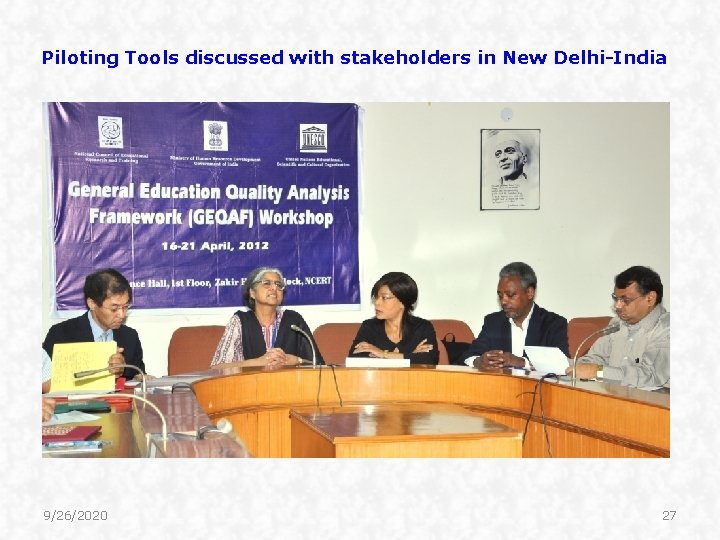
Piloting Tools discussed with stakeholders in New Delhi-India 9/26/2020 27
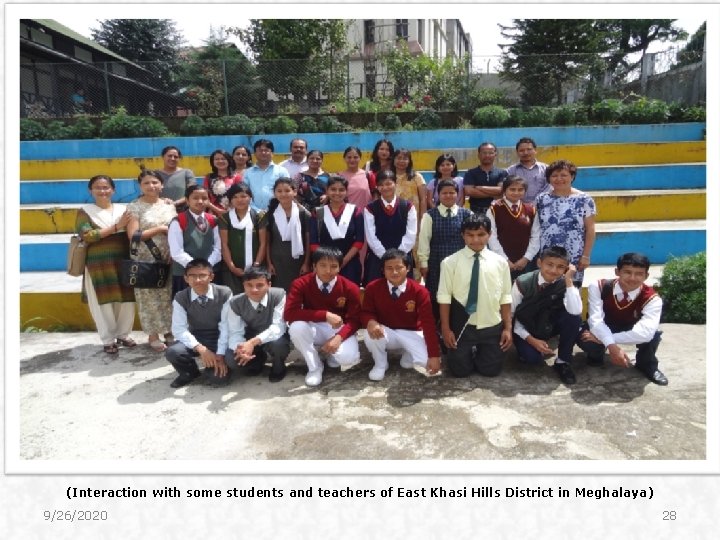
(Interaction with some students and teachers of East Khasi Hills District in Meghalaya) 9/26/2020 28
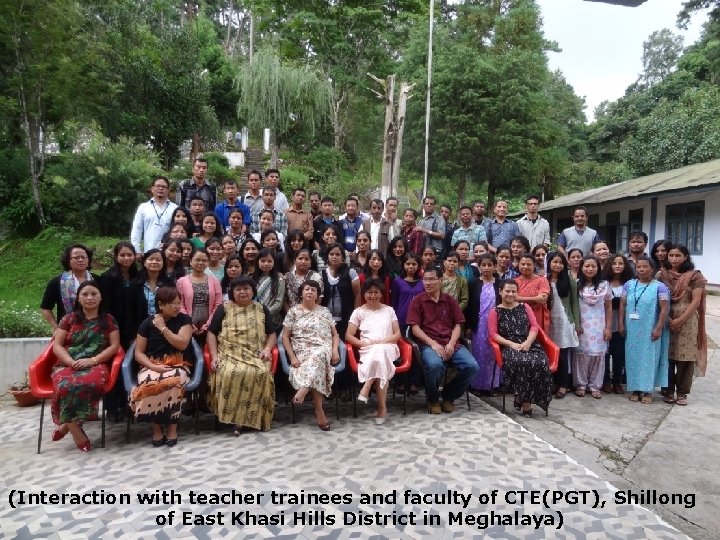
(Interaction with teacher trainees and faculty of CTE(PGT), Shillong 9/26/2020 29 of East Khasi Hills District in Meghalaya)
(A scenic beauty while approaching Shillong, the capital of Meghalaya) 9/26/2020 30