GENA 2112 The Characteristics of Western Culture Modern

- Slides: 29
GENA 2112 The Characteristics of Western Culture Modern Europe & "The Political Collapse of Europe" 3/9/2021 Prof. Frederick Hok-ming CHEUNG
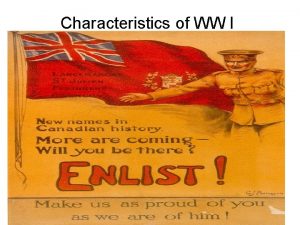
World War I n From cooperation to competition n (from alliances to arms race)
Cooperation Among the Great Powers n n 1878 Berlin Conference Russo-Turkish War 1885 stopped Austro-Bulgarian War 1897 Britain, Russia, France, Italy → stopped Greco. Turkish War
Cooperation Among the Great Powers n n n n 1900, Boxer Uprising in China + US John Hay’s Open Door Policy Cooperation among the Great Powers International organization 1864 founded Red Cross 1875: Universal Telegraph Union (30 countries) 1878: Universal Postal Union (60 counties)
From Cooperation to Competition n n n from Cooperation to Competition Scramble for Africa, Asia (China), (Alliances to arms race) → highly dangerous Yet, ironic: e. g. 1. guns 2. water
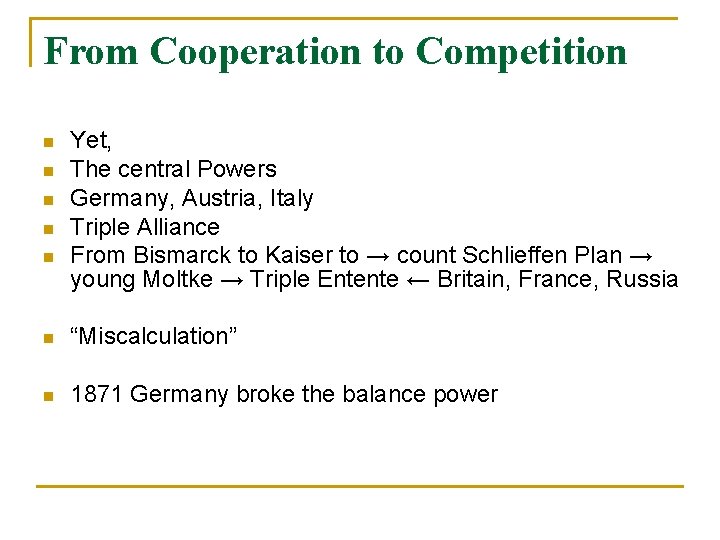
From Cooperation to Competition n n Yet, The central Powers Germany, Austria, Italy Triple Alliance From Bismarck to Kaiser to → count Schlieffen Plan → young Moltke → Triple Entente ← Britain, France, Russia n “Miscalculation” n 1871 Germany broke the balance power
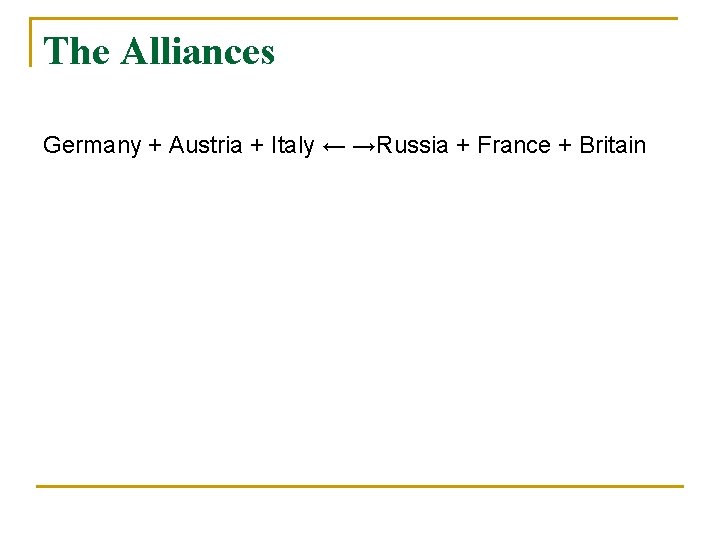
The Alliances Germany + Austria + Italy ← →Russia + France + Britain
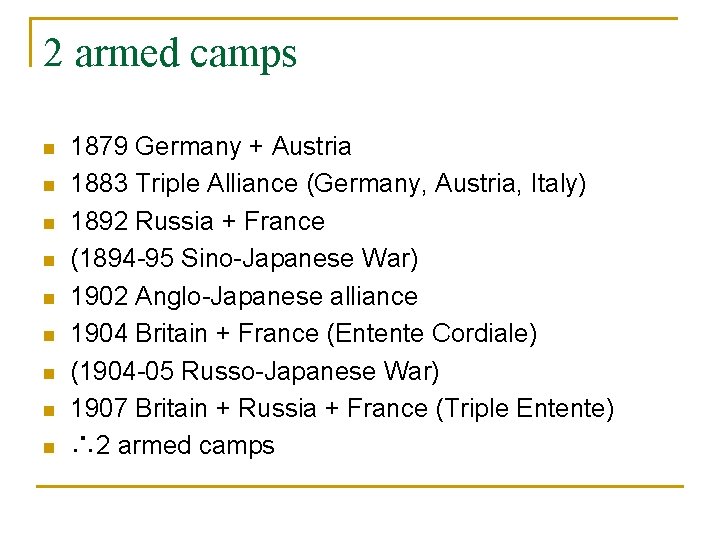
2 armed camps n n n n n 1879 Germany + Austria 1883 Triple Alliance (Germany, Austria, Italy) 1892 Russia + France (1894 -95 Sino-Japanese War) 1902 Anglo-Japanese alliance 1904 Britain + France (Entente Cordiale) (1904 -05 Russo-Japanese War) 1907 Britain + Russia + France (Triple Entente) ∴ 2 armed camps
“Balance of Power” Theory n n “balance of power” theory --- controversial Irony
WWI: A Question of Responsibility ? n 1919 the victors: certain of the answer (責任誰負?) n n n = “the Central Powers” begun WWI “The Germans”, in Article 231 of the Treaty of Versailles, were made to admit their war guilt 1919 + 33 years 1952
WWI: A Question of Responsibility ? yet (責任誰負?) n a committee of French & German historian [翻案], agreed n n n on the following, rather different: “The documents do not permit attributing, to any government or nation, a premeditated desire for European war in 1914. Distrust was at its highest, and leading groups were dominated by the thought that war was inevitable, everyone thought that the other side was contemplating aggression…” now, tons of documents, books, articles, etc. on the cause of the WWI
National Responsibility 1. 2. 3. n n Austria & Serbia Russia & Germany Britain & France Other cause, alliances system, economic motives, imperialism, nationalism, militarism, “miscalculation”, “overconfidence”, “distrust” WWI, above all else, was caused by a tremendous lack of imagination
World War I: Literature n n n Hajo Holborn, The Political Collapse of Europe (張譯《歐洲的政治式微》) ↓ (《歐洲的沒落》� 王曾才校訂並序� 「山窮水盡疑無路 」) Political miscalculation cruel war WWI
Paris Peace Conference n n n 1919 Paris Peace Conference US President Wilson: 14 Points (May Fourth: 五四運動) H. G. Wells (1866 -1946) [英]小說家: WWI
World War I n 1919 Paris Peace Conference between 1815 Vienna Settlement soon US withdrew n “cease-fire” ? n ↓WWII ? (part II of WWI) ? n n
The Aftermath of World War I n n n Paris Peace Conference (1919) tried to solve world problems but in vain. Germany Russia/ Soviet Union (1917) communism↑
The Aftermath of World War I n n March 30, 1949 Sir Winston Churchill Boston between France Revolution 1789 --- nationalism, liberalism↑ (Napoleon) Russia Revolution 1917 --- communism (Lenin)
The Aftermath of World War I 1. 2. 3. Pan Slavism Russia --- Tolstoy, Peace & War [戰爭與和平] Russian music --- Tchaikovsky (柴可夫斯基) n International Communist Movement + Lenin & Stalin --- spreading + USA, 1920 returned to splendid isolation n n
The Aftermath of World War I n {1997 HK} n Britain q India q Middle East q Ireland n n John Maynard Keynes Br. , Paris Peace Treaty
John Maynard Keynes, n The Economic Consequences of the Peace Treaty
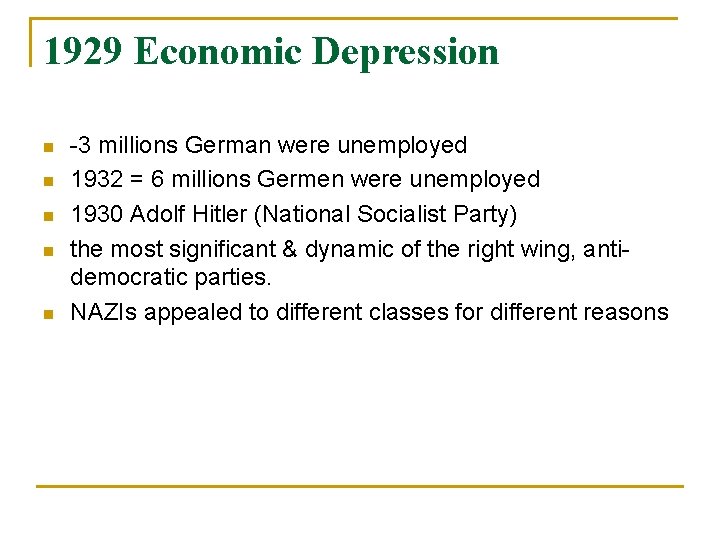
1929 Economic Depression n n Yet, 1929 Economic Depression Rise of Hitler Totalitarianism ↑ Nazism ↑ fascism ↑/ communism↑ Germany↑ (appeasement policy)
1929 Economic Depression n n -3 millions German were unemployed 1932 = 6 millions Germen were unemployed 1930 Adolf Hitler (National Socialist Party) the most significant & dynamic of the right wing, antidemocratic parties. NAZIs appealed to different classes for different reasons
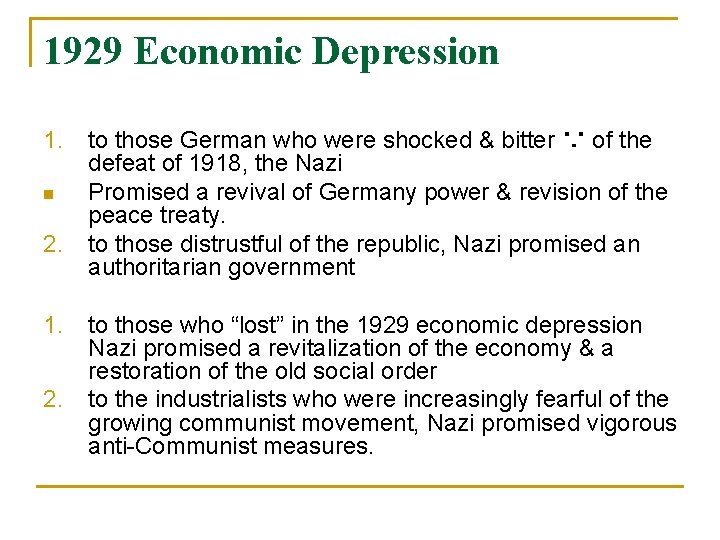
1929 Economic Depression 1. n 2. 1. 2. to those German who were shocked & bitter ∵ of the defeat of 1918, the Nazi Promised a revival of Germany power & revision of the peace treaty. to those distrustful of the republic, Nazi promised an authoritarian government to those who “lost” in the 1929 economic depression Nazi promised a revitalization of the economy & a restoration of the old social order to the industrialists who were increasingly fearful of the growing communist movement, Nazi promised vigorous anti-Communist measures.
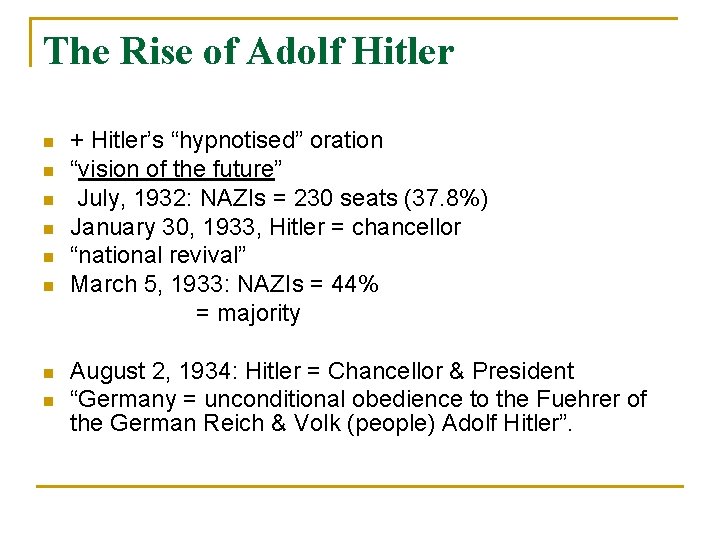
The Rise of Adolf Hitler n n n + Hitler’s “hypnotised” oration “vision of the future” July, 1932: NAZIs = 230 seats (37. 8%) January 30, 1933, Hitler = chancellor “national revival” March 5, 1933: NAZIs = 44% = majority n n August 2, 1934: Hitler = Chancellor & President “Germany = unconditional obedience to the Fuehrer of the German Reich & Volk (people) Adolf Hitler”.
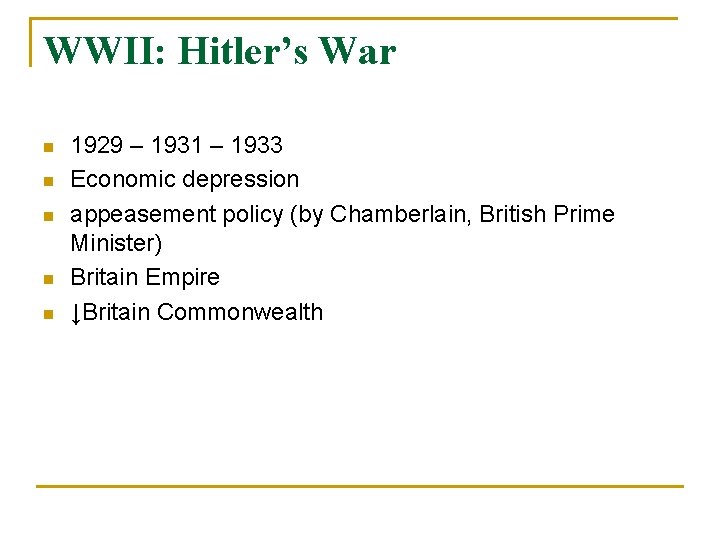
WWII: Hitler’s War n n n 1929 – 1931 – 1933 Economic depression appeasement policy (by Chamberlain, British Prime Minister) Britain Empire ↓Britain Commonwealth
WWII: Hitler’s War n n n March, 1936 Germany in Rhine reorganized its military troops Against Versailles Treaty + Mussolini (Italy) [Fascism] (invaded Ethiopia) Berlin --- Rome Axis Hitler (encouraged by British appeasement policy) Mein Kempf (My Struggle) [我的奮鬥] Psychological - persuasive France
Hitler and Germany n Hitler: German = superior race, pure blood n
Hitler and Germany n Hitler: undeniably, political genius Hysteria n Stalin warned Churchill & Roosevelt n
Hitler and Germany n n n 1938 Germany annexed Austria then Czechoslovakia 1939 Poland 1941 Soviet Union December 7, 1941 Japanese → USA = WWII June 6, 1940, Normandy (“the longest day”) (May, 1945) the end of the War in Europe (August 5, 1945 US 1 st atomic bomb on Hiroshima --- 100, 000 killed August 7, 1945 US 2 nd atomic bomb on Nagasaki//)