
GENA 2112 The Characteristics of Western Culture Medieval
- Slides: 15
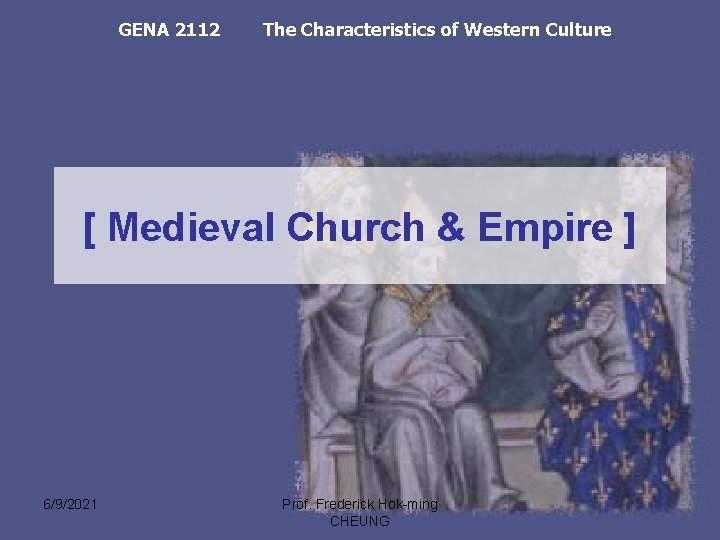
GENA 2112 The Characteristics of Western Culture [ Medieval Church & Empire ] 6/9/2021 Prof. Frederick Hok-ming CHEUNG
Empire versus Papacy “It was during the Middle Ages that the Roman Church developed from obscure beginning as a small persecuted community in the Capital (i. e. Rome) of the Roman Empire, into a world embracing institution endowed with the supreme power of governing the universal church. ” ------ Geoffrey Barraclough, The Medieval Papacy
The Rise of the Christian Church accidental, unforeseen, out of control, no blueprint, not well-planned papal “reaction” – “piecemeal”
Empire versus Papacy Constantine “Caesaropapacism” Charlemagne>Pope Leo III (800) Henry III of Holy Roman Empire, in 1046, deposed 3 popes until Pope Leo IX ↑(1049 -54) reforms
Empire versus Papacy (1056 -1106 Holy Roman Empire Henry IV (6 years old)) ∴ 1059 Papal Election Decree Popes elected by Cardinals ∴freed of secular interference – 1073 -85 Hilderbrand = Pope Gregory VII 1075 Pope Gregory VII: Dictatus Papae
Empire versus Papacy The theory of papal supremacy Banning lay investiture (lay control of ecclesiastical appointments) traditionally, a newly chosen bishop was invested by a lay lord with a ring & a pastoral staff, symbolic of his marriage to the Church & his duty to be a good shepherd to his Christian flock. . 1076 “Archbishop Of Milan” 1077 Pope Gregory VII excommunicated & deposed Holy Roman Emperor Henry IV 1077 Holy Roman Emperor Henry IV crossed the Alps to seek pope’s forgiveness at the Castle of Canossa in Tuscany
Empire versus Papacy “humbled & barefoot in the snow, clothed in rough garments” ∴Gregory lifted excommunication Holy Roman Emperor Henry IV returned & rebuilt authority & suppressed the princely particularism ∴regained power ------ ignored his promises at Canossa ∴ 1080 Gregory excommunicated & deposed Henry IV again
Empire versus Papacy BUT this time, Holy Roman Emperor Henry IV had consolidated his political position ∴Invaded Gregory Pope Gregory VII summoned vassal Robert Guiscard from Southern Italy (Sicily) {the Normans} to rescue The Normans frightened away the Holy Roman Empire’s army but the Normans sacked Rome (1085, Gregory died) Nevertheless, theory of the papal monarchy established
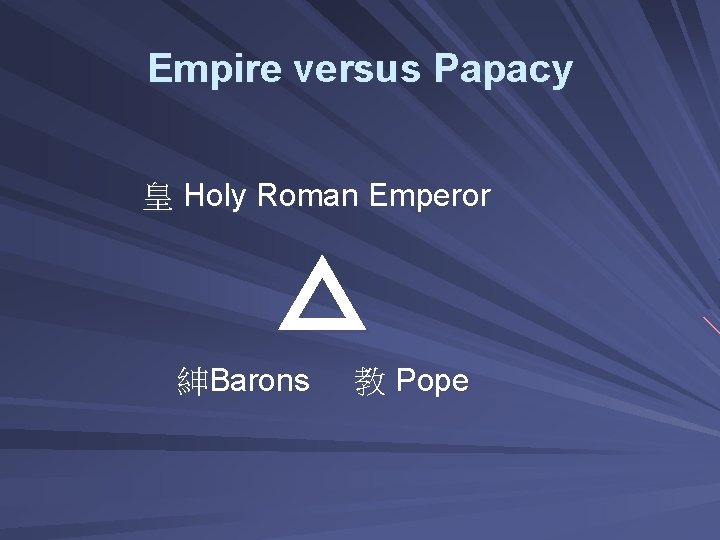
Empire versus Papacy 皇 Holy Roman Emperor △ 紳Barons 教 Pope
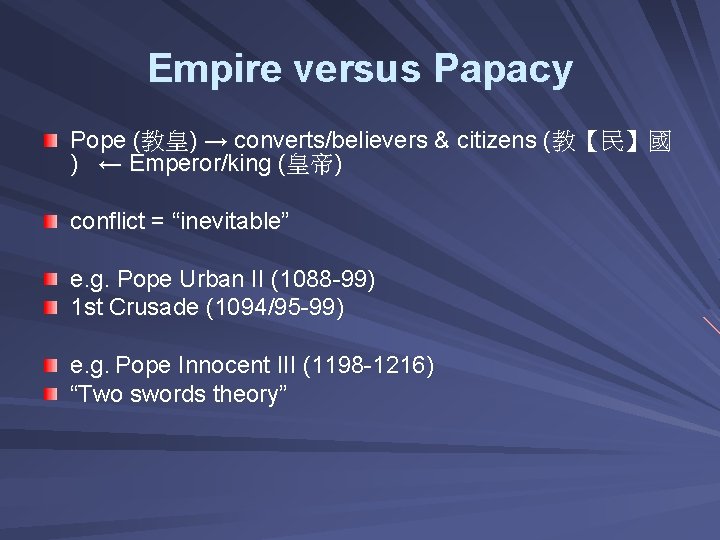
Empire versus Papacy Pope (教皇) → converts/believers & citizens (教【民】國 ) ← Emperor/king (皇帝) conflict = “inevitable” e. g. Pope Urban II (1088 -99) 1 st Crusade (1094/95 -99) e. g. Pope Innocent III (1198 -1216) “Two swords theory”
Empire versus Papacy Two swords theory ∴secular < spiritual
Empire versus Papacy Pope Innocent III : the most “powerful of all medieval popes” → England (King John: Archbishop of Canterbury [1207]1213) → Holy Roman Emperorsuccession
Empire versus Papacy after Innocent III↓ Pope Boniface VIII (1294 -1303) : another lawyer-pope proud, aged, & inflexible 1302 Unam Sanctam (One Sword Theory)
Empire versus Papacy Philip the Fair (France) r. 1285 -1314 1303 kidnapped Pope Boniface VIII at Anagni ∴humiliated (antithesis of Canossa, 1076) escaped & died shortly
Empire versus Papacy 1305 Cardinals elected Pope Clement V (a French) (1305 -14) ↓ Papacy at Avignon (France) = end of an era medieval papacy ∵involvement in secular politics tended more and more to compromise & discredit its spiritual leadership