Friday 12 00 Geology Seminar Dr Lucy Flesch
- Slides: 15
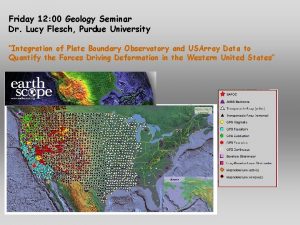
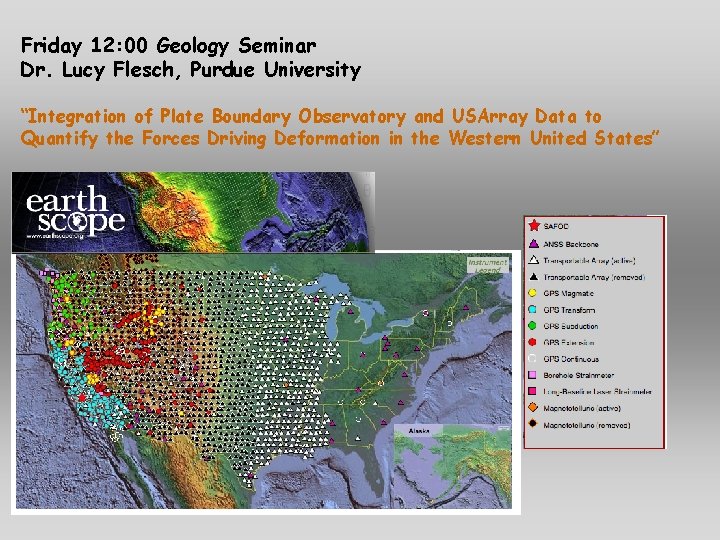
Friday 12: 00 Geology Seminar Dr. Lucy Flesch, Purdue University “Integration of Plate Boundary Observatory and USArray Data to Quantify the Forces Driving Deformation in the Western United States”
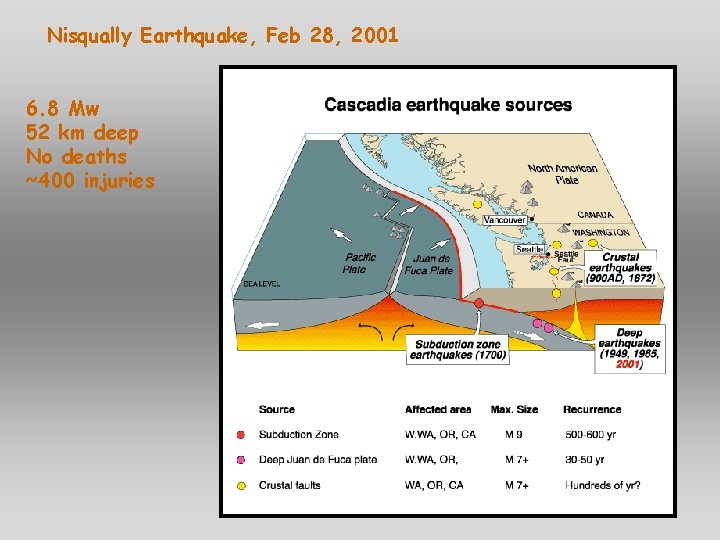
Nisqually Earthquake, Feb 28, 2001 6. 8 Mw 52 km deep No deaths ~400 injuries
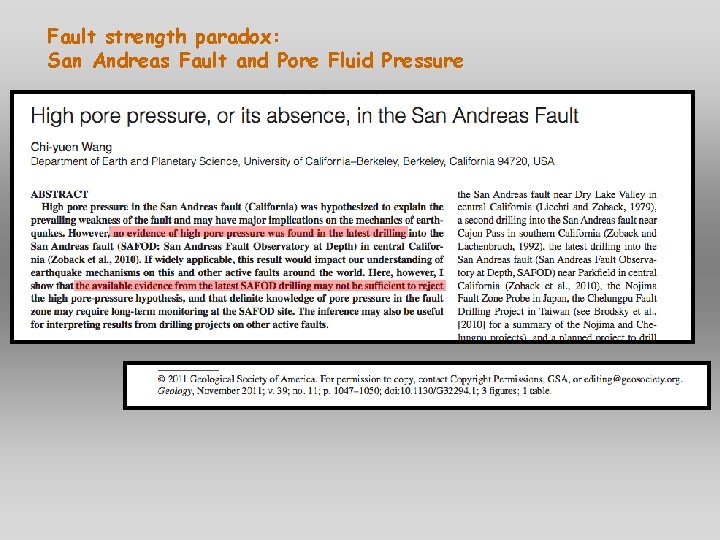
Fault strength paradox: San Andreas Fault and Pore Fluid Pressure
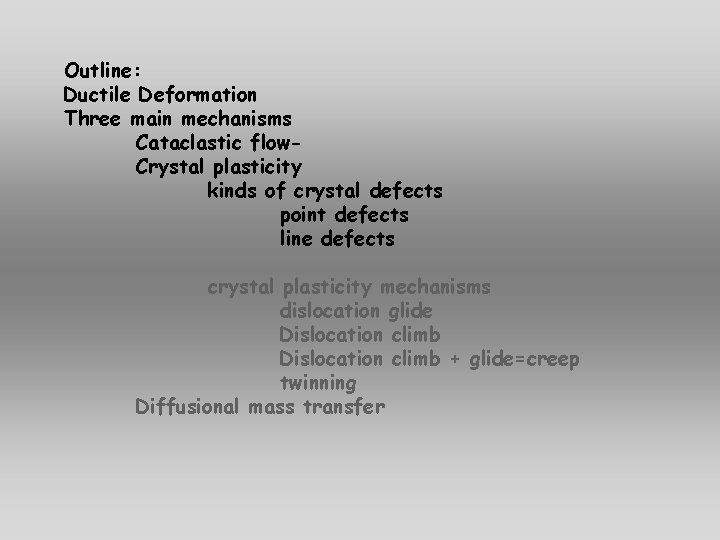
Outline: Ductile Deformation Three main mechanisms Cataclastic flow. Crystal plasticity kinds of crystal defects point defects line defects crystal plasticity mechanisms dislocation glide Dislocation climb + glide=creep twinning Diffusional mass transfer
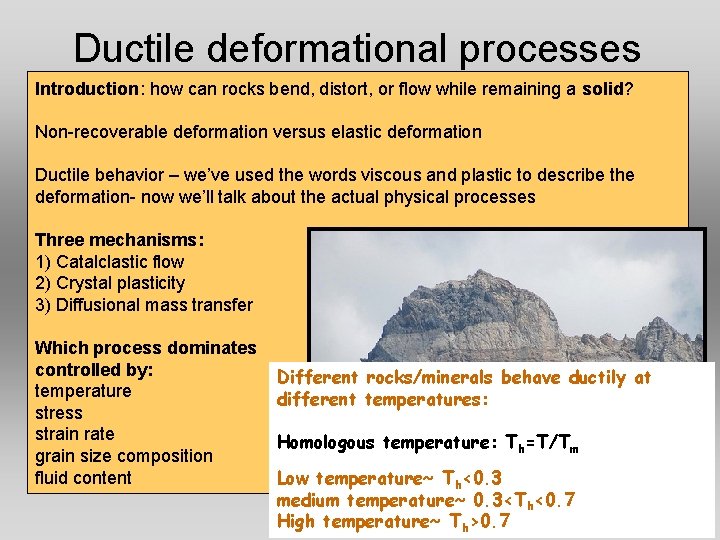
Ductile deformational processes Introduction: how can rocks bend, distort, or flow while remaining a solid? Non-recoverable deformation versus elastic deformation Ductile behavior – we’ve used the words viscous and plastic to describe the deformation- now we’ll talk about the actual physical processes Three mechanisms: 1) Catalclastic flow 2) Crystal plasticity 3) Diffusional mass transfer Which process dominates controlled by: temperature stress strain rate grain size composition fluid content Different rocks/minerals behave ductily at different temperatures: Homologous temperature: Th=T/Tm Low temperature~ Th<0. 3 medium temperature~ 0. 3<Th<0. 7 High temperature~ Th>0. 7
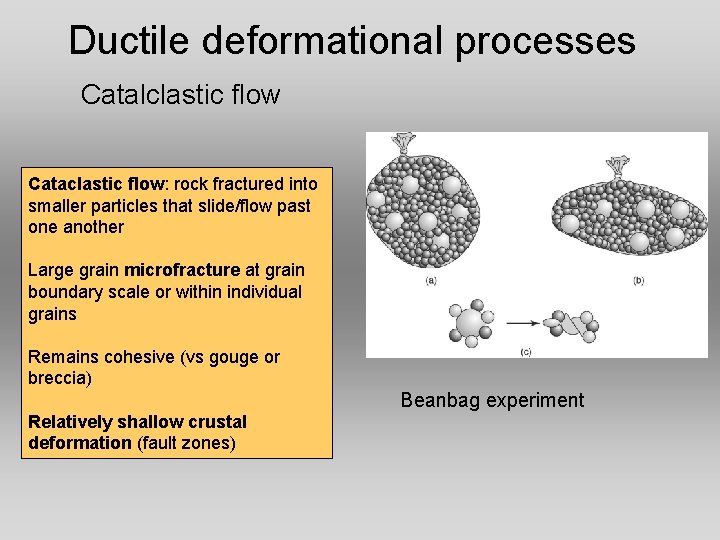
Ductile deformational processes Catalclastic flow Cataclastic flow: rock fractured into smaller particles that slide/flow past one another Large grain microfracture at grain boundary scale or within individual grains Remains cohesive (vs gouge or breccia) Beanbag experiment Relatively shallow crustal deformation (fault zones)
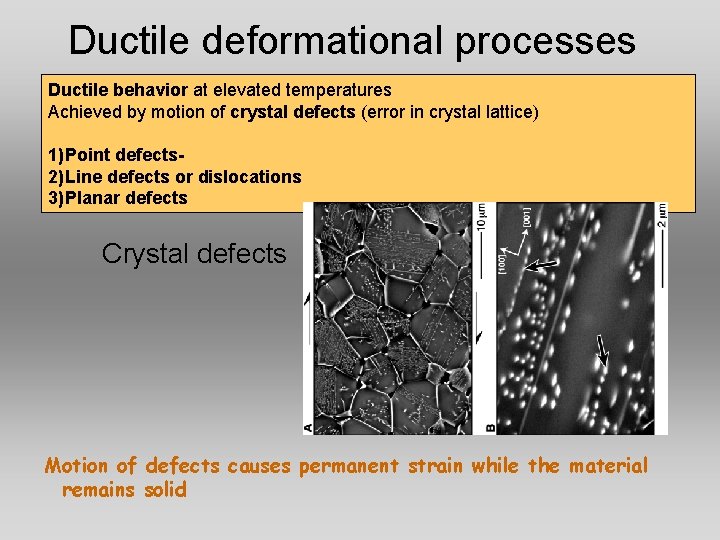
Ductile deformational processes Ductile behavior at elevated temperatures Achieved by motion of crystal defects (error in crystal lattice) 1)Point defects 2)Line defects or dislocations 3)Planar defects Crystal defects Motion of defects causes permanent strain while the material remains solid
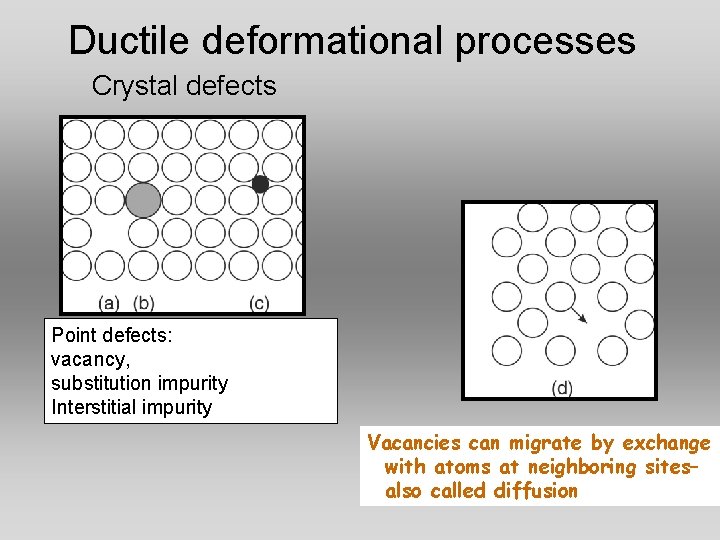
Ductile deformational processes Crystal defects Point defects: vacancy, substitution impurity Interstitial impurity Vacancies can migrate by exchange with atoms at neighboring sites– also called diffusion
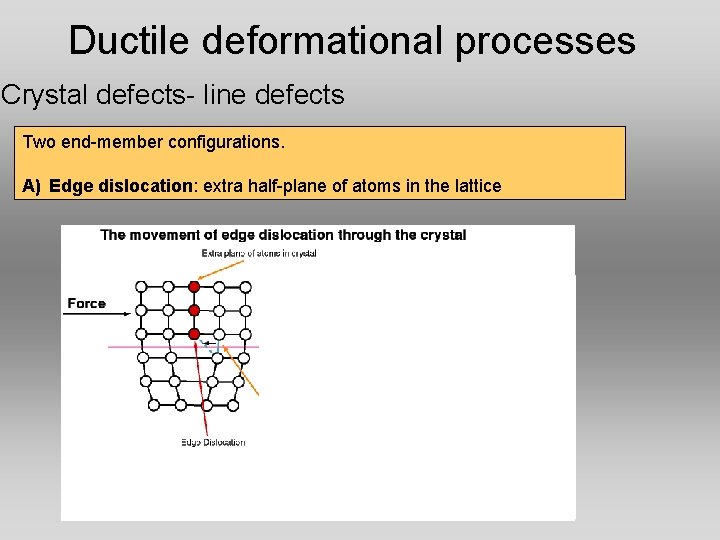
Ductile deformational processes Crystal defects- line defects Two end-member configurations. A) Edge dislocation: extra half-plane of atoms in the lattice
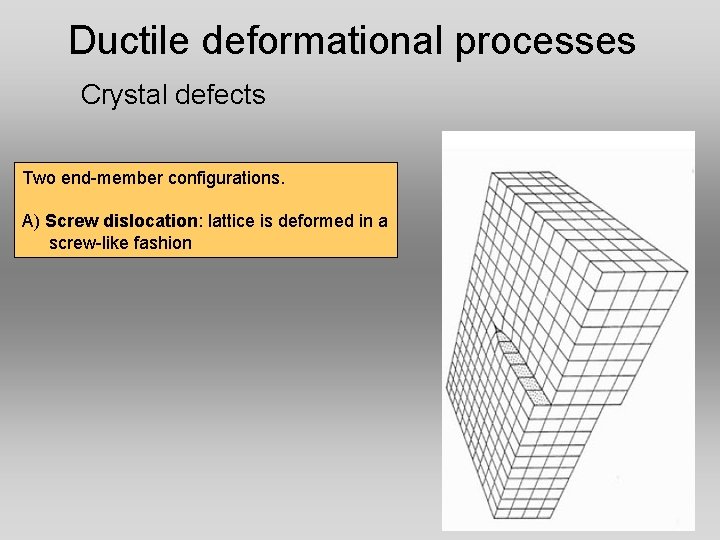
Ductile deformational processes Crystal defects Two end-member configurations. A) Screw dislocation: lattice is deformed in a screw-like fashion
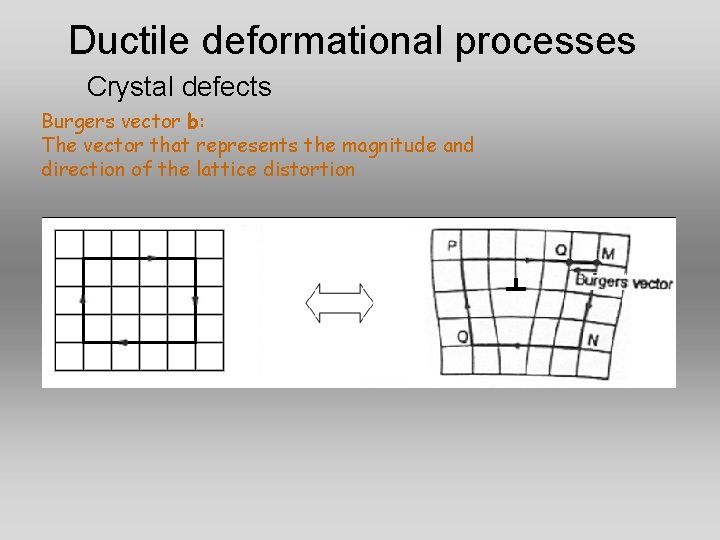
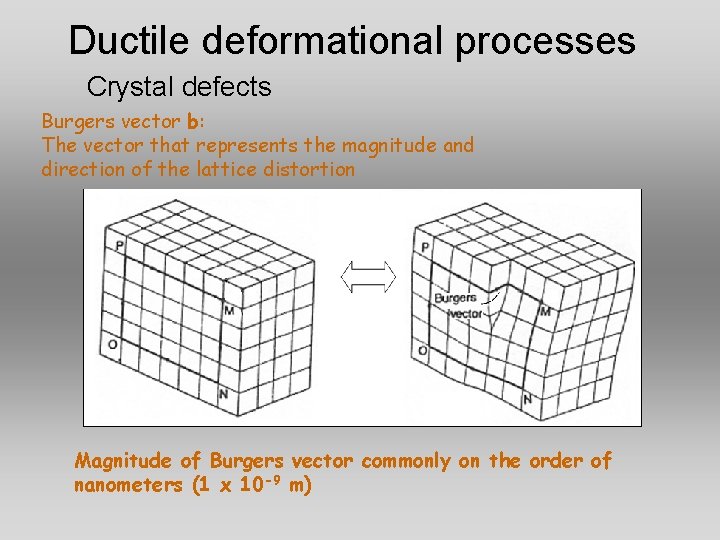
Ductile deformational processes Crystal defects Burgers vector b: The vector that represents the magnitude and direction of the lattice distortion
Ductile deformational processes Crystal defects Burgers vector b: The vector that represents the magnitude and direction of the lattice distortion Magnitude of Burgers vector commonly on the order of nanometers (1 x 10 -9 m)
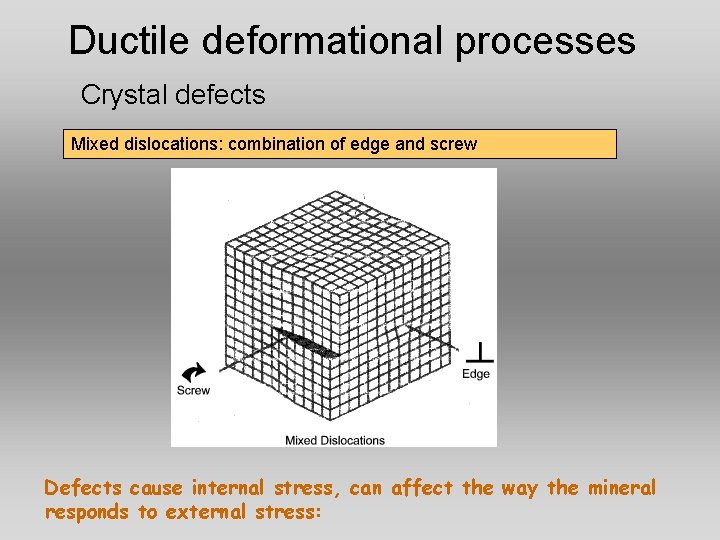
Ductile deformational processes Crystal defects Mixed dislocations: combination of edge and screw Defects cause internal stress, can affect the way the mineral responds to external stress:
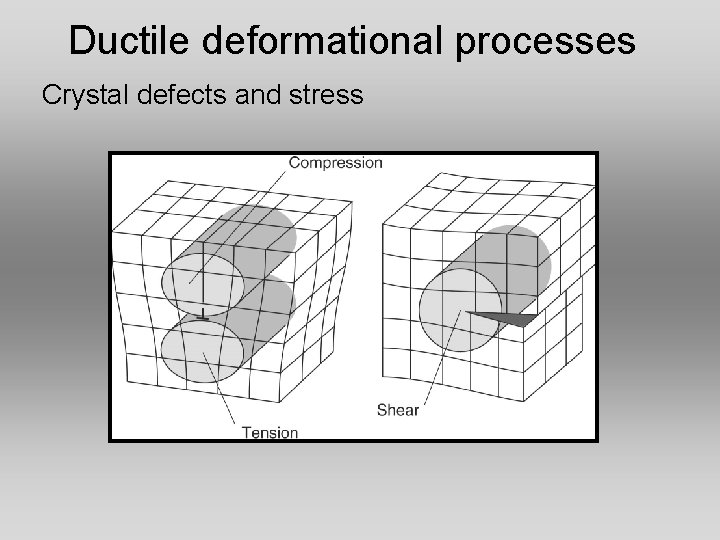
Ductile deformational processes Crystal defects and stress
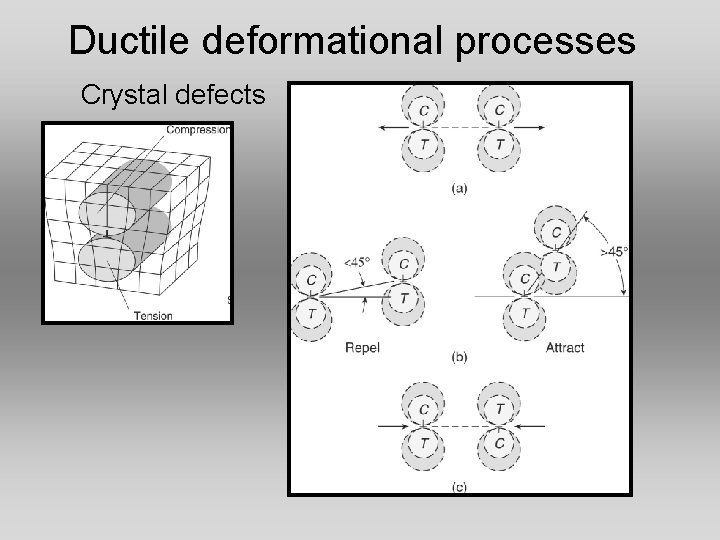
Ductile deformational processes Crystal defects