
Problems of Interoperability in Information Systems Nick Rossiter
Problems of Interoperability in Information Systems Nick Rossiter and Michael Heather CEIS, Northumbria University, UK nick. rossiter@unn. ac. uk WOSC 2008 Wroclaw 1
Four Challenges • • Enterprise Interoperability Knowledge-oriented Collaboration Web Technologies Interoperability Service Utility Need dynamic connections WOSC 2008 Wroclaw 2
What is Underlying Logic? • Not set theory – OK for closed local systems – But falls foul of Gödel as higher-order operations needed – Neither complete nor decidable outside FOPC – CWA is not realistic – But experimental verification is valuable • Not pure category theory – Axiomatic – So also falls foul of Gödel WOSC 2008 Wroclaw 3
Process Logic • Strong candidate • Long pedigree – Heraclites – Whitehead – Category theory – Cartesian closed categories WOSC 2008 Wroclaw 4
Uses of Category Theory – – – – Cartesian closed categories (CCC, naturality) Systems theory with Heyting logic (open systems) Topos (So. S) Monad (transaction logic, process) Adjointness (relationships) 2 -categories (vertical + horizontal composition) Higher-order logic in CCC • Without axioms and reliance on number • Gödel free in connecting systems in our view – For good practice, avoid categorification WOSC 2008 Wroclaw 5
Twin-track Approach • Two subsystems • 1. Data Structures and Rules – 3 -level architecture – In terms of mappings A B C D • With dual D C B A • 2. Behaviour – 3 -level architecture – In terms of cycles F: A B; G: B A • GF 3 times • FG 3 times WOSC 2008 Wroclaw 6
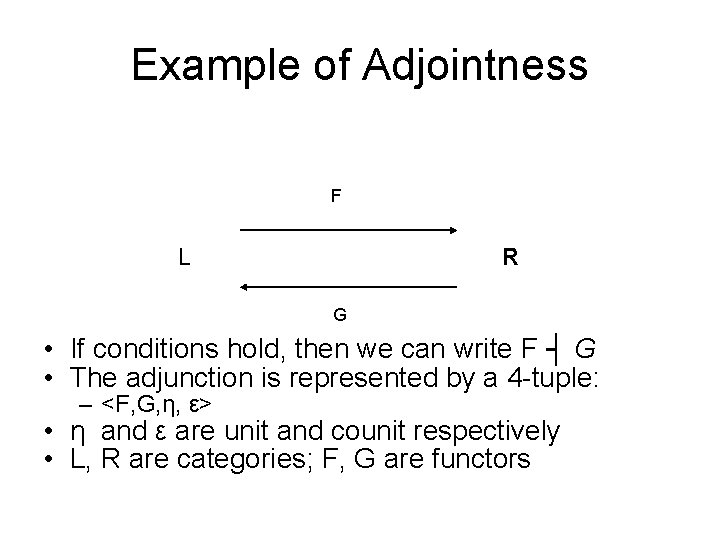
Example of Adjointness F L R G • If conditions hold, then we can write F ┤ G • The adjunction is represented by a 4 -tuple: – <F, G, η, ε> • η and ε are unit and counit respectively • L, R are categories; F, G are functors
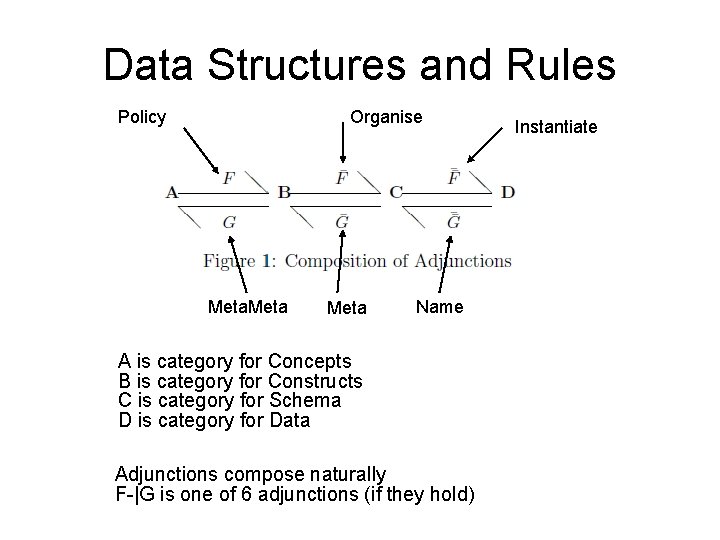
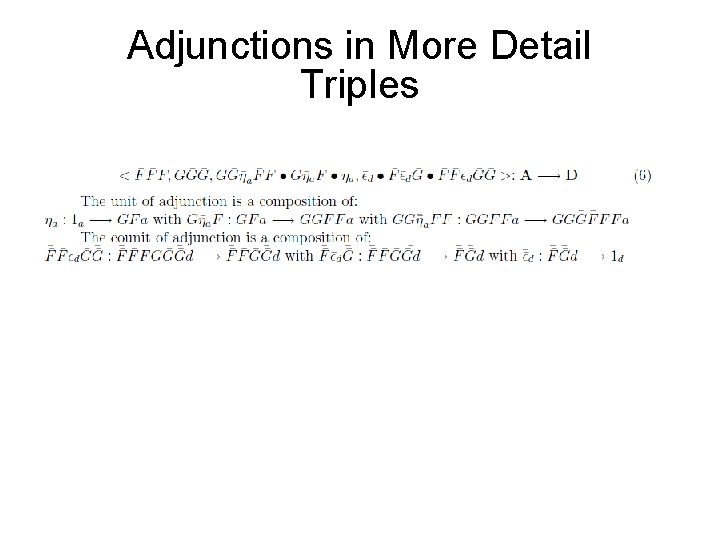
Data Structures and Rules Policy Organise Meta Name A is category for Concepts B is category for Constructs C is category for Schema D is category for Data Adjunctions compose naturally F-|G is one of 6 adjunctions (if they hold) Instantiate
Principles • Have pairs of abstractions • Each level is defined by level above • Adjunctions permit relationships less than equivalence between the levels • Having more than three levels of abstraction does not achieve greater precision • Can be viewed as multi-level type subsystem
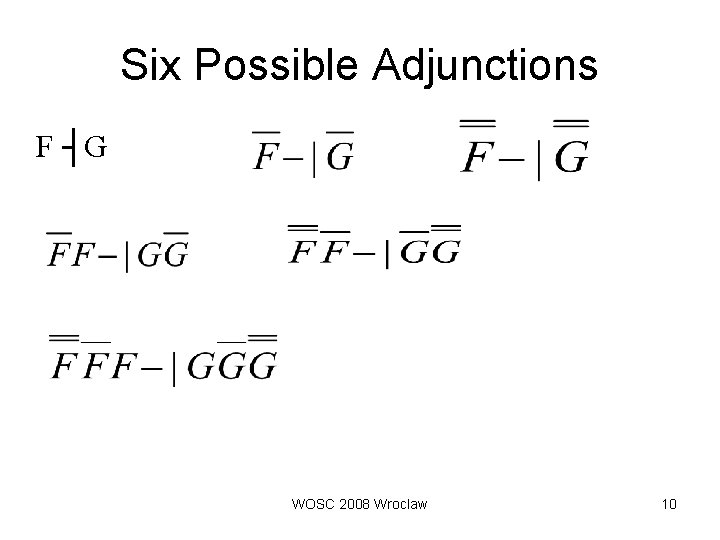
Six Possible Adjunctions F ┤G WOSC 2008 Wroclaw 10
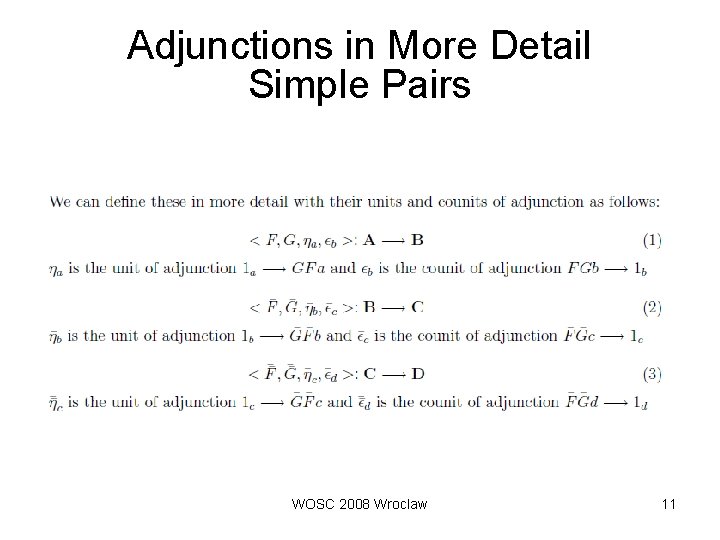
Adjunctions in More Detail Simple Pairs WOSC 2008 Wroclaw 11
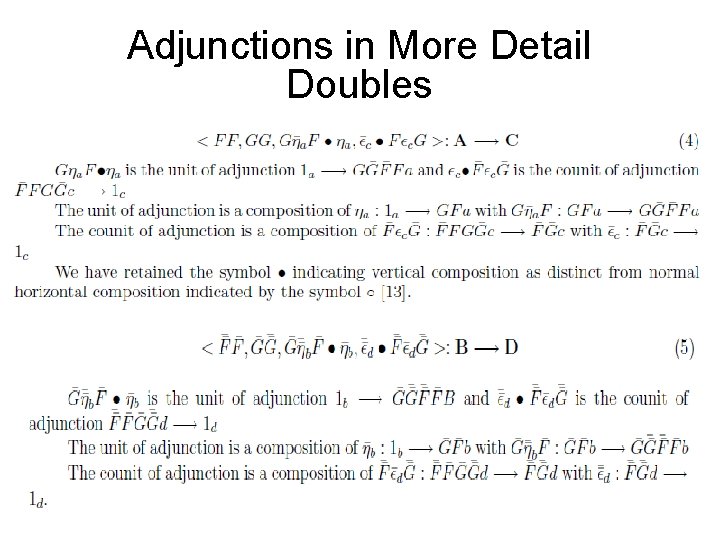
Adjunctions in More Detail Doubles
Adjunctions in More Detail Triples
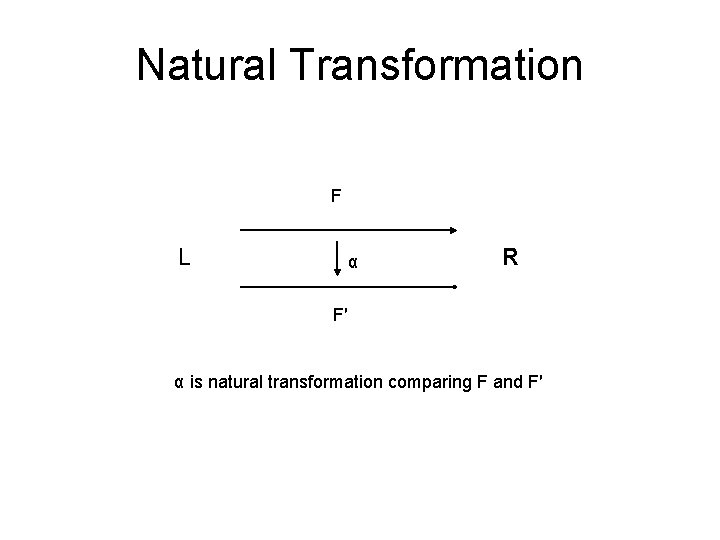
Desired Properties • If all adjunctions hold – Have clearly-defined multi-level type subsystem • Can relate one subsystem to another by – Natural transformation • Maps between functors • Provides interoperability between subsystems for – Data structures and rules
Natural Transformation F L α R F′ α is natural transformation comparing F and F′
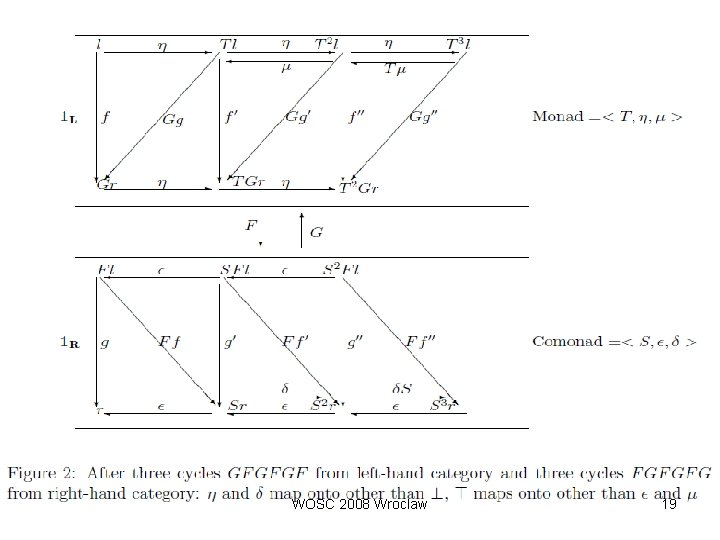
Behaviour/Anticipation Monad/Comonad • Define subsystem – Handle transactions • ACID properties • Atomicity, Consistency, Isolation, Durability – Have 3 cycles • 1. make changes • 2. review changes • 3. holistic check that all is well – Example with Bank ATM: • 1. debit account • 2. check funds available • 3. holistic check that all changes recorded safely
Monad • Construction for transactions is the Monad • Monad is a triple <T, η, μ> – T is an endofunctor (functor with same source and target) • e. g. GF : A B A – η is unit of adjunction e. g. 1 L GF(L) • Compares initial value for object L with value for L after one cycle – μ is multiplication T 2 T • comparing result from 2 nd cycle with 1 st • e. g. GFGF • Full details of definition involve T 3 (GFGFGF)
Comonad • Monad gives left-hand-perspective (L) • Comonad gives right-hand perspective (R) • Comonad is a triple <S, ε, δ> – S is FG • e. g. B A B – ε is counit of adjunction e. g. FG(R) 1 R – δ is comultiplication T T 2 • Anticipation – looking forward
WOSC 2008 Wroclaw 19
System Viewpoint for Interoperability • Have a system formed from 2 subsystems – For data structures/rules • 3 levels of mapping as functors between categories • Each mapping represents a level-pair of abstractions – For behaviour • 3 cycles as a monad/comonad structure • Interoperability – Comparing one system with another by natural transformations or higher-order categories • Recent work on Security by Ph. D student Dimitris Sisiaridis with category theory produces the system unification
Possible Way Forward • Not for everybody to learn category theory! • Development of tool – Assist with interoperability – Based on process category theory – Graphical – Haskell is a candidate • Facilities include monads
- Slides: 21