Forensic Linguistics Sara Marina Ahmed Prez Loreto Alcntara


- Slides: 15
Forensic Linguistics Sara Marina Ahmed Pérez, Loreto Alcántara Albaladejo, Araceli Bañón García, Mercedes María Cascales Muñoz
Index • Introduction • What Forensic Linguistics is • Applications and branches of forensic linguistics • Forensic Linguistics in real-life: cases • Conclusion
Introduction Forensic linguistics is the application of linguistic knowledge methods and insights to the forensic context of law, language, crime investigation, trial, and judicial procedure. (Wikipedia) From now on we are going to refer to Forensic Linguistics as FLing
Forensic Linguistics It deals with the kind of language and behaviour of people. Uses: - Forensic stylistics - Forensic dialectology - Forensic phonetics (wikipedia)
Forensic Linguistics Areas of legal research: - Language of legal texts Acts of Parliament, private wills or court judgements) - Language of legal processes (cross examination, testimonies in court, evidence presentation and so on)
Applications and Branches Applications - Three major areas: 1. The language of law 2. Language in legal processes 3. Linguistic evidence in legal proceeding - Levels to analyse forensic linguistic: graphic, phonetic, morphologic, syntax, lexicon and paradigmatic and discourse analysis.
Applications and Branches - Sexual Offenses - Citizens' emergency calls - Witness and suspects in interviews - Police interviews in judicial process. (M. Coulthard & A. Johnson, 2010)
SEXUAL OFFENSES Types: rape, child abuse, grooming Verbal harrasment: 1. Comments 2. Embarrassing questions 3. Employment conditions and sexual favors Police photograph offenders when theyregister.
CITIZENS'EMERGENCY CALLS The information provide in them belongs to the field of forensic linguistics. Assesment about the incidents 1. Urgently 2. Seriousness 3. Potential criminality Calls for police assistance play a significant role
Witness and suspects in interviews Three major aspects: to identify the criminal, to locate and aprehend him and to prove is guilt in court. Tools: instrumentation, information and interview and interrogation.
Police interviews in the judiciaal process. Te formal interview is a key part of any investigation. The interview has a significant fuction as a piece of evidence, exhibited and presented in court. Words spoken have a dual context and a dual function.
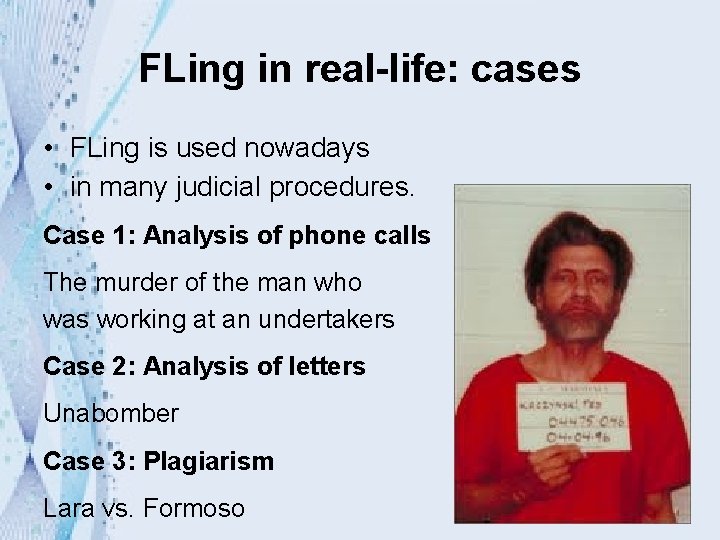
FLing in real-life: cases • FLing is used nowadays • in many judicial procedures. Case 1: Analysis of phone calls The murder of the man who was working at an undertakers Case 2: Analysis of letters Unabomber Case 3: Plagiarism Lara vs. Formoso
Conclusion To conclude I will say that Forensic Linguistics, as we have seen during this presentation, could usefully help to solve many different kind of cases, among other applications, such as the ones we have explain in this work. We really hope you have enjoyed this presentation, and you have some more interest in Forensic Linguistics
References Courthald, M. & Johnson, A. (Eds. ) (2010). The Routledge Handbook of Forensic Linguistics. New York, NY: Taylor & Frances e-Library. http: //www. inbrief. co. uk/discrimination-law/sex-discrimination-act. htm http: //www. inbrief. co. uk/offences/the-sex-offenders-register. htm http: //www. inbrief. co. uk/offences/sex-offenders-register. htm http: //www. inbrief. co. uk/discrimination-law/sex-discrimination-act. htm http: //en. wikipedia. org/wiki/Forensic_linguistics
Thanks!