Five Main Sources of Law Chapter 1 1
- Slides: 11
Five Main Sources of Law Chapter 1
(1. ) Constitutional Law • Constitution – a country’s formal document that spells out the principles by which its government operates. • U. S. Constitution is most basic law. • State Constitutions are not the same as the U. S. Constitution. They are usually longer and more detailed than the U. S. Constitution.
U. S. Constitution • • • Article I – sets up legislative branch. Article II – sets up executive branch. Article III – sets up judicial branch. Article IV – states must accept laws of other states. Article V – How amendments can be added. Article VI – Supremacy Clause. U. S. Constitution and laws of United States are highest in the country.
(2. ) Common Law • Common Law – a set of laws made by the courts which provide a series of consistent rules that later courts must follow. • Originated in England, not used as much as it was in the past. Parts of common law are still used in some states. • Precedent – a past case that a court follows when making a present decision. • Stare Decisis – let the decision stand. Process of relying on past court cases.
(3. ) Civil Law • Civil Law – non-criminal law and is based on statutes. • Originated in Europe with the framework of Roman Law. • Statutes – a law passed by a government body that has been made for the purpose of creating laws.
Statutes • They are created when a proposed bill is passed and signed by Governor (state) or President (federal) • Statutes can declare law on an issue. • Statutes can order someone to do something. (Wear seatbelts, pay taxes) • Statutes can order someone not to do something. (murder is crime)
Statutes Con’t. • Federal – laws passed by Congress and signed by the President. • Commerce Clause – power for Congress to make laws pertaining to commerce (business) between two states. • State – can make their own, but cannot conflict with federal. • UCC – Uniform Commercial Code. Most statutes relating to business are the same in all 50 states.
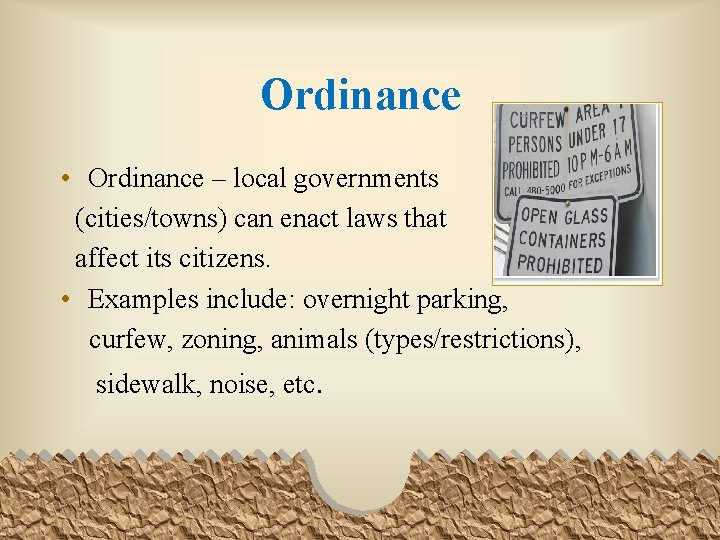
Ordinance • Ordinance – local governments (cities/towns) can enact laws that affect its citizens. • Examples include: overnight parking, curfew, zoning, animals (types/restrictions), sidewalk, noise, etc.
(4. ) Case Law • Case Law – courts make the law through the following three ways: • #1 Common Law – decisions made by the highest court of that state must be followed by all other courts in the state. • #2 Interpreting Law – Courts have to figure out what a statute means, when one is confusing. Must be part of a case in order to be interpreted. • #3 Judicial Review – courts can decide whether laws conflict with the constitution.
(5. ) Administrative Law Admin. Law – the body of rules created by government agencies. • Congress and state legislatures do not have knowledge in every field, nor do they have the time to do all that they are supposed to. • Agencies are created and given power to regulate certain activities. Example: Federal Communications Commission – regulates radio, television and cable companies.
International Law • Not a major source of law in the U. S. • Int’l treaties signed by the U. S. carry the same weight as a federal statute. Everyone in the U. S. must follow any treaty the U. S. has signed. • Int’l Trade Agreements: not binding, but provide recommendations for how countries should interact within the international community.