Finding Themes in Literature A message from the
- Slides: 16
Finding Themes in Literature A message from the author…
The Reader’s Job • Part of your job as a reader is to understand the author’s message. • Writers seldom come out and tell you, “Hey, Reader! THIS is what I want you to GET from my writing. ” • You, as the reader, must make inferences and draw conclusions about what the author is trying to express.
HEY! What’s the BIG IDEA? !! • What does the story mean? • Themes are usually about BIG IDEAS. For example: – Freedom – Trust – Friendship – Good vs. Evil – Prejudice
So, what is theme? • Theme is the message from the author. • Themes can be found everywhere: – Literature – Art – Movies • The theme of a fable is the moral of the story. • The theme of a piece of literature is its message about life and how people behave.
THIS is THEME… q. Theme is the meaning behind the story. q. It is an accepted truth about life. q. It is NOT a single word, but rather an important statement about society, or human nature.
Get to the POINT! • Theme is NOT the TOPIC. • Theme IS the POINT being made about the TOPIC. • Theme is a statement about LIFE. • A GOOD theme teaches a VALUABLE lesson about life.
Finding the Theme • What is the topic and what is the “BIG IDEA” related to that topic? • What do the characters say or do that relates to the topic? • What do these things tell you that are important to learn about life? • The topic is… • The BIG IDEA is… • The characters say… • The characters do… • The text tells me… • It is important to…
THEME TOPICS
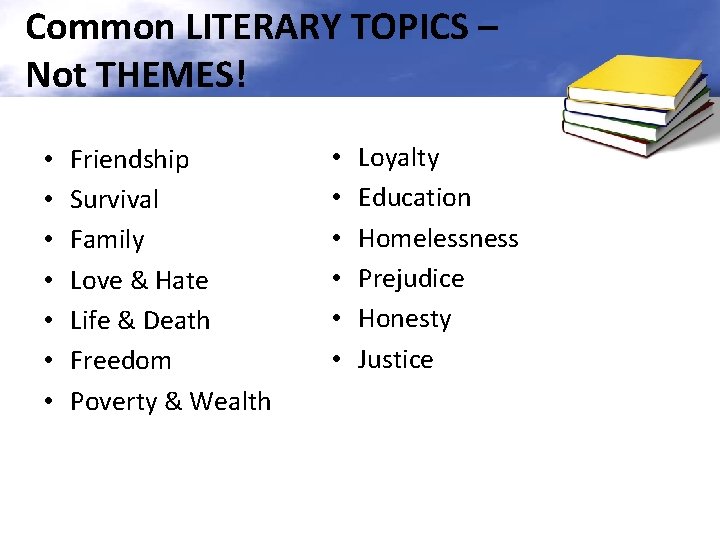
Common LITERARY TOPICS – Not THEMES! • • Friendship Survival Family Love & Hate Life & Death Freedom Poverty & Wealth • • • Loyalty Education Homelessness Prejudice Honesty Justice
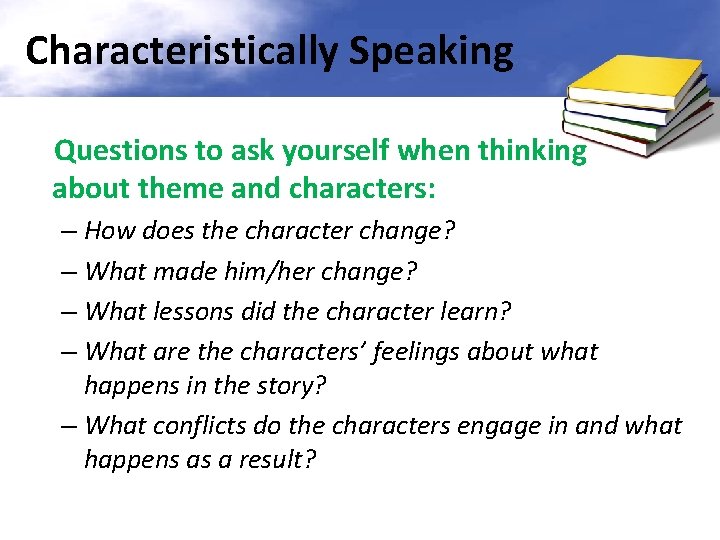
Characteristically Speaking Questions to ask yourself when thinking about theme and characters: – How does the character change? – What made him/her change? – What lessons did the character learn? – What are the characters’ feelings about what happens in the story? – What conflicts do the characters engage in and what happens as a result?
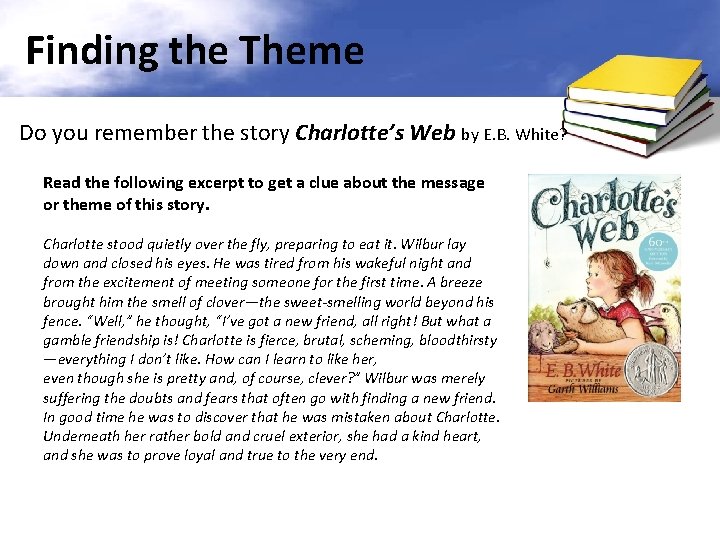
Finding the Theme Do you remember the story Charlotte’s Web by E. B. White? Read the following excerpt to get a clue about the message or theme of this story. Charlotte stood quietly over the fly, preparing to eat it. Wilbur lay down and closed his eyes. He was tired from his wakeful night and from the excitement of meeting someone for the first time. A breeze brought him the smell of clover—the sweet-smelling world beyond his fence. “Well, ” he thought, “I’ve got a new friend, all right! But what a gamble friendship is! Charlotte is fierce, brutal, scheming, bloodthirsty —everything I don’t like. How can I learn to like her, even though she is pretty and, of course, clever? ” Wilbur was merely suffering the doubts and fears that often go with finding a new friend. In good time he was to discover that he was mistaken about Charlotte. Underneath her rather bold and cruel exterior, she had a kind heart, and she was to prove loyal and true to the very end.
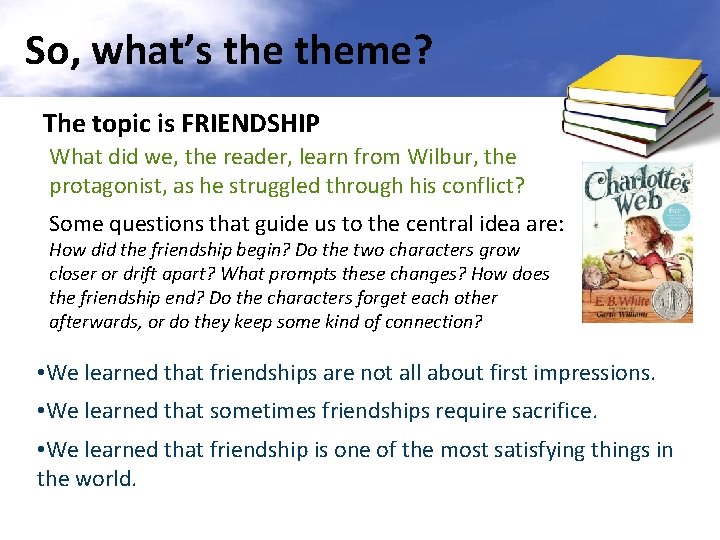
So, what’s theme? The topic is FRIENDSHIP What did we, the reader, learn from Wilbur, the protagonist, as he struggled through his conflict? Some questions that guide us to the central idea are: How did the friendship begin? Do the two characters grow closer or drift apart? What prompts these changes? How does the friendship end? Do the characters forget each other afterwards, or do they keep some kind of connection? • We learned that friendships are not all about first impressions. • We learned that sometimes friendships require sacrifice. • We learned that friendship is one of the most satisfying things in the world.
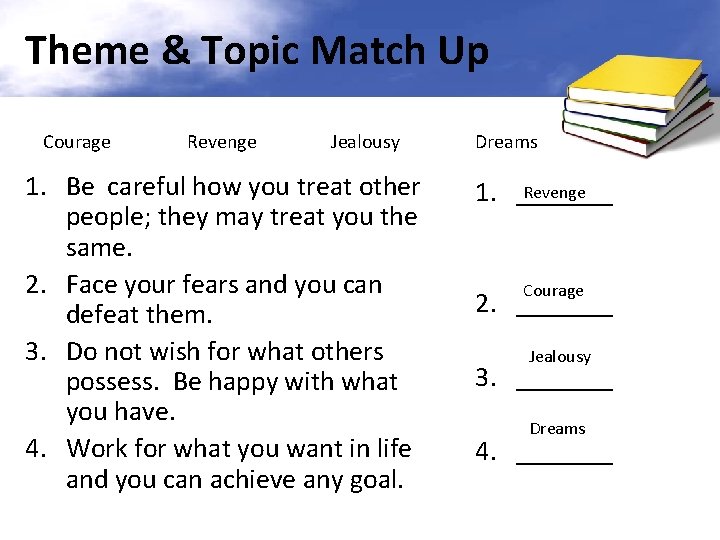
Theme & Topic Match Up Courage Revenge Jealousy 1. Be careful how you treat other people; they may treat you the same. 2. Face your fears and you can defeat them. 3. Do not wish for what others possess. Be happy with what you have. 4. Work for what you want in life and you can achieve any goal. Dreams Revenge 1. _______ Courage 2. _______ Jealousy 3. _______ Dreams 4. _______
HOW TO WRITE A THEMATIC STATEMENT
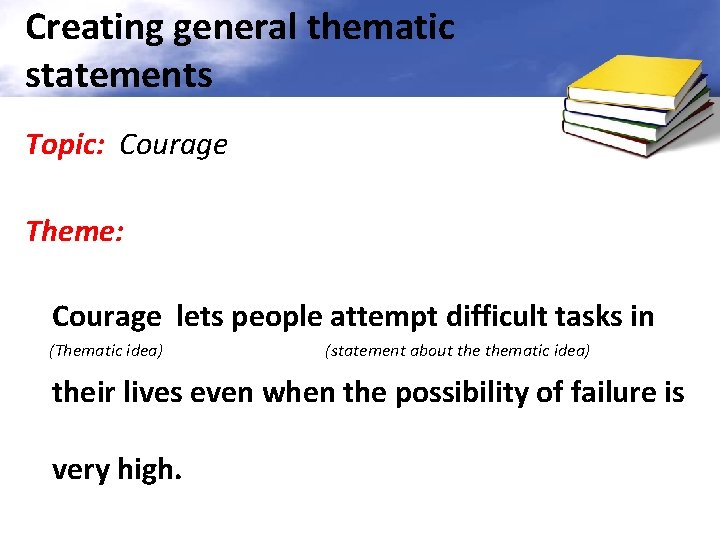
Creating general thematic statements Topic: Courage Theme: Courage lets people attempt difficult tasks in (Thematic idea) (statement about thematic idea) their lives even when the possibility of failure is very high.
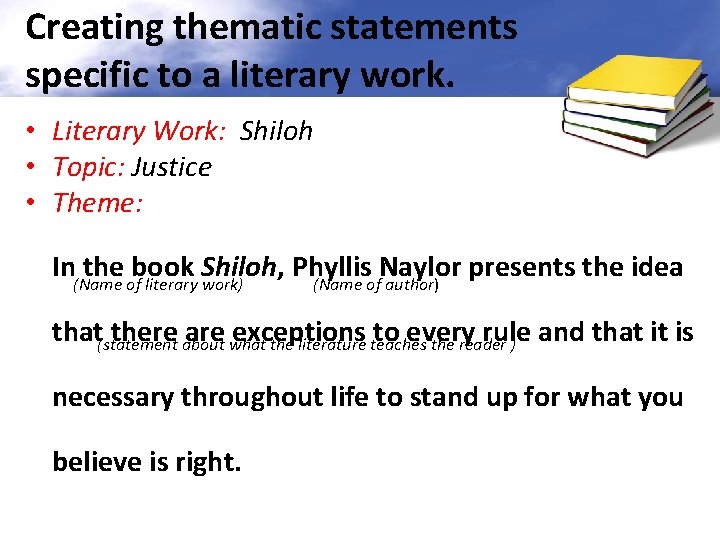
Creating thematic statements specific to a literary work. • Literary Work: Shiloh • Topic: Justice • Theme: In(Name the ofbook Shiloh, Phyllis Naylor presents the idea literary work) (Name of author) that(statement there about are what exceptions to every rule and that it is the literature teaches the reader ) necessary throughout life to stand up for what you believe is right.