FACILITATION REGIONAL IMPLEMENTATION SEMINAR Dakar 5 8 March
- Slides: 14
FACILITATION REGIONAL IMPLEMENTATION SEMINAR Dakar, 5 – 8 March 2018 ELECTRONIC FILING OF DIFFERENCES (EFOD) SYSTEM: BACKGROUND & INTRODUCTION by Jitu Thaker Technical Officer, Facilitation 5 March 2018
OVERVIEW OF EFOD PRESENTATIONS Compliance Issues with regard to Annex 9 Background & Introduction ICAO’s Role in Maintaining the EFOD System States’ Role in Making Entries into the EFOD System ------------------------------Understanding the EFOD System How to make entries into the EFOD System Report on Entries into the Annex 9 CC Potential EFOD Problems faced by States
OVERVIEW Compliance Issues with regard to Annex 9 Background & Introduction to EFOD ICAO’s Role in Maintaining the EFOD System States’ Role in Making Entries into the EFOD System
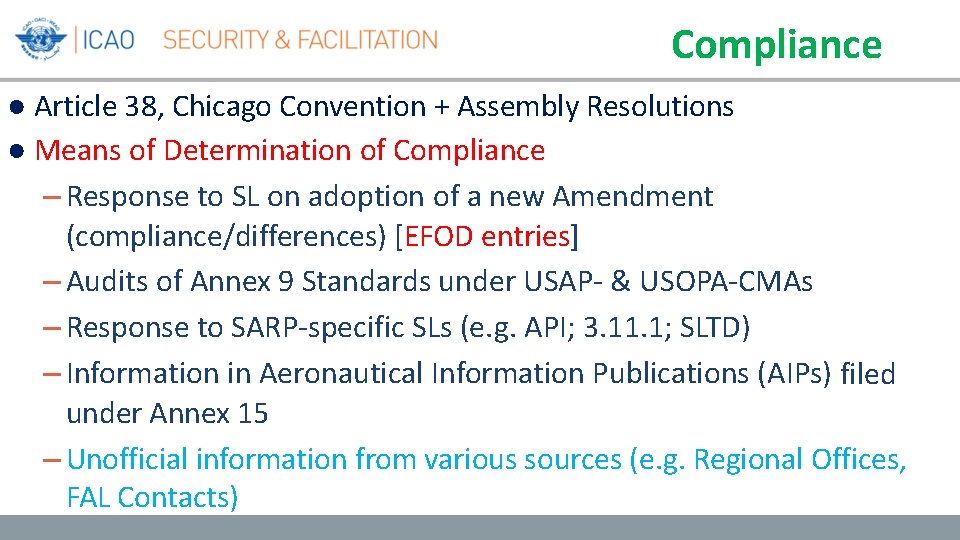
Compliance ● Article 38, Chicago Convention + Assembly Resolutions ● Means of Determination of Compliance – Response to SL on adoption of a new Amendment (compliance/differences) [EFOD entries] – Audits of Annex 9 Standards under USAP- & USOPA-CMAs – Response to SARP-specific SLs (e. g. API; 3. 11. 1; SLTD) – Information in Aeronautical Information Publications (AIPs) filed under Annex 15 – Unofficial information from various sources (e. g. Regional Offices, FAL Contacts)
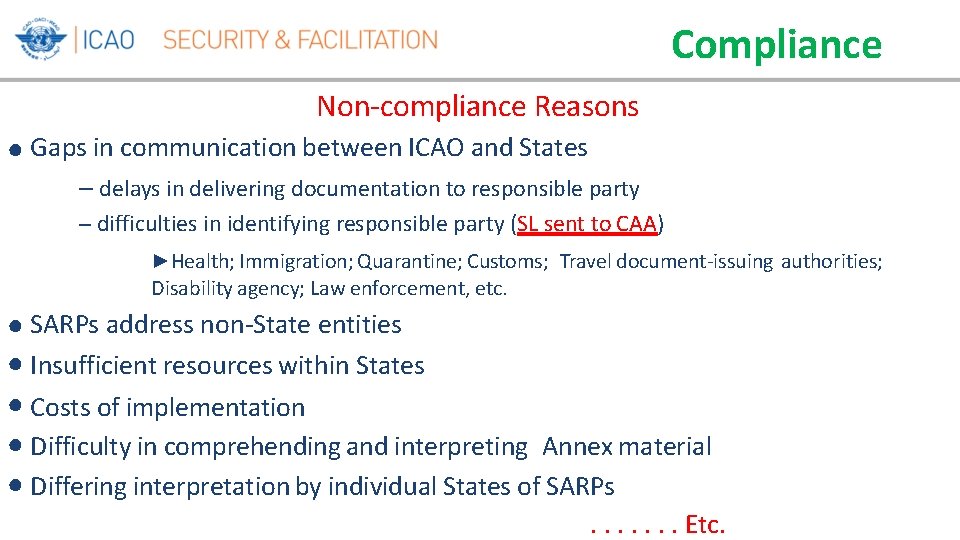
Compliance Non-compliance Reasons ● Gaps in communication between ICAO and States ─ delays in delivering documentation to responsible party ─ difficulties in identifying responsible party (SL sent to CAA) ►Health; Immigration; Quarantine; Customs; Travel document-issuing authorities; Disability agency; Law enforcement, etc. ● SARPs address non-State entities ● Insufficient resources within States ● Costs of implementation ● Difficulty in comprehending and interpreting Annex material ● Differing interpretation by individual States of SARPs. . . . Etc.
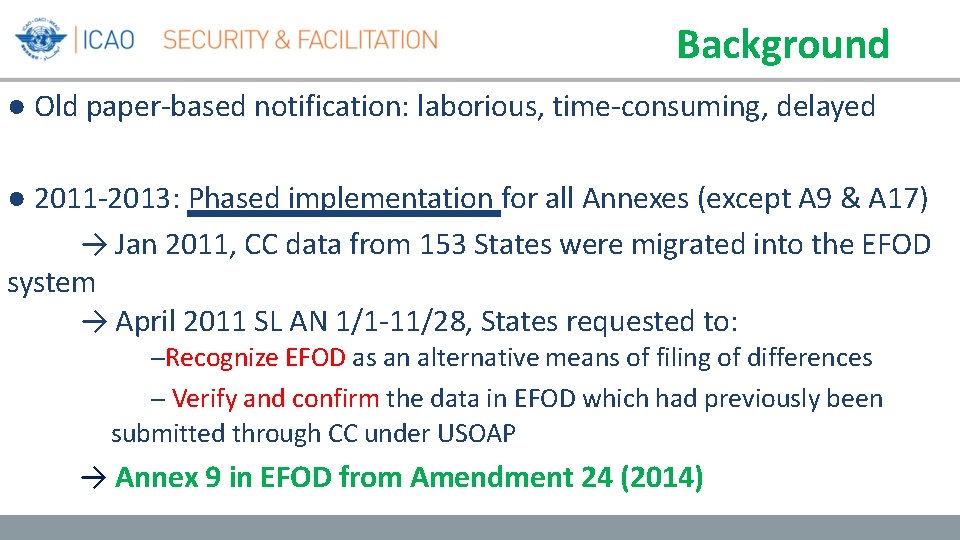
Background ● Old paper-based notification: laborious, time-consuming, delayed ● 2011 -2013: Phased implementation for all Annexes (except A 9 & A 17) → Jan 2011, CC data from 153 States were migrated into the EFOD system → April 2011 SL AN 1/1 -11/28, States requested to: ─Recognize EFOD as an alternative means of filing of differences ─ Verify and confirm the data in EFOD which had previously been submitted through CC under USOAP → Annex 9 in EFOD from Amendment 24 (2014)
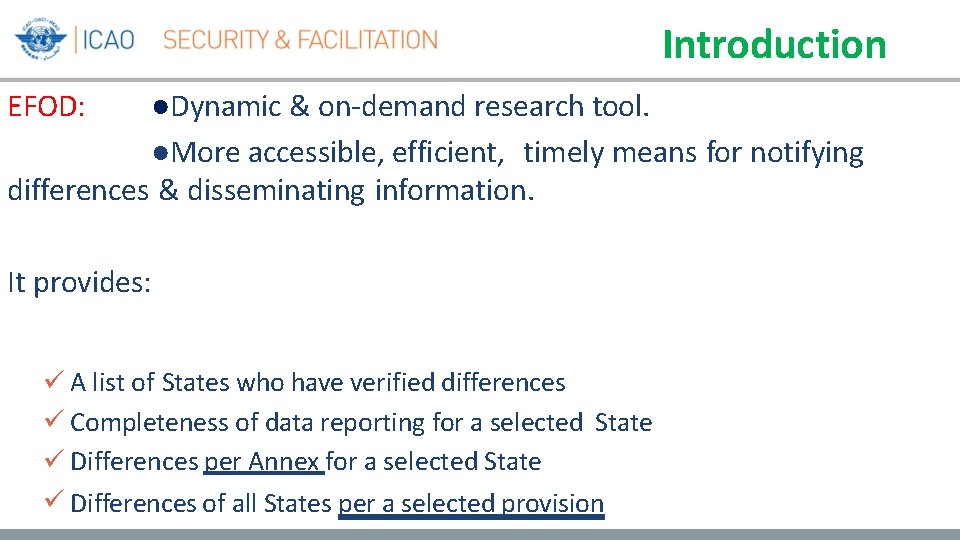
Introduction EFOD: ●Dynamic & on-demand research tool. ●More accessible, efficient, timely means for notifying differences & disseminating information. It provides: A list of States who have verified differences Completeness of data reporting for a selected State Differences per Annex for a selected State Differences of all States per a selected provision
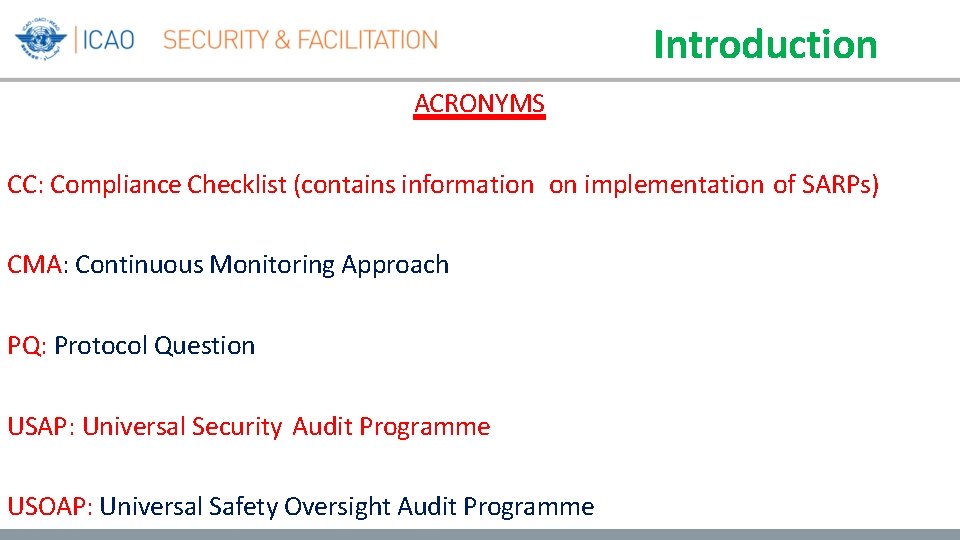
Introduction ACRONYMS CC: Compliance Checklist (contains information on implementation of SARPs) CMA: Continuous Monitoring Approach PQ: Protocol Question USAP: Universal Security Audit Programme USOAP: Universal Safety Oversight Audit Programme
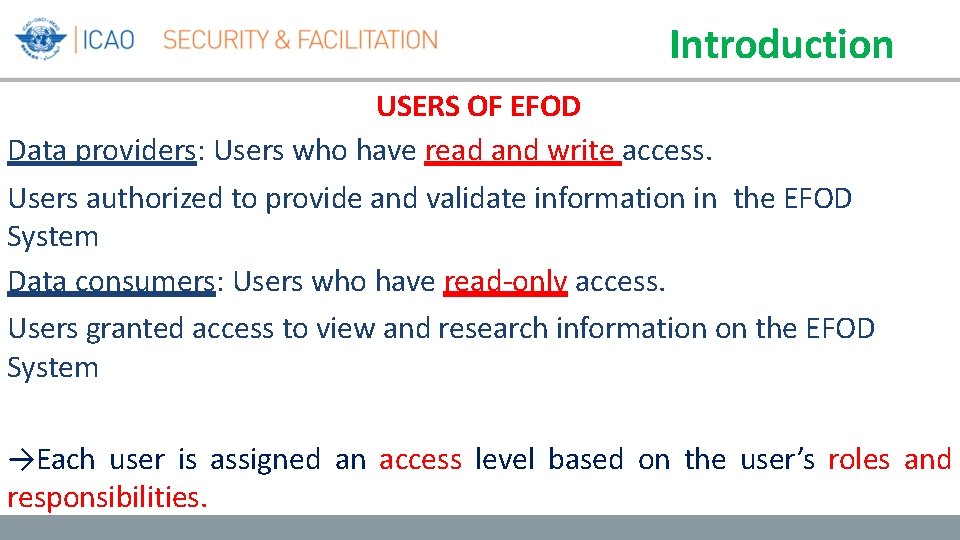
Introduction USERS OF EFOD Data providers: Users who have read and write access. Users authorized to provide and validate information in the EFOD System Data consumers: Users who have read-only access. Users granted access to view and research information on the EFOD System →Each user is assigned an access level based on the user’s roles and responsibilities.
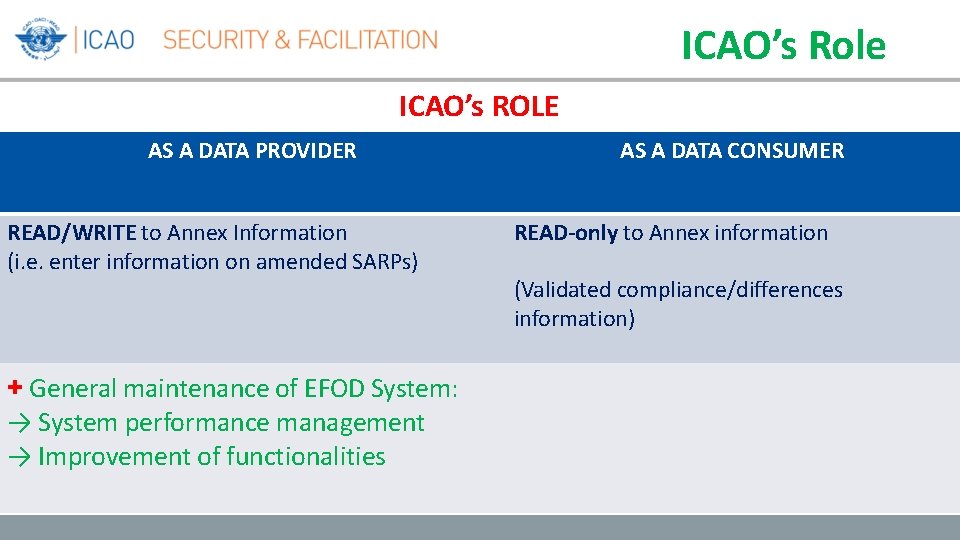
ICAO’s Role ICAO’s ROLE AS A DATA PROVIDER READ/WRITE to Annex Information (i. e. enter information on amended SARPs) + General maintenance of EFOD System: → System performance management → Improvement of functionalities AS A DATA CONSUMER READ-only to Annex information (Validated compliance/differences information)
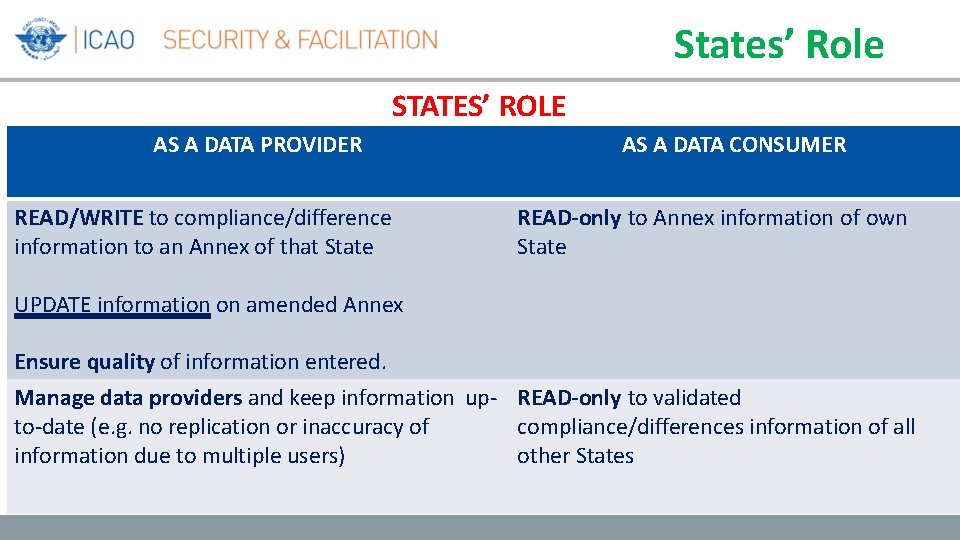
States’ Role STATES’ ROLE AS A DATA PROVIDER READ/WRITE to compliance/difference information to an Annex of that State AS A DATA CONSUMER READ-only to Annex information of own State UPDATE information on amended Annex Ensure quality of information entered. Manage data providers and keep information up- READ-only to validated compliance/differences information of all to-date (e. g. no replication or inaccuracy of other States information due to multiple users)
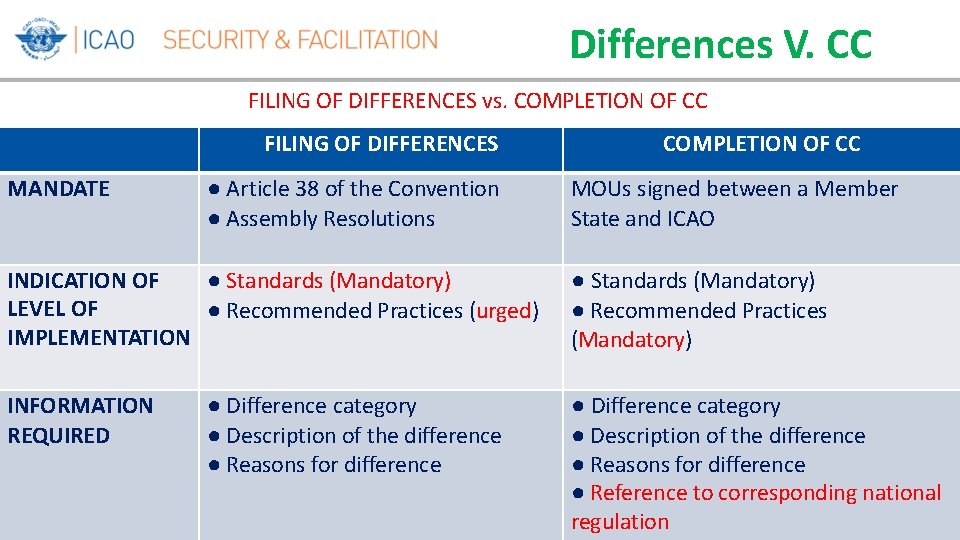
Differences V. CC FILING OF DIFFERENCES vs. COMPLETION OF CC FILING OF DIFFERENCES MANDATE ● Article 38 of the Convention ● Assembly Resolutions COMPLETION OF CC MOUs signed between a Member State and ICAO INDICATION OF ● Standards (Mandatory) LEVEL OF ● Recommended Practices (urged) IMPLEMENTATION ● Standards (Mandatory) ● Recommended Practices (Mandatory) INFORMATION REQUIRED ● Difference category ● Description of the difference ● Reasons for difference ● Reference to corresponding national regulation ● Difference category ● Description of the difference ● Reasons for difference
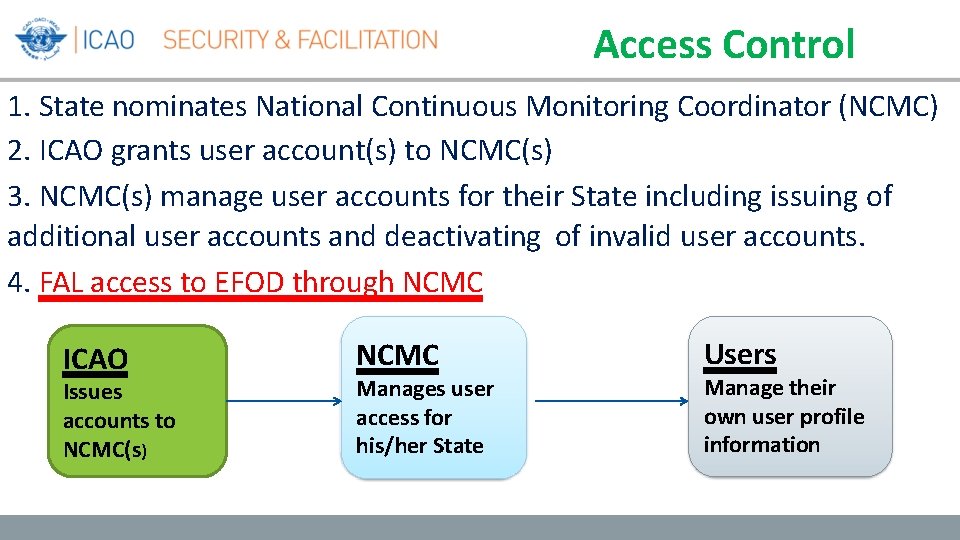
Access Control 1. State nominates National Continuous Monitoring Coordinator (NCMC) 2. ICAO grants user account(s) to NCMC(s) 3. NCMC(s) manage user accounts for their State including issuing of additional user accounts and deactivating of invalid user accounts. 4. FAL access to EFOD through NCMC ICAO Issues accounts to NCMC(s) NCMC Manages user access for his/her State Users Manage their own user profile information
. -- • . . . v I ICAO SECURI & TY FACILITATIO N THANK YOU! QUESTIONS?