Explanation More talk and chalk Greg Thornton History


- Slides: 12
Explanation More talk and chalk Greg Thornton – History Subject Leader
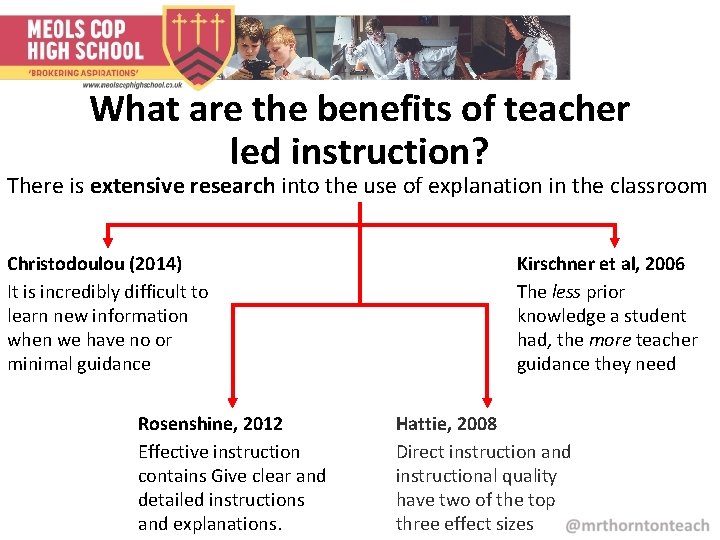
What are the benefits of teacher led instruction? There is extensive research into the use of explanation in the classroom Christodoulou (2014) It is incredibly difficult to learn new information when we have no or minimal guidance Rosenshine, 2012 Effective instruction contains Give clear and detailed instructions and explanations. Kirschner et al, 2006 The less prior knowledge a student had, the more teacher guidance they need Hattie, 2008 Direct instruction and instructional quality have two of the top three effect sizes
The Six Keys to Great Explanation 1. Strong subject knowledge 2. Credibility and Clarity 3. Concise design 4. Examples & Analogy 5. Storytelling 6. Chances to elaborate
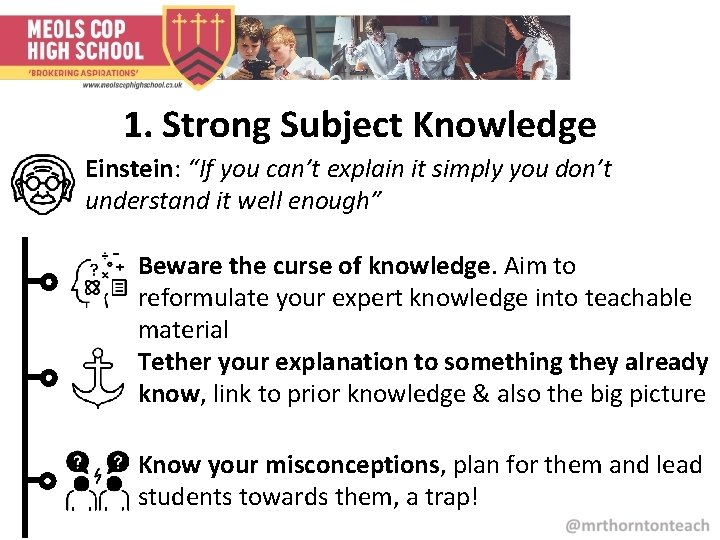
1. Strong Subject Knowledge Einstein: “If you can’t explain it simply you don’t understand it well enough” Beware the curse of knowledge. Aim to reformulate your expert knowledge into teachable material Tether your explanation to something they already know, link to prior knowledge & also the big picture Know your misconceptions, plan for them and lead students towards them, a trap!
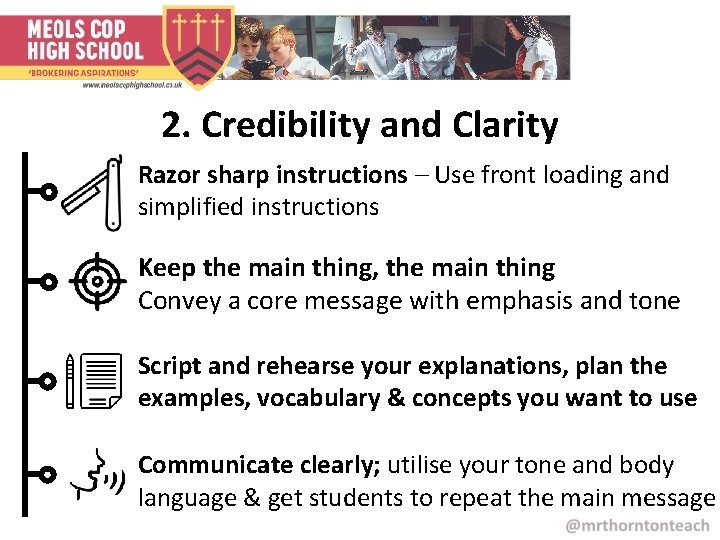
2. Credibility and Clarity Razor sharp instructions – Use front loading and simplified instructions Keep the main thing, the main thing Convey a core message with emphasis and tone Script and rehearse your explanations, plan the examples, vocabulary & concepts you want to use Communicate clearly; utilise your tone and body language & get students to repeat the main message
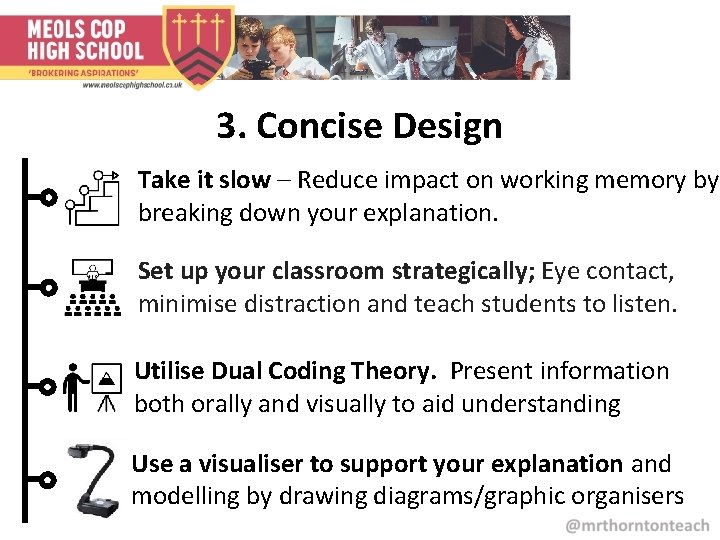
3. Concise Design Take it slow – Reduce impact on working memory by breaking down your explanation. Set up your classroom strategically; Eye contact, minimise distraction and teach students to listen. Utilise Dual Coding Theory. Present information both orally and visually to aid understanding Use a visualiser to support your explanation and modelling by drawing diagrams/graphic organisers
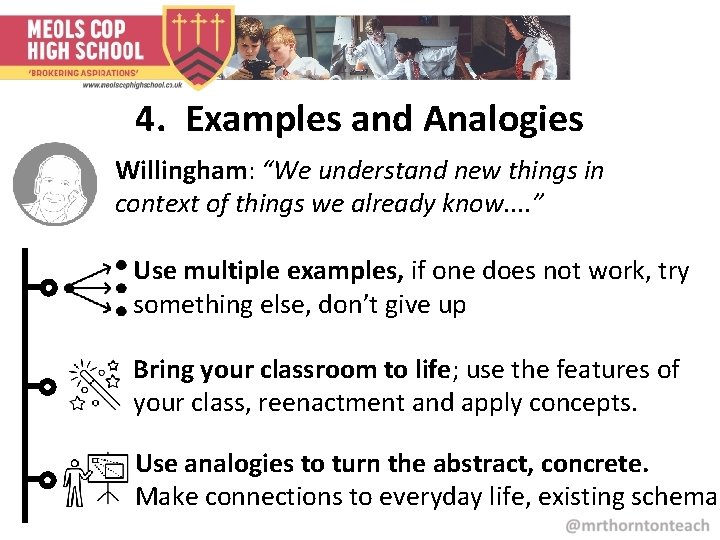
4. Examples and Analogies Willingham: “We understand new things in context of things we already know. . ” Use multiple examples, if one does not work, try something else, don’t give up Bring your classroom to life; use the features of your class, reenactment and apply concepts. Use analogies to turn the abstract, concrete. Make connections to everyday life, existing schema
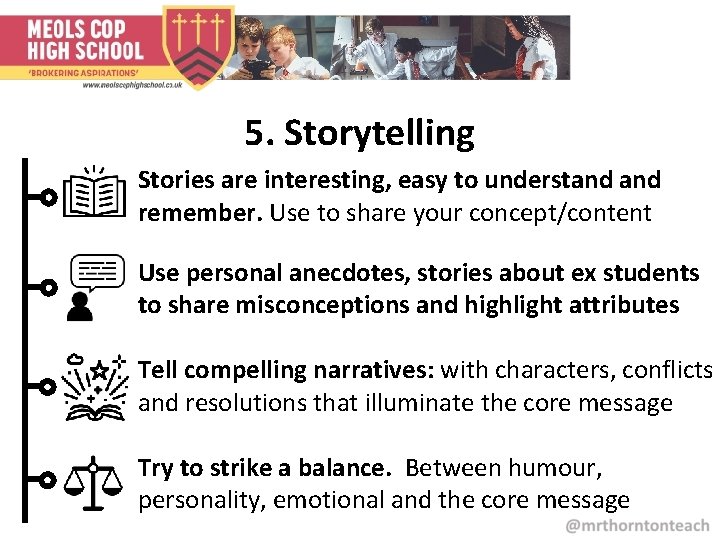
5. Storytelling Stories are interesting, easy to understand remember. Use to share your concept/content Use personal anecdotes, stories about ex students to share misconceptions and highlight attributes Tell compelling narratives: with characters, conflicts and resolutions that illuminate the core message Try to strike a balance. Between humour, personality, emotional and the core message
6. Chances to Elaborate Enser & Enser: ”Self explanation can be synthesizing the material with that they already know” Encourage students to visualise what they have learnt. This helps them to better understand recall the information. Use structured talk to get students to explain the ideas in their own words, thus allowing them time for self-explanation and the opportunity to apply the new ideas to their existing concrete knowledge.
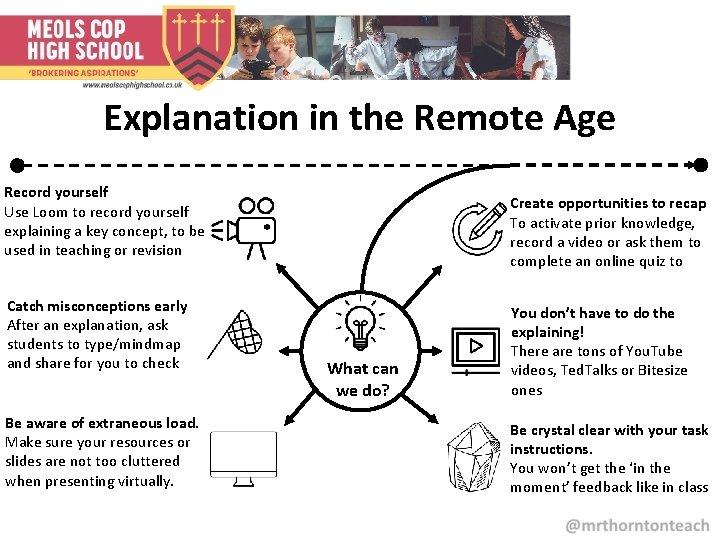
Explanation in the Remote Age Record yourself Use Loom to record yourself explaining a key concept, to be used in teaching or revision Catch misconceptions early After an explanation, ask students to type/mindmap and share for you to check Be aware of extraneous load. Make sure your resources or slides are not too cluttered when presenting virtually. Create opportunities to recap To activate prior knowledge, record a video or ask them to complete an online quiz to What can we do? You don’t have to do the explaining! There are tons of You. Tube videos, Ted. Talks or Bitesize ones Be crystal clear with your task instructions. You won’t get the ‘in the moment’ feedback like in class
Any questions?