EXERCISE ADHERENCE Matt Vaartstra University of Idaho Edited


- Slides: 30
EXERCISE ADHERENCE Matt Vaartstra University of Idaho Edited from: Damon Burton
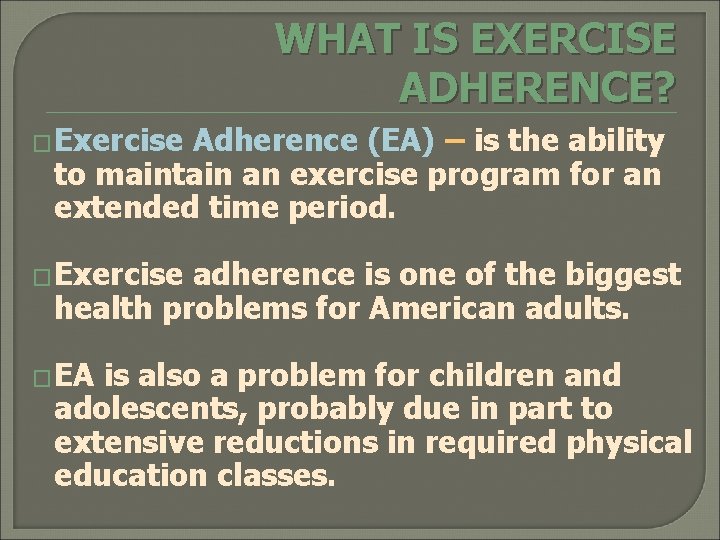
WHAT IS EXERCISE ADHERENCE? � Exercise Adherence (EA) – is the ability to maintain an exercise program for an extended time period. � Exercise adherence is one of the biggest health problems for American adults. � EA is also a problem for children and adolescents, probably due in part to extensive reductions in required physical education classes.
How big a problem is exercise adherence among American adults?
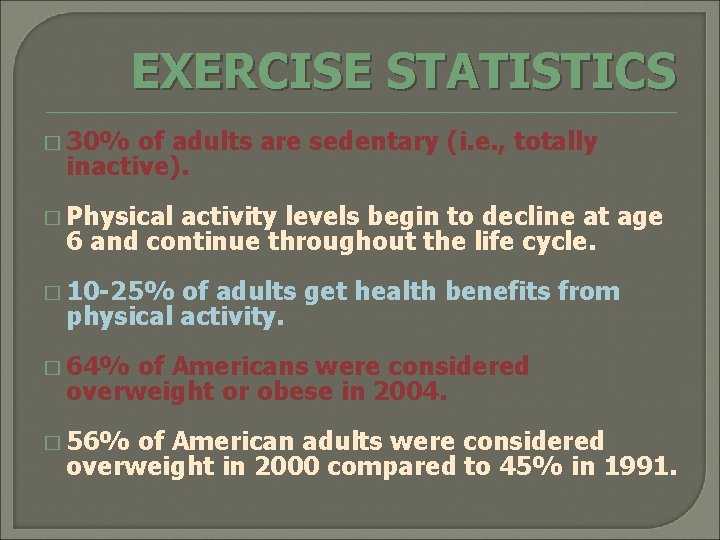
EXERCISE STATISTICS � 30% of adults are sedentary (i. e. , totally inactive). � Physical activity levels begin to decline at age 6 and continue throughout the life cycle. � 10 -25% of adults get health benefits from physical activity. � 64% of Americans were considered overweight or obese in 2004. � 56% of American adults were considered overweight in 2000 compared to 45% in 1991.
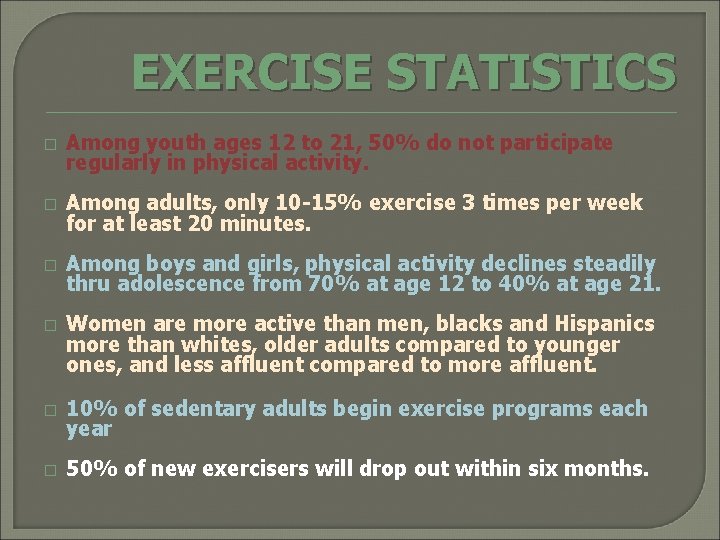
EXERCISE STATISTICS � Among youth ages 12 to 21, 50% do not participate regularly in physical activity. � Among adults, only 10 -15% exercise 3 times per week for at least 20 minutes. � Among boys and girls, physical activity declines steadily thru adolescence from 70% at age 12 to 40% at age 21. � Women are more active than men, blacks and Hispanics more than whites, older adults compared to younger ones, and less affluent compared to more affluent. � 10% of sedentary adults begin exercise programs each year � 50% of new exercisers will drop out within six months.
What are the major reasons why adults exercise?
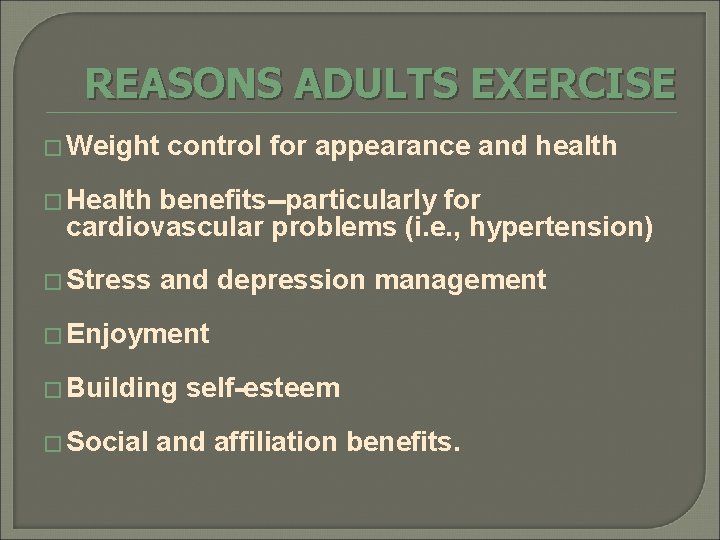
REASONS ADULTS EXERCISE � Weight control for appearance and health � Health benefits--particularly for cardiovascular problems (i. e. , hypertension) � Stress and depression management � Enjoyment � Building � Social self-esteem and affiliation benefits.
Do the reasons adults start an exercise program differ from the reasons that they continue to exercise?
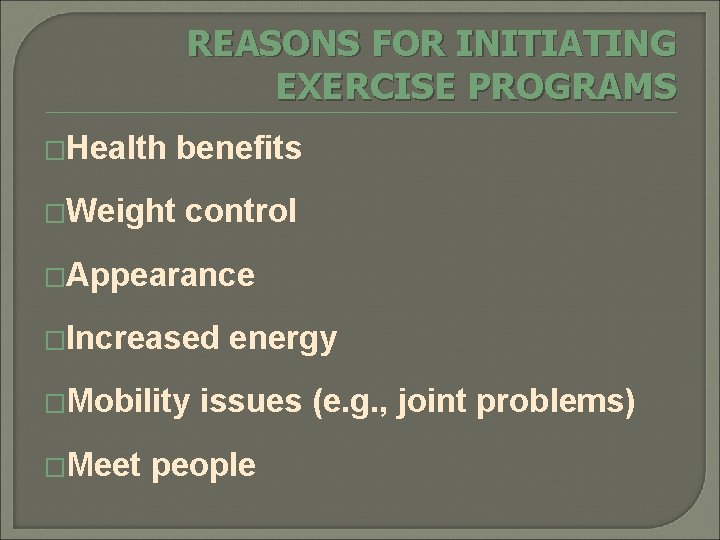
REASONS FOR INITIATING EXERCISE PROGRAMS �Health benefits �Weight control �Appearance �Increased �Mobility �Meet energy issues (e. g. , joint problems) people
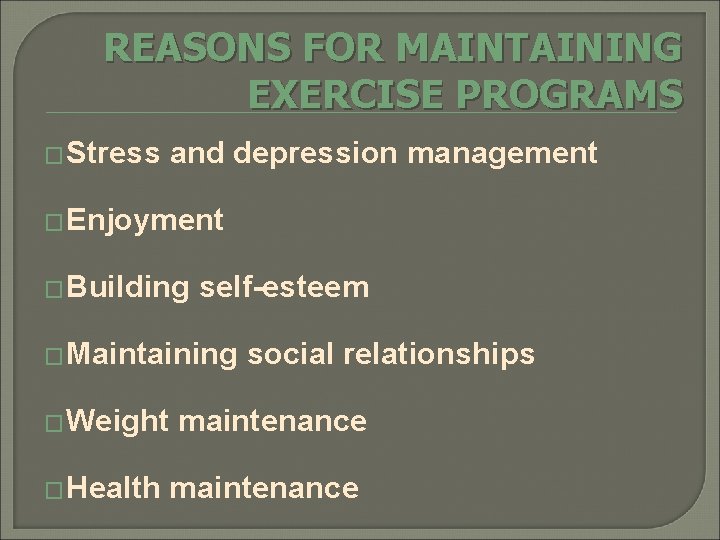
REASONS FOR MAINTAINING EXERCISE PROGRAMS � Stress and depression management � Enjoyment � Building self-esteem � Maintaining � Weight � Health social relationships maintenance
What are the common excuses for not exercising?
EXERCISE BARRIERS � Lack of time � Lack of energy � Lack of motivation
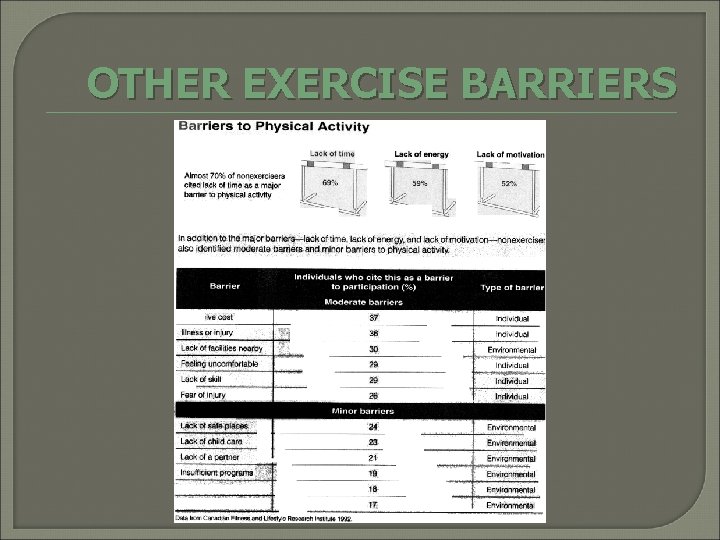
OTHER EXERCISE BARRIERS
OTHER EXERCISE BARRIERS • Social support barriers • Health and fitness barriers • Other commitments • Resource barriers • Programming barriers
TRANSTHEORETICAL MODEL OF BEHAVIOR CHANGE � TTM proposes that behavior change involves movement through stages of change. � The term “transtheoretical” describes a broad framework that includes both (a) when (stages) and (b) how behavior changes. � Cognitive change processes (e. g. , knowledge of sedentary risk) peak in the action state whereas behavior processes (e. g. , social support) are most critical in the maintenance stage. � Matching strategies to current stage of change seems to be a effective intervention strategy. � EA relapse typically increases in probability when a major “life change” occurs. � Self-monitoring and tweaking of EA programs is necessary to prevent relapse.
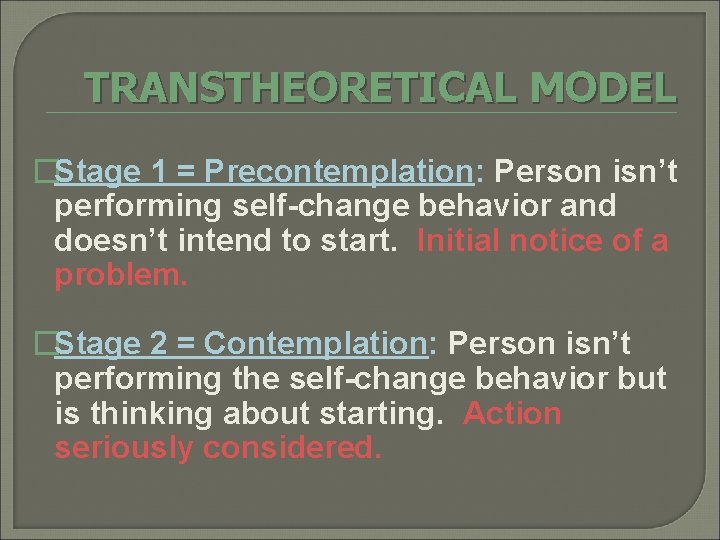
TRANSTHEORETICAL MODEL �Stage 1 = Precontemplation: Person isn’t performing self-change behavior and doesn’t intend to start. Initial notice of a problem. �Stage 2 = Contemplation: Person isn’t performing the self-change behavior but is thinking about starting. Action seriously considered.
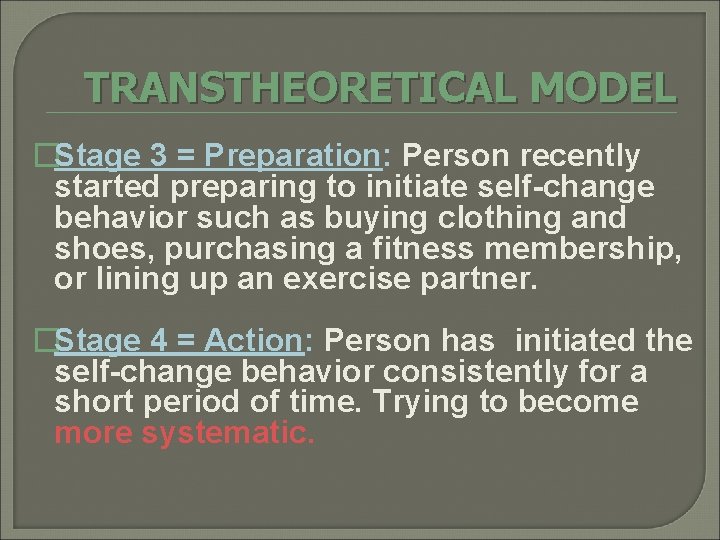
TRANSTHEORETICAL MODEL �Stage 3 = Preparation: Person recently started preparing to initiate self-change behavior such as buying clothing and shoes, purchasing a fitness membership, or lining up an exercise partner. �Stage 4 = Action: Person has initiated the self-change behavior consistently for a short period of time. Trying to become more systematic.
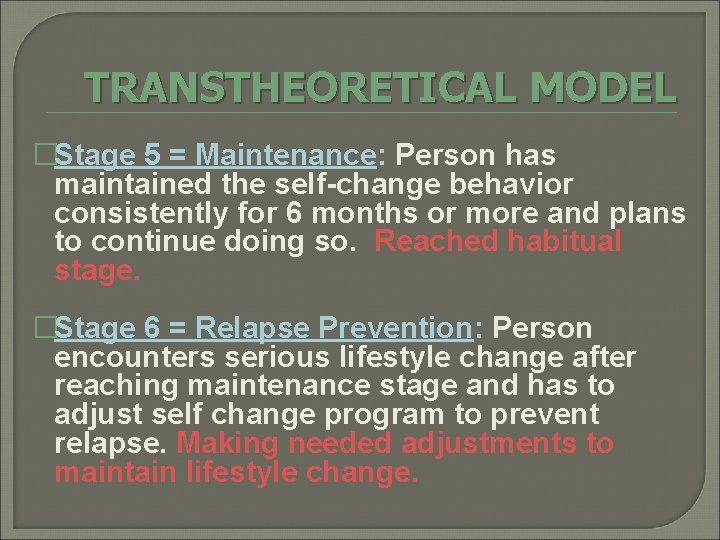
TRANSTHEORETICAL MODEL �Stage 5 = Maintenance: Person has maintained the self-change behavior consistently for 6 months or more and plans to continue doing so. Reached habitual stage. �Stage 6 = Relapse Prevention: Person encounters serious lifestyle change after reaching maintenance stage and has to adjust self change program to prevent relapse. Making needed adjustments to maintain lifestyle change.
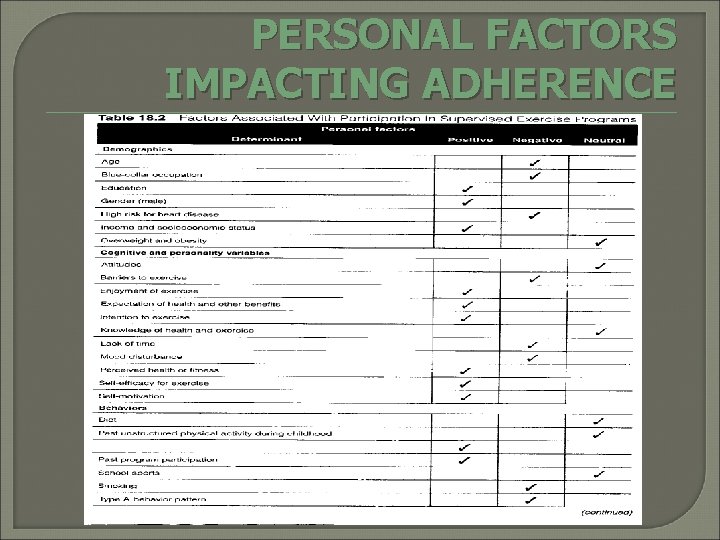
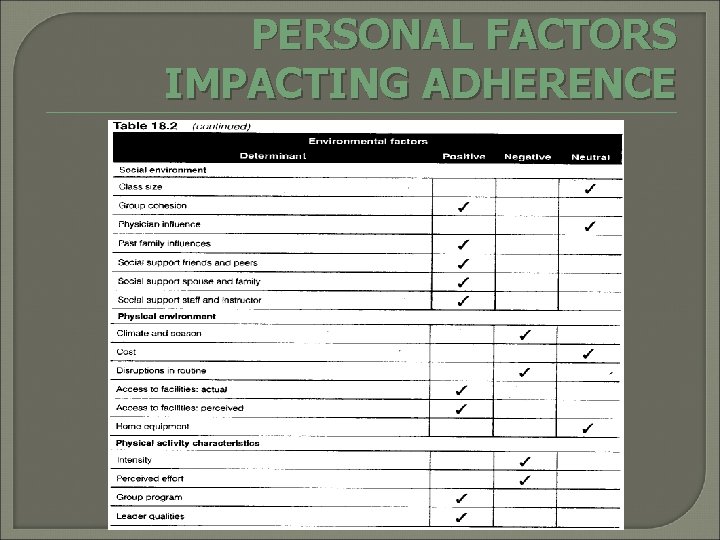
FACTORS IMPACTING EXERCISE ADHERENCE • Personal factors • Environmental factors
PERSONAL FACTORS IMPACTING ADHERENCE
PERSONAL FACTORS IMPACTING ADHERENCE
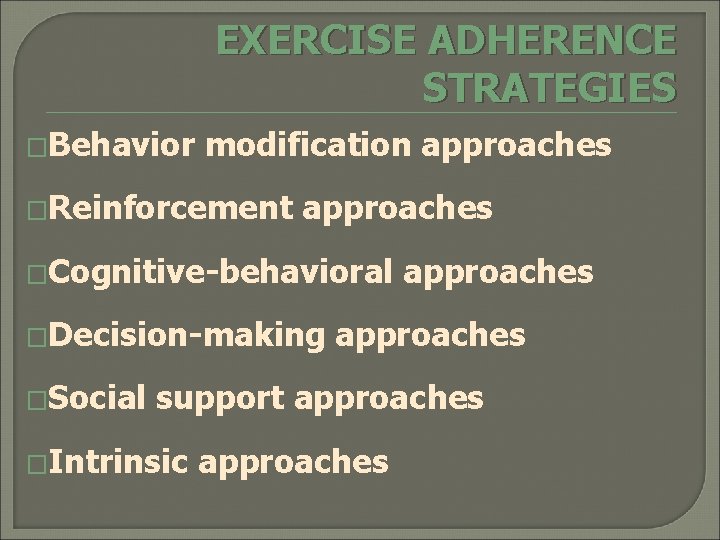
EXERCISE ADHERENCE STRATEGIES �Behavior modification approaches �Reinforcement approaches �Cognitive-behavioral �Decision-making �Social approaches support approaches �Intrinsic approaches
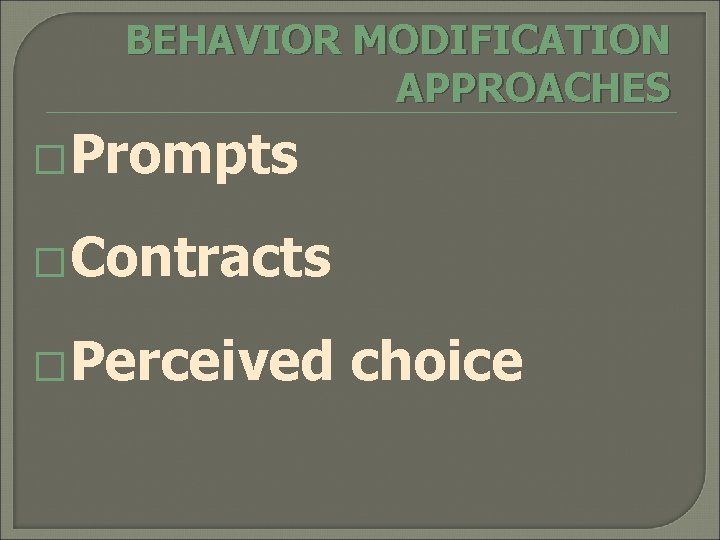
BEHAVIOR MODIFICATION APPROACHES �Prompts �Contracts �Perceived choice
REINFORCEMENT APPROACHES �Charting attendance and participation �Rewarding attendance and participation �Feedback and testing
COGNITIVE-BEHAVIORAL APPROACHES �Goals �Self talk �Thought focus strategies • association • dissociation
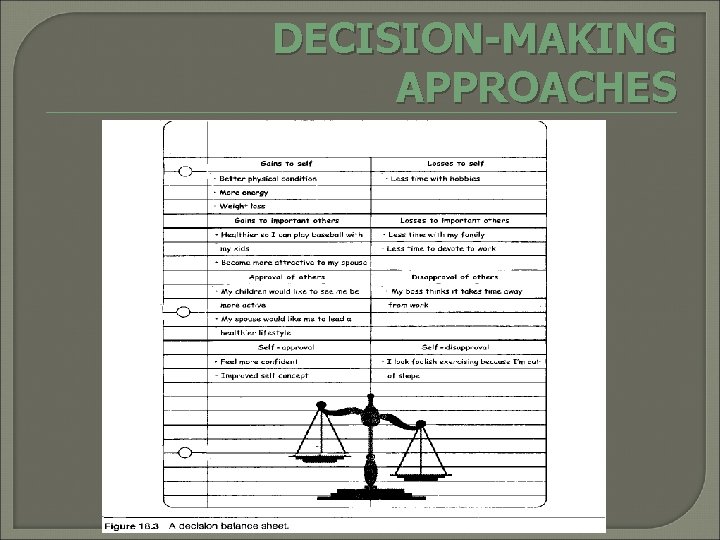
DECISION-MAKING APPROACHES
SOCIAL SUPPORT APPROACHES �Social support from partner, group or class �Know need �Must where to go for what you trust and respect person to go to them for support
INTRINSIC APPROACHES �Focus on the experience �Focus on the process �Engage activity in meaningful physical
BEST EXERCISE ADHERENCE STRATEGIES 1. Make exercise fun and enjoyable 2. Tailor exercise frequency, duration and intensity to the exerciser 3. Promote group exercise 4. Keep daily exercise logs 5. Reinforce success 6. Find a convenient place to exercise
The End