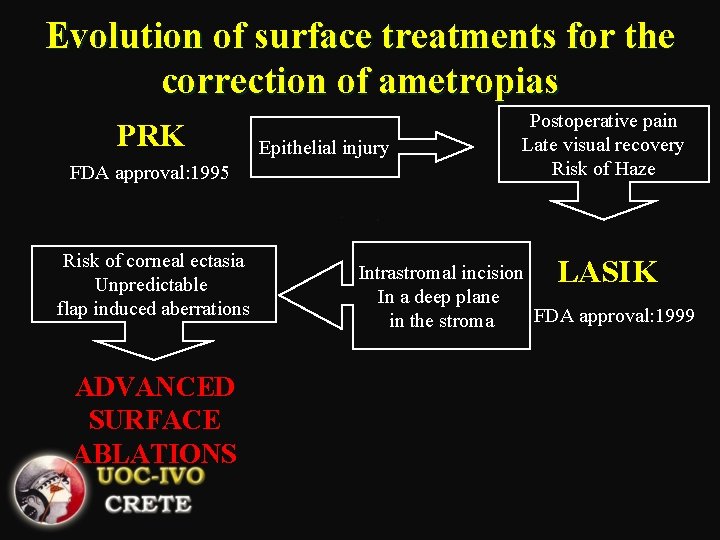
Evolution of surface treatments for the correction of
- Slides: 10
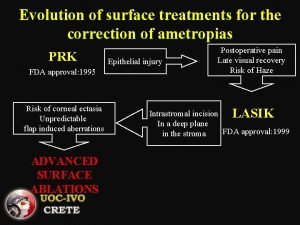
Evolution of surface treatments for the correction of ametropias PRK FDA approval: 1995 Risk of corneal ectasia Unpredictable flap induced aberrations ADVANCED SURFACE ABLATIONS Epithelial injury Postoperative pain Late visual recovery Risk of Haze LASIK Intrastromal incision In a deep plane FDA approval: 1999 in the stroma
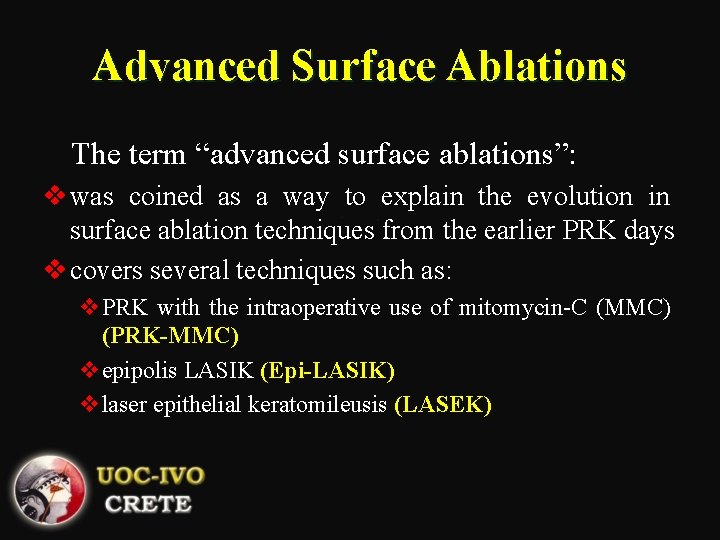
Advanced Surface Ablations The term “advanced surface ablations”: v was coined as a way to explain the evolution in surface ablation techniques from the earlier PRK days v covers several techniques such as: v. PRK with the intraoperative use of mitomycin-C (MMC) (PRK-MMC) vepipolis LASIK (Epi-LASIK) vlaser epithelial keratomileusis (LASEK)
Advanced Surface Ablations Advanced surface ablation techniques offer several advantages over conventional PRK such as: vincreased quality of vision vreduced postoperative pain vminimized corneal haze
Advanced Surface Ablations Reasons for selecting a surface treatment: v Thin corneas for attempted correction (residual bed thickness < 300μm) v Preoperative Dry Eye v Epithelial basement membrane dystrophies v Flat or steep corneas v No risk of flap-related complications v No risk of flap-induced aberrations
Epithelial Removal The epithelium can be removed with several ways: v. Mechanical removal of the epithelium with a blade or newly a rotating brush v. Epithelial removal with the use of alcohol (LASEK) v. Epi-LASIK v. Epithelial removal with the laser (transepithelial)
Evolution of Advanced Surface Ablations (I) v. Introduction of MMC for the control of corneal haze: v. Therapeutic use globally accepted (selected complicated cases) v. Intraoperative prophylactic use after PRK (PRK-MMC)
Evolution of Advanced Surface Ablations (II) v. Introduction to the retained epithelial flaps (LASEK, Epi-LASIK): v. Allow for decreased incidence of haze v. Offer with better tolerance of patients v. Mechanical epithelial separation provides with the benefit of avoiding alcohol toxicity
PRK-MMC v 0. 02% for up to 1. 5 min depending on the attempted correction (delay in epithelial healing at 2 min) v Reduction of myofibroblast activity / haze (compared to corticosteroids) v Faster visual recovery and confocal microscopic normalization v Safety up to about 10 yrs max experience
LASEK v A dilute solution (20%) is used on the eye in a holding cup (8. 5 mm diameter) for approximately 30 seconds in order to loosen the epithelium and creates a complete epithelial flap v After the loosened epithelium is slid to the side and the stromal surface is treated with the laser v The epithelium is replaced or can be directly removed
Epi-LASIK v Surface ablation (epi-polis superficial) v Epithelium is separated as a sheet and replaced on the ablated stroma v Special device (Epikeratome) - automated procedure v No use of alcohol v Dealing with drawbacks of PRK (postoperative pain/ discomfort, late visual recovery, haze) and avoiding risks of LASIK v Suitable for thin corneas