Even More on Mosquitoes Final Words on Malaria
- Slides: 20
Even More on Mosquitoes: Final Words on Malaria, Filariasis and Yellow Fever Announcements No Quiz Today – Next Tuesday About Nov. 12 … Talking today: Sarah and Natalie On Deck: Charity
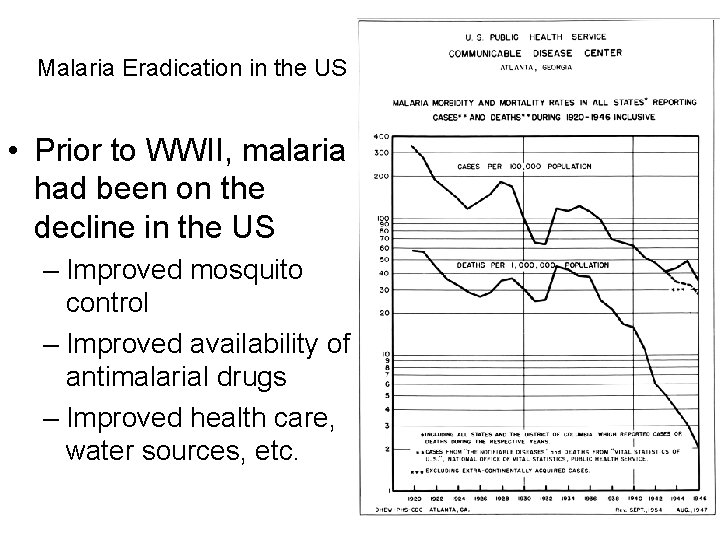
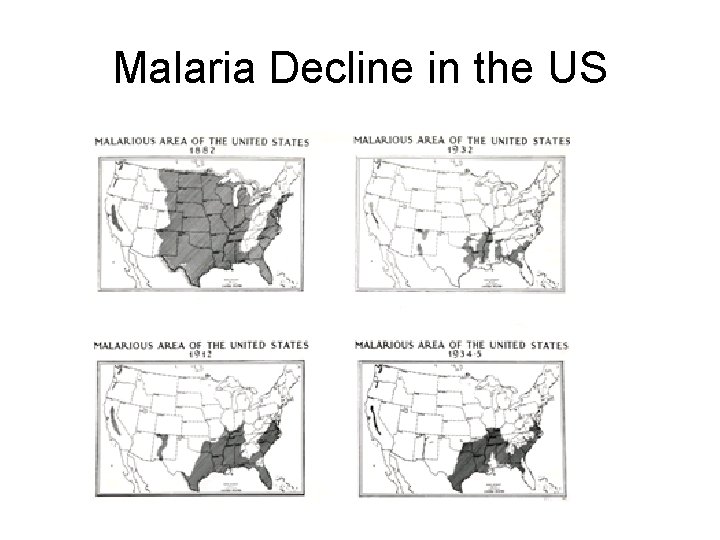
Malaria Eradication in the US • Prior to WWII, malaria had been on the decline in the US – Improved mosquito control – Improved availability of antimalarial drugs – Improved health care, water sources, etc.
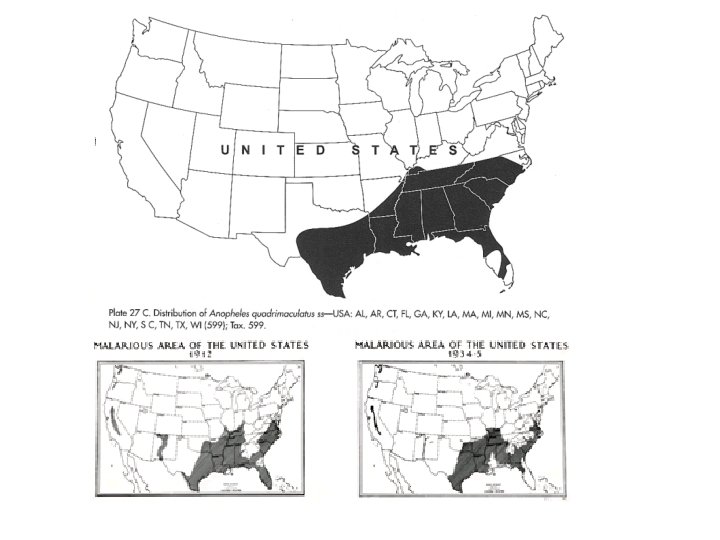
Malaria Decline in the US
Malaria Eradication in the US • After WWII, spraying base housing at Ft. Campbell eliminated malaria from the base • National Malaria Eradication Program began July 1, 1947 • Based on DDT application to the interior surfaces of rural homes in malaria locales • Nearly 5 million homes treated in first 2 years • Program ended in 1952
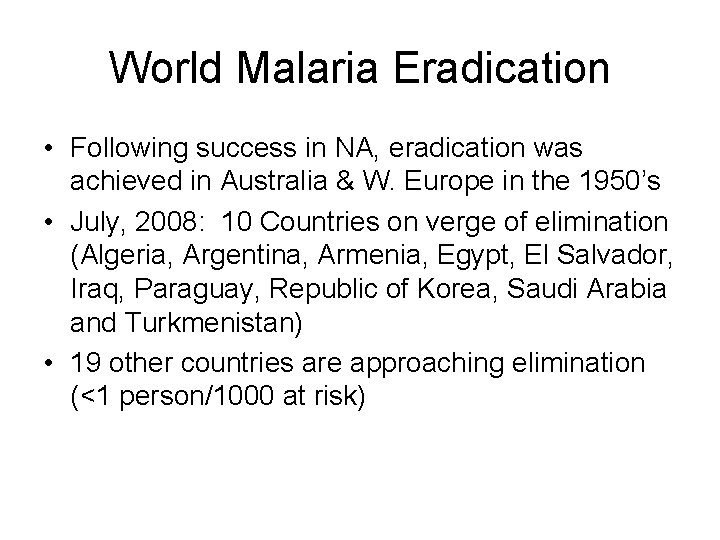
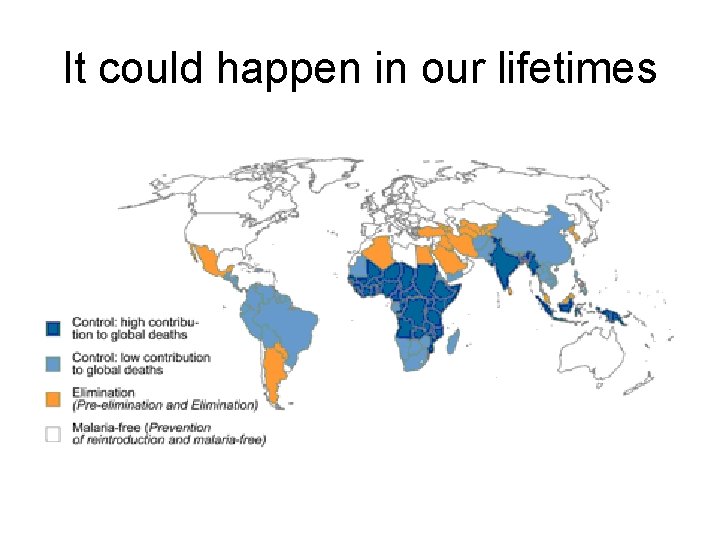
World Malaria Eradication • Following success in NA, eradication was achieved in Australia & W. Europe in the 1950’s • July, 2008: 10 Countries on verge of elimination (Algeria, Argentina, Armenia, Egypt, El Salvador, Iraq, Paraguay, Republic of Korea, Saudi Arabia and Turkmenistan) • 19 other countries are approaching elimination (<1 person/1000 at risk)
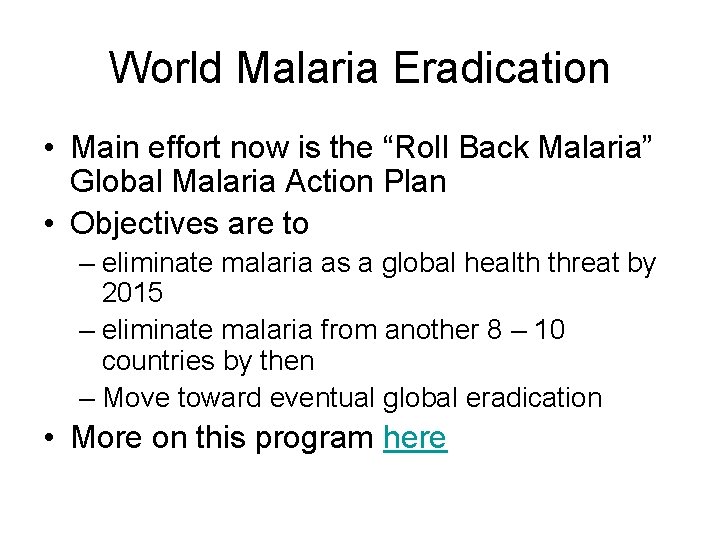
World Malaria Eradication • Main effort now is the “Roll Back Malaria” Global Malaria Action Plan • Objectives are to – eliminate malaria as a global health threat by 2015 – eliminate malaria from another 8 – 10 countries by then – Move toward eventual global eradication • More on this program here
It could happen in our lifetimes
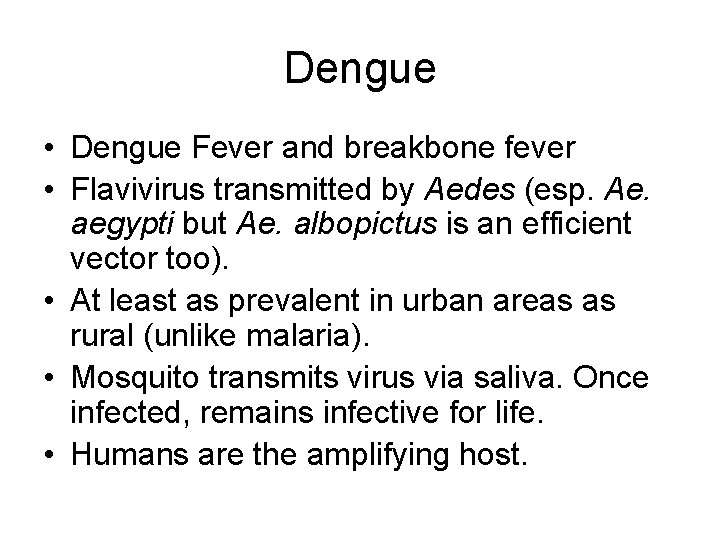
Dengue • Dengue Fever and breakbone fever • Flavivirus transmitted by Aedes (esp. Ae. aegypti but Ae. albopictus is an efficient vector too). • At least as prevalent in urban areas as rural (unlike malaria). • Mosquito transmits virus via saliva. Once infected, remains infective for life. • Humans are the amplifying host.
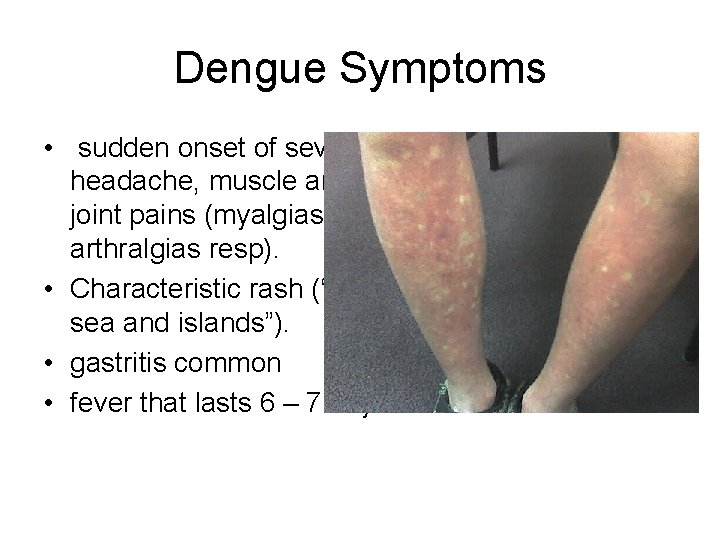
Dengue Symptoms • sudden onset of severe headache, muscle and joint pains (myalgias and arthralgias resp). • Characteristic rash (“red sea and islands”). • gastritis common • fever that lasts 6 – 7 days
Accute Symptoms • Dengue Hemorrhagic Fever (DHF) – – widespread hemorrhage thrombocytopenia (few platelets in blood) haemoconcentration via plasma reduction hepatocellular carcinoma and cirrhosis common 1 – 3 years post-DHF • Dengue Shock Syndrome (case mortality 20%): All of the above PLUS – Weak rapid pulse, – Narrow pulse pressure (less than 20 mm Hg) – Cold, clammy skin and restlessness.
All three types of Dengue Fever caused by one of four viral serotypes • DEN-1, DEN-2, DEN-3, DEN-4 • Relationship between these, the vector, and the disease is not clear. • In an epidemic, usually one is dominant. The dominant serotype varies by location and year. • If you catch one and survive, you are immune to it. But … • Prior immunity to one increases susceptibility to others (and the probability of DHF or DSS reaction). • This has complicated the development of a vaccine.
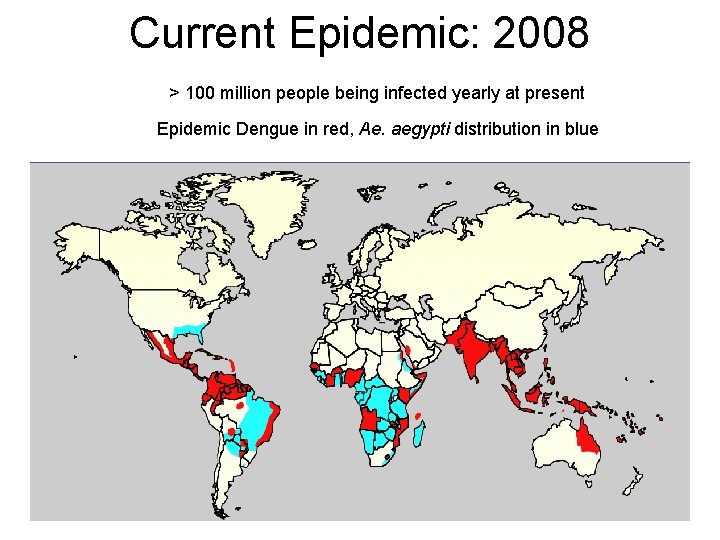
Current Epidemic: 2008 > 100 million people being infected yearly at present Epidemic Dengue in red, Ae. aegypti distribution in blue
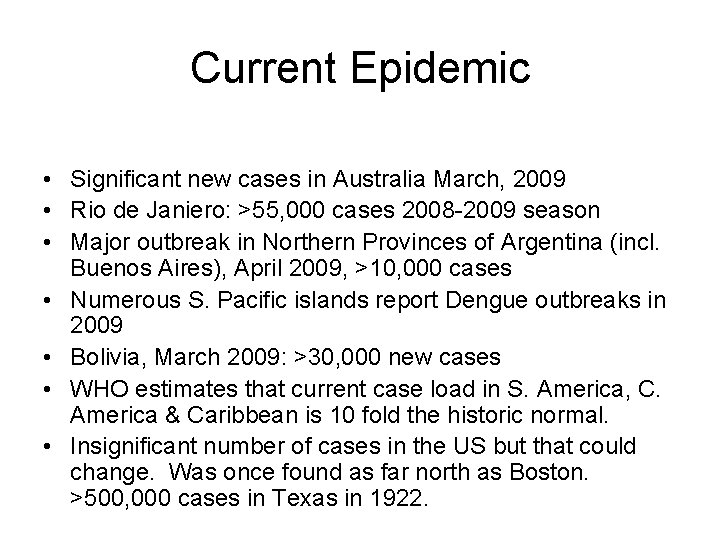
Current Epidemic • Significant new cases in Australia March, 2009 • Rio de Janiero: >55, 000 cases 2008 -2009 season • Major outbreak in Northern Provinces of Argentina (incl. Buenos Aires), April 2009, >10, 000 cases • Numerous S. Pacific islands report Dengue outbreaks in 2009 • Bolivia, March 2009: >30, 000 new cases • WHO estimates that current case load in S. America, C. America & Caribbean is 10 fold the historic normal. • Insignificant number of cases in the US but that could change. Was once found as far north as Boston. >500, 000 cases in Texas in 1922.
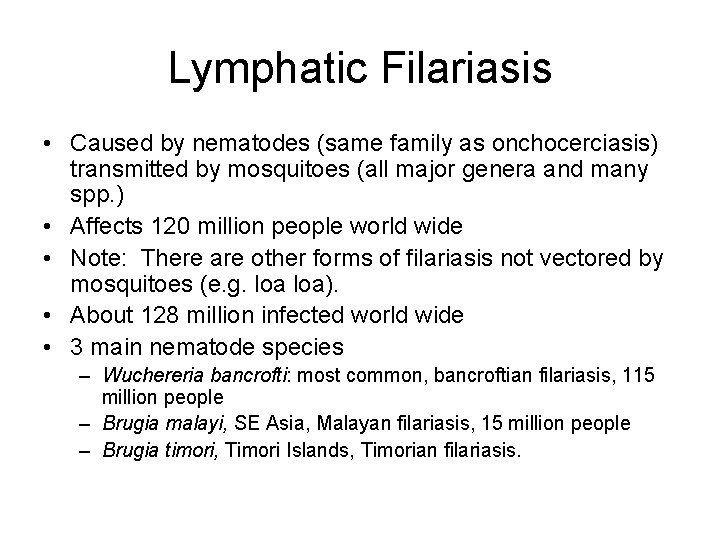
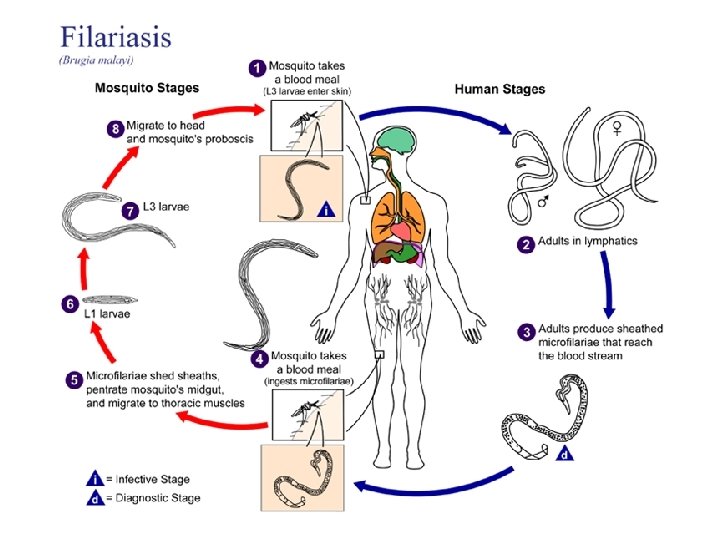
Lymphatic Filariasis • Caused by nematodes (same family as onchocerciasis) transmitted by mosquitoes (all major genera and many spp. ) • Affects 120 million people world wide • Note: There are other forms of filariasis not vectored by mosquitoes (e. g. loa). • About 128 million infected world wide • 3 main nematode species – Wuchereria bancrofti: most common, bancroftian filariasis, 115 million people – Brugia malayi, SE Asia, Malayan filariasis, 15 million people – Brugia timori, Timori Islands, Timorian filariasis.
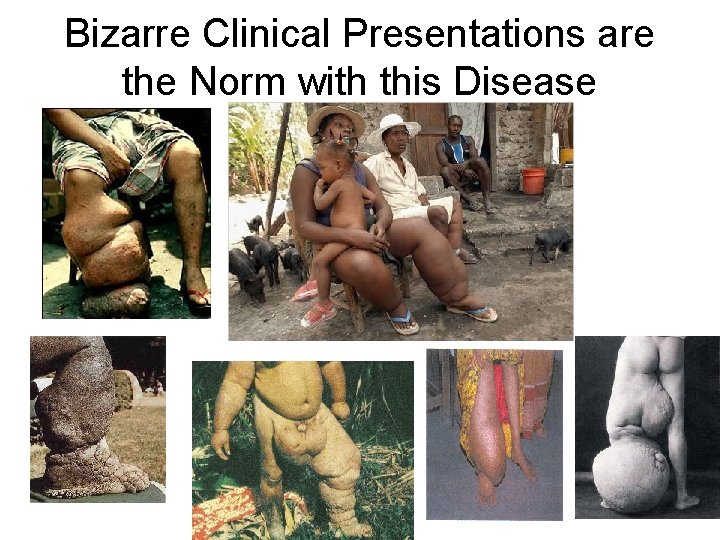
Bizarre Clinical Presentations are the Norm with this Disease
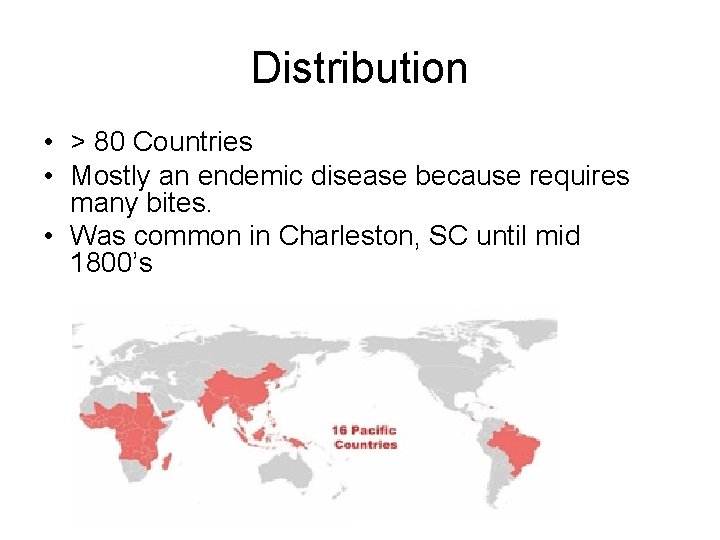
Distribution • > 80 Countries • Mostly an endemic disease because requires many bites. • Was common in Charleston, SC until mid 1800’s
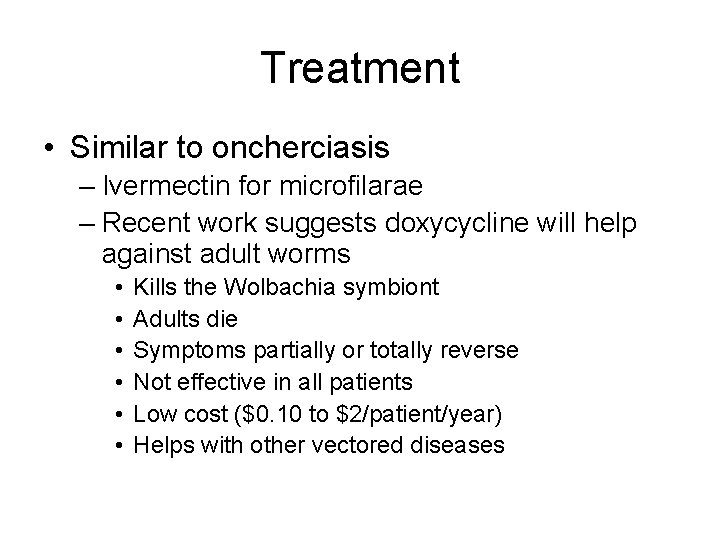
Treatment • Similar to oncherciasis – Ivermectin for microfilarae – Recent work suggests doxycycline will help against adult worms • • • Kills the Wolbachia symbiont Adults die Symptoms partially or totally reverse Not effective in all patients Low cost ($0. 10 to $2/patient/year) Helps with other vectored diseases
Yellow Fever • • Historically second only to malaria but now lags dengue. Potential for catastrophic outbreaks persists. Like Dengue, a Flavivirus Called “Yellow Fever” because of the jaundice that it often creates • First arbovirus (arthropod borne virus) associated with human disease. – Carlos Finlay, Cuban physician, first suggested the connection between mosquitoes and yellow fever – Walter Reed conducted human experiments with US soldier volunteers to confirm the connection. – Reed’s discovery enabled the US to complete the Panama Canal where the French could not.