Ethical Education WORLD RELIGIONS Strange potency this thing
- Slides: 18
Ethical Education WORLD RELIGIONS
"Strange potency, this thing we call Religion! It came into man's world untold centuries ago, and it is still in man's world today. It is still there, deep and tremendous: a mighty draught for a mightier thirst, a vast richness to fill a vaster need. No matter where one turns in time or space, there it is inescapably. Wherever there is a man, there seems to be also a spirit or a god; wherever there is human life, there is also faith. . . "One wonders about it. What is it, this thing we call Religion? Whence did it come? And why? And how? . . . What was it yesterday? What is it today? -- And what will it become tomorrow? . . . " - Lewis Browne
WHAT DOES RELIGION MEAN? v All religions begin with a human reflective experience of the holy v. What is the meaning of life? v. Beyond rational/ethical conceptions v. Experience of mystery, the sense of Otherness, the acceptance that there is a reality that transcends the level of ordinary experience. v. Rooted in the primal traditions v. Religion dates back as far as 50, 000 BCE, and emerges from the traditions of tribal people who depended on the land on the forces of nature.
v. Religion is a social-cultural system that relates humanity to supernatural, transcendental, or spiritual elements. v. No scholarly consensus over what precisely constitutes a religion v. May contain various elements v. Deity or Deities v. Prophets that connect to the deity v. Sacred histories/narratives: that lead to sacred texts, symbolic stories, holy places, rituals, festivals, symbols v. Code of Conduct v. Connecting people in faith in an organised way v. Always based on community: How to live together v. Always connected to human culture v. There an estimated 10, 000 distinct religions worldwide v 84% of the world's population is affiliated with one of the five largest religious groups: Christianity, Islam, Hinduism, Buddhism, Judaism
THE EVOLUTION OF RELIGION v sociologists and anthropologists proposed various theories on how religion began and the stages of its development. v. The earliest religions started with ANIMISM (lat. Anima: breath/soul) vthe belief in spiritual beings. Nature (trees, mountains and sky) have souls and consciousnes vpeople have spirits that do/can exist separately from their bodies. vspiritual essence, that is souls or spirits exist, not only in humans but also in animals, plants, inanimate objects like rocks, geographical features such as mountains and rivers, phenomena of the natural environment including wind, thunder, lightning and even shadow. v. POLYTHEISM (greek: many gods) the worship of or belief in more than one god v. Examples: Hinduism (India), ancient Egyptian religion, Greek mythology, Celtic mythology v. MONOTHEISM (greek: one god) is the belief in a single or one god. Examples are Judaism, Christianity and Islam
The Story of God –With Morgan Freeman • https: //www. youtube. co m/watch? v=l 9 PEMc_n. Xu Q&frags=pl%2 Cwn
5 MAJOR WORLD RELIGIONS 1. Hinduism 2. Buddhism 3. Judaism 4. Christianity 5. Islam
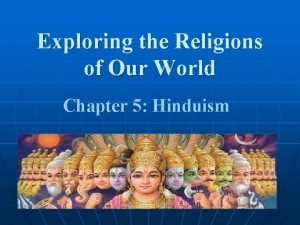
WHAT IS HINDUISM? v Hindus follow the religion of Hinduism. It is one of the oldest of the world’s major religions and is almost 4, 000 years old. Hinduism originated in India. v The Vedas are a collection of hymns written between 1500 and 700 BC that form the basis of Hinduism. v Hindus believe that the universe was created by one God, Brahman takes many forms or incarna- tions. The three main forms are called the Trimurti: Brahma, Vishnu and Shiva. Brahma is the creator, Vishnu the preserver and Shiva the destroyer. v 5 Vedas are written in Sanskrit. v Hindus worship many gods depending on their family and background. Most Hindus have a shrine in their home where they can worship (puja) individually or with their family. Hindus can also worship in a mandir (temple) where they are led by priests and teachers known as Brahmins.
WHAT IS BUDDHISM? v Buddhism is an important religion in many Asian countries such as China, Thailand Japan. It is followed by about 350 million people around the world. v Prince Siddhartha Gautama founded it about 2, 500 years ago in Northern India (near what is now Nepal). v When Prince Siddhartha Gautama achieved enlightenment he was known as the Buddha. v The sacred book of Buddhism is called the Tipitaka and is written in an ancient Indian language called. Pali. v Buddhists do not believe in a creator god. Buddhists believe in samsara, a continuous cycle of birth, life, death and rebirth. People have many lives until they gain enough wisdom to get to a very happy state of being called nirvana. Nirvana is a state of perfect peace, free from suffering. v Buddhists visit temples or shrines to pay respect to Buddha and to meditate. This is often led by Buddhist monks. One of the most important Buddhist festivals is Vesak, a celebration of Buddha’s birth. It takes place in late May or early June at the full moon.
WHAT IS JUDAISM? v Judaism is one of the oldest religions with one God (Yaweh) and it has over 13 million follow- ers. v It began in the Middle East nearly 4, 000 years ago. v The Torah is the holy book of the Jewish faith. v The most important day of the week is the Sabbath (Shabbat in Hebrew), a day when no work should be done. The Sabbath starts at sunset on Friday and continues until sunset on Saturday to remember the seventh day of creation on which God rested. v Jewish people worship in synagogues and their spiritual leaders are called rabbis
WHAT IS CHRISTIANITY? v Christianity is over 2, 000 years old and is one of the world’s largest religions. v There are more than two billion Christians in the world. v Christianity originated in Roman-occupied Judea (an area that is now part of Israel). v Christians believe that Jesus Christ was the son of God and a teacher who performed miracles and preached kindness, generosity and forgiveness. v The. Bible is the holy book of the Christian faith. It contains the Old Hebrew Bible and the Christian Bible. v The most important day of the week is Sunday, a day when no work should be done. v Christians worship in churches and their leaders are called priests or ministers
WHAT IS ISLAM? v Muslims follow the religion of Islam. A Muslim is someone who submits to the will of Allah(God). v Muslims follow the five basic duties reflected in the Five Pillars of Islam. v Islam originated over 1, 300 years ago in modern-day Saudi Arabia. v The Qur'an (Koran) is the holy book of the Islamic faith. It is believed to be a record of the exact words that Allah delivered to the Prophet Muhammad by the Archangel Jibril (Gabriel) over 1, 300 years ago. The Qur'an is written in Arabic. v The most important day of the week is Friday, when Muslims gather together to pray in a building called a mosque led by a religious leader called an Imam.
HOMEWORK v. Learning about World Religions -HANDOUT v. Read your text, highlight the tricky words in the text and look them up in a dictionary v. Present the text to the class v. You can choose different ways to present your text: v. Write a song/poem v. Create a "Timeline" of facts v. Write a short essay v. Make a collage v. Draw a picture of what is happening in the text v. Create a powerpoint presentation v. Or come up with your own way of presentation
MAP OF RELIGIONS vhttp: //d 3 tt 741 pwxqwm 0. cloudfront. net/WGBH/sj 14 -intreligmap/index. html v. Look at the Map, How many different Religions can you detect? v. What are the main areas for the different Religions v. According to the map which is the biggest Religion and which is the smallest? v. Do you think this is an accurate representation?
WHAT WE LEARNED TODAY v. What the word Religion means v. The elements of Religions v. What the words Animism, Polytheism, Monotheism mean v. What the 5 Major World Religions are v. The Religious World Map
WHAT WE WILL LEARN NEXT WEEK? v. Next week we will look at the different creation stories of the 5 major World Religions
v https: //ed. ted. com/lessons/the-five-major-world-religions-johnbellaimey/review_open#question-9 v Whatch the video