Essentials of Sociology 9 th Edition Chapter 2
- Slides: 17
Essentials of Sociology 9 th Edition Chapter 2: Culture This multimedia product and its contents are protected under copyright law. The following are prohibited by law: any public performance or display, including transmission of any image over a network; preparation of any derivative work, including the extraction, in whole or in part, of any images; any rental, lease, or lending of the program Copyright © 2011 Pearson Education, Inc. All rights reserved. 1 Culture
Chapter Overview n What is Culture? n Values in U. S. Society n Components of Symbolic Culture n Technology in the Global Village n Many Cultural Worlds: Subcultures and Countercultures n Cultural Lag, Diffusion, and Labeling Copyright © 2011 Pearson Education, Inc. All rights reserved. 2 Culture
What is Culture? Culture is: The language, beliefs, values, norms, and behaviors passed on from one generation to the next How is this accomplished? Material vs. Nonmaterial Cultures Cultural Lag: When nonmaterial culture lags behind material culture Copyright © 2011 Pearson Education, Inc. All rights reserved. 3 Culture
Ethnocentrism and Culture Shock What is Normal, Natural, or Usual? We believe our ways are “Normal” Ethnocentrism-the belief that our culture is the “best” Culture Shock- coming into contact with a culture that is different from what we know Copyright © 2011 Pearson Education, Inc. All rights reserved. 4 Culture
Cultural Relativism Understanding a cultures practices from their perspective i. e. , Bull Fighting in Spain Richard Edgerton - “Sick Cultures” Copyright © 2011 Pearson Education, Inc. All rights reserved. 5 Culture
Components of Symbolic Culture Symbols Gestures Language Norms (Folkways, Mores, Taboos) Values Copyright © 2011 Pearson Education, Inc. All rights reserved. 6 Culture
Five Purposes of Language Allows Human Experience to Be Cumulative Provides a Social or Shared Past Provides a Social or Shared Future Allows Shared Perspectives Allows Complex, Shared, Goal-Directed Behavior Copyright © 2011 Pearson Education, Inc. All rights reserved. 7 Culture
Sapir-Whorf Hypothesis Instead of objects determining our language, our language determines the way we see objects i. e. Eskimos and snow Copyright © 2011 Pearson Education, Inc. All rights reserved. 8 Culture
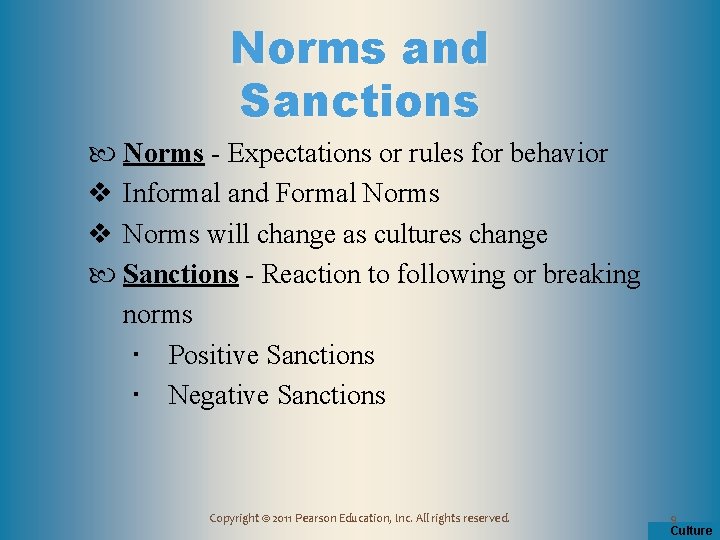
Norms and Sanctions Norms - Expectations or rules for behavior v Informal and Formal Norms v Norms will change as cultures change Sanctions - Reaction to following or breaking norms Positive Sanctions Negative Sanctions Copyright © 2011 Pearson Education, Inc. All rights reserved. 9 Culture
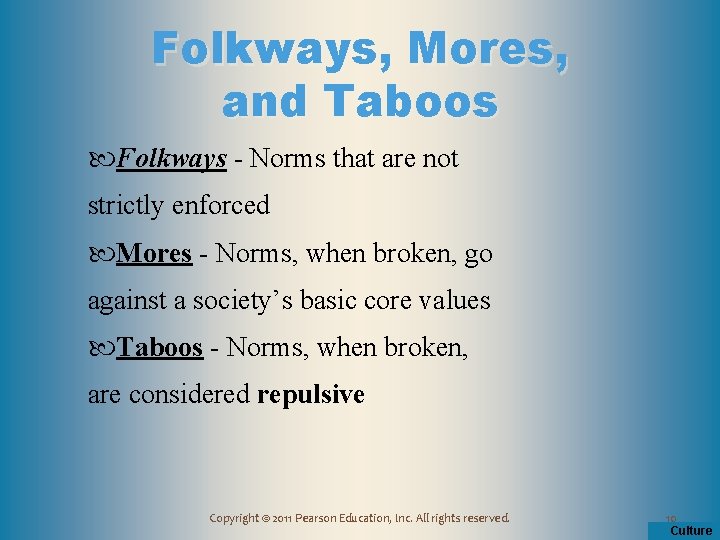
Folkways, Mores, and Taboos Folkways - Norms that are not strictly enforced Mores - Norms, when broken, go against a society’s basic core values Taboos - Norms, when broken, are considered repulsive Copyright © 2011 Pearson Education, Inc. All rights reserved. 10 Culture
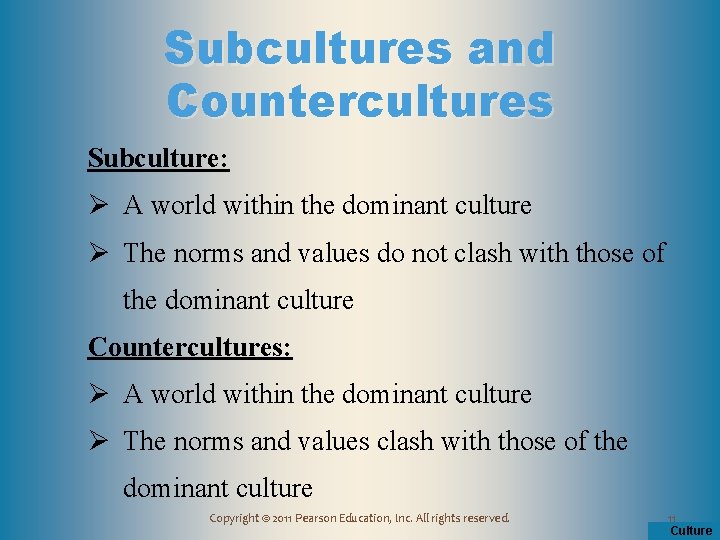
Subcultures and Countercultures Subculture: Ø A world within the dominant culture Ø The norms and values do not clash with those of the dominant culture Countercultures: Ø A world within the dominant culture Ø The norms and values clash with those of the dominant culture Copyright © 2011 Pearson Education, Inc. All rights reserved. 11 Culture
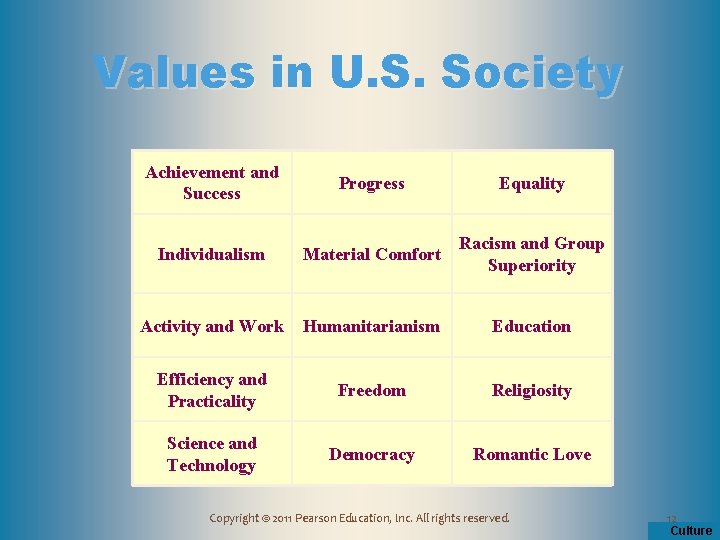
Values in U. S. Society Achievement and Success Progress Equality Individualism Material Comfort Racism and Group Superiority Activity and Work Humanitarianism Education Efficiency and Practicality Freedom Religiosity Science and Technology Democracy Romantic Love Copyright © 2011 Pearson Education, Inc. All rights reserved. 12 Culture
Value Clusters and Contradictions n Value Clusters: Values that are similar to each other n Value Contradictions: Values that contradict one another Copyright © 2011 Pearson Education, Inc. All rights reserved. 13 Culture
Emerging Values Leisure Self-fulfillment Physical Fitness Youthfulness Concern for the Environment Copyright © 2011 Pearson Education, Inc. All rights reserved. 14 Culture
Ideal vs. Real Culture Sociologists use the term ideal culture to refer to the values, norms, and goals that a group considers ideal, worth aiming for (i. e Success). Sociologists call the norms and values that people actually follow real culture. Copyright © 2011 Pearson Education, Inc. All rights reserved. Culture
Technology in the Global Village Central to a group’s material culture is its technology. Technology can be equated with tools. New technology refers to an emerging technology that has a significant impact on social life. ØTechnology sets the framework for a group’s nonmaterial culture. Copyright © 2011 Pearson Education, Inc. All rights reserved. Culture
Cultural Diffusion and Cultural Leveling Cultural Diffusion: The spreading of cultural characteristics from one culture to another Why is this happening so rapidly? Cultural Leveling: When cultures start to become similar to each other Copyright © 2011 Pearson Education, Inc. All rights reserved. 17 Culture