
Sociology SIXTEENTH EDITION Chapter 1 The Sociological Perspective








- Slides: 65
Sociology SIXTEENTH EDITION Chapter 1 The Sociological Perspective Copyright © 2017, 2014, 2011 Pearson Education, Inc. All Rights Reserved
Learning Objectives (1 of 2) 1. 1 Explain how the sociological perspective differs from common sense. 1. 2 State several reasons that a global perspective is important in today's world. 1. 3 Identify the advantages of sociological thinking for developing public policy, for encouraging personal growth, and for advancing in a career. Copyright © 2017, 2014, 2011 Pearson Education, Inc. All Rights Reserved
Learning Objectives (2 of 2) 1. 4 Link the origins of sociology to historical social changes. 1. 5 Summarize sociology's major theoretical approaches. 1. 6 Apply sociology's major theoretical approaches to the topic of sports. Copyright © 2017, 2014, 2011 Pearson Education, Inc. All Rights Reserved
The Power of Society • Sociology shows us the power of society to guide all our life decisions in much the same way that the seasons influence our choice of clothing. Copyright © 2017, 2014, 2011 Pearson Education, Inc. All Rights Reserved
What groups do you belong to? • We all belong to many different groups. Are our roles the same for each? Why or why not? • How do we know what our roles are? Copyright © 2017, 2014, 2011 Pearson Education, Inc. All Rights Reserved
The Sociological Perspective: What Is…? • Sociology – Systematic study of human society – The study of groups and group interactions, societies and social interactions, from small and personal groups to very large groups – Distinctive view guided by sociological perspective Society- a group of people who live in a defined geographic area, who interact with one another, and who share a common culture • Sociological Perspective – View that sees general patterns of society in the lives of particular people Copyright © 2017, 2014, 2011 Pearson Education, Inc. All Rights Reserved
The Sociological Perspective • How is the sociological perspective defined? – Seeing general patterns in the behavior of particular people (Berger 1963) – Seeing society shapes what we think and do in patterned ways – Seeing society in our everyday lives – Seeing sociologically, especially through marginality and crisis – Seeing sociologically Copyright © 2017, 2014, 2011 Pearson Education, Inc. All Rights Reserved
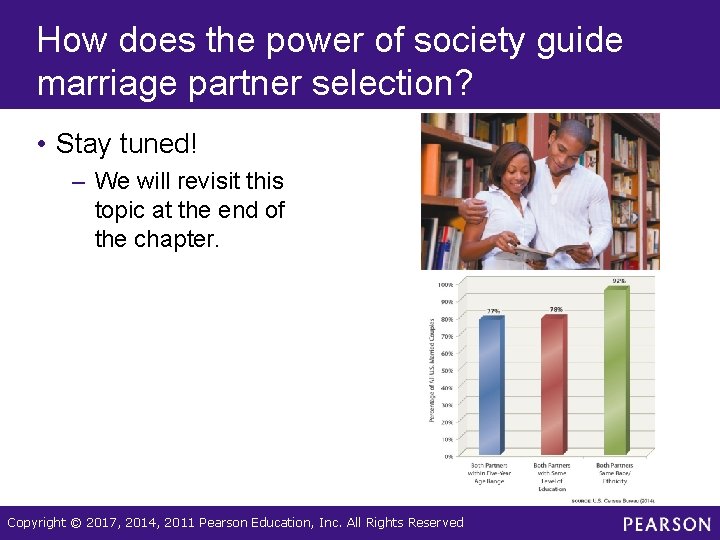
How does the power of society guide marriage partner selection? • Stay tuned! – We will revisit this topic at the end of the chapter. Copyright © 2017, 2014, 2011 Pearson Education, Inc. All Rights Reserved
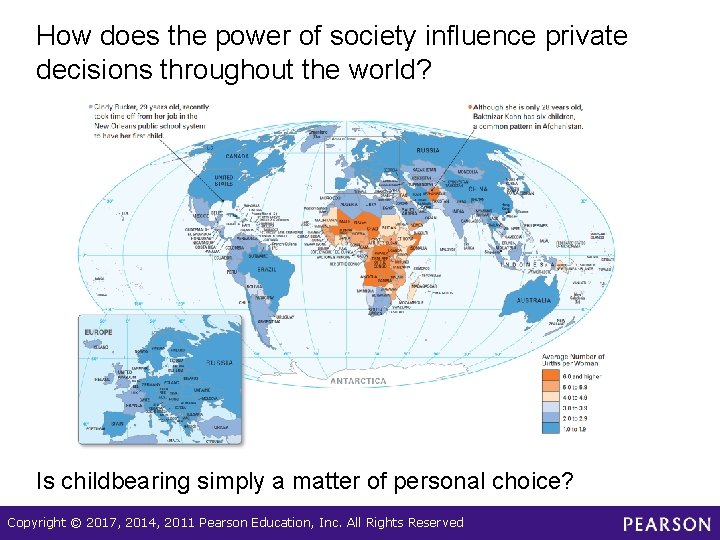
How does the power of society influence private decisions throughout the world? Is childbearing simply a matter of personal choice? Copyright © 2017, 2014, 2011 Pearson Education, Inc. All Rights Reserved
Sociologists Study All Aspects of Society • Micro-level- study small groups and individual interactions – Example: Study accepted rules of conversation in various groups such as teenagers or business professionals • Macro-level- large groups and societies – Example: The ways in which language has changed over time Copyright © 2017, 2014, 2011 Pearson Education, Inc. All Rights Reserved
The Sociological Perspective: Durkheim's Study of Suicide • Does society affect decisions about suicide? – Emile Durkheim's research findings – More likely to commit: Male Protestants who were wealthy and unmarried – Less likely to commit: Male Jews and Catholics who were poor and married Copyright © 2017, 2014, 2011 Pearson Education, Inc. All Rights Reserved
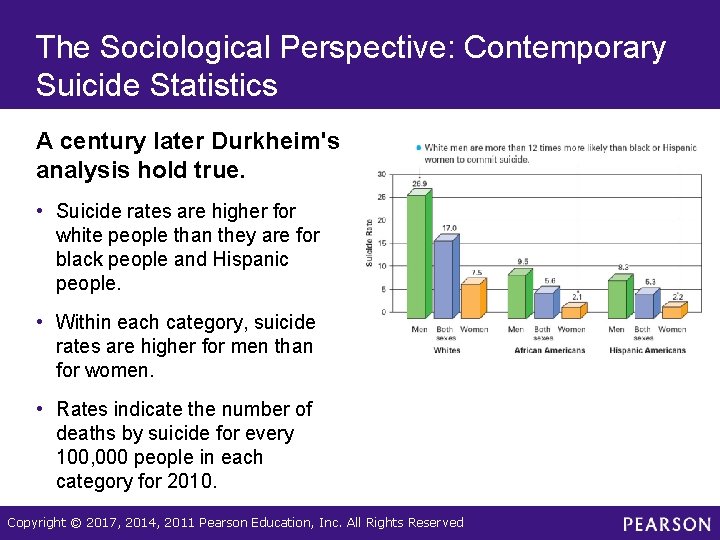
The Sociological Perspective: Contemporary Suicide Statistics A century later Durkheim's analysis hold true. • Suicide rates are higher for white people than they are for black people and Hispanic people. • Within each category, suicide rates are higher for men than for women. • Rates indicate the number of deaths by suicide for every 100, 000 people in each category for 2010. Copyright © 2017, 2014, 2011 Pearson Education, Inc. All Rights Reserved
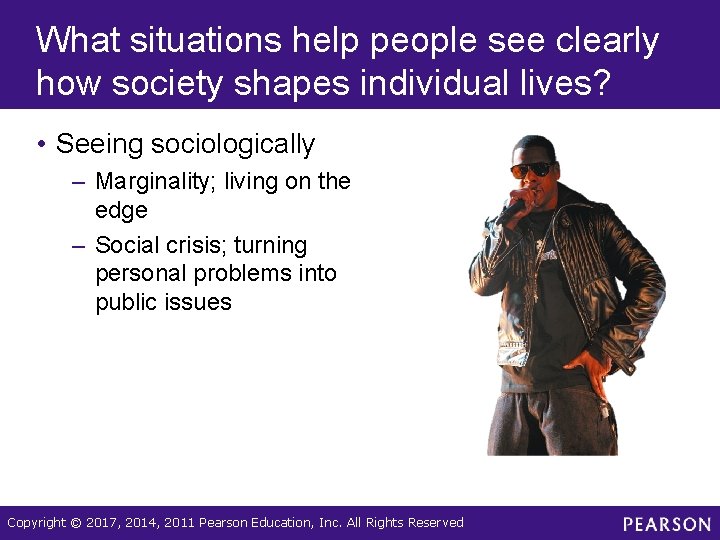
What situations help people see clearly how society shapes individual lives? • Seeing sociologically – Marginality; living on the edge – Social crisis; turning personal problems into public issues Copyright © 2017, 2014, 2011 Pearson Education, Inc. All Rights Reserved
Culture • Culture- group’s shared practices, values, and beliefs – Way of life, everyday interactions – Includes everything produced by a society, including all of the social rules – Sociologists often study culture using the sociological imagination Copyright © 2017, 2014, 2011 Pearson Education, Inc. All Rights Reserved
What is the sociological imagination? • C. Wright Mills – Sociological imagination- awareness of the relationship between a person’s behavior and experience and the wider culture that shaped the person’s choices and perceptions – Society, not people, is main cause of poverty and other social problems. – By turning personal problems into public issues, the sociological imagination is the key to bringing people together to create needed change. Copyright © 2017, 2014, 2011 Pearson Education, Inc. All Rights Reserved
The Importance of a Global Perspective: What Is…? • Global Perspective – Study of the larger world and our society's place in it • Global Awareness – Logical extension of the sociological perspective Copyright © 2017, 2014, 2011 Pearson Education, Inc. All Rights Reserved
In what way can nations be categorized by their level of economic development? • Country categories – Low-income § Nations with a low standard of living in which most people are poor § Forty-nine nations include most of Africa and part of Asia – Middle-income § Nations with a standard of living about average for the world as a whole § Seventy-two nations include many of the countries of Eastern Europe, some of Africa, and almost all of Latin America and Asia – High-income § Nations with the highest overall standards of living § Seventy-four countries include the U. S. and Canada, Argentina, the nations of Western Europe, Israel, Saudi Arabia, Japan, and Australia Copyright © 2017, 2014, 2011 Pearson Education, Inc. All Rights Reserved
Why is it important to study comparisons between the U. S. and other nations? • Comparisons are important because: – Where we live shapes the lives we lead. – Societies are increasingly interconnected through technology and economics. – Many social problems that we face in the United States are more serious elsewhere. – Thinking globally is a good way to learn more about ourselves. Copyright © 2017, 2014, 2011 Pearson Education, Inc. All Rights Reserved
Importance of a Global Perspective • “In sum, in an increasingly interconnected world, we can understand our way of life and ourselves only to the extent that we understand others and the societies in which they live. ” • What then are the benefits of applying the sociological perspective? Copyright © 2017, 2014, 2011 Pearson Education, Inc. All Rights Reserved
Applying the Sociological Perspective • Usefulness of applying the sociological perspective – Sociology guides many of our life-shaping laws and policies. – Using a sociological perspective leads to important personal growth and awareness. – Studying sociology aids in the preparation for the world of work. Copyright © 2017, 2014, 2011 Pearson Education, Inc. All Rights Reserved
Applying the Sociological Perspective: Sociology and Public Policy • Sociologists shape public policy in countless ways • What examples can you identify? Copyright © 2017, 2014, 2011 Pearson Education, Inc. All Rights Reserved
Applying the Sociological Perspective: Sociology and Personal Growth • The sociological perspective – – Helps us assess truth of common sense Helps us see opportunities and constraints Empowers us to be active participants in society Helps us live in a diverse world Copyright © 2017, 2014, 2011 Pearson Education, Inc. All Rights Reserved
Applying the Sociological Perspective: Careers • The “sociological advantage” – Sociology is excellent preparation for jobs in dozens of diverse fields (American Sociological Association, 2002, 2011 a, 2011 b). Copyright © 2017, 2014, 2011 Pearson Education, Inc. All Rights Reserved
Origins of Sociology • What are the origins? – The birth of sociology was itself the result of powerful social forces. – Let's take a closer look at some of these forces. Copyright © 2017, 2014, 2011 Pearson Education, Inc. All Rights Reserved
What kinds of social change were especially important in the development of sociology? • During the eighteenth and nineteenth centuries – Rise of a factory-based industrial economy – Explosive growth of cities – New ideas about democracy and political rights Copyright © 2017, 2014, 2011 Pearson Education, Inc. All Rights Reserved
Social Change and Sociology: A New Industrial Economy • Middle Ages: – Farming and small-scale manufacturing • End of Eighteenth Century – New energy sources – Large, anonymous work forces – Large scale production; movement of system of production – Weakening of community influence Copyright © 2017, 2014, 2011 Pearson Education, Inc. All Rights Reserved
Social Change and Sociology: Growth of Cities • Urban migrant problems: Pollution, crimes, and homelessness • Enclosure movement: Reduction in tenet access and movement to city Copyright © 2017, 2014, 2011 Pearson Education, Inc. All Rights Reserved
Social Change and Sociology: Political Change • Middle Ages: Society is an expression of God's will • Gradual attack of tradition: Thomas Hobbes (1588– 1679), John Locke (1632– 1704), and Adam Smith (1723– 1790) • Shift to self-interest: Personal liberty and individual rights • French Revolution: Greater break with politics and social tradition: Tocqueville (1805– 1859) Copyright © 2017, 2014, 2011 Pearson Education, Inc. All Rights Reserved
Social Change and Sociology: A New Awareness of Society • What changes combined to make people more aware of their surroundings? − Huge factories − Exploding cities − New spirit of individualism • The new discipline of sociology was born in England, France, and Germany. Do you know why? Copyright © 2017, 2014, 2011 Pearson Education, Inc. All Rights Reserved
Science and Sociology • Ancient civilizations – Thought about nature of society – K'ung Fu-tzu, Confucius, Plato, Aristotle • Medieval period – Imagined ideal study society – Marcus Aurelius, Aquinas, Pisan, Shakespeare Copyright © 2017, 2014, 2011 Pearson Education, Inc. All Rights Reserved
Science and Sociology: A New View • Comte – Coined term “sociology” in 1838 – Saw sociology as product of a three-stage historical development § Theoretical stage (Church in the Middle Age § Metaphysical stage (Enlightenment and the ideas of Hobbes, Locke, and Rousseau) § Scientific stage (Modern physics, chemistry, sociology, and the work of Copernicus, Galileo, and Newton) Copyright © 2017, 2014, 2011 Pearson Education, Inc. All Rights Reserved
Science and Sociology: A Closer Look at Comte • Comte (continued) – Used scientific approach to the study of society in positivism – Believed that society operates according to its own laws, much as the physical world operates according to gravity and other laws of nature – Disputed by modern sociologists who posit a more complex view of human behavior, including that related to social injustice Copyright © 2017, 2014, 2011 Pearson Education, Inc. All Rights Reserved
Sociological Theory: What Is…? • Theory – Statement of how and why specific facts are related • Theoretical Approach – Basic image of society that guides thinking and research § Structural-functional § Social-conflict § Symbolic-interaction Copyright © 2017, 2014, 2011 Pearson Education, Inc. All Rights Reserved
Structural-Functional Approach (1 of 2) • The basics – Macro-level orientation is concerned with broad patterns that shape society as a whole. – Society is viewed as a complex system; parts work together to promote solidarity and stability. Copyright © 2017, 2014, 2011 Pearson Education, Inc. All Rights Reserved
Structural-Functional Approach (2 of 2) • Key elements – Social structure: Any relatively stable patterns of social behavior found in social institutions – Social function: Consequences for the operation of society as a whole § Manifest functions: Recognized and intended consequences of any social pattern § Latent functions: Unrecognized and unintended consequences of any social pattern Copyright © 2017, 2014, 2011 Pearson Education, Inc. All Rights Reserved
Who's Who in the Structural-Functional Approach (1 of 2) • Auguste Comte – Importance of social integration during times of rapid change • Emile Durkheim − Helped establish sociology as a discipline • Herbert Spencer − Compared society to the human body Copyright © 2017, 2014, 2011 Pearson Education, Inc. All Rights Reserved
Who's Who in the Structural-Functional Approach (2 of 2) • Robert K. Merton – Manifest functions are recognized and intended consequences – Latent functions are unrecognized and unintended consequences – Social dysfunctions are undesirable consequences Copyright © 2017, 2014, 2011 Pearson Education, Inc. All Rights Reserved
Evaluation of the Structural-Functional Approach • Evaluation – Favored approach in mid-1900 s – Focus on stability at expense of conflict makes this approach somewhat conservative – Less utilized today Copyright © 2017, 2014, 2011 Pearson Education, Inc. All Rights Reserved
Social Conflict Approach: What Is…? (1 of 2) • Social-conflict approach – Sees society as arena of inequality that generates conflict and change Copyright © 2017, 2014, 2011 Pearson Education, Inc. All Rights Reserved
Social Conflict Approach: What Is…? (2 of 2) • Gender-conflict theory – Focuses on inequality and conflict between women and men – Feminism • Race-conflict theory – Focuses on inequality and conflict between people of different racial and ethnic categories Copyright © 2017, 2014, 2011 Pearson Education, Inc. All Rights Reserved
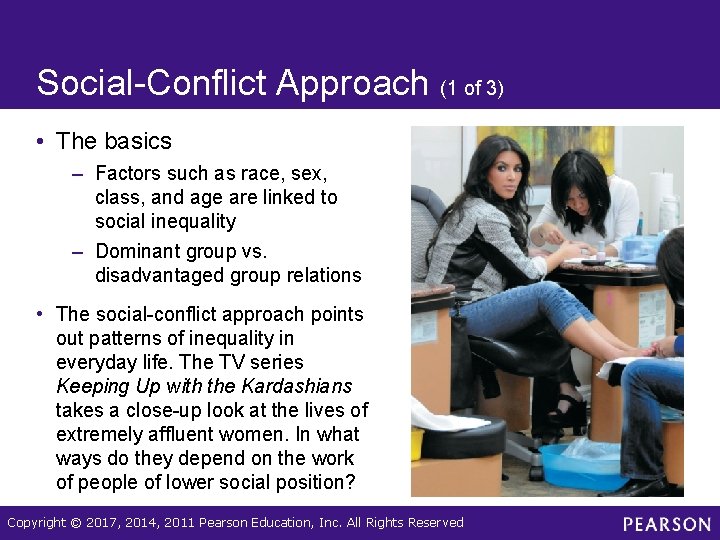
Social-Conflict Approach (1 of 3) • The basics – Factors such as race, sex, class, and age are linked to social inequality – Dominant group vs. disadvantaged group relations • The social-conflict approach points out patterns of inequality in everyday life. The TV series Keeping Up with the Kardashians takes a close-up look at the lives of extremely affluent women. In what ways do they depend on the work of people of lower social position? Copyright © 2017, 2014, 2011 Pearson Education, Inc. All Rights Reserved
Social-Conflict Approach (2 of 3) • Key elements – Rejects the idea that social structure promotes the operation of society as a whole – Suggests society is structured in ways to benefit a few at the expense of the majority Copyright © 2017, 2014, 2011 Pearson Education, Inc. All Rights Reserved
Social-Conflict Approach (3 of 3) • Evaluation – Many sociologists use social-conflict approach not just to understand society but also to bring about societal change that would reduce inequality. – Critics of the conflict perspective point to its overly negative view of society. Copyright © 2017, 2014, 2011 Pearson Education, Inc. All Rights Reserved
Who's Who in the Social-Conflict Approach • Karl Marx – Focus on importance of social class in inequality and social conflict • W. E. B. Du Bois – Focus on race as the major problem facing the U. S. in the 20 th century Copyright © 2017, 2014, 2011 Pearson Education, Inc. All Rights Reserved
Gender-Conflict Approach and Feminism • The basics – Gender-conflict theory: Focuses on inequality and conflict between women and men – Feminism: Advocacy of social equality for women and men linked to gender-conflict theory Copyright © 2017, 2014, 2011 Pearson Education, Inc. All Rights Reserved
Who's Who In Feminism and the Gender-Conflict Approach • Harriet Martineau – First woman sociologist – Translated Comte's work from French to English – Documented the evils of slavery, argued for laws to protect factory workers, and fought for changes in education policy for women Copyright © 2017, 2014, 2011 Pearson Education, Inc. All Rights Reserved
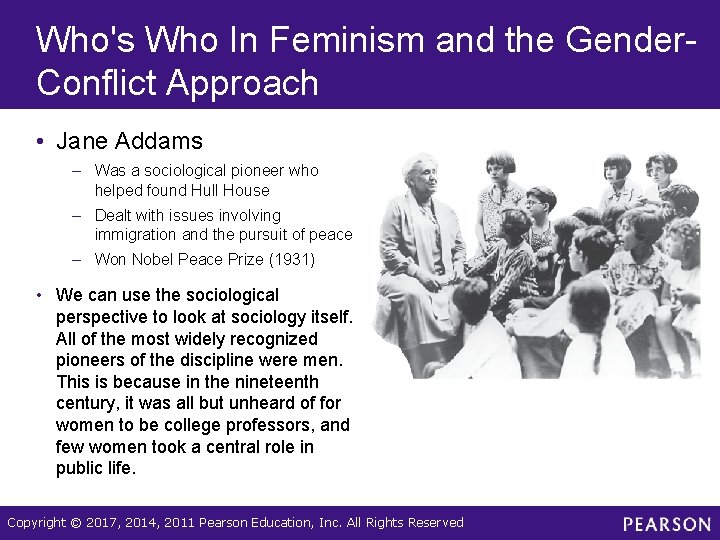
Who's Who In Feminism and the Gender. Conflict Approach • Jane Addams – Was a sociological pioneer who helped found Hull House – Dealt with issues involving immigration and the pursuit of peace – Won Nobel Peace Prize (1931) • We can use the sociological perspective to look at sociology itself. All of the most widely recognized pioneers of the discipline were men. This is because in the nineteenth century, it was all but unheard of for women to be college professors, and few women took a central role in public life. Copyright © 2017, 2014, 2011 Pearson Education, Inc. All Rights Reserved
The Race-Conflict Approach (1 of 2) • The basics – Focus on inequality and conflict between people of different racial and ethnic categories Copyright © 2017, 2014, 2011 Pearson Education, Inc. All Rights Reserved
The Race-Conflict Approach (2 of 2) • The basics – Focuses on inequality and conflict between people of different racial and ethnic categories – Suggests racial conflict is still an issue in U. S. Copyright © 2017, 2014, 2011 Pearson Education, Inc. All Rights Reserved
Who's Who in the Race-Conflict Approach (1 of 2) • Ida Wells Barnett – Born to slave parents but rose to become a teacher and then a journalist and newspaper publisher – Campaigned for racial equality throughout her life Copyright © 2017, 2014, 2011 Pearson Education, Inc. All Rights Reserved
Who's Who in the Race-Conflict Approach (2 of 2) • W. E. B. Du Bois – Earned the first doctorate awarded by Harvard to a person of color – Founded the Atlanta Sociological Laboratory – Believed that sociologists should not simply learn about society's problems but also try to solve them Copyright © 2017, 2014, 2011 Pearson Education, Inc. All Rights Reserved
Social-Conflict Theories • Evaluation – Large following gained in recent decades – Focus on inequality, but largely ignores how shared values and interdependence unify members of a society – Cannot claim scientific objectivity Copyright © 2017, 2014, 2011 Pearson Education, Inc. All Rights Reserved
Symbolic-Interaction Approach (1 of 2) • The basics – Presents a micro-level orientation – Offers a close-up focus on social interactions in specific situations – Views society as the product of everyday interactions of individuals Copyright © 2017, 2014, 2011 Pearson Education, Inc. All Rights Reserved
Symbolic-Interaction Approach (2 of 2) • Key elements – Society is a shared reality that people construct as they interact with one another. – Society is a complex, ever-changing mosaic of subjective meanings. Copyright © 2017, 2014, 2011 Pearson Education, Inc. All Rights Reserved
Who's Who in the Symbolic-Interaction Approach (1 of 2) • Max Weber – Understanding a setting from the people in it • George Herbert Mead – How we build personalities from social experience Copyright © 2017, 2014, 2011 Pearson Education, Inc. All Rights Reserved
Who's Who in the Symbolic-Interaction Approach (2 of 2) • Erving Goffman – Dramaturgical analysis • George Homans and Peter Blau – Social-exchange analysis Copyright © 2017, 2014, 2011 Pearson Education, Inc. All Rights Reserved
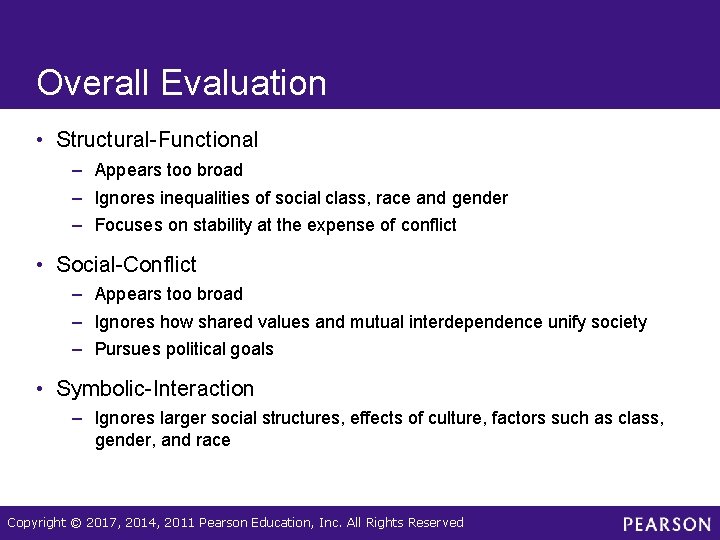
Overall Evaluation • Structural-Functional – Appears too broad – Ignores inequalities of social class, race and gender – Focuses on stability at the expense of conflict • Social-Conflict – Appears too broad – Ignores how shared values and mutual interdependence unify society – Pursues political goals • Symbolic-Interaction – Ignores larger social structures, effects of culture, factors such as class, gender, and race Copyright © 2017, 2014, 2011 Pearson Education, Inc. All Rights Reserved
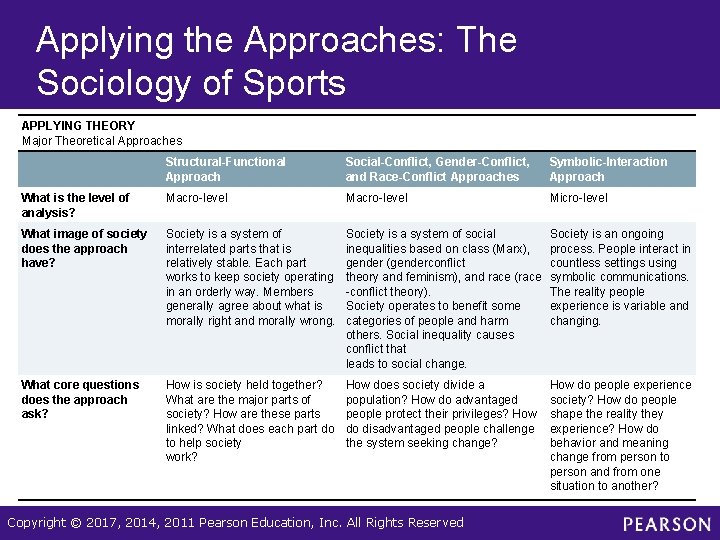
Applying the Approaches: The Sociology of Sports APPLYING THEORY Major Theoretical Approaches Structural-Functional Approach Social-Conflict, Gender-Conflict, and Race-Conflict Approaches Symbolic-Interaction Approach What is the level of analysis? Macro-level Micro-level What image of society does the approach have? Society is a system of interrelated parts that is relatively stable. Each part works to keep society operating in an orderly way. Members generally agree about what is morally right and morally wrong. Society is a system of social inequalities based on class (Marx), gender (genderconflict theory and feminism), and race (race -conflict theory). Society operates to benefit some categories of people and harm others. Social inequality causes conflict that leads to social change. Society is an ongoing process. People interact in countless settings using symbolic communications. The reality people experience is variable and changing. What core questions does the approach ask? How is society held together? What are the major parts of society? How are these parts linked? What does each part do to help society work? How does society divide a population? How do advantaged people protect their privileges? How do disadvantaged people challenge the system seeking change? How do people experience society? How do people shape the reality they experience? How do behavior and meaning change from person to person and from one situation to another? Copyright © 2017, 2014, 2011 Pearson Education, Inc. All Rights Reserved
The Sociology of Sports (1 of 2) • Functions of Sports – A structural-functional approach directs our attention to ways sports help society operate. – Sports have functional and dysfunctional consequences. Copyright © 2017, 2014, 2011 Pearson Education, Inc. All Rights Reserved
The Sociology of Sports (2 of 2) • Sports and conflict – Social-conflict analysis points out games people play reflect their social standing. – Sports have been oriented mostly toward males. – Sports in the United States are bound up with inequalities. Copyright © 2017, 2014, 2011 Pearson Education, Inc. All Rights Reserved
Do the Math! • Why is there a high number of African Americans in some professional sports? – Athletic performance in some sports can be precisely measured and is not influenced by racial prejudice. Copyright © 2017, 2014, 2011 Pearson Education, Inc. All Rights Reserved
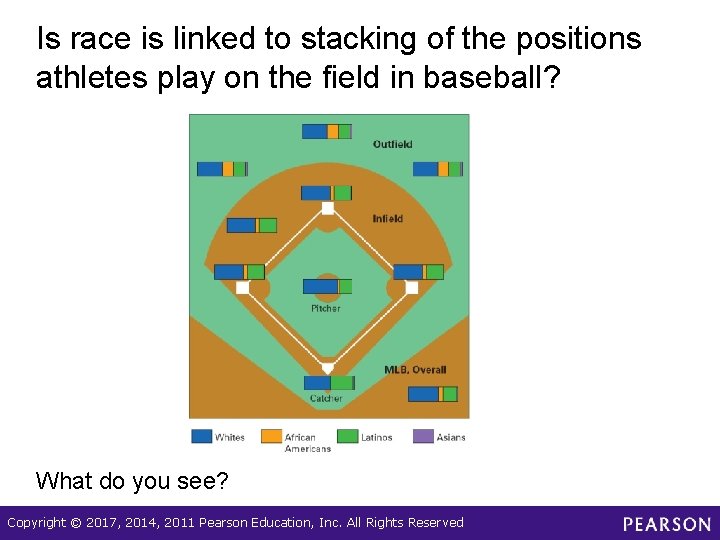
Is race is linked to stacking of the positions athletes play on the field in baseball? What do you see? Copyright © 2017, 2014, 2011 Pearson Education, Inc. All Rights Reserved
Sports as Interaction • Symbolic-interaction approach – Posits sports are less a system than an ongoing process • Structural-functional, social-conflict, and symbolicinteraction – Provide different insights into sports – No one is more correct than the others Copyright © 2017, 2014, 2011 Pearson Education, Inc. All Rights Reserved
Is sociology nothing more than a stereotype? • No! – Generalizations are not applied to everyone in a category. – Generalizations square with the available facts. – Generalizations are offered fair-mindedly, with an interest in getting at the truth. • A sociology classroom is a good place to get at the truth behind common stereotypes. Copyright © 2017, 2014, 2011 Pearson Education, Inc. All Rights Reserved
Back to Marriage Partner Selection • True or False? – All societies enforce various rules that state who should or should not marry whom. Copyright © 2017, 2014, 2011 Pearson Education, Inc. All Rights Reserved