ESP COURSE English for Specific Purposes for Class
- Slides: 14
ESP COURSE (English for Specific Purposes) for Class Teachers (11 -12, 13 -14) Vera Savic, MA Lecturer in English 2010/2011 Faculty of Education in Jagodina University of Kragujevac vera. savic@pefja. kg. ac. rs
Learning to Learn Savic, V. (2009): English for Specific Purposes for Students of Education, pp 20 -23 1. 2. 3. 4. Who is the author of the text? Where and when was it published? What is it about? What does the author say about leatning to leatrn? 5. Why is this topic important?
Learning to Learn - objective to acquire fast moving world learning teaching context to equip with preferably schooling day-to-day practice chapter explicitly mixed ability classes incorporate to raise awareness encompass - guidelines coursebook contain rationale to boost self-esteem self-confidence to cover metacognitive reflection monitoring to prompt to deal with categorize
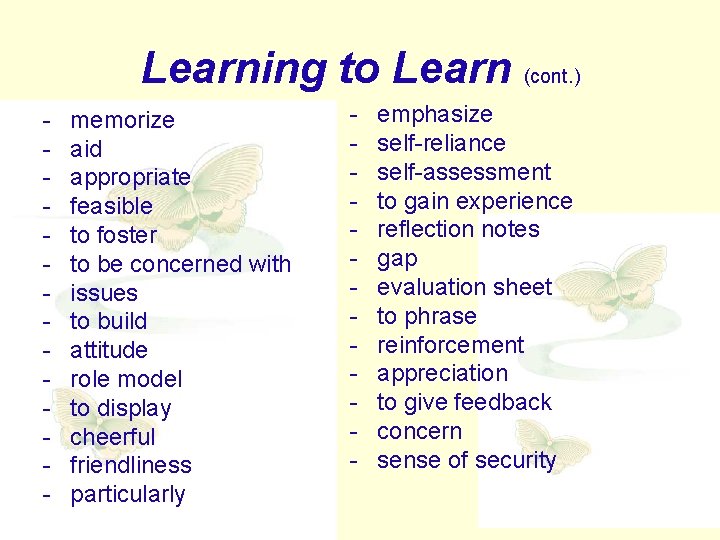
Learning to Learn (cont. ) - memorize aid appropriate feasible to foster to be concerned with issues to build attitude role model to display cheerful friendliness particularly - emphasize self-reliance self-assessment to gain experience reflection notes gap evaluation sheet to phrase reinforcement appreciation to give feedback concern sense of security
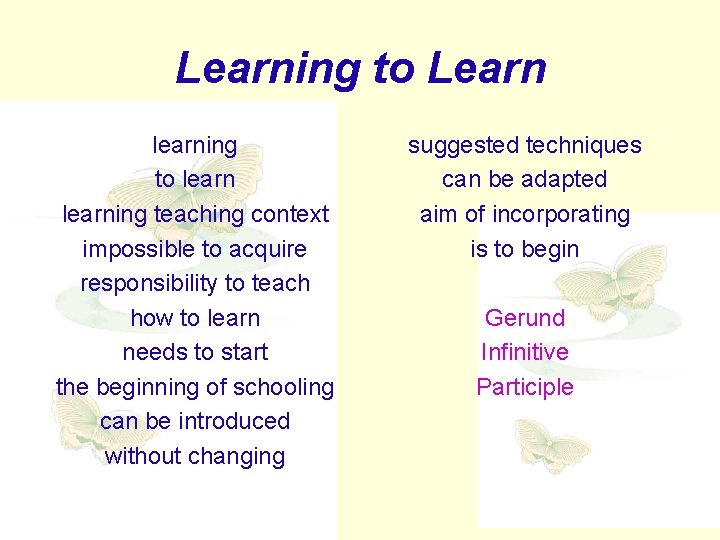
Learning to Learn learning to learning teaching context impossible to acquire responsibility to teach how to learn needs to start the beginning of schooling can be introduced without changing suggested techniques can be adapted aim of incorporating is to begin Gerund Infinitive Participle
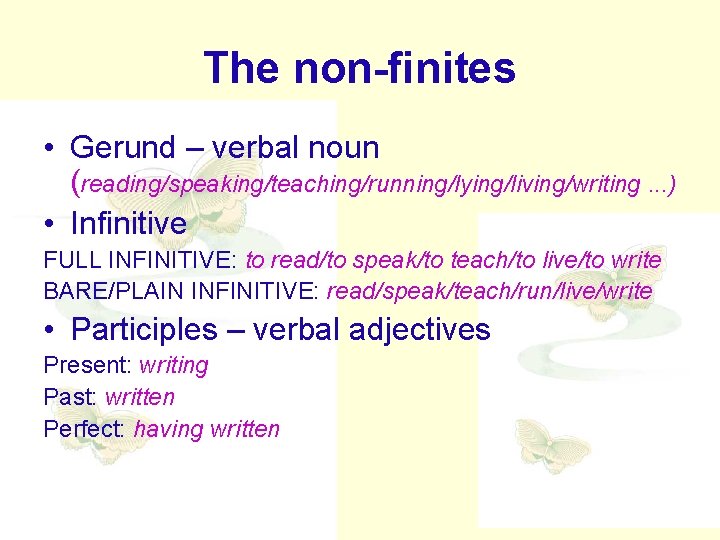
The non-finites • Gerund – verbal noun (reading/speaking/teaching/running/lying/living/writing. . . ) • Infinitive FULL INFINITIVE: to read/to speak/to teach/to live/to write BARE/PLAIN INFINITIVE: read/speak/teach/run/live/write • Participles – verbal adjectives Present: writing Past: written Perfect: having written
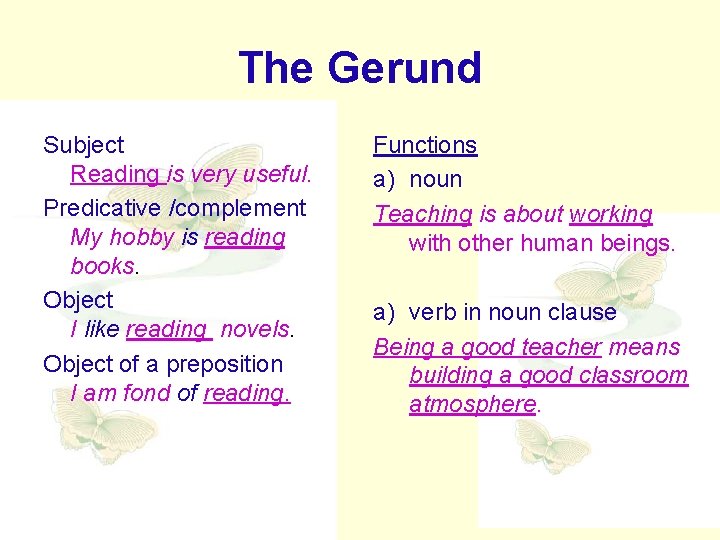
The Gerund Subject Reading is very useful. Predicative /complement My hobby is reading books. Object I like reading novels. Object of a preposition I am fond of reading. Functions a) noun Teaching is about working with other human beings. a) verb in noun clause Being a good teacher means building a good classroom atmosphere.
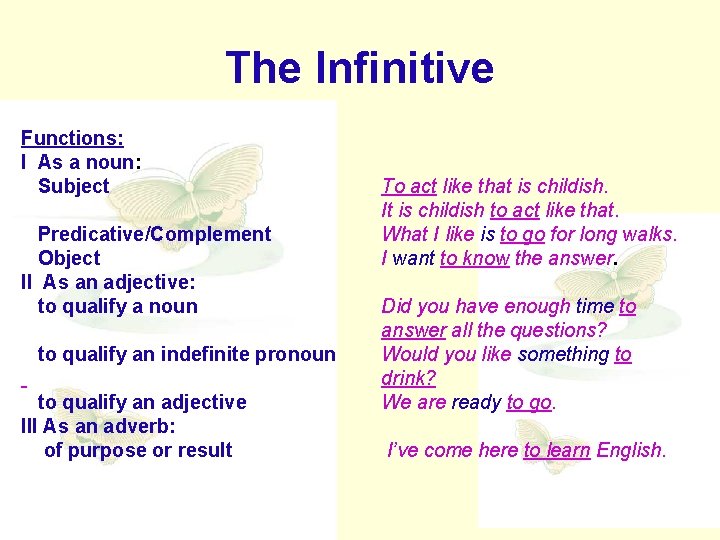
The Infinitive Functions: I As a noun: Subject Predicative/Complement Object II As an adjective: to qualify a noun to qualify an indefinite pronoun to qualify an adjective III As an adverb: of purpose or result To act like that is childish. It is childish to act like that. What I like is to go for long walks. I want to know the answer. Did you have enough time to answer all the questions? Would you like something to drink? We are ready to go. I’ve come here to learn English.
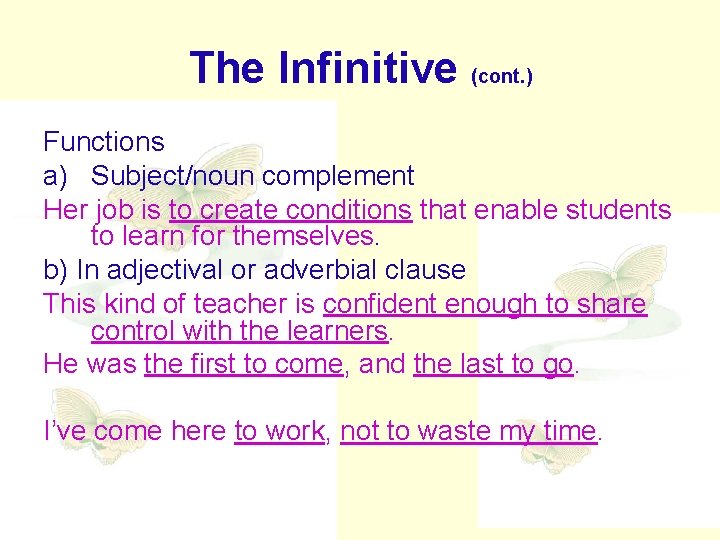
The Infinitive (cont. ) Functions a) Subject/noun complement Her job is to create conditions that enable students to learn for themselves. b) In adjectival or adverbial clause This kind of teacher is confident enough to share control with the learners. He was the first to come, and the last to go. I’ve come here to work, not to waste my time.
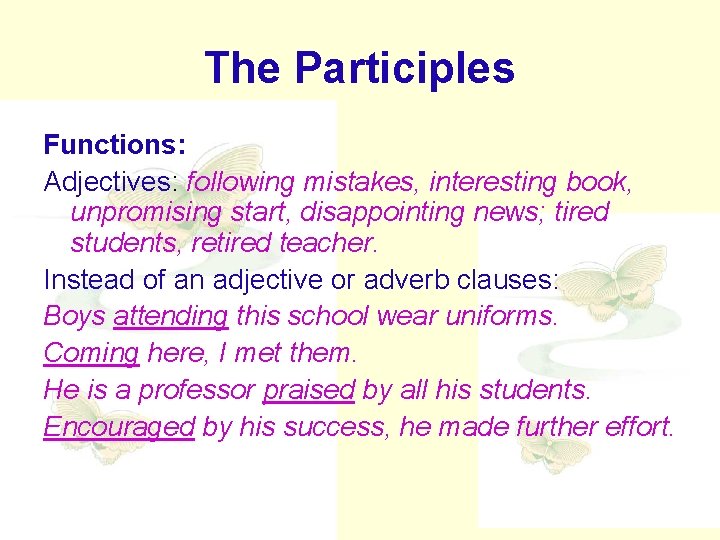
The Participles Functions: Adjectives: following mistakes, interesting book, unpromising start, disappointing news; tired students, retired teacher. Instead of an adjective or adverb clauses: Boys attending this school wear uniforms. Coming here, I met them. He is a professor praised by all his students. Encouraged by his success, he made further effort.
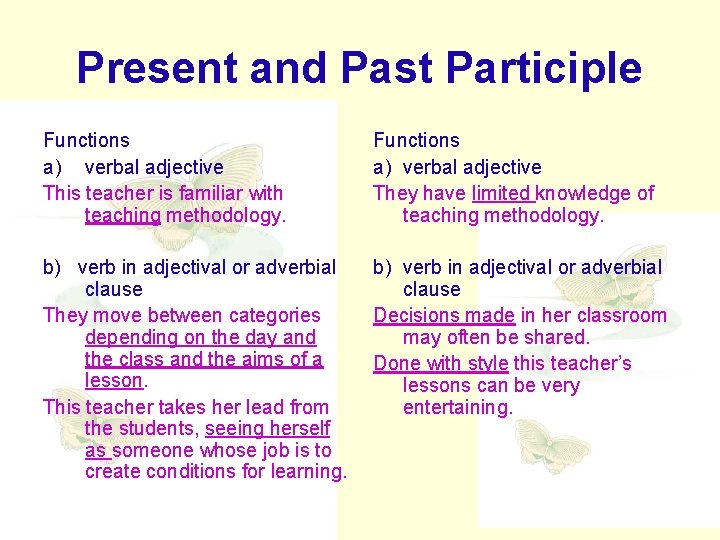
Present and Past Participle Functions a) verbal adjective This teacher is familiar with teaching methodology. Functions a) verbal adjective They have limited knowledge of teaching methodology. b) verb in adjectival or adverbial clause They move between categories depending on the day and the class and the aims of a lesson. This teacher takes her lead from the students, seeing herself as someone whose job is to create conditions for learning. b) verb in adjectival or adverbial clause Decisions made in her classroom may often be shared. Done with style this teacher’s lessons can be very entertaining.
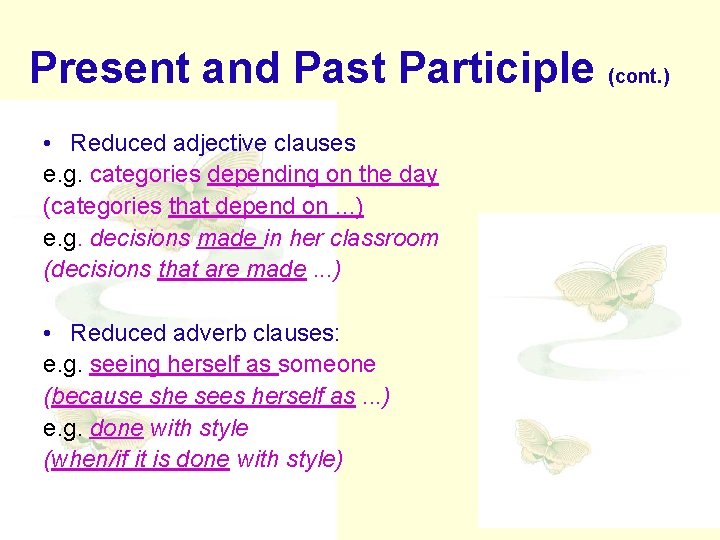
Present and Past Participle (cont. ) • Reduced adjective clauses e. g. categories depending on the day (categories that depend on. . . ) e. g. decisions made in her classroom (decisions that are made. . . ) • Reduced adverb clauses: e. g. seeing herself as someone (because she sees herself as. . . ) e. g. done with style (when/if it is done with style)
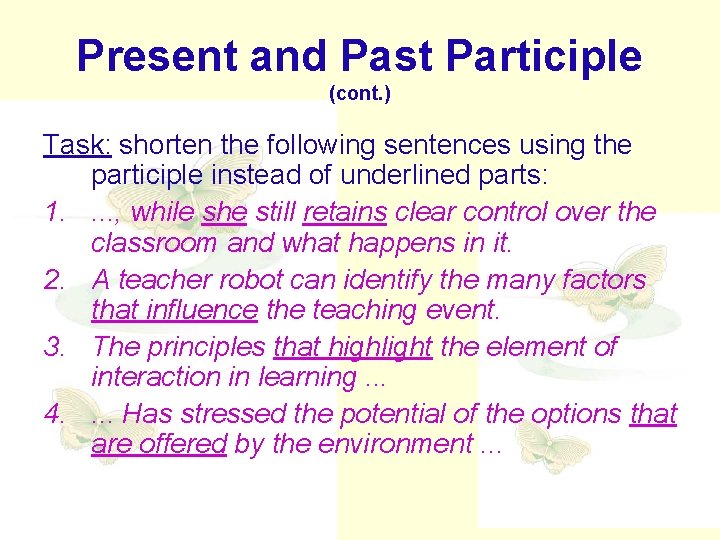
Present and Past Participle (cont. ) Task: shorten the following sentences using the participle instead of underlined parts: 1. . , while she still retains clear control over the classroom and what happens in it. 2. A teacher robot can identify the many factors that influence the teaching event. 3. The principles that highlight the element of interaction in learning. . . 4. . Has stressed the potential of the options that are offered by the environment. . .
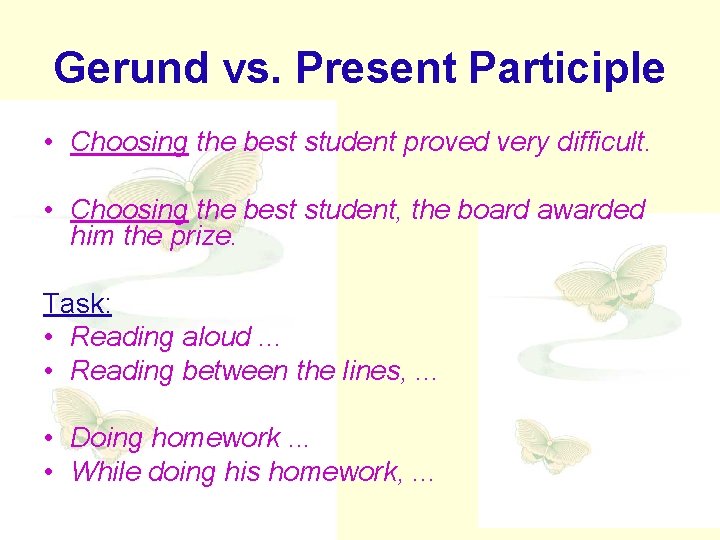
Gerund vs. Present Participle • Choosing the best student proved very difficult. • Choosing the best student, the board awarded him the prize. Task: • Reading aloud. . . • Reading between the lines, . . . • Doing homework. . . • While doing his homework, . . .