
ESP Course Design Master 1Semster II ESP Mrs




- Slides: 41
ESP Course Design Master 1/Semster II ESP Mrs. Somia BOUDINAR
�The growth of the ESP movement is a result of the rapid development of the world economy and has been greatly influenced by ELT methodology and the development of Applied Linguistics.
�The first dominating approach to ESP course design focused on the grammatical and lexical items of a particular field of English. With the growing popularity of Communicative Language Teaching (CLT), language use became the key emphasis in the ESP world, known as the “functional–notional approach”.
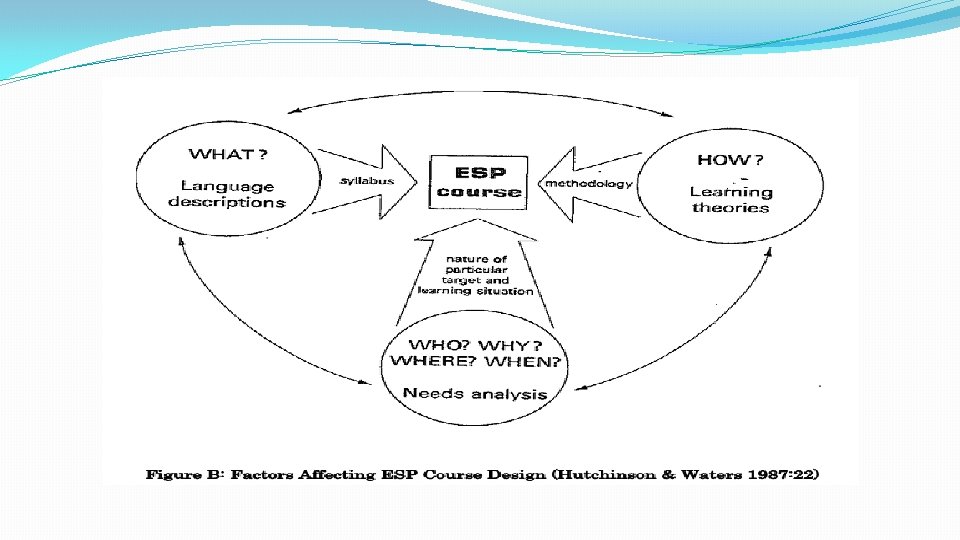
� Hutchinson and Water (1987) emphasized on the fact that ESP teachers are concerned more with designing appropriate courses for various groups of learners. There are THREE factors affecting ESP course design: LANGUAGE DESCRIPTION, LEARNING THEORIES, NEEDS ANALYSIS. The interdependence of these factors in the course design process is very important; the course design must bring the learner into play.
�The task for the ESP developer is to ensure that all three of these factors are integrated into syllabus. This is a difficult task due to the incredible amount of research required. Because ESP requires comprehensive needs analysis and because the learning-centered syllabus is NOT static, it is impossible to expect that the developer be in a position to identify the perfect balance of the abilities noted above for any particular group of learners
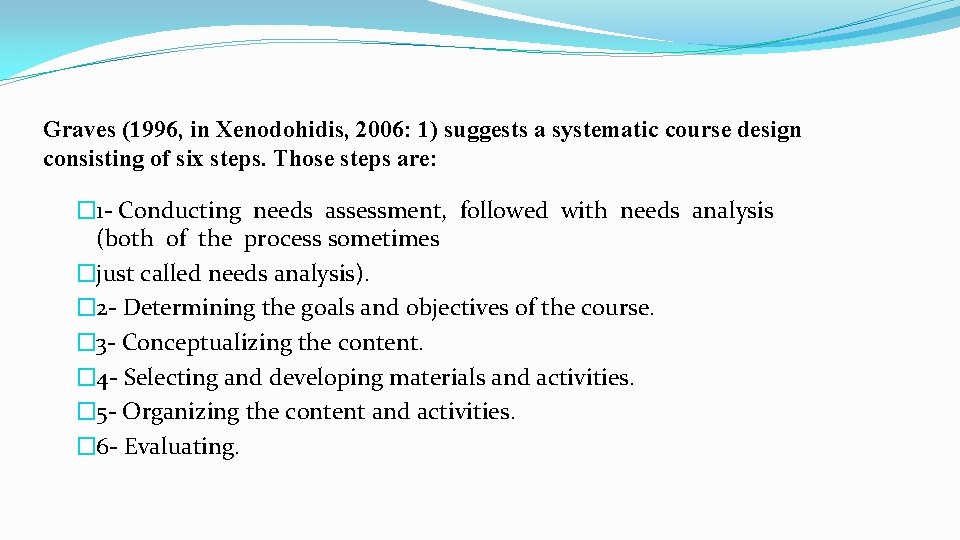
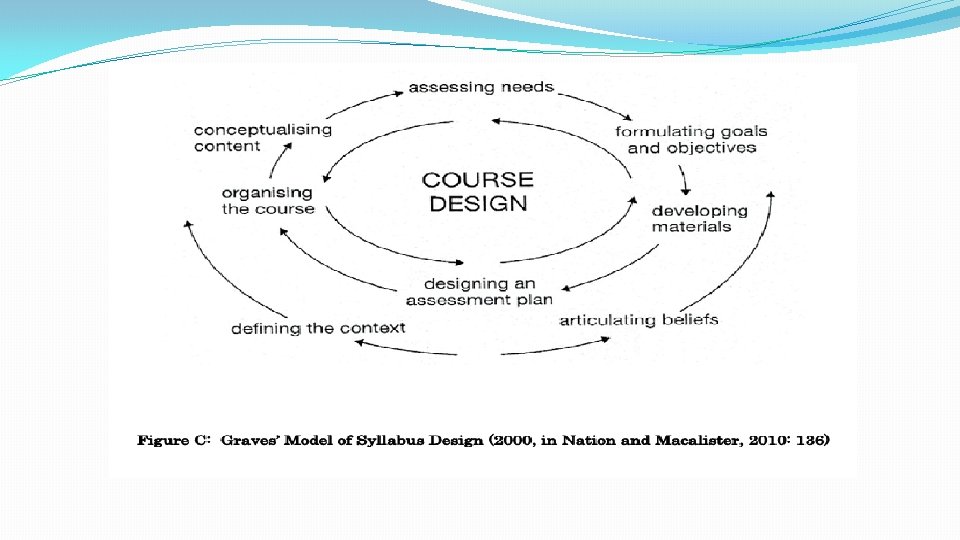
Graves (1996, in Xenodohidis, 2006: 1) suggests a systematic course design consisting of six steps. Those steps are: � 1 - Conducting needs assessment, followed with needs analysis (both of the process sometimes �just called needs analysis). � 2 - Determining the goals and objectives of the course. � 3 - Conceptualizing the content. � 4 - Selecting and developing materials and activities. � 5 - Organizing the content and activities. � 6 - Evaluating.
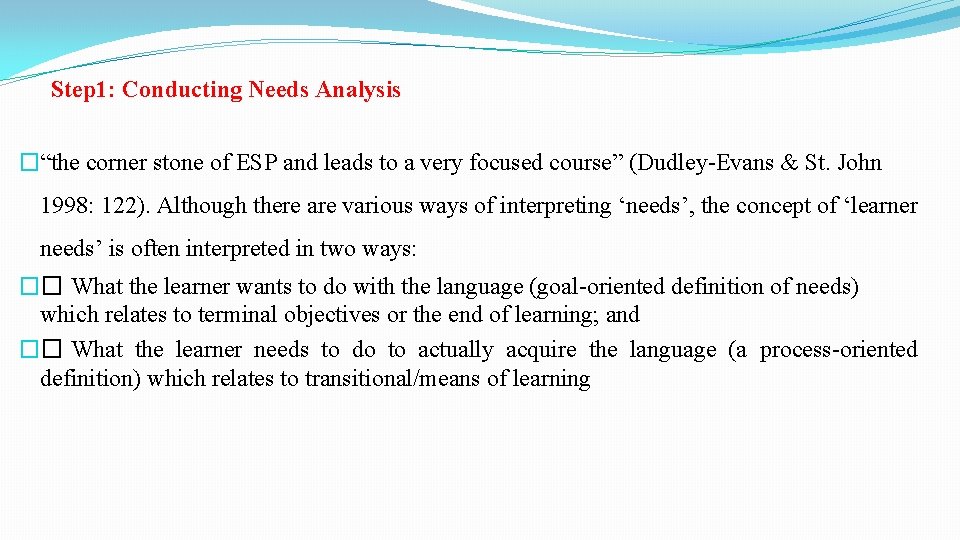
Step 1: Conducting Needs Analysis �“the corner stone of ESP and leads to a very focused course” (Dudley-Evans & St. John 1998: 122). Although there are various ways of interpreting ‘needs’, the concept of ‘learner needs’ is often interpreted in two ways: �� What the learner wants to do with the language (goal-oriented definition of needs) which relates to terminal objectives or the end of learning; and �� What the learner needs to do to actually acquire the language (a process-oriented definition) which relates to transitional/means of learning
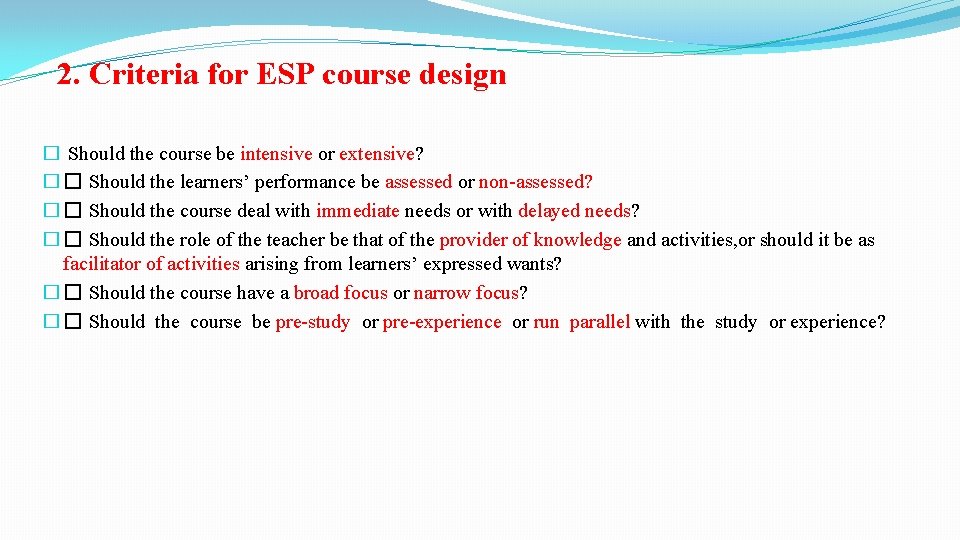
2. Criteria for ESP course design � Should the course be intensive or extensive? � � Should the learners’ performance be assessed or non-assessed? � � Should the course deal with immediate needs or with delayed needs? � � Should the role of the teacher be that of the provider of knowledge and activities, or should it be as facilitator of activities arising from learners’ expressed wants? � � Should the course have a broad focus or narrow focus? � � Should the course be pre-study or pre-experience or run parallel with the study or experience?
2. Criteria for ESP course design �Should the materials be common-core or specific to learners’ study or work? ��Should the group taking the course be homogeneous or should it be heterogeneous? ��Should the course design be worked out by the language teacher after consultation with the learners and the institution, or should it be subject to a process of negotiation with the learners? By asking these questions prior to planning course design, the ESP teacher can be better prepared, more so if the teacher has to balance out some of these parameters which are linked to institutional and learner expectations (Dudley. Evans and St John, 1998).
By asking these questions prior to planning course design, the ESP teacher can be better prepared, more so if the teacher has to balance out some of these parameters which are linked to institutional and learner expectations (Dudley-Evans and St John, 1998).
The content of any ESP course should be determined by a comprehensive needs analysis as this first step is seen as being absolutely crucial if ESP practitioners wish to design a course that will maximally benefit their learners (Wright, 2001)
�Placement testing (administering tests designed to assess general English ability and ability to perform adequately in work contexts – this might help determine the starting level of courses in the ESP course) �Linguistics needs analysis (to identify skill development, linguistic structure, lexical items, language functions and levels of formality) � Learning needs analysis (identify learners’ attitudes towards different kinds of methodology, learning tasks and activities); and � Learner perceptions analysis (discover learners’ perceptions of themselves and others as part of their company culture, and their relationships with people from other company, cultures).
�The notion of needs analysis in ESP has been expanded in different ways by different scholars. Chambers (1980, in Basturkmen 2010, p. 18) for instance, states that: “Needs analysis should be concerned with establishment of communicative needs and their realisations, resulting from an analysis of the communication in target situation - what I will refer to as target situation analysis. ”
Step 2: Determination of Goals and Objectives of the Course Xenodohidis (2002, 4) confirms that: “the goals should be realistic; otherwise the students would be demotivated. ” �Goals can be expressed in general terms and be given more details when considering the content of the course (Nation & Macalister 2010: 6). Here are some examples of goals that have been set for language courses:
� Objectives: it aims to � (a) Encourage students to communicate in a wide range of everyday situations. � (b) Sustain interest and motivation. � (c) Help students understand formulate the grammatical rules of English. � (d) Develop students’ receptive skills beyond those of their productive skills. � (e) Give students insights into daily life in Britain. � (f) Develop specific skills, including skills required for examination purposes. � (g) Contribute to the students’ personal, social and educational development. � Radley and Sharley (1987, in Nation & Macalister 2010: 6)
Step 3: Content Conceptualization �It is important for teachers to consider the following questions: � �What reading passage will I use? ��What vocabulary will I get the learners to focus on in this activity? � �Which items shall I use for the blanks in this blank-filling activity? ��How can I recycle the language items used in the previous lessons? � �What topics should I get the learners to talk about in my discussion activities?
According to Reilly (1998, in Xenodohidis, 2006: 20) there are some practical guidelines to content choice and design: � �Define what the students should be able to do as exactly and realistically as possible, as the result of the instruction; � �Rank the syllabi in order of importance according to desired outcomes; � �Evaluate available resources and match them with the syllabi; � �Designate one or two syllabi as dominant; � �Review how combination and integration of syllabi types can be achieved and in what proportion; � �And translate decisions into actual teaching units
�Content conceptualization is often related to needs analysis and course goals and objectives. In this stage, it is necessary to identify language function and language expression in relation to the needs and objectives of the learners either for academic or professional purposes.
Step 4: Selection and Development of Materials and Activities Language �INSTRUCTION has FIVE important components – STUDENTS, a TEACHER, MATERIALS, teaching METHODS, and EVALUATION. �Why do we use materials in language instruction?
�Allwright (1990) argues that materials should teach students to learn, act as resource books of ideas and activities for teaching/learning, and give teachers rationale for what they do; yet from Allwright’s point of view, textbooks are too inflexible to be used directly as instructional material.
�O’Neill (1990), in contrast, argues that materials may be suitable for students’ needs, even if they are not designed specifically for them; textbooks make it possible for students to review and prepare their lessons; textbooks are efficient in terms of time and money, and they can and should allow for adaptation and improvisation.
Choosing the appropriate materials that suit the learners’ interest is a very difficult task; in this favor, Harding (2007: 10 -11) offers some useful advice in this respect: � � Use contexts, texts and situations from the students’ subject area. Whether they are real or simulated, they will naturally involve the language the students need. � � Exploit authentic materials that students use in their specialism or vocation – and do not be put off by the fact that it may not look like ‘normal English’. � � Make the task authentic as well as the texts. Get the students doing things with the material that they actually need to do in their work.
According to Graves (1996, in Xenodohidis, 2006: 12), in order to select materials, the following issues should be taken into account: 1. Effectiveness in achieving the course purposes. 2. Appropriateness of the materials, so that the students will feel comfortable. This means that the material will be relevant to their interests and language level. � 3. Feasibility, so that the material will be in accordance with students’ capabilities and the course will not prove too difficult for them. � 4. Choosing materials may mean development of new material, collection of various materials or adaptation of existing ones. The source of materials can be from published materials (textbooks, journals, magazines).
� One of the key characteristics of ESP is that teachers and course developers value the use of authentic texts and tasks. The term ‘AUTHENTIC’ denotes that the texts were written for purposes other than language teaching and learning. For example, for developing a course for medical sciences, the teacher would try to include texts written by doctors or scientists and then include tasks replicating those doctors in the workplace that might carry out, such as a conversation between a doctor and his patient, a medical prescription, etc. � To be continued…
Step 5: Organization of Content and Activities � The format and presentation of content and activities are the most common decisions made by a teacher. Every day teachers have to consider questions like the following: � � What activities will I get the learners to do today? � � Shall I get the learners to do this activity individually or in pairs or groups? � � Should I pre-teach these items before the learners meet them in the reading passage? � � Shall I write this on the blackboard or by using handouts? � � Should I have a pre-reading discussion or should I get the learners to talk about the text after the reading? � � Have I got a good balance of activities in this lesson? � All the above questions are related to organization of content and activities, because they involve what the learners do in the lesson and the order in which they do them. This step is mainly influenced by needs analysis and environment analysis
� The choice of an activity depends on environment analysis factors: � - Does the physical arrangement of the classroom make it easy to do group work? � - Is there enough time to complete the activity? � - Are the learners well-behaved enough to be able to work quietly and independently? � - Have the learners done this activity before or will they need to be taught how to do the activity properly?
Most teachers will make these decisions intuitively; yet, if the technique or activity is unsuccessful, it is always worthwhile looking at the environment factors to see if changes can be made so that the activity will work well. For example, group work might not be successful simply because the learners are not sitting in a good group work arrangement. Changing the seating arrangement could make the activity successful. Similarly, pair work may be unsuccessful because learners are not working with an appropriate partner. Changing the way the learners form pairs could make the activity successful.
� The choice of activity also depends on needs analysis factors. � Some activities may be asking the learners to do things they are not yet able to do. � Some activities may be too easy. � Fluency development activities should involve easy material that the learners are already familiar with. This means of course that the learners either have to be aware of why they are doing the activity, or there is some other challenge to the activity such as an increase in speed which adds an element of difficulty to it.
Course organization is important since it provides the teacher and the students with a clear idea of what will be taught (Xenodohidis, 2006). Two principles underlying the concept of sequencing material are: building and recycling. �Building can follow the process of the simple to the more complex, from concrete to more open ended, while � Recycling means that the students deal with taught materials in a new way.
Step 6: Assessment and Evaluation � The last step but not the least is “assessment and evaluation”, which is an integral part of the development of any model of a course which comes after the implementation stage of the course. These processes should also be integrated into the design process to ensure that these goals and objectives are achieved. � Assessment can provide a teacher and learners with information about the learners’ present knowledge, progress and level, and can also be a means of encouraging involvement and participation. � The purpose of assessment and monitoring is to make sure that the learners will get the most benefit from the course. This involves carefully observing the learners and the course, and suggesting changes to the course and the way it is run.
� Evaluation examines at all aspects of course design to check if the course is the best possible. It requires looking both at the results of the course, its planning and running. That is why, everyday teachers have to consider questions like the following: � Is the course going well? � - Are the learners happy and satisfied with the course? � - Am I happy with the course? � - Can I find ways in which I can improve the course? � - Did today’s lesson go well? � - Is the course preparing the learners properly to reach the needed objectives?
Evaluation Steps � All of the early steps in evaluation aim at deciding why the evaluation is being done and if it is possible to do it. � 1) Find who the evaluation is for and what kind of information they need. � 2) Find what the results of the evaluation will be used for – to improve the course, to decide whether to keep or get rid of the course. � 3) Decide if the evaluation is necessary or if the needed information is already available. � 4) Find how much time and money are available to do the evaluation. � 5) Decide what kinds of information will be gathered. (Amount of learning, Quality of teaching Quality of curriculum design, Quality of course administration, Quality of support services – library, language lab, etc. Teacher satisfaction, Learner satisfaction, Later success of graduates of the course)
6) Try to gain the support of the people involved in the evaluation. 7) Decide how to gather the information and who will be involved in the gathering of information. 8) Decide how to present the findings. 9) Decide if a follow-up evaluation is planned to check the implementation of the findings. A further step would be to evaluate the evaluation. Was the evaluation reliable, valid and practical? (Nation & Macalister, 2010: 123 -124)
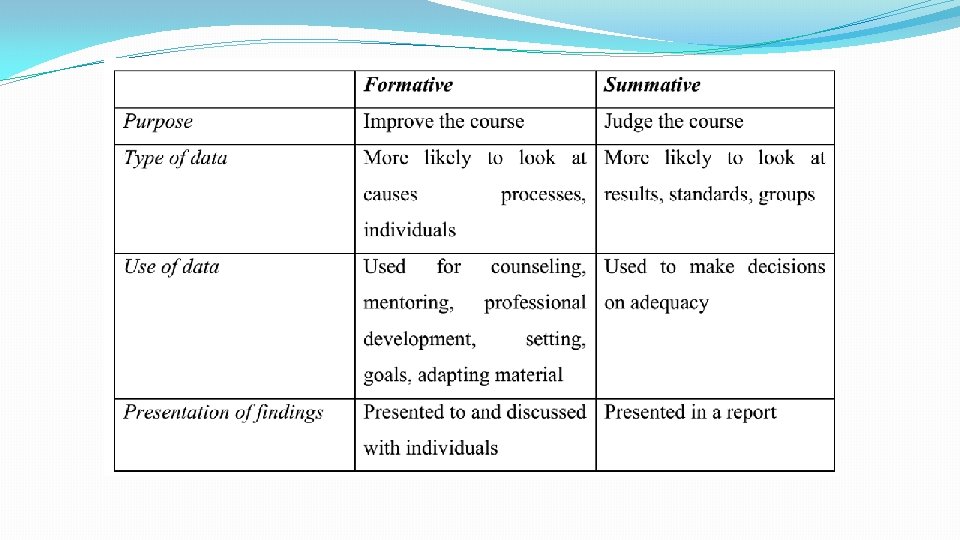
Type of Evaluation � A distinction is made between formative evaluation and summative evaluation. A � formative evaluation has the purpose of forming or shaping the course to improve it. � Summative evaluation has the purpose of making a summary judgment on the quality or adequacy of the course so that it can be compared with other courses, compared with previous summative evaluations, or judged as being up to a certain criterion or not
� The formative/summative distinction is important when informing the people who are the focus of an evaluation about the purpose of the evaluation, in helping the evaluator decide what kind of information will be most useful to gather, and in using the information gathered. � Deciding whether the evaluation is summative or formative is one decision, and deciding if it is to be long term or short term is another (Beretta, 1986). Most evaluations are short term. Some are conducted over a few days and others may take a long period.
Conclusion While not fundamentally different from teaching English as a foreign language, ESP has often provided the opportunity to test out and develop innovations prior to their more general use. The use of need analysis, task -based learning, the use of authentic materials, genre analysis, the teaching of language and content combined represent the core of an ESP course program.
BIBLIOGRAPHY � Graves, K. (1996). Teachers as Ccourse Developers. Cambridge: Cambridge University Press. � Hutchinson. T & Waters. A. (1987). English for Specific Purposes: A Learning-Centred Approach. Cambridge: Cambridge University Press. � Harding, K. (2007). English for Specific Purposes. Oxford: OUP. � Johns, A. M. & Dudley-Evans, T. (1991). English for specific purposes international in scope, specific in purpose. TESOL Quarterly, 25, 297 – 314. � Kennedy, C. and Bolitho, R. (1984). English for Specific Purposes. Hong Kong: Macmillan Publishers Limited. � Xenodohidis, T. H. (2006). An ESP Curriculum for Greek EFL Students of Computing: A New Approach. ESP World. Retrieved 25 November 2013 from http: //www. espworld. info/Articles_2/ESP%20 Curriculum. html
Thanks for Your Attention! “Aspire to inspire before you expire…”