ESOPs Tax Advantaged Exit Strategy Succession and Liquidity
- Slides: 45
ESOPs: Tax Advantaged Exit Strategy, Succession and Liquidity presented to: Plastics Executives by Eitan Milstein
Why are there so many employee-owned (plastics) companies?
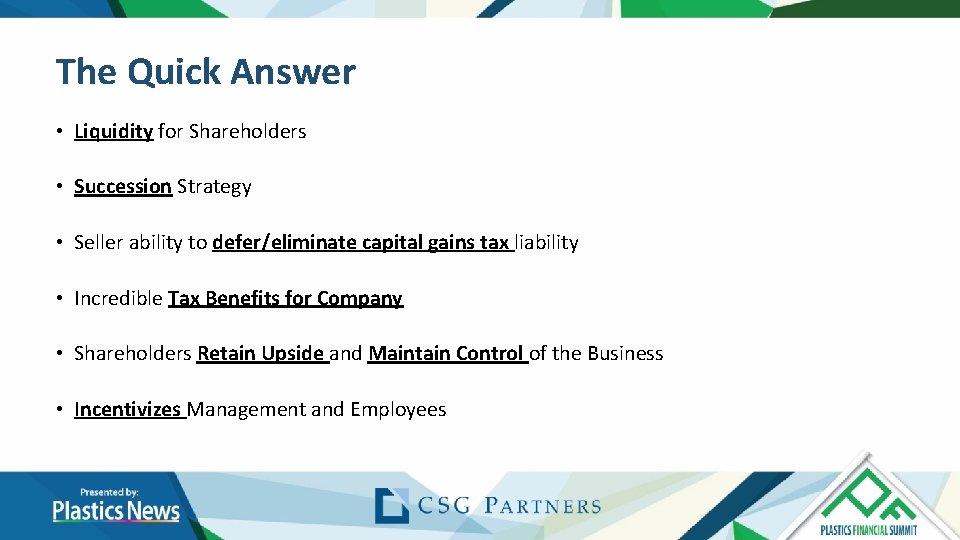
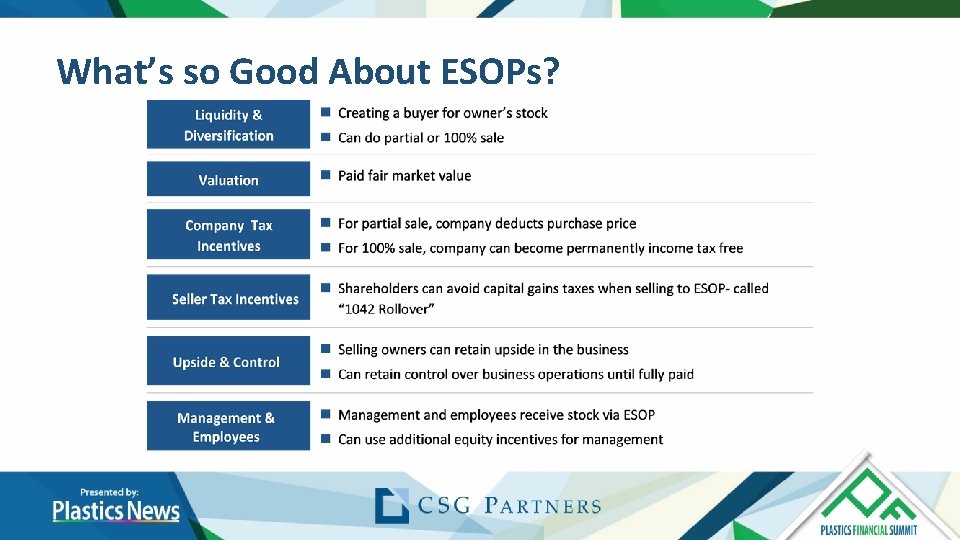
The Quick Answer • Liquidity for Shareholders • Succession Strategy • Seller ability to defer/eliminate capital gains tax liability • Incredible Tax Benefits for Company • Shareholders Retain Upside and Maintain Control of the Business • Incentivizes Management and Employees
About CSG Partners Boutique middle-market investment bank, specializing in ESOPs, mergers & acquisitions, and capital advisory services Firm Overview Nation’s largest investment banking practice for ESOPs Headquartered in New York, with offices in San Francisco and Washington DC Founded in 2001 as affiliate of American Express, now privately owned Implemented well over 160 ESOP transactions for companies with total market value exceeding $9 Billion Experience DEPTH OF EXPERIENCE Named “ 2013 Boutique Investment Bank of the Year” by ACG New York, and winner “M&A Deal of the Year ($200$500 MM)” Two-time winner “Acquisition Financing Deal of the Year Award” from The M&A Advisor CSG clients have ranged the full middle-market spectrum, with values from $10 MM to $650 MM
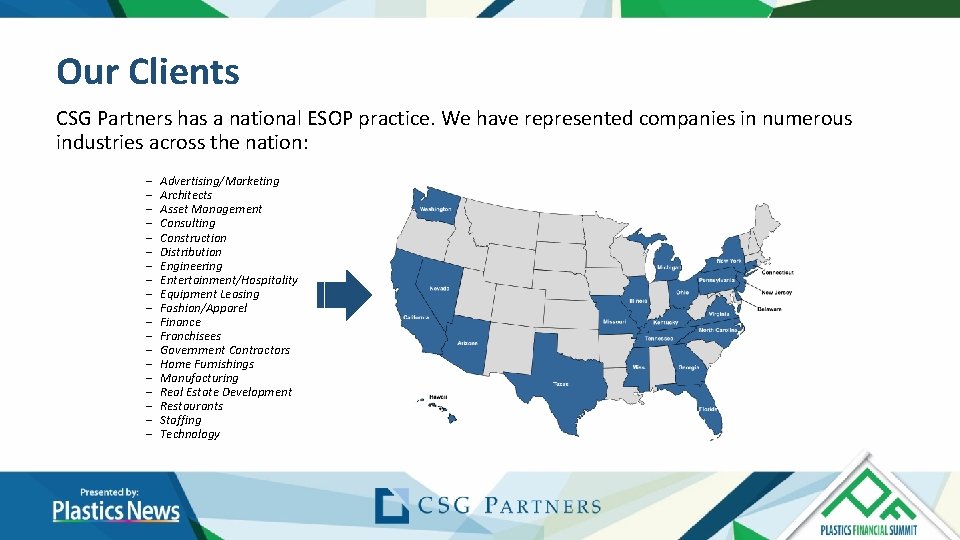
Our Clients CSG Partners has a national ESOP practice. We have represented companies in numerous industries across the nation: ‒ ‒ ‒ ‒ ‒ Advertising/Marketing Architects Asset Management Consulting Construction Distribution Engineering Entertainment/Hospitality Equipment Leasing Fashion/Apparel Finance Franchisees Government Contractors Home Furnishings Manufacturing Real Estate Development Restaurants Staffing Technology
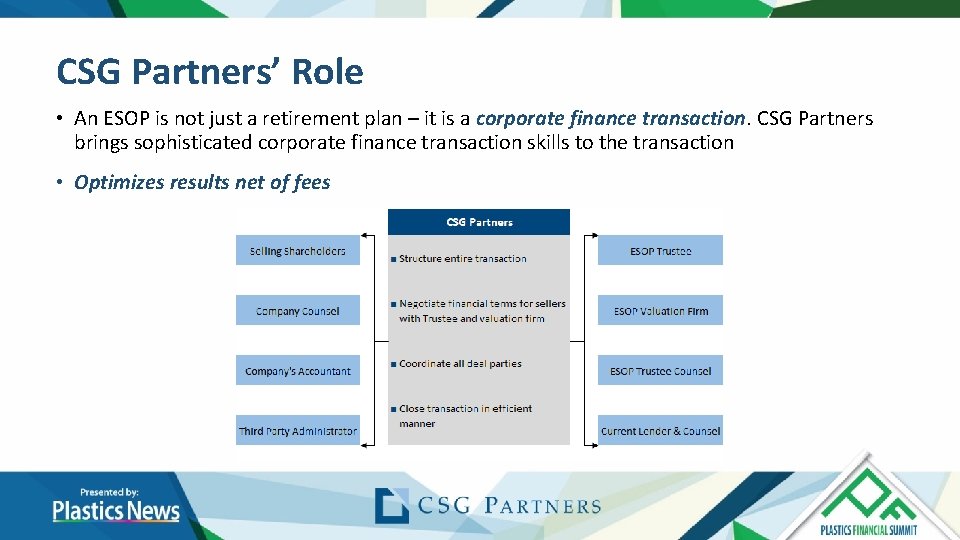
CSG Partners’ Role • An ESOP is not just a retirement plan – it is a corporate finance transaction. CSG Partners brings sophisticated corporate finance transaction skills to the transaction • Optimizes results net of fees
Agenda • Optionsfor for. Plastics Owners of Plastics Companies • ESOP Basics • Structuring Ideas • ESOP Candidates and Opportunities • Recent Case Study
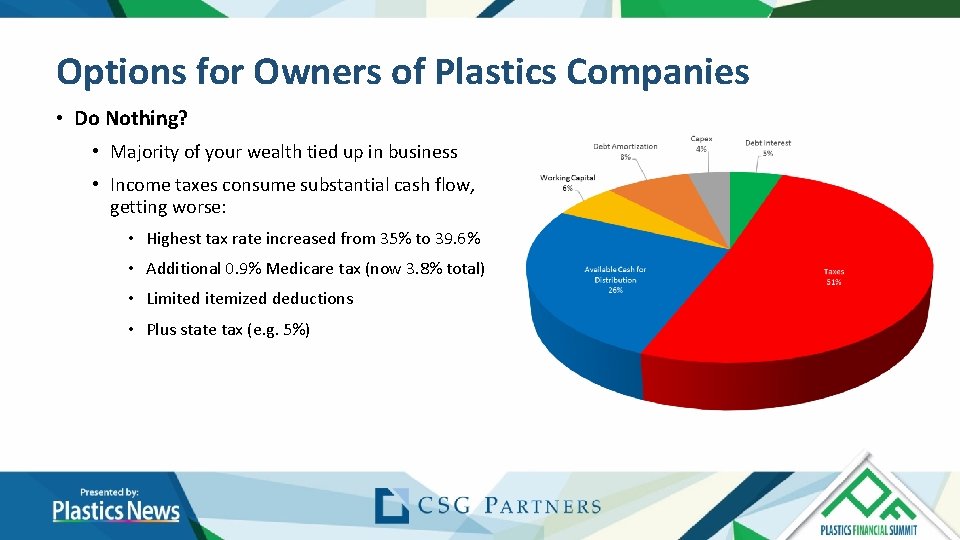
Options for Owners of Plastics Companies • Do Nothing? • Majority of your wealth tied up in business • Income taxes consume substantial cash flow, getting worse: • Highest tax rate increased from 35% to 39. 6% • Additional 0. 9% Medicare tax (now 3. 8% total) • Limited itemized deductions • Plus state tax (e. g. 5%)
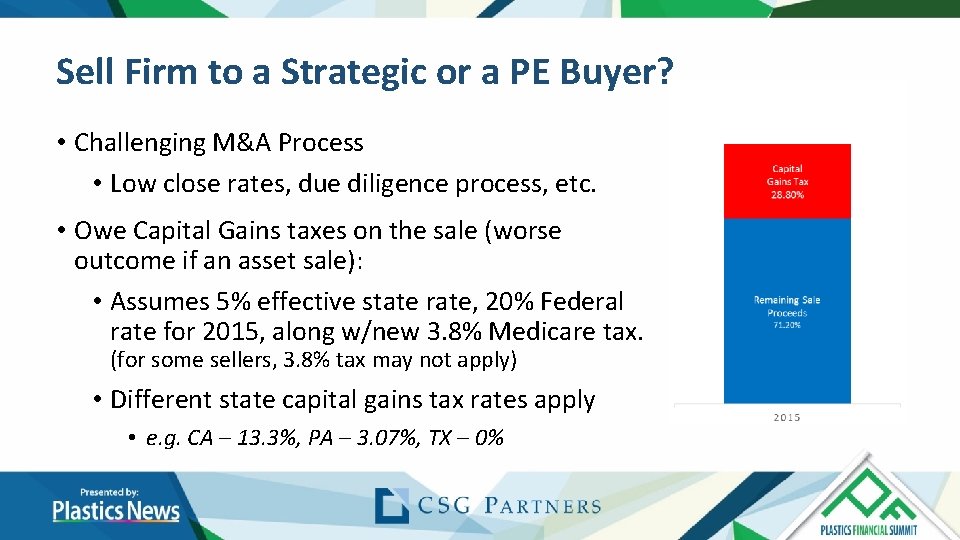
Sell Firm to a Strategic or a PE Buyer? • Challenging M&A Process • Low close rates, due diligence process, etc. • Owe Capital Gains taxes on the sale (worse outcome if an asset sale): • Assumes 5% effective state rate, 20% Federal rate for 2015, along w/new 3. 8% Medicare tax. (for some sellers, 3. 8% tax may not apply) • Different state capital gains tax rates apply • e. g. CA – 13. 3%, PA – 3. 07%, TX – 0%
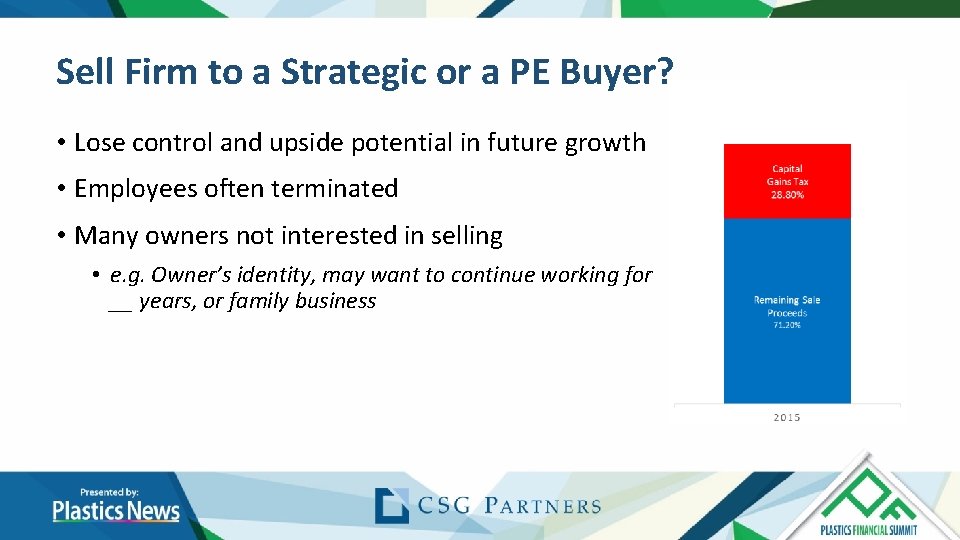
Sell Firm to a Strategic or a PE Buyer? • Lose control and upside potential in future growth • Employees often terminated • Many owners not interested in selling • e. g. Owner’s identity, may want to continue working for __ years, or family business
What’s so Good About ESOPs?
Sell to an ESOP? • ESOP = Employee Stock Ownership Plan • Over 11, 500 companies in the U. S. have used ESOPs • Unique retirement plan created by the company, for employees: • Invests primarily in company stock • Can buy stock from owners • Can borrow money to finance purchase • Significant tax incentives Selling to an ESOP is a tax-advantaged liquidity strategy for owners
Impact of Employee Ownership • Avg annual sales growth ~2. 5% • Avg annual employment growth 2. 3% • Employee ownership increases employee retention by nearly 50% • ESOP employees were laid off 4 x LESS than employees of conventionallyowned companies during the last recession • Nearly 15% more ESOP companies survived recession than non-ESOP owned companies *Source: NCEO, Rutgers University Study https: //www. nceo. org/assets/pdf/articles/esop_perf_tables. pdf
Agenda • Options for Plastics Owners • ESOPBasics • Structuring Ideas • ESOP Candidates and Opportunities • Recent Case Study
Valuation Negotiated between selling shareholders and an ESOP Trustee • Trustee represents interests of employees • Cannot pay more than “Fair Market Value” • Independent valuation firm advises the ESOP Trustee – NOT the selling owners Discounted Cash Flow (DCF) Analysis • Typical method to determine value • Calculates present value of company’s cash flow • Public market comps • M&A transactions in industry
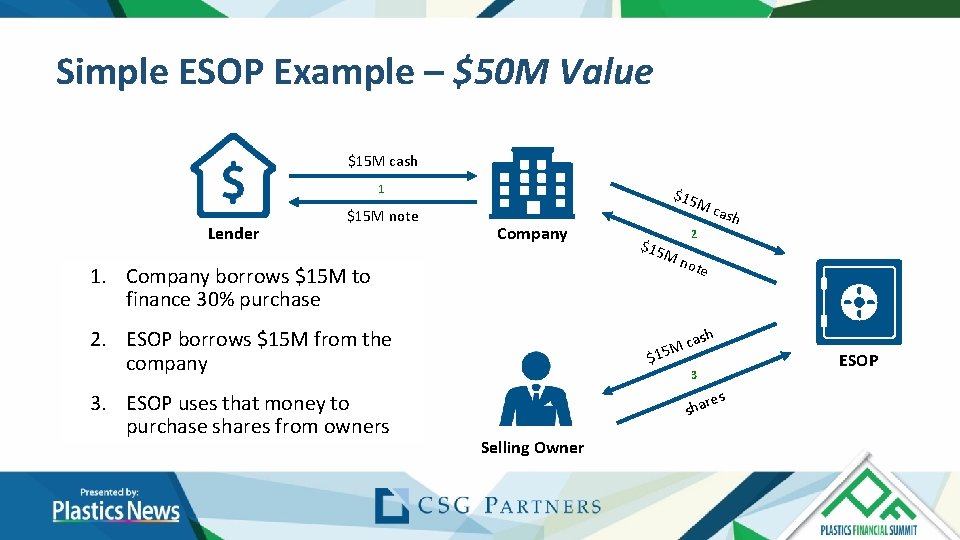
Simple ESOP Example – $50 M Value $15 M cash 1 Lender $15 M note $15 Mc Company 2 $15 Mn 1. Company borrows $15 M to finance 30% purchase 2. ESOP borrows $15 M from the company 3. ESOP uses that money to purchase shares from owners ash ote ash c M 5 1 $ 3 res sha Selling Owner ESOP
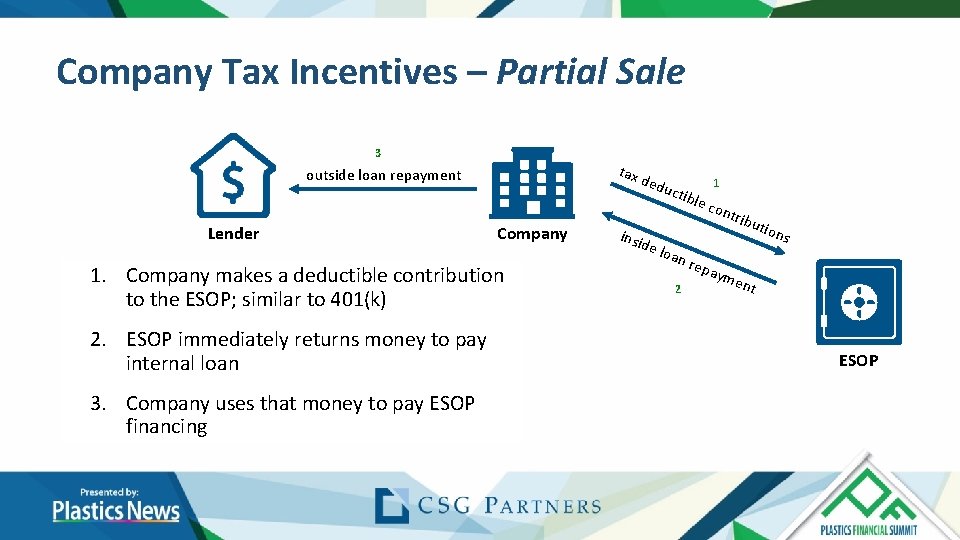
Company Tax Incentives – Partial Sale 3 tax ded ucti b outside loan repayment 1 le c Lender Company 1. Company makes a deductible contribution to the ESOP; similar to 401(k) 2. ESOP immediately returns money to pay internal loan 3. Company uses that money to pay ESOP financing insi de l ont ribu tion oan r s epa 2 yme n t ESOP
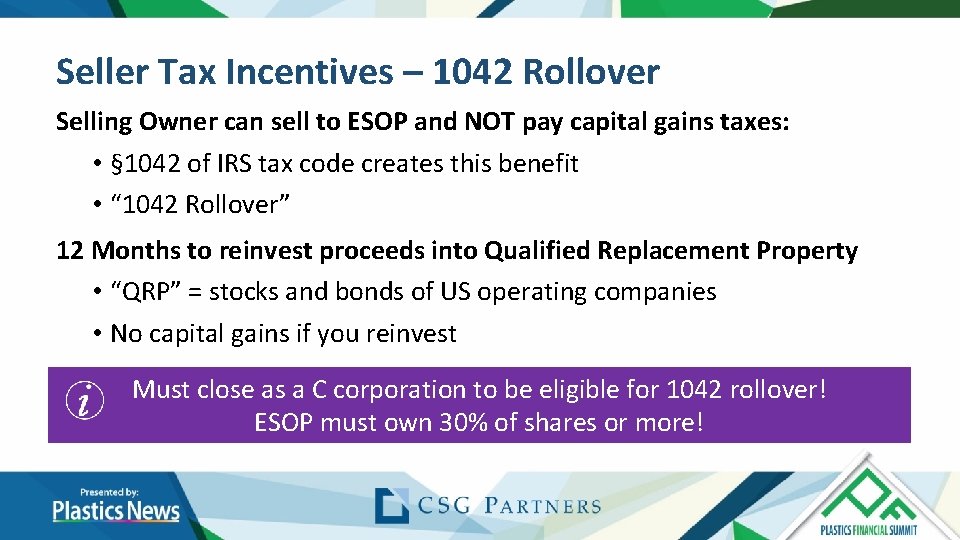
Seller Tax Incentives – 1042 Rollover Selling Owner can sell to ESOP and NOT pay capital gains taxes: • § 1042 of IRS tax code creates this benefit • “ 1042 Rollover” 12 Months to reinvest proceeds into Qualified Replacement Property • “QRP” = stocks and bonds of US operating companies • No capital gains if you reinvest Must close as a C corporation to be eligible for 1042 rollover! ESOP must own 30% of shares or more!
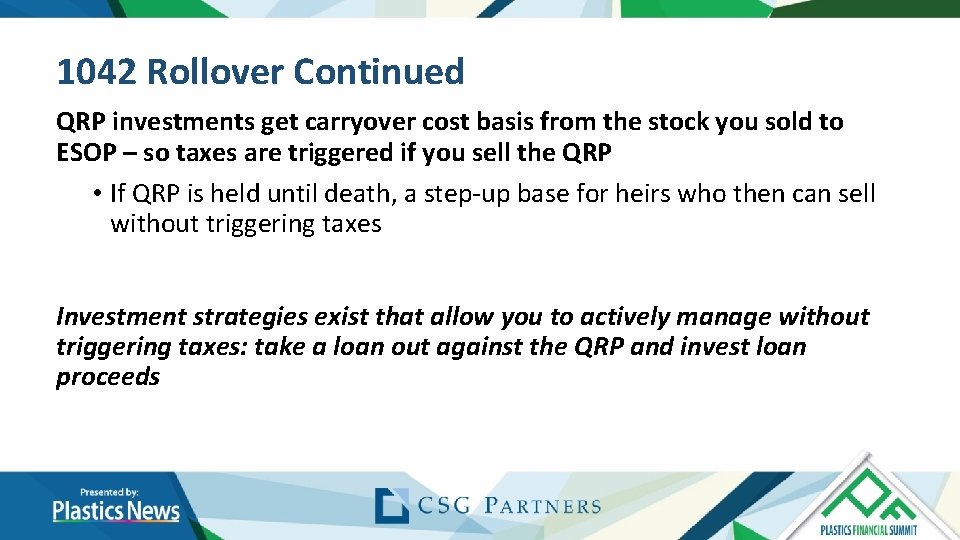
1042 Rollover Continued QRP investments get carryover cost basis from the stock you sold to ESOP – so taxes are triggered if you sell the QRP • If QRP is held until death, a step-up base for heirs who then can sell without triggering taxes Investment strategies exist that allow you to actively manage without triggering taxes: take a loan out against the QRP and invest loan proceeds
Retain Upside & Control Selling owner can retain upside • Only sell partial interest and retain upside on the balance • Even if the ESOP owns 100%, the warrant strategy can provide opportunity for a “second bite” Selling owner can maintain control • Even if selling a majority interest, or even 100%, selling owner can retain full control over business operations • Control: • Business controlled by Board of Directors • ESOP Trustee is a “directed trustee” – meaning trustee votes on corporate matters only as directed • Transaction documents can give selling owner control over Board • If financed with seller’s note, covenants will ensure control
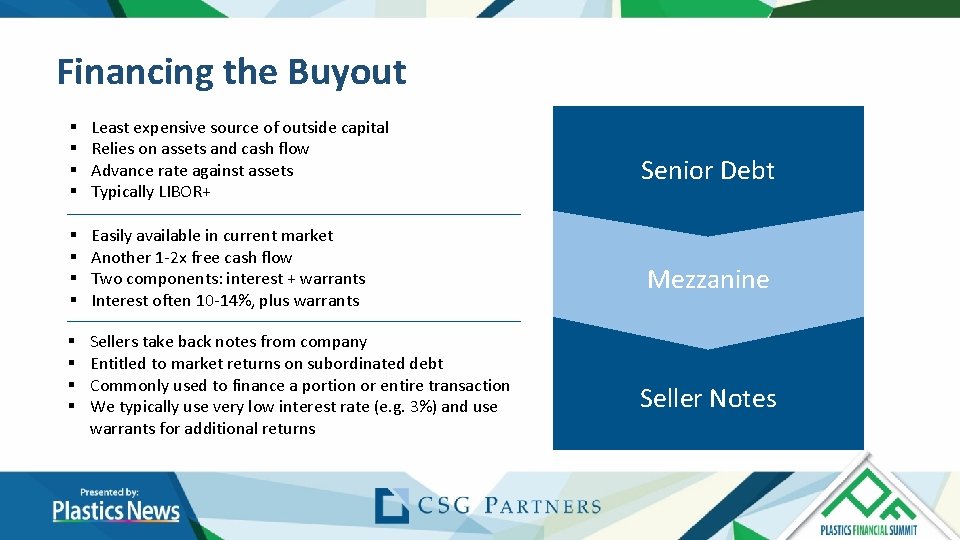
Financing the Buyout § § Least expensive source of outside capital Relies on assets and cash flow Advance rate against assets Typically LIBOR+ § § Easily available in current market Another 1 -2 x free cash flow Two components: interest + warrants Interest often 10 -14%, plus warrants § § Sellers take back notes from company Entitled to market returns on subordinated debt Commonly used to finance a portion or entire transaction We typically use very low interest rate (e. g. 3%) and use warrants for additional returns Senior Debt Mezzanine Seller Notes
Employee Benefit ESOP is a powerful incentive for management and corporate employees Stock is allocated to employees: • Over time, and is allocated to employees accounts based on wages • Higher compensated employees are allocated more stock • Can increase benefit to management with warrants and other synthetic equity • Vests like a 401(k); departing non-vested employees forfeit and shares are redistributed Employee Benefits • Upon certain events (death, disability, retirement), employee has right to put the stock back to the company • Payments to employee can be made over several years
Agenda • Options for Plastics Owners • ESOP Basics • • Structuring. Ideas • ESOP Candidates and Opportunities • Recent Case Study
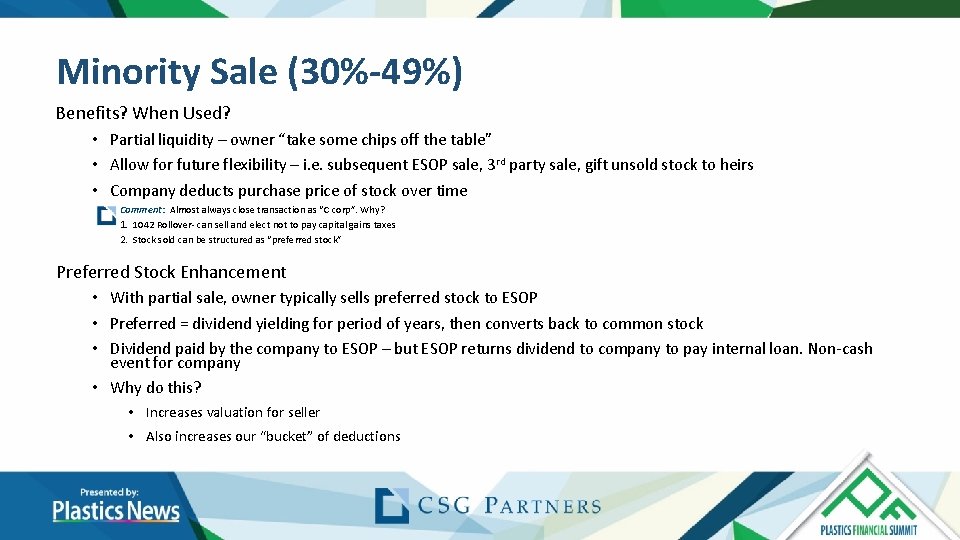
Minority Sale (30%-49%) Benefits? When Used? • Partial liquidity – owner “take some chips off the table” • Allow for future flexibility – i. e. subsequent ESOP sale, 3 rd party sale, gift unsold stock to heirs • Company deducts purchase price of stock over time Comment: Almost always close transaction as “C corp”. Why? 1. 1042 Rollover- can sell and elect not to pay capital gains taxes 2. Stock sold can be structured as “preferred stock” Preferred Stock Enhancement • With partial sale, owner typically sells preferred stock to ESOP • Preferred = dividend yielding for period of years, then converts back to common stock • Dividend paid by the company to ESOP – but ESOP returns dividend to company to pay internal loan. Non-cash event for company • Why do this? • Increases valuation for seller • Also increases our “bucket” of deductions
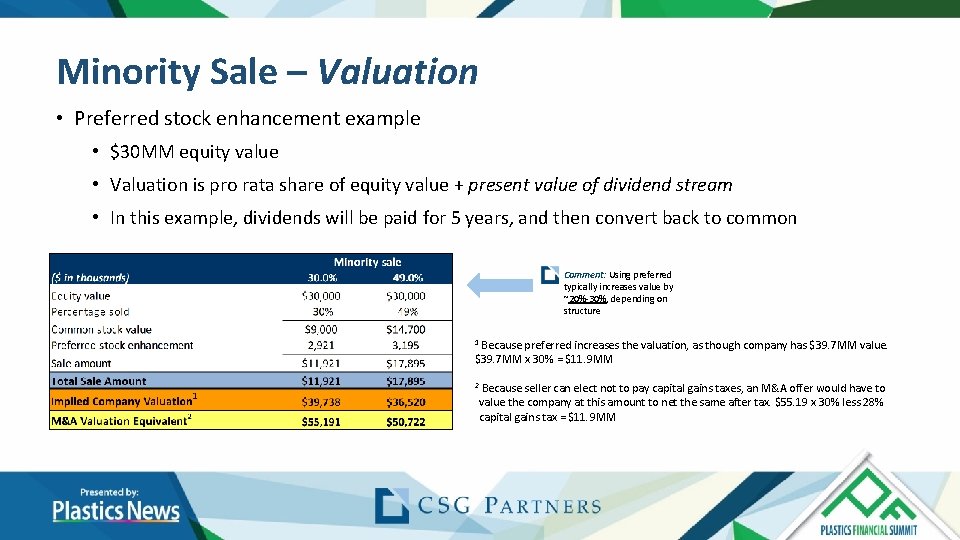
Minority Sale – Valuation • Preferred stock enhancement example • $30 MM equity value • Valuation is pro rata share of equity value + present value of dividend stream • In this example, dividends will be paid for 5 years, and then convert back to common Comment: Using preferred typically increases value by ~20%-30%, depending on structure Because preferred increases the valuation, as though company has $39. 7 MM value. $39. 7 MM x 30% = $11. 9 MM 1 2 Because seller can elect not to pay capital gains taxes, an M&A offer would have to value the company at this amount to net the same after tax. $55. 19 x 30% less 28% capital gains tax = $11. 9 MM
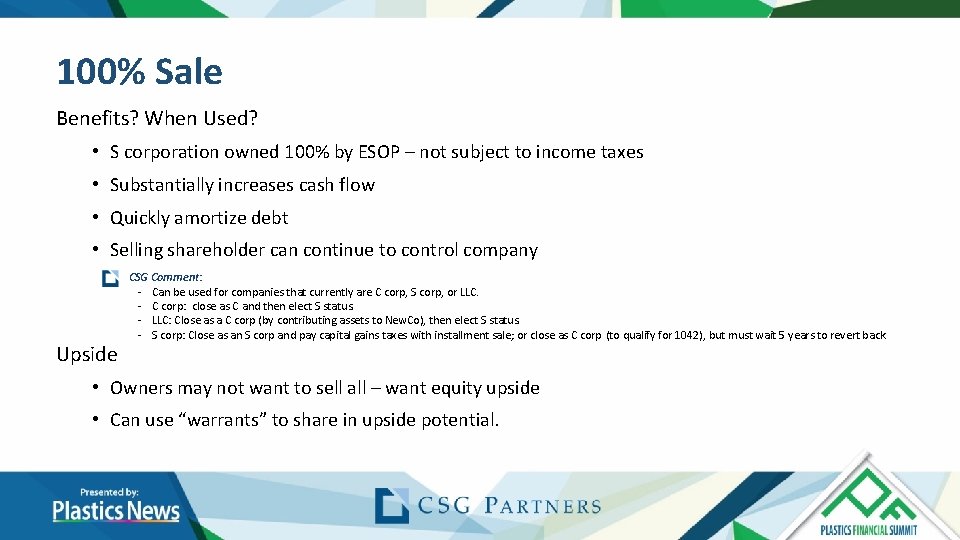
100% Sale Benefits? When Used? • S corporation owned 100% by ESOP – not subject to income taxes • Substantially increases cash flow • Quickly amortize debt • Selling shareholder can continue to control company Upside CSG Comment: - Can be used for companies that currently are C corp, S corp, or LLC. - C corp: close as C and then elect S status. - LLC: Close as a C corp (by contributing assets to New. Co), then elect S status. - S corp: Close as an S corp and pay capital gains taxes with installment sale; or close as C corp (to qualify for 1042), but must wait 5 years to revert back • Owners may not want to sell all – want equity upside • Can use “warrants” to share in upside potential.
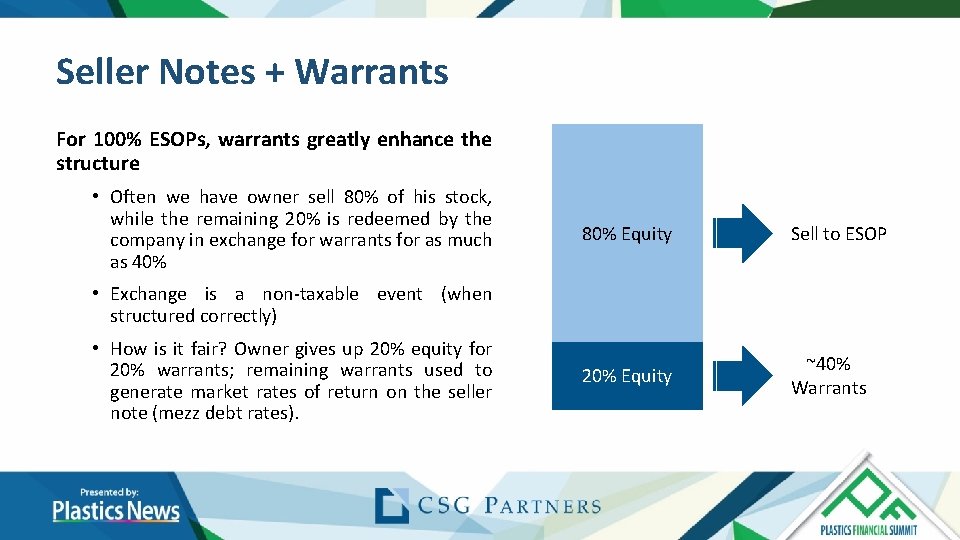
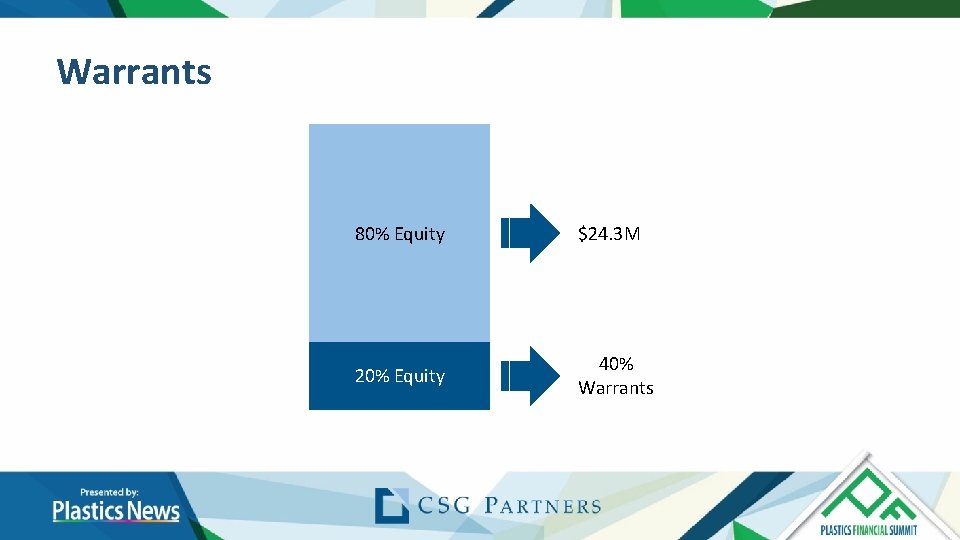
Seller Notes + Warrants For 100% ESOPs, warrants greatly enhance the structure • Often we have owner sell 80% of his stock, while the remaining 20% is redeemed by the company in exchange for warrants for as much as 40% 80% Equity Sell to ESOP 20% Equity ~40% Warrants • Exchange is a non-taxable event (when structured correctly) • How is it fair? Owner gives up 20% equity for 20% warrants; remaining warrants used to generate market rates of return on the seller note (mezz debt rates).
Agenda • Options for Plastics Owners • ESOP Basics • Structuring Ideas • ESOPCandidatesand and. Opportunities • Recent Case Study
Planning Opportunities 1. Alternative to M&A • A tax-advantaged alternative liquidity strategy • Bypass M&A market • If low tax basis a sale will trigger significant taxes (Capital gain or ordinary income tax if asset sale) • Can continue controlling company and ease out over time with additional upside 2. Family-Owned Businesses • Many do not want to sell entire business and/or bring in new outside owners • ESOP provides liquidity and tax savings, but family can retain control
Planning Opportunities (cont’d) 3. Companies with Significant Depreciation • e. g. asset-rich manufacturers with significant accumulated depreciation • Traditional asset sale – triggers depreciation recapture (ordinary income) • Owners can sell to ESOP and avoid depreciation recapture 4. Management Buyout • Owners prefer to sell to management, who typically lacks funds. Every dollar they pay is post tax money, and yet, once received by the seller it is again taxable, resulting in double taxation. • Can use ESOP to buy owner, get management team substantial equity via ESOP and management incentive plans
Planning Opportunities (cont’d) 5. High Payroll Companies • Owner can sell 100% to ESOP, a tax exempt entity, making the Co tax-free forever • Can also result in a large tax refund. Why? • The 25% payroll contribution often large enough to offset prior-year taxes, then create NOL • For C corporation, tax refund comes back to company • For S corporation, tax refund goes to owner 6. Easing out of the Business • Owner may implement ESOP for tax and cash flow savings, but wants to work for x more years while retaining control • Can sell to ESOP in stages • Can sell 100% and take seller note – which will take several years to pay
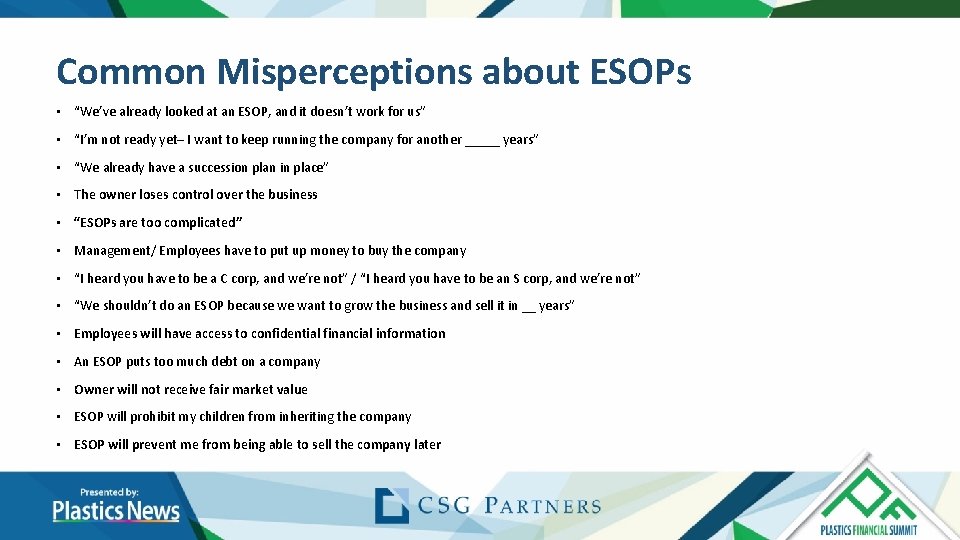
Common Misperceptions about ESOPs • “We’ve already looked at an ESOP, and it doesn’t work for us” • “I’m not ready yet– I want to keep running the company for another _____ years” • “We already have a succession plan in place” • The owner loses control over the business • “ESOPs are too complicated” • Management/ Employees have to put up money to buy the company • “I heard you have to be a C corp, and we’re not” / “I heard you have to be an S corp, and we’re not” • “We shouldn’t do an ESOP because we want to grow the business and sell it in __ years” • Employees will have access to confidential financial information • An ESOP puts too much debt on a company • Owner will not receive fair market value • ESOP will prohibit my children from inheriting the company • ESOP will prevent me from being able to sell the company later
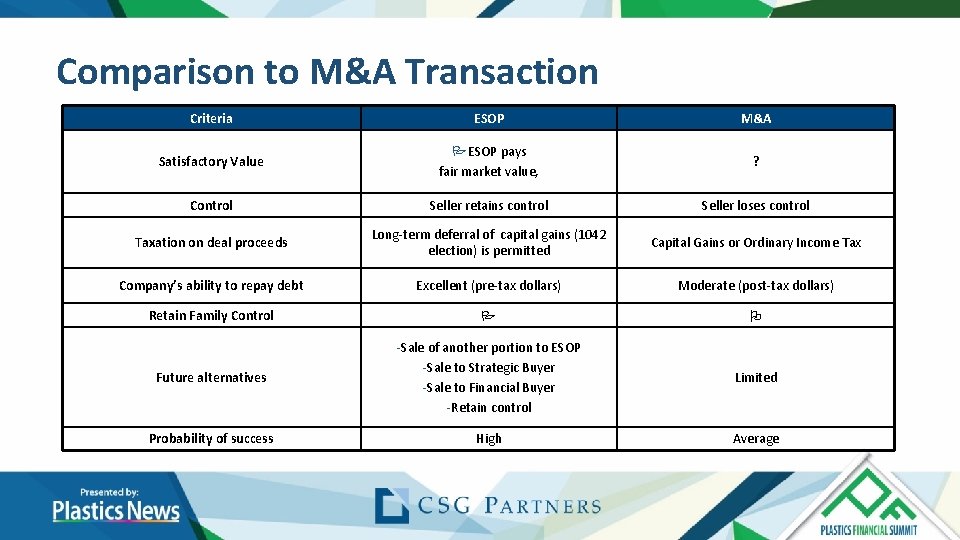
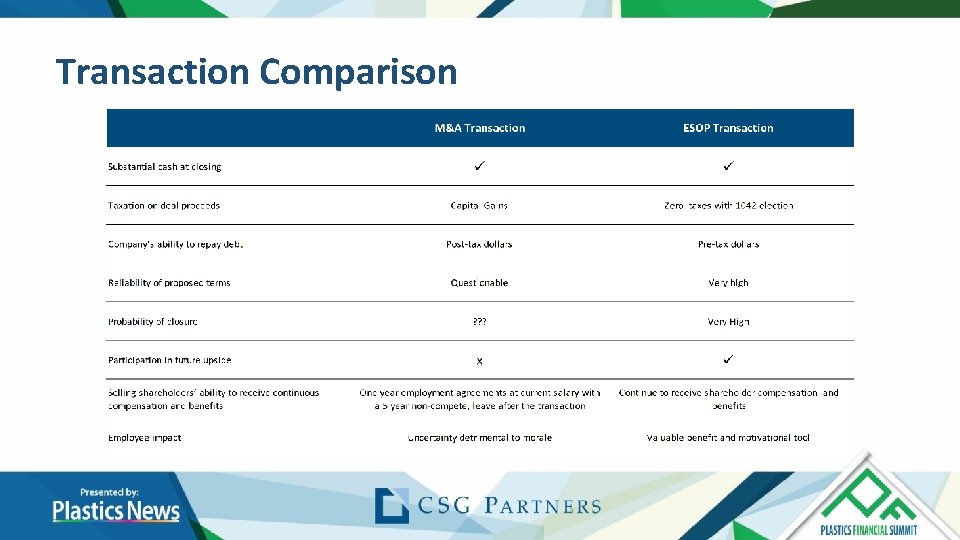
Comparison to M&A Transaction Criteria ESOP M&A Satisfactory Value ESOP pays fair market value, ? Control Seller retains control Seller loses control Taxation on deal proceeds Long-term deferral of capital gains (1042 election) is permitted Capital Gains or Ordinary Income Tax Company’s ability to repay debt Excellent (pre-tax dollars) Moderate (post-tax dollars) Retain Family Control Future alternatives -Sale of another portion to ESOP -Sale to Strategic Buyer -Sale to Financial Buyer -Retain control Limited Probability of success High Average
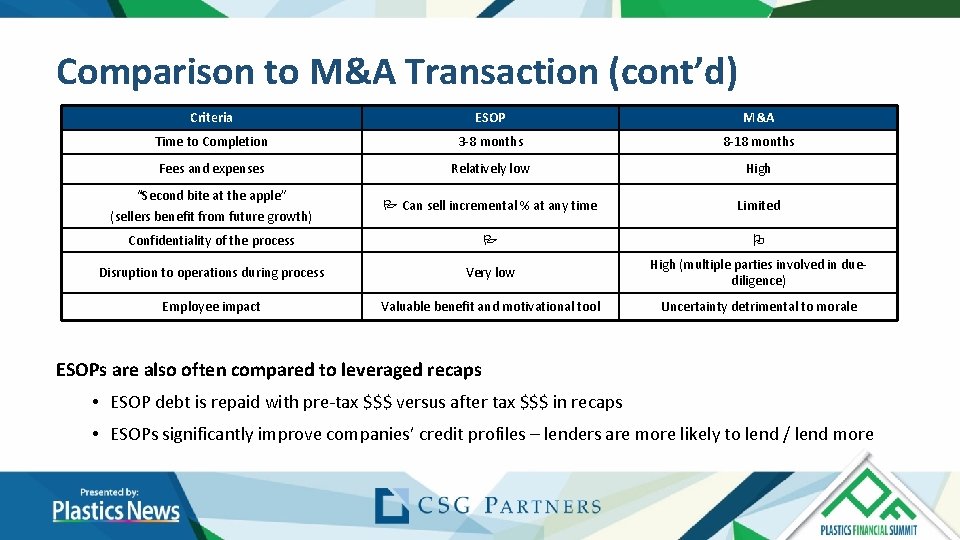
Comparison to M&A Transaction (cont’d) Criteria ESOP M&A Time to Completion 3 -8 months 8 -18 months Fees and expenses Relatively low High “Second bite at the apple” (sellers benefit from future growth) Can sell incremental % at any time Limited Confidentiality of the process Disruption to operations during process Very low High (multiple parties involved in duediligence) Employee impact Valuable benefit and motivational tool Uncertainty detrimental to morale ESOPs are also often compared to leveraged recaps • ESOP debt is repaid with pre-tax $$$ versus after tax $$$ in recaps • ESOPs significantly improve companies’ credit profiles – lenders are more likely to lend / lend more
Agenda • Options for Plastics Owners • ESOP Basics • Structuring Ideas • ESOP Candidates and Opportunities • Recent. Case. Study
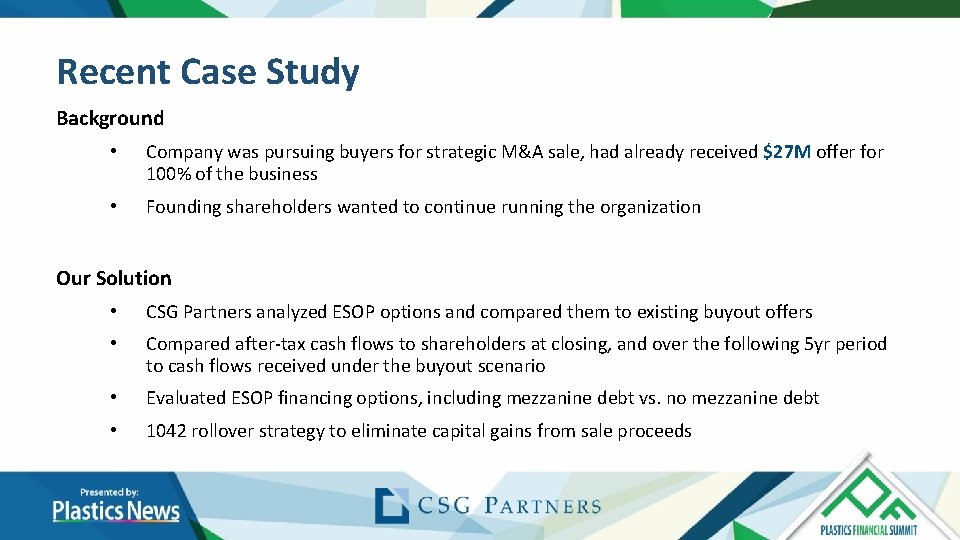
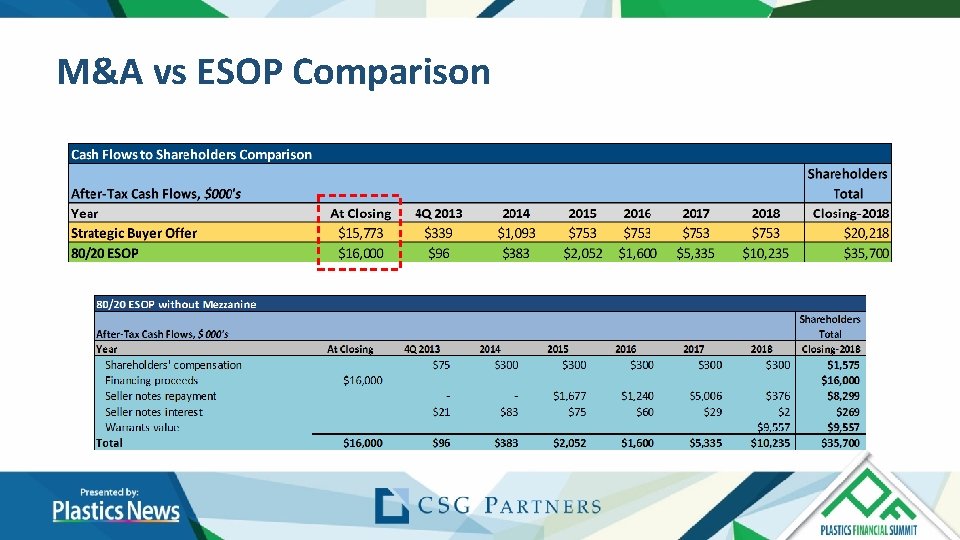
Recent Case Study Background • Company was pursuing buyers for strategic M&A sale, had already received $27 M offer for 100% of the business • Founding shareholders wanted to continue running the organization Our Solution • CSG Partners analyzed ESOP options and compared them to existing buyout offers • Compared after-tax cash flows to shareholders at closing, and over the following 5 yr period to cash flows received under the buyout scenario • Evaluated ESOP financing options, including mezzanine debt vs. no mezzanine debt • 1042 rollover strategy to eliminate capital gains from sale proceeds
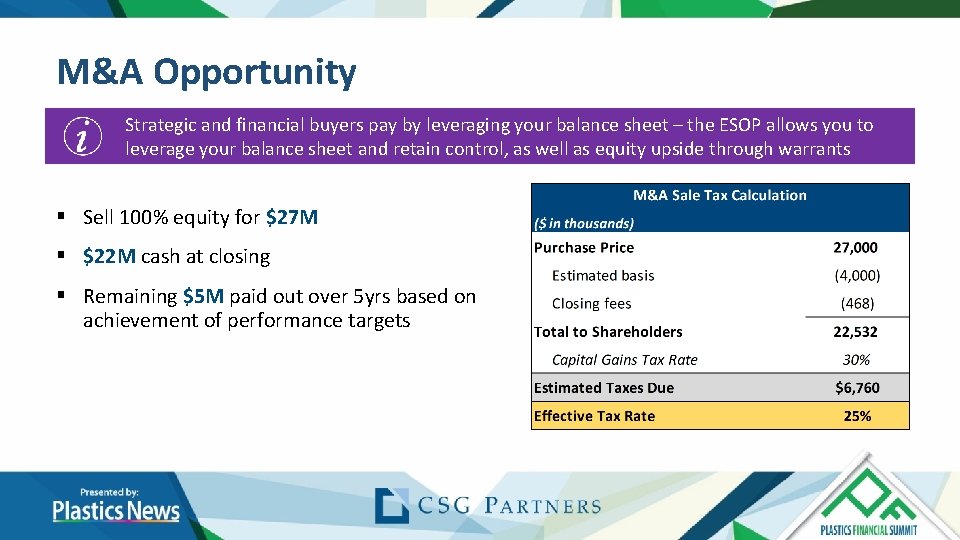
M&A Opportunity Strategic and financial buyers pay by leveraging your balance sheet – the ESOP allows you to leverage your balance sheet and retain control, as well as equity upside through warrants § Sell 100% equity for $27 M § $22 M cash at closing § Remaining $5 M paid out over 5 yrs based on achievement of performance targets
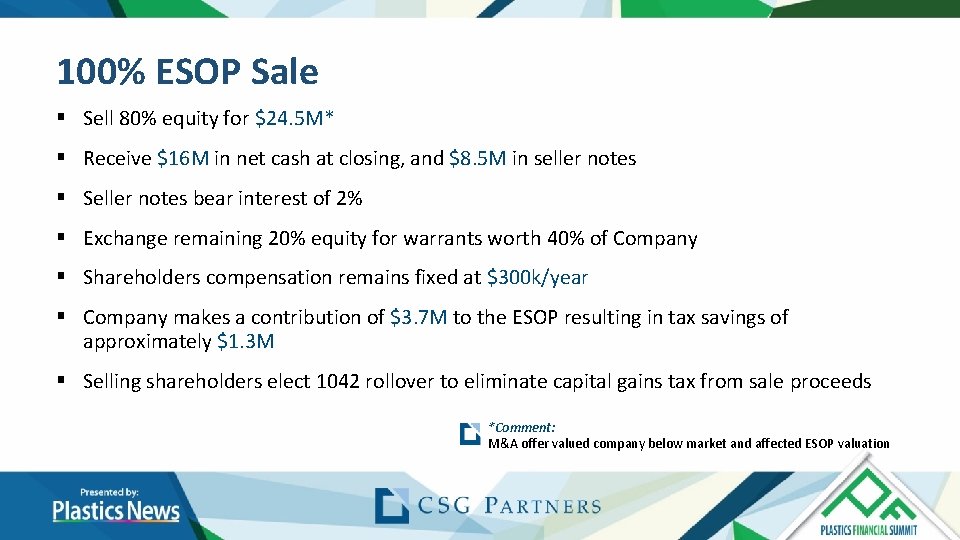
100% ESOP Sale § Sell 80% equity for $24. 5 M* § Receive $16 M in net cash at closing, and $8. 5 M in seller notes § Seller notes bear interest of 2% § Exchange remaining 20% equity for warrants worth 40% of Company § Shareholders compensation remains fixed at $300 k/year § Company makes a contribution of $3. 7 M to the ESOP resulting in tax savings of approximately $1. 3 M § Selling shareholders elect 1042 rollover to eliminate capital gains tax from sale proceeds *Comment: M&A offer valued company below market and affected ESOP valuation
Transaction Comparison
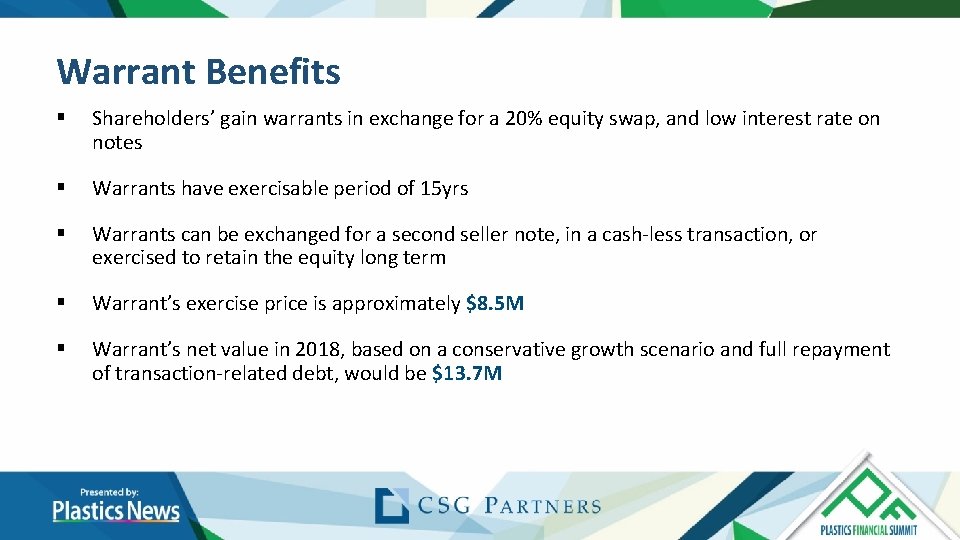
Warrant Benefits § Shareholders’ gain warrants in exchange for a 20% equity swap, and low interest rate on notes § Warrants have exercisable period of 15 yrs § Warrants can be exchanged for a second seller note, in a cash-less transaction, or exercised to retain the equity long term § Warrant’s exercise price is approximately $8. 5 M § Warrant’s net value in 2018, based on a conservative growth scenario and full repayment of transaction-related debt, would be $13. 7 M
Warrants 80% Equity $24. 3 M 20% Equity 40% Warrants
M&A vs ESOP Comparison
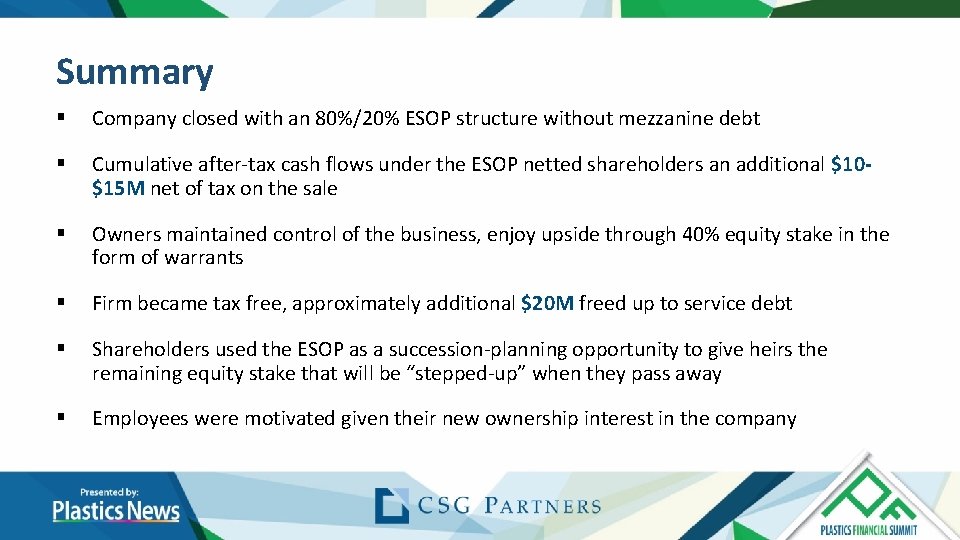
Summary § Company closed with an 80%/20% ESOP structure without mezzanine debt § Cumulative after-tax cash flows under the ESOP netted shareholders an additional $10$15 M net of tax on the sale § Owners maintained control of the business, enjoy upside through 40% equity stake in the form of warrants § Firm became tax free, approximately additional $20 M freed up to service debt § Shareholders used the ESOP as a succession-planning opportunity to give heirs the remaining equity stake that will be “stepped-up” when they pass away § Employees were motivated given their new ownership interest in the company
Thank You Eitan Milstein Managing Director CSG Partners 40 Fulton Street, 6 th Floor New York, NY 10038 T: (415) 464 -0699 C: (415) 497 -9290 www. csgpartners. com Eitan joined CSG in 2008 after thirteen years at GE Capital, where he most recently was Senior Vice President of its Media, Communications & Entertainment unit. During his tenure at GE, he held senior positions at various groups, including Structured Finance, Capital Markets, Global Sponsor Finance and Commercial and Industrial Finance. Prior to joining GE, Eitan was the founder and CEO of Access Credit Corporation, an equipment finance company specializing in municipal leasing, maritime finance and advisory services, which he later sold. He was also the Executive Vice President of a sister company, Access Leasing Corp. where he co-developed a residual option product and was actively involved in acquiring options in excess of $1. 5 billion of original value. During his thirty years of experience in the financial services industry, he has been actively involved in M&A, recapitalization, acquisitions and restructuring transactions, in providing senior debt, junior capital and equity to middle market and large corporations. Eitan graduated from Tel Aviv University with degrees in Economics and in Political Science and received his MBA from Arizona State University. He holds Series 7, Series 63, and Series 79 securities licenses. Copyright 2015 CSG Partners LLC (“CSG”). This presentation may contain general, summary discussions of certain tax, investment regulatory, accounting and/or legal issues relevant to the contemplated transactions. Any such discussion is necessarily generic and may not be applicable to, or complete for, any particular recipient's specific facts and circumstances. CSG does not offer and does not purport to offer, tax, investment, regulatory, accounting or legal advice, and this information should not and cannot be relied upon as such. CSG makes no warranties or representations of any kind with respect to the attached information. In no event shall CSG be liable for any use of or reliance on such information, or for any inaccuracies or errors in such information. All analytics, examples, rates, and returns in this presentation are for preliminary discussion purposes only and are not guarantees of future results. IRS Circular 230 Disclosure: To comply with requirements imposed by the IRS, we inform you that any U. S. federal tax advice contained herein (including any attachments), unless specifically stated otherwise, is not intended or written to be used, and cannot be used, for the purposes of (i) avoiding penalties under the Internal Revenue Code or (ii) promoting, marketing or recommending to another party any transaction or matter herein.