Eric Woods UPS STRIKE OF 1997 TEAMSTERS In
- Slides: 18
Eric Woods UPS STRIKE OF 1997
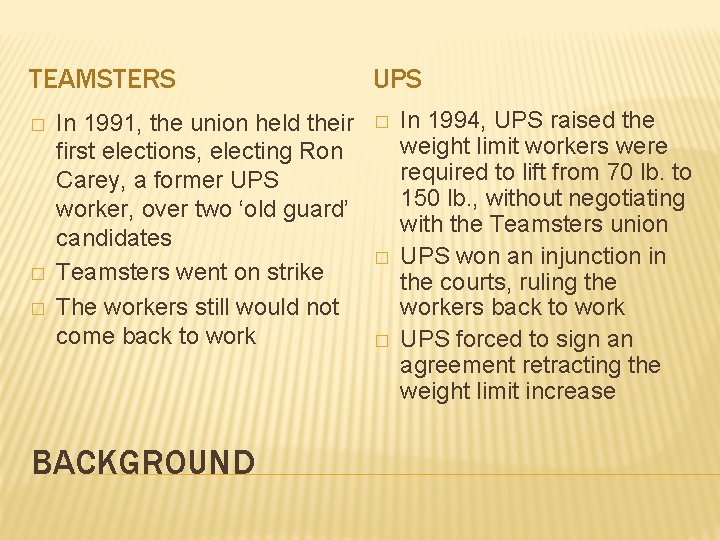
TEAMSTERS � � � In 1991, the union held their first elections, electing Ron Carey, a former UPS worker, over two ‘old guard’ candidates Teamsters went on strike The workers still would not come back to work BACKGROUND UPS � � � In 1994, UPS raised the weight limit workers were required to lift from 70 lb. to 150 lb. , without negotiating with the Teamsters union UPS won an injunction in the courts, ruling the workers back to work UPS forced to sign an agreement retracting the weight limit increase
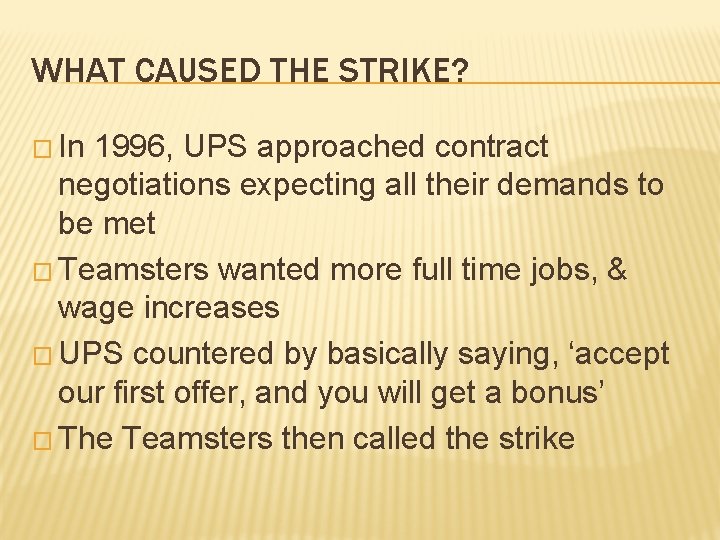
WHAT CAUSED THE STRIKE? � In 1996, UPS approached contract negotiations expecting all their demands to be met � Teamsters wanted more full time jobs, & wage increases � UPS countered by basically saying, ‘accept our first offer, and you will get a bonus’ � The Teamsters then called the strike
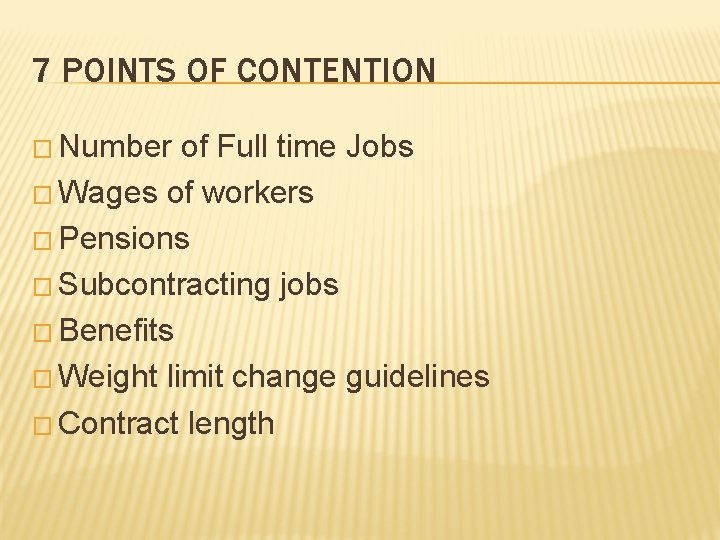
7 POINTS OF CONTENTION � Number of Full time Jobs � Wages of workers � Pensions � Subcontracting jobs � Benefits � Weight limit change guidelines � Contract length
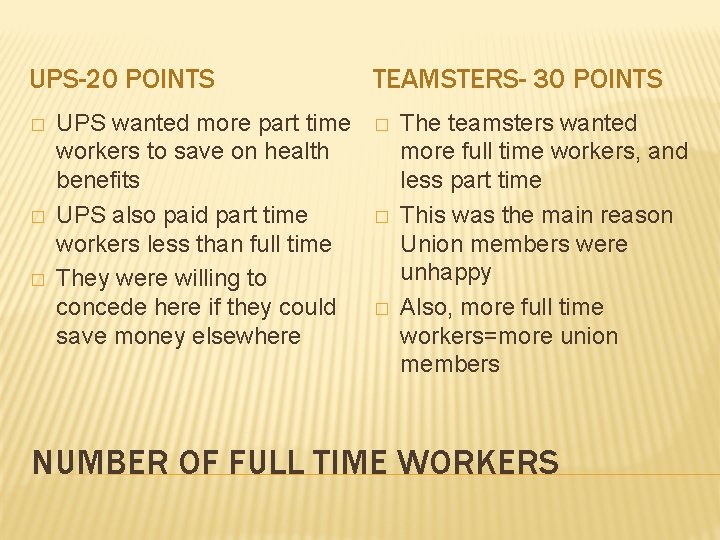
UPS-20 POINTS � � � UPS wanted more part time workers to save on health benefits UPS also paid part time workers less than full time They were willing to concede here if they could save money elsewhere TEAMSTERS- 30 POINTS � � � The teamsters wanted more full time workers, and less part time This was the main reason Union members were unhappy Also, more full time workers=more union members NUMBER OF FULL TIME WORKERS
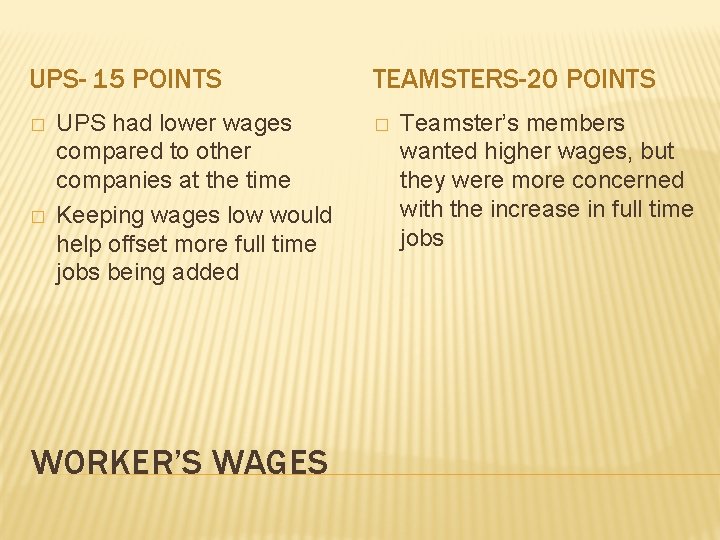
UPS- 15 POINTS � � UPS had lower wages compared to other companies at the time Keeping wages low would help offset more full time jobs being added WORKER’S WAGES TEAMSTERS-20 POINTS � Teamster’s members wanted higher wages, but they were more concerned with the increase in full time jobs
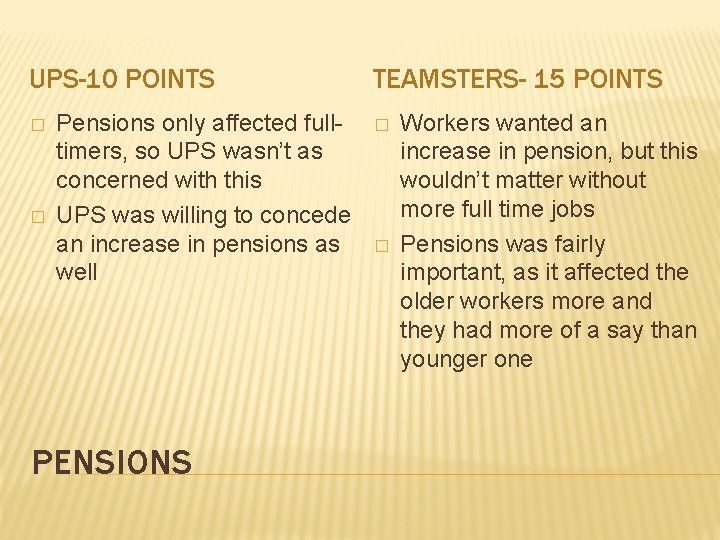
UPS-10 POINTS � � Pensions only affected fulltimers, so UPS wasn’t as concerned with this UPS was willing to concede an increase in pensions as well PENSIONS TEAMSTERS- 15 POINTS � � Workers wanted an increase in pension, but this wouldn’t matter without more full time jobs Pensions was fairly important, as it affected the older workers more and they had more of a say than younger one
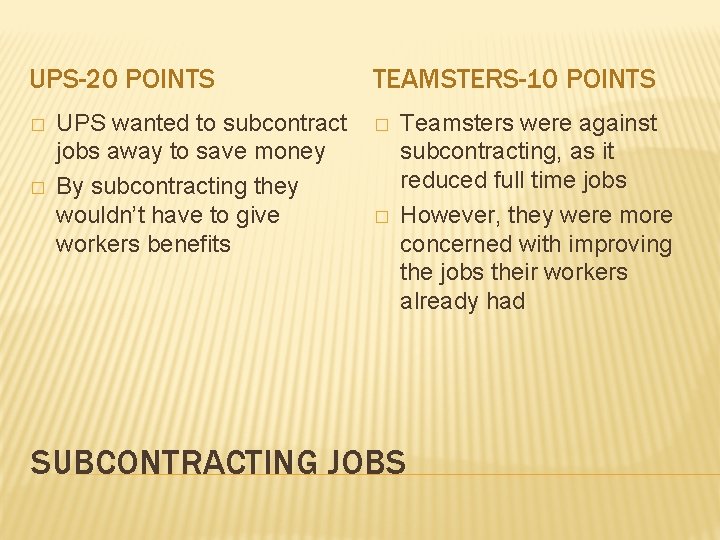
UPS-20 POINTS � � UPS wanted to subcontract jobs away to save money By subcontracting they wouldn’t have to give workers benefits TEAMSTERS-10 POINTS � � Teamsters were against subcontracting, as it reduced full time jobs However, they were more concerned with improving the jobs their workers already had SUBCONTRACTING JOBS
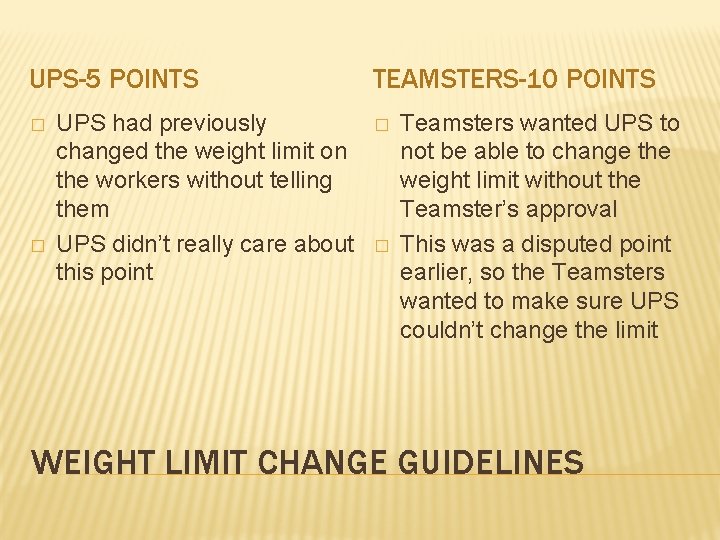
UPS-5 POINTS � � UPS had previously changed the weight limit on the workers without telling them UPS didn’t really care about this point TEAMSTERS-10 POINTS � � Teamsters wanted UPS to not be able to change the weight limit without the Teamster’s approval This was a disputed point earlier, so the Teamsters wanted to make sure UPS couldn’t change the limit WEIGHT LIMIT CHANGE GUIDELINES
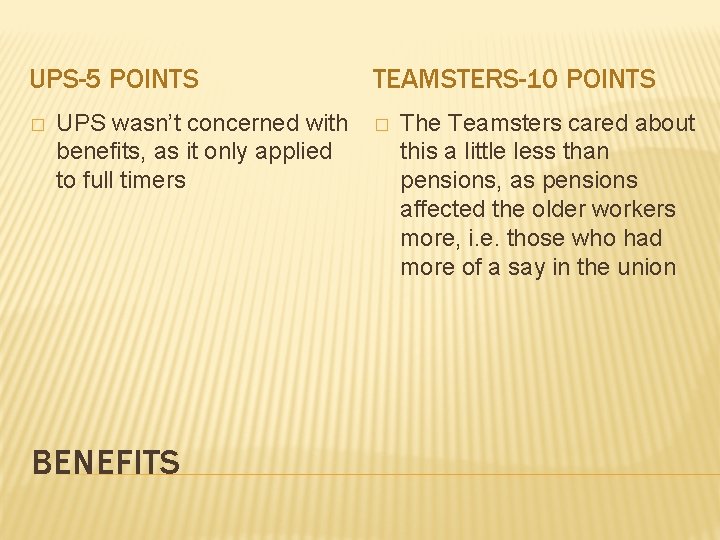
UPS-5 POINTS � UPS wasn’t concerned with benefits, as it only applied to full timers BENEFITS TEAMSTERS-10 POINTS � The Teamsters cared about this a little less than pensions, as pensions affected the older workers more, i. e. those who had more of a say in the union
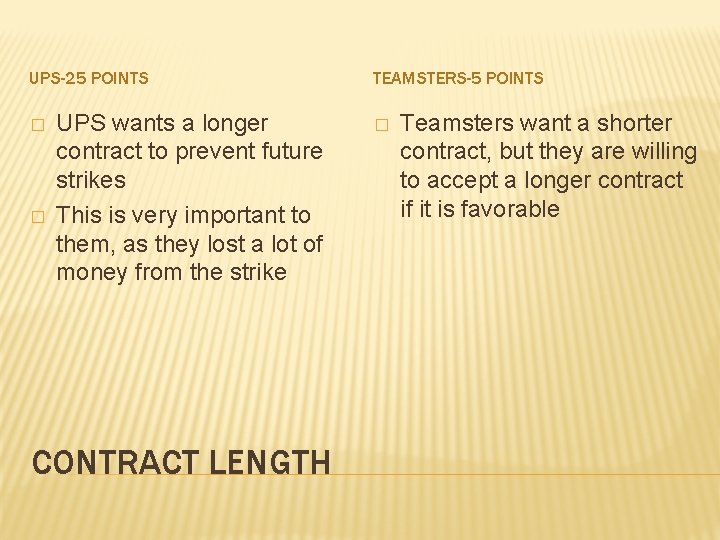
UPS-25 POINTS � � UPS wants a longer contract to prevent future strikes This is very important to them, as they lost a lot of money from the strike CONTRACT LENGTH TEAMSTERS-5 POINTS � Teamsters want a shorter contract, but they are willing to accept a longer contract if it is favorable
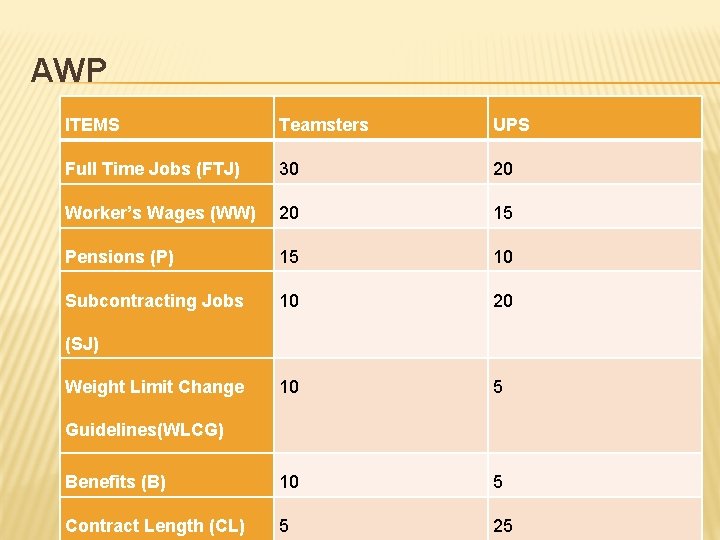
AWP ITEMS Teamsters UPS Full Time Jobs (FTJ) 30 20 Worker’s Wages (WW) 20 15 Pensions (P) 15 10 Subcontracting Jobs 10 20 10 5 Benefits (B) 10 5 Contract Length (CL) 5 25 (SJ) Weight Limit Change Guidelines(WLCG)
AWP ITEMS Teamsters UPS Full Time Jobs (FTJ) 30 20 Worker’s Wages (WW) 20 15 Pensions (P) 15 10 Subcontracting Jobs 10 20 10 5 Benefits (B) 10 5 Contract Length (CL) 5 25 (SJ) Weight Limit Change Guidelines(WLCG)
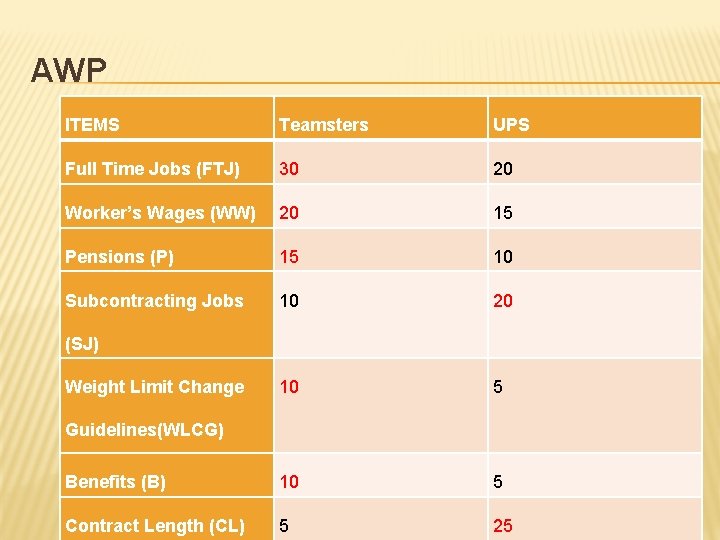
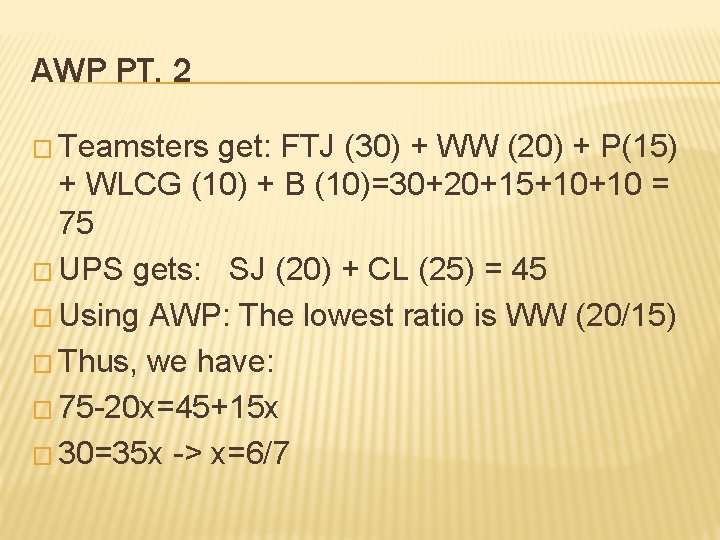
AWP PT. 2 � Teamsters get: FTJ (30) + WW (20) + P(15) + WLCG (10) + B (10)=30+20+15+10+10 = 75 � UPS gets: SJ (20) + CL (25) = 45 � Using AWP: The lowest ratio is WW (20/15) � Thus, we have: � 75 -20 x=45+15 x � 30=35 x -> x=6/7
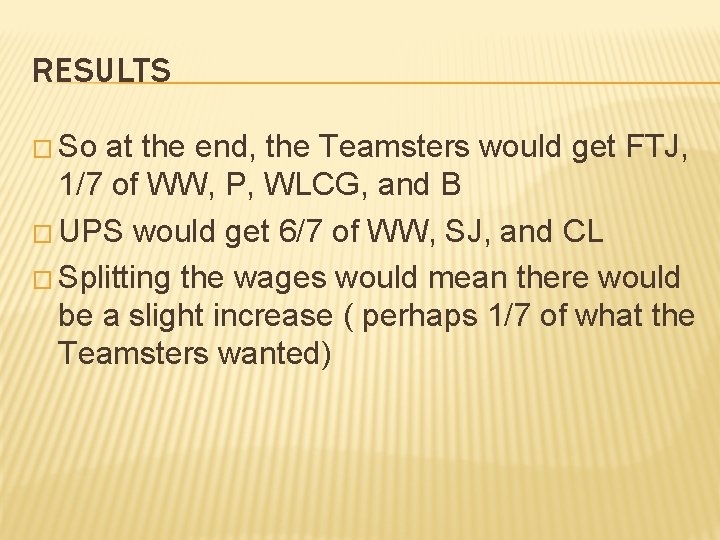
RESULTS � So at the end, the Teamsters would get FTJ, 1/7 of WW, P, WLCG, and B � UPS would get 6/7 of WW, SJ, and CL � Splitting the wages would mean there would be a slight increase ( perhaps 1/7 of what the Teamsters wanted)
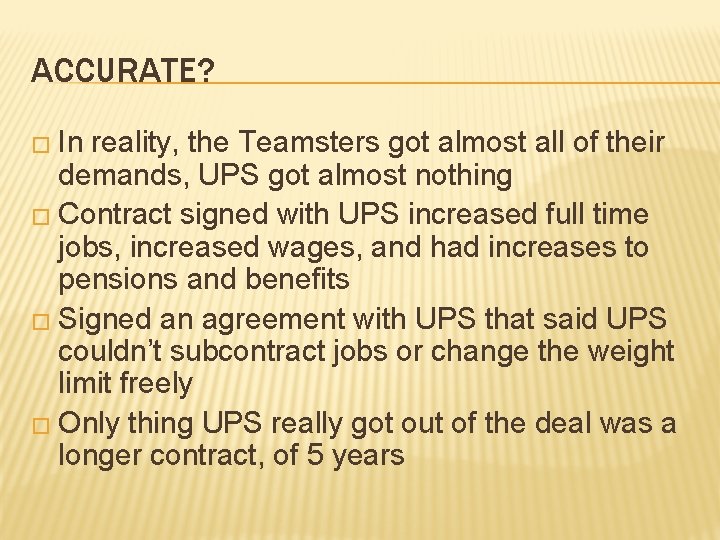
ACCURATE? � In reality, the Teamsters got almost all of their demands, UPS got almost nothing � Contract signed with UPS increased full time jobs, increased wages, and had increases to pensions and benefits � Signed an agreement with UPS that said UPS couldn’t subcontract jobs or change the weight limit freely � Only thing UPS really got out of the deal was a longer contract, of 5 years
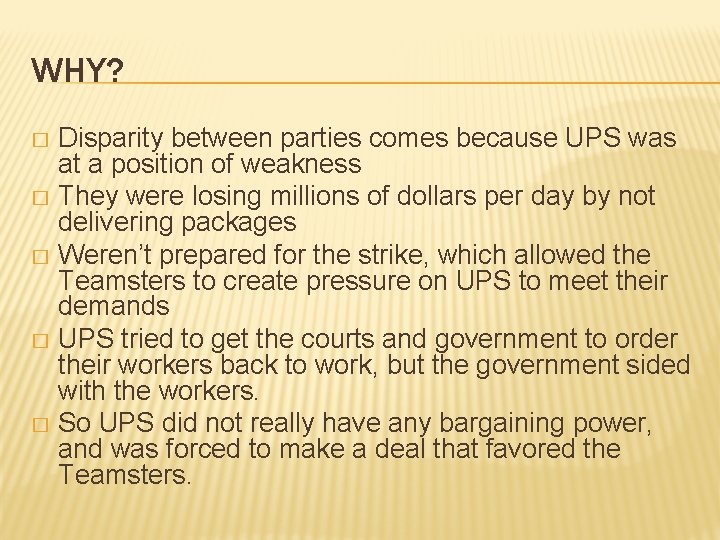
WHY? Disparity between parties comes because UPS was at a position of weakness � They were losing millions of dollars per day by not delivering packages � Weren’t prepared for the strike, which allowed the Teamsters to create pressure on UPS to meet their demands � UPS tried to get the courts and government to order their workers back to work, but the government sided with the workers. � So UPS did not really have any bargaining power, and was forced to make a deal that favored the Teamsters. �
BIBLIO � � � � http: //en. wikipedia. org/wiki/United_Parcel_Service_strike_ of_1997 http: //isreview. org/issues/55/bigbrown. shtml http: //workerscompass. org/lessons-of-the-1997 -teamsterstrike-at-ups-part-1/ http: //www. pbs. org/newshour/bb/business-july-dec 97 ups_8 -19 a/ http: //www. cnn. com/US/9708/20/ups. update. early/ “Ron Carey’s Weird Strike”, Wall Street Journal, August 1997. Bob Herbert, “Worker’s Rebellion”, New York Times, August 7, 1997.